
You are writing an email. You want to say something about a funny movie. Then you stop. Is it “humor” or “humour”? You look at the word. Both look fine. Both look wrong. So you search.
You are not alone. Every day, thousands of people type “humor or humour” into Google. Writers, students, bloggers, and business owners all ask the same thing. They want a fast answer. They also want to know if one spelling is a mistake.
Here is the good news. Neither one is wrong. They are the same word. The only difference is where you live and who you write for. One spelling is common in the United States. The other is common in the United Kingdom, Canada, Australia, and many other places.
This guide clears up the confusion. Here is what you will get from this guide. A quick answer. The story behind the word. The reason two spellings exist. You will also see tables, real examples, and common mistakes. Last, you will get simple advice on which spelling to pick. By the end, you will never second-guess yourself again.
Humor or Humour Quick Answer
Humor is the American spelling. Humour is the British spelling. Both mean the same thing: the quality of being funny, or the ability to enjoy funny things.
- American English: “She has a great sense of humor.”
- British English: “She has a great sense of humour.”
That is it. The meaning does not change. The sound does not change. Only the letter “u” is different.
Use humor if your readers are in the United States. Use humour if your readers are in the UK, Canada, Australia, New Zealand, India, South Africa, and most other English-speaking places.
The same rule works for related words:
- humorous (US) and humorous (UK). This one is the same in both!
- humorist (US) and humourist (UK)
- humorless (US) and humourless (UK)
The Origin of Humor or Humour
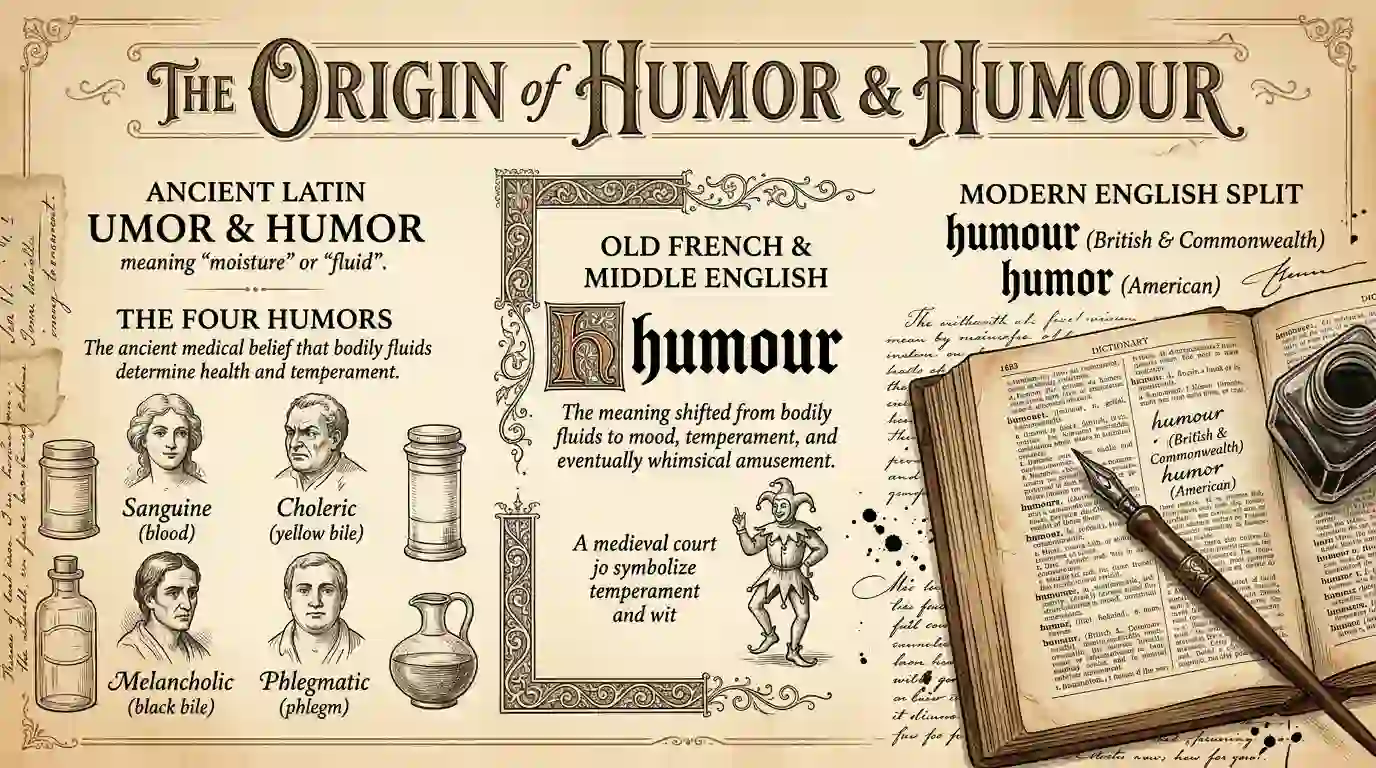
The word started in Latin. The Latin word humor meant “liquid” or “fluid.” Old doctors used it in a special way. They believed the body had four fluids, called humors. These were blood, phlegm, yellow bile, and black bile.
They thought these fluids shaped your mood. Too much of one fluid could make you sad, angry, or calm. Over time, the word came to mean “mood.” Later, it came to mean “a funny mood,” and then “funny things.”
The word moved into French as humour (or humeur). Then it came into English in the 1300s. For a long time, English writers used many spellings. Some wrote “humor.” Some wrote “humour.” Nobody was in charge of spelling.
Why Two Spellings Exist
In the early 1800s, an American writer named Noah Webster made a dictionary. He wanted American spelling to be simpler and different from British spelling. He dropped the “u” from words like colour, honour, and humour.
His dictionary was popular. Americans began to use the short forms. The British kept the older forms, which came from French. That is why the two spellings still exist today.
British English vs American English Spelling
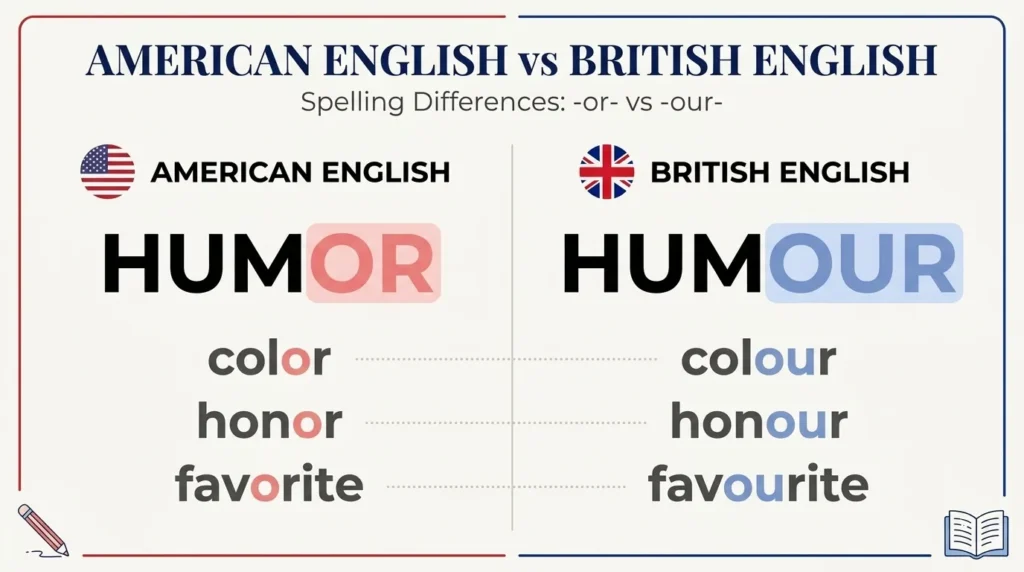
The “our” and “or” split is one of the biggest spelling gaps between the two types of English. Many words follow the same pattern.
| American English | British English | Meaning |
| humor | humour | being funny |
| color | colour | what you see, like red |
| favorite | favourite | liked the most |
| honor | honour | respect or praise |
| neighbor | neighbour | person who lives next door |
| flavor | flavour | how food tastes |
| labor | labour | work |
| behavior | behaviour | how you act |
Simple Rules to Remember
- US spelling: Words end in “-or.”
- UK spelling: Words end in “-our.”
- Suffix exception: In British English, the “u” often drops when you add some endings. For example, humour becomes humorous. Honour becomes honorable (or honourable, both are seen). Labour becomes laborious.
- Exceptions: Some words end in “-or” in both places, like error, actor, and doctor.
Which Spelling Should You Use?
The best spelling depends on your readers. Here is a simple guide.
Writing for the United States
Use humor. Your readers will expect it. Spell checkers will agree. If you write “humour,” some readers may think it is a typo.
Writing for the UK, Canada, Australia, and New Zealand
Use humour. This is the standard in all these places. Canada is a little mixed. Canadians use “humour,” “colour,” and “honour,” but they use some American spellings too. Still, “humour” is the safe pick.
Writing for a Global Audience
Pick one spelling and stick with it. Look at where most of your readers live. Match your biggest audience. US readers get “humor.” UK and Commonwealth readers get “humour.” Not sure who they are? Your website analytics will tell you.
Pro Tips
- Set your spell checker to the right language. Choose English (US) or English (UK).
- Follow your company or school style guide.
- Do not mix both spellings in one piece of writing.
- Keep proper names as they are. For example, a magazine called Humour Weekly keeps its “u.”
Common Mistakes with Humor or Humour
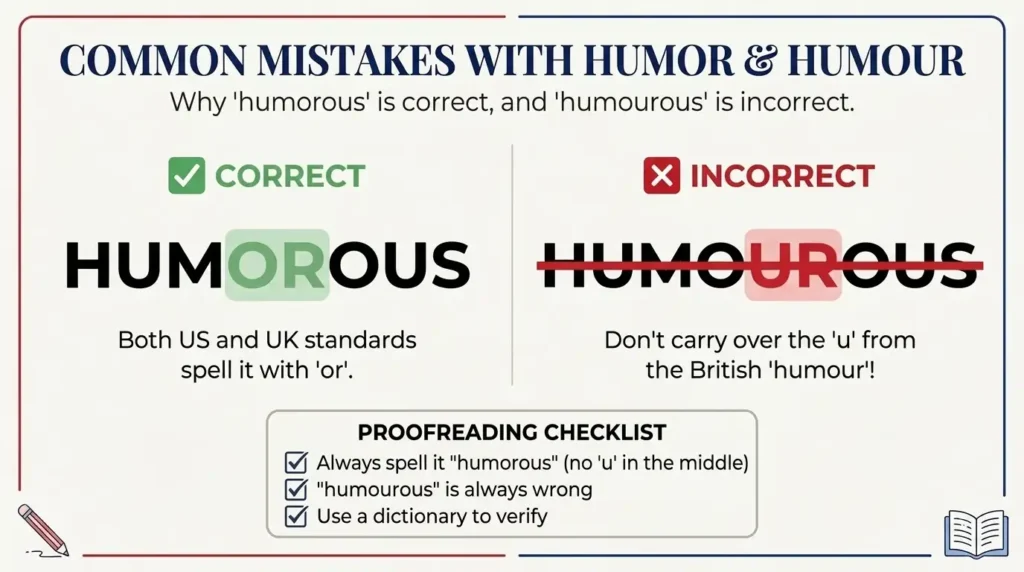
Here are the errors people make most often.
Mixing both spellings in one article.
- Wrong: “His humor is dry. I love British humour.”
- Right: “His humour is dry. I love British humour.”
Using the wrong spelling for your audience.
- Wrong: A New York company writes “humour” on its website.
- Right: A New York company writes “humor.”
Writing “humourous.”
- Wrong: “That was a humourous story.”
- Right: “That was a humorous story.”
The word humorous has no “u,” even in British English.
Thinking one spelling is “correct” and one is “wrong.” Both are correct. They are just regional.
Changing spelling inside a quote. If you quote someone, keep their spelling as they wrote it.
Forgetting the spell checker language. Your tool may “fix” a word to the wrong version. Always check the language setting.
Humor or Humour in Everyday Examples

See how the word looks in real life.
In Emails
- US: “Thanks for the joke! I needed some humor today.”
- UK: “Thanks for the joke! I needed some humour today.”
In News Headlines
- US: “Late-Night Humor Draws Record Viewers”
- UK: “Stand-Up Humour Fills Theatres Across the Country”
On Social Media
- US: “My dad’s humor is the worst. I love it. #dadjokes”
- UK: “My dad’s humour is the worst. I love it. #dadjokes”
In Formal Writing
- US: “The study looked at how workplace humor affects team trust.”
- UK: “The study looked at how workplace humour affects team trust.”
In Job Applications
- US: “I bring energy, focus, and a good sense of humor.”
- UK: “I bring energy, focus, and a good sense of humour.”
Humor or Humour Google Trends & Usage Data
Search data tells a clear story. The two spellings follow where English speakers live.
Humor is the more popular spelling worldwide. That is mostly because the United States has the most English speakers online. Most searches in the US use “humor.”
Humour is strong in the United Kingdom, Ireland, Australia, New Zealand, and South Africa. It is also common in Canada and India. In these places, people search for “humour” more often than “humor.”
Note: Search numbers change over time. For the newest data, check Google Trends yourself. Type both words and compare them by country.
Why People Search for Both
- Students want to know which spelling to use for school.
- Writers and bloggers want to match their readers.
- Business owners want their brand to look professional.
- Non-native speakers see both spellings and feel confused.
Usage by Context
- News sites: They follow their home country’s spelling.
- Books: Publishers pick the spelling for each market.
- Websites: Many global brands use US spelling by default.
- Schools: Teachers ask students to follow one standard.
Humor vs Humour: Side-by-Side Comparison
| Feature | Humor | Humour |
| Type of English | American | British and Commonwealth |
| Used in | USA, Philippines (mostly) | UK, Canada, Australia, NZ, India, South Africa |
| Meaning | Being funny | Being funny |
| Adjective | humorous | humorous |
| Without a feeling | humorless | humourless |
| Global search popularity | Higher overall | Strong in Commonwealth countries |
| Best for | US readers | UK and Commonwealth readers |
| Is it correct? | Yes | Yes |
Frequently Asked Questions
Is it humor or humour?
Both are correct. “Humor” is American English. “Humour” is British English. Pick the one that fits your readers.
Are humor and humour pronounced the same?
Yes. They sound the same. Only the spelling is different.
Which spelling do Canadians use?
Canadians usually write “humour.” Canadian English follows British spelling for “-our” words, but it uses some American habits too.
Is “humourous” a word?
No. The correct word is “humorous” in both American and British English. Drop the “u.”
Why did Americans drop the “u”?
Noah Webster wanted simpler spelling. He removed the “u” in his dictionary in the early 1800s. Americans followed his lead.
Can I use both spellings in one document?
No. Pick one and keep it the same all the way through. Mixing them looks careless.
Which spelling is better for SEO?
Use the spelling your audience searches for. For US readers, use “humor.” For UK and Commonwealth readers, use “humour.” If you target both, you can use each spelling once in a helpful way, like in a title or a short note.
Does the spelling change the meaning?
No. The meaning is the same. Both mean the quality of being funny.
Conclusion
So, humor or humour? The answer is simple. Both are right. They are two spellings of one word.
Use humor for readers in the United States. Use humour for readers in the UK, Canada, Australia, New Zealand, India, and most other English-speaking places. The meaning is the same. The sound is the same. Only the “u” changes.
Remember a few key points. First, pick one spelling and stay with it. Second, never write “humourous.” The word is always “humorous.” Third, set your spell checker to the right language. Fourth, keep quotes and brand names as they are written.
The split came from history. Latin gave us the word. French shaped its spelling. Then Noah Webster made a simpler American version. Today, both live on.
Your best move is to know your reader. Write for them, and your choice will always look right. Now you can write with confidence, and maybe add a little humor (or humour) to your day.

I’m Raheela Rani, a professional content writer and author with 3 years of experience in writing, editing, and storytelling. Through VisitLivo.com, I create clear, engaging, and well-crafted content that helps readers learn, connect, and communicate with confidence.









1 thought on “Humor or Humour? Which Spelling to Use (US vs UK)<p class="post-updated-date">🕓 <span class="updated-label">Last updated on</span> <time datetime="2026-11-03T10:25:15+00:00">November 3, 2026</time></p><script type="application/ld+json"> { "@context": "https://schema.org", "@type": "BlogPosting", "mainEntityOfPage": { "@type": "WebPage", "@id": "https://visitlivo.com/humor-or-humour/" }, "datePublished": "2026-11-03T10:25:14+00:00", "dateModified": "2026-11-03T10:25:15+00:00" } </script>”