You are typing a message. You stop. Is it “chosing” or “choosing“? You are not alone. Many people ask this every month, and the doubt is real. The word looks like it should follow a simple rule, yet the spelling feels off either way.
People search for “chosing or choosing” for a few reasons. Some people want to write professional emails, while students check their essays. Others are learning English and want to make sure their writing is correct. Others just saw one spelling and wondered about the other.
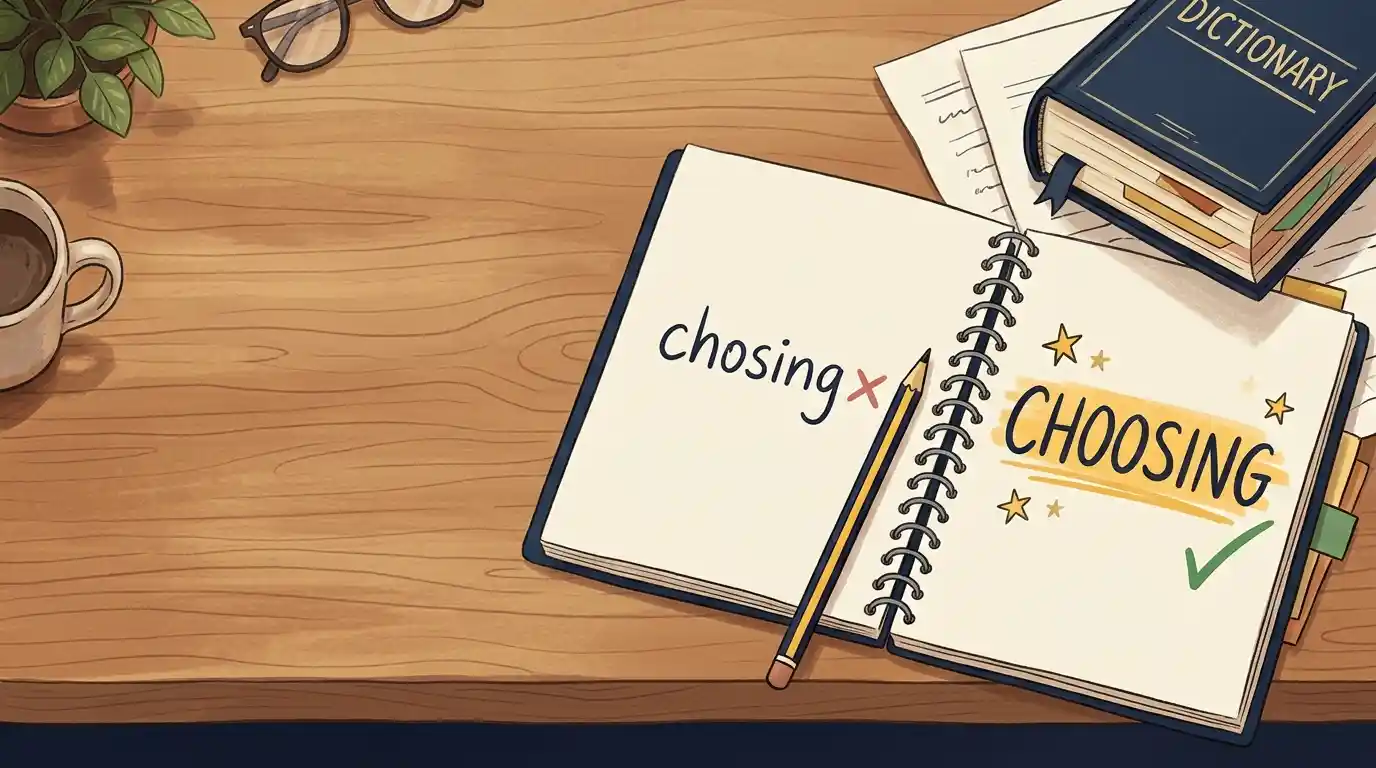
This article clears up the confusion fast. Here is the short story: “choosing” is the only correct spelling. “Chosing” is a common typo. This spelling is incorrect in both British and American English.
Below, you will learn why the mistake happens, where the word comes from, and how to avoid it for good. We keep it simple, so you can find your answer in seconds.
Chosing or Choosing Quick Answer
Choosing is correct. Chosing is wrong.
“Choosing” is the “-ing” form of the verb “choose.” It means picking one thing from two or more.
Here are some examples:
- I am choosing a new phone.
- She is choosing between two jobs.
- We spent an hour choosing a gift.
- Choosing the right words takes time.
Now the wrong version:
I am chosing a new phone.She is chosing between two jobs.
A good rule: the word needs two o’s. Say it aloud. You hear a long “oo” sound, like in “moon.” Two o’s, then.
The Origin of Choosing

“Choosing” comes from the verb “choose.” That verb is very old. It goes back to Old English, where the word was cēosan. Similar words exist in other old Germanic languages, such as Dutch, German, and Old Norse. That tells us the word has been around for over a thousand years.
Over time, the spelling changed many times. English once spelled words in many different ways. As printing spread, spelling slowly became fixed. The modern form “choose” settled into place with the double “o.”
The verb has these forms:
- choose (present): I choose pizza.
- chose (past): I chose pizza yesterday.
- chosen (past participle): I have chosen pizza.
- choosing (-ing form): I am choosing pizza.
Why Do Spelling Differences Exist Here?
They do not. For many words, British and American writers spell things differently. But “choosing” is not one of them. Both sides use the same spelling.
So where does “chosing” come from? There are two main causes:
- The word “chose.” It has one “o” and sounds close to the start of “chosing.” People mix the two.
- The “drop the e” rule. Many verbs drop the final “e” before “-ing,” like “make” and “making.” People apply that rule too fast and also drop an “o.”
The correct change is only this: choose → choosing. The “e” drops. Both “o”s stay.
British English vs American English Spelling
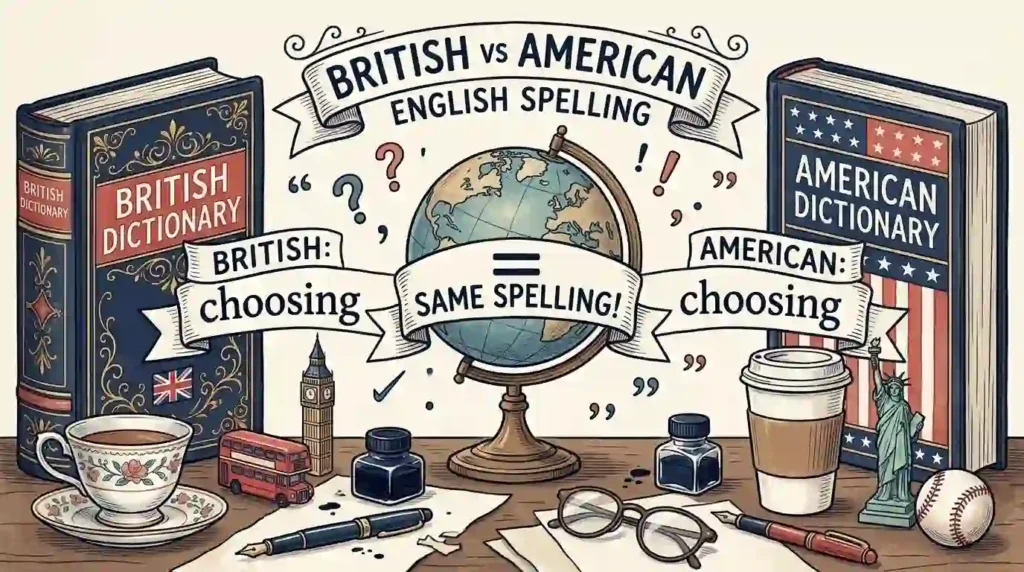
Here is the key point. There is no British or American difference for this word. Both use “choosing.” “Chosing” is not accepted in either one.
British and American spelling do differ on many other words. The table below shows a few, so you can see that “choosing” is not on the list.
| Word | British English | American English | Same or different? |
| Choosing | choosing | choosing | Same |
| Color | colour | color | Different |
| Organize | organise (or organize) | organize | Different |
| Judgment | judgement (or judgment) | judgment | Different |
| Traveling | travelling | traveling | Different |
| Center | centre | center | Different |
| Chosing | not accepted | not accepted | Wrong in both |
Some other word groups follow clear rules:
- -our vs -or: colour / color, favourite / favorite
- -re vs -er: centre / center, theatre / theater
- Double l: travelling / traveling, cancelled / canceled
“Choosing” follows none of these. It is simply spelled one way.
Which Spelling Should You Use?
The answer is easy: use choosing. But let’s check each audience.
If your readers are in the US: Use “choosing.” US dictionaries list no other spelling.
If your readers are in the UK, Australia, Canada, India, or other Commonwealth countries: Use “choosing.” The British and Commonwealth styles are the same here.
If your readers are global: Use “choosing.” It is understood everywhere. “Chosing” may look like a mistake to anyone.
If you write for school, work, or business: Use “choosing.” A small typo can make your work look careless.
If you write SEO content: Use “choosing” in your text. Only use “chosing” if you are writing about the typo, as we do here.
Simple rule: no matter who you write for, the answer does not change.
Common Mistakes with Choosing
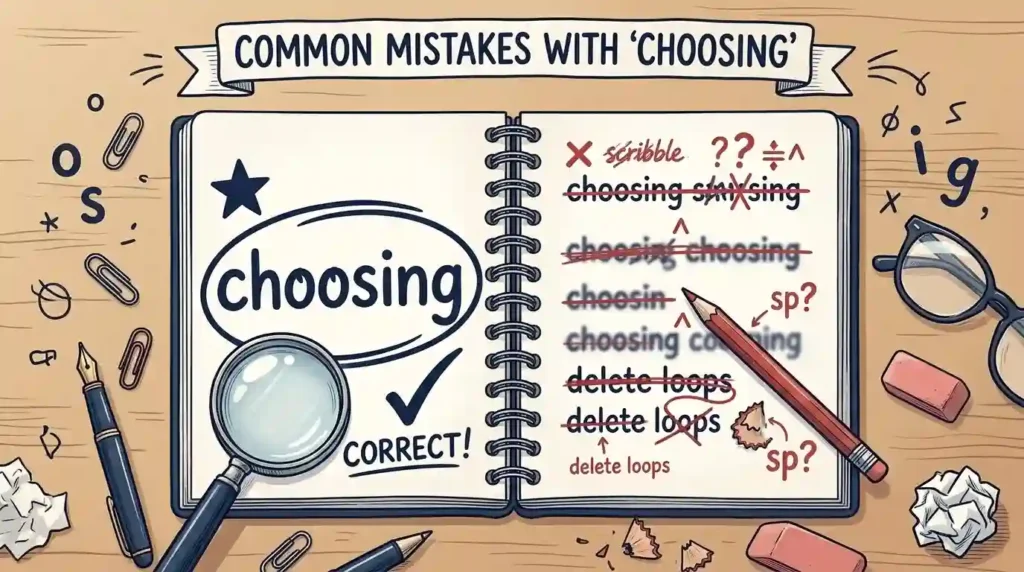
Here are the errors people make most often, and the fixes.
| Mistake | Correct form | Why it is wrong |
| chosing | choosing | Missing an “o” |
| chossing | choosing | Extra “s” and missing an “o” |
| choozing | choosing | Wrong letter. The sound uses “s” in spelling |
| choosen | chosen | Extra “o” in the past participle |
| I have chose | I have chosen | Needs the past participle |
| I choosed | I chose | “Choose” is irregular |
| loose / lose mix-ups | choose, lose | “Choose” and “loose” look alike but are different words |
Tip 1: “Chose” is the past. “Choose” is the present. Do not mix them.
- Wrong: Yesterday I choose the red one.
- Right: Yesterday I chose the red one.
Tip 2: The word “choosing” has a double “o” because the base word “choose” has a double “o.”
Tip 3: Run a spell check, but do not trust it fully. It can miss errors when the typo is a real word, such as “chose” used in place of “choose.”
Choosing in Everyday Examples

See how the right spelling looks in real life.
In emails
- “Thank you for choosing our company.”
- “I am still choosing between the two offers. I will reply by Friday.”
In news
- “Voters are choosing a new mayor today.”
- “Many families are choosing to shop online.”
On social media
- “Choosing joy today. ☀️”
- “Can’t stop choosing pizza over salad. No regrets.”
In formal writing
- “The committee is responsible for choosing the final candidates.”
- “Choosing a suitable research method is a key step in any study.”
Notice the pattern. In every case, the spelling has two o’s. The tone changes, but the spelling does not.
Chosing or Choosing Google Trends and Usage Data
I cannot pull live Google Trends numbers here, so I will not make up figures. Here is what is safe to say, and how you can check it yourself.
What we can say:
- “Choosing” is used far more than “chosing” in books, news, and web pages. This is expected, because it is the correct form.
- Searches that contain a typo, like “chosing or choosing,” usually come from people who want a quick check.
- Misspelling searches often rise during school terms and exam seasons, and when people write job applications.
- Interest tends to come from countries where English is widely used, both as a first and as a second language.
How to check the data yourself:
- Go to Google Trends (trends.google.com).
- Type “choosing” and add “chosing” to compare.
- Set the region to the United States, United Kingdom, India, Pakistan, or any country you need.
- Pick a time range, such as the past five years.
- Look at “Interest by region” to see where each term is strongest.
You will see that “choosing” leads by a wide margin in every region.
Keyword Variations Side by Side
| Variation | Correct? | Part of speech | Example |
| choosing | ✅ Yes | Verb (-ing form) | I am choosing a color. |
| chosing | ❌ No | Typo | — |
| choose | ✅ Yes | Verb (present) | I choose tea. |
| chose | ✅ Yes | Verb (past) | I chose tea. |
| chosen | ✅ Yes | Past participle | She was chosen. |
| chossing | ❌ No | Typo | — |
| choozing | ❌ No | Typo | — |
FAQs
Is it “chosing” or “choosing”?
It is “choosing.” “Chosing” is a typo and is not accepted in any dictionary.
Is “chosing” a British spelling?
No. British English spells the word “choosing,” just like American English.
Why do people write “chosing”?
Most people mix it up with “chose.” Others drop the “e” before “-ing” and accidentally drop an “o” too.
What is the difference between “chose” and “choose”?
“Choose” is for now or the future. “Chose” is for the past. Example: “I choose cake today. I chose cake last week.”
What is the past participle of “choose”?
It is “chosen.” Example: “She has chosen a new path.”
Does the “e” in “choose” stay when I add “-ing”?
No. You drop the “e” and add “-ing.” You get “choosing.” Keep both “o”s.
Will spell check catch “chosing”?
Usually, yes. Most tools mark it with a red line. Still, learn the rule so you can write with confidence even when no tool is helping.
How can I remember the correct spelling?
Say it out loud. You hear a long “oo.” So write two o’s: choosing.
Conclusion
The answer is simple. “Choosing” is correct. “Chosing” is a typo. Use “choosing” everywhere, every time, in every country.
Here are the key points to remember. First, “choosing” comes from the verb “choose.” The “oo” stays, and the final “e” drops before “-ing.” Second, there is no British or American split here. Both sides spell it the same way. Third, the mistake happens because “chose” is a real word, and people shorten “choosing” to match it. Fourth, spell check helps, but knowing the rule is better.
Here is a quick trick. Say the word out loud. You hear a long “oo” sound, like in “moon.” That sound needs two o’s. So write “choosing” with both of them.
If you write emails, essays, posts, or reports, the right spelling builds trust. Small errors can make good writing look careless. Now you know the fix. Pick “choosing,” and move on with confidence. Bookmark this page for the next time doubt shows up.

“I’m Ibadat Fatima, a professional content writer and author with 3 years of experience in writing, editing, and storytelling. I share my work through visitlivo.com, where I help readers connect with clear, engaging, and well-crafted content.”