You see NH3 in a chemistry book. The question pops up fast: is it a strong base or a weak one? Many students get stuck here. The answer seems easy, but the reason behind it is not.
People search “NH3 strong or weak” for a simple cause. Tests ask it. Homework asks it. Teachers ask it. And the strong and weak labels sound like they mean “dangerous” or “safe.” They do not.
Here is the confusion. Ammonia smells sharp. It can burn your skin. So it must be strong, right? Not in chemistry. In chemistry, “strong” and “weak” tell you one thing only: how much a substance reacts with water.
This article gives you the quick answer first. Then it shows you why. You will see the numbers, the common mistakes, and real examples. You will also get a table and a short FAQ.
Read on, and you will never mix this up again.
NH3 Strong or Weak Quick Answer
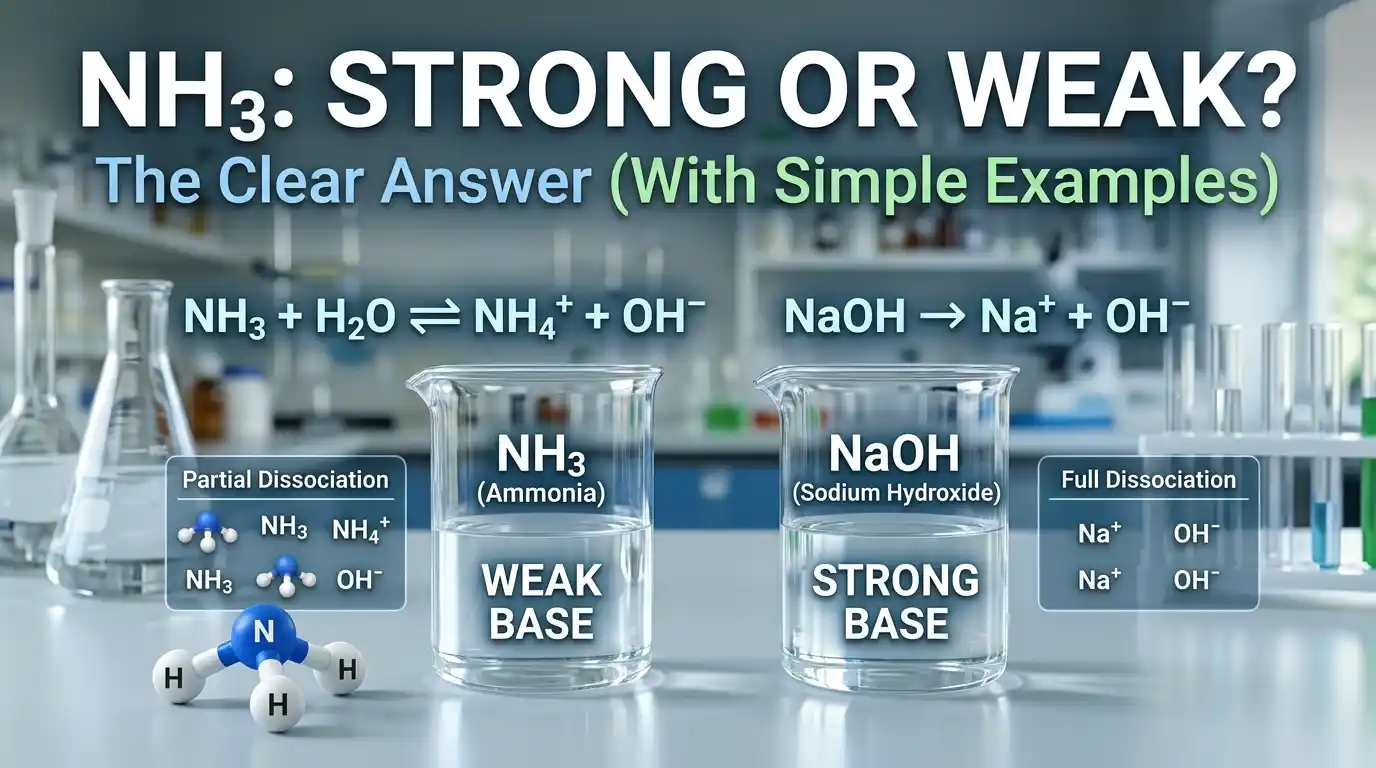
NH3 (ammonia) is a weak base.
It does not fully react with water. Only a small part of it does. Most NH3 stays as NH3.
Here is the reaction:
NH3 + H2O ⇌ NH4⁺ + OH⁻
The arrow goes both ways. That means the reaction can go back. In a 0.1 M ammonia solution, only about 1% turns into NH4⁺ and OH⁻.
Compare it with sodium hydroxide (NaOH). NaOH splits fully in water. That makes it a strong base.
| Substance | Type | Splits in water |
| NaOH | Strong base | Fully |
| KOH | Strong base | Fully |
| NH3 | Weak base | Only a little |
Quick test: if a base has no metal and has nitrogen, it is often weak. NH3 fits.
The Origin of the Idea: Why NH3 Is Called Weak
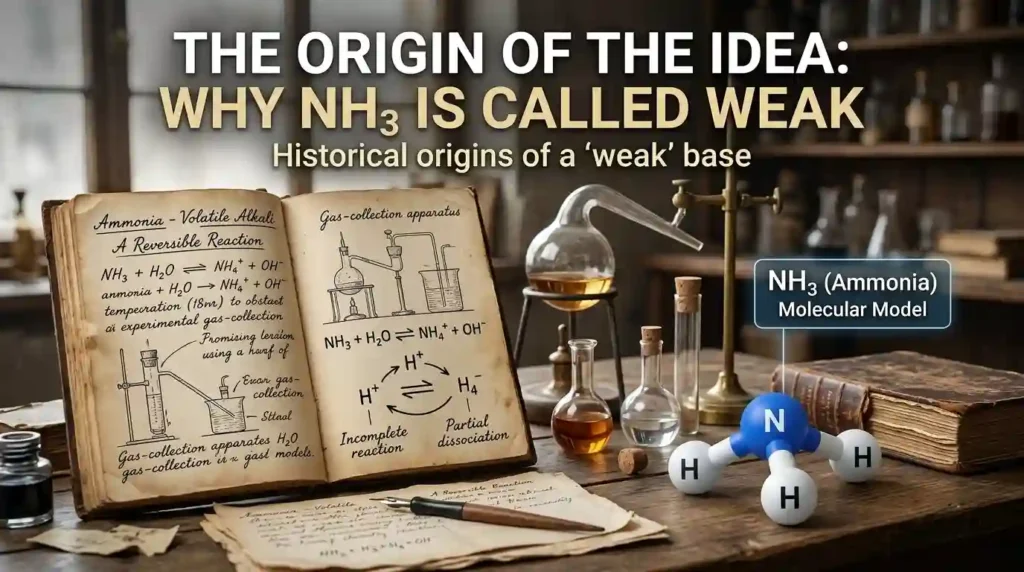
The word “ammonia” has an old story. Ancient people found a salt near a temple of the god Ammon in North Africa. They called it “sal ammoniac.” The gas from it later became known as ammonia.
In 1774, Joseph Priestley, an English chemist, made the gas in a lab. Others soon studied how it acted in water.
Later, scientists built the idea of acids and bases. Svante Arrhenius said bases make OH⁻ in water. Then Brønsted and Lowry said a base takes a proton (H⁺). NH3 fits the second idea best. It grabs an H⁺ and becomes NH4⁺.
Then came the idea of strength. Scientists asked: how much does a base do this? They measured it with a number called Kb.
- NH3 has a Kb of about 1.8 × 10⁻⁵
- That is very small
- So NH3 is weak
Strong bases like NaOH do not even need a Kb. They split fully.
Strong vs Weak How to Tell Them Apart
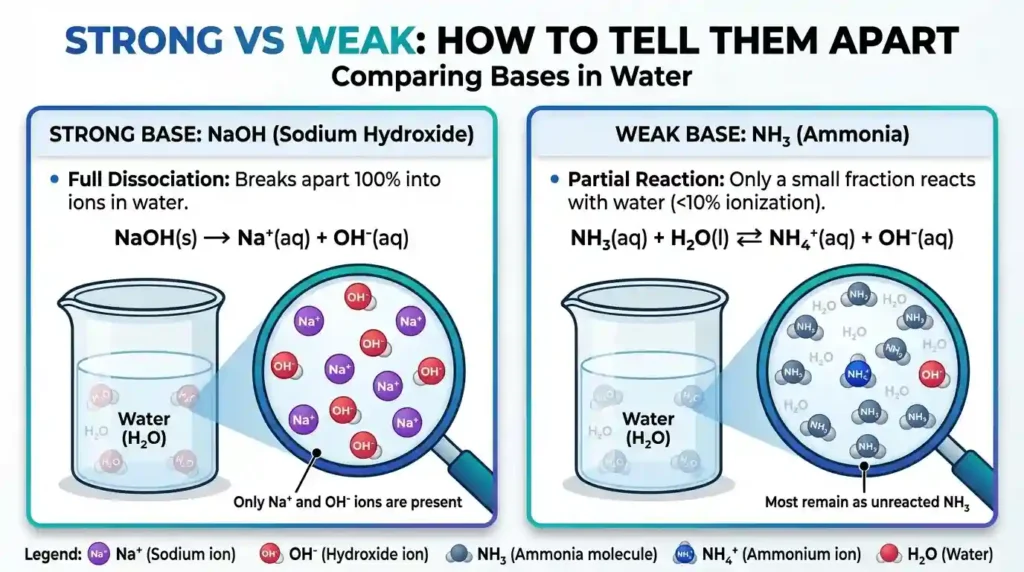
Your usual “British vs American” comparison does not apply here. The real comparison is strong versus weak. Here it is side by side.
| Feature | Strong Base (e.g., NaOH) | Weak Base (e.g., NH3) |
| Splits in water | 100% | Small part (about 1% in 0.1 M) |
| Reaction arrow | One way (→) | Two ways (⇌) |
| Kb value | Very large | Small (1.8 × 10⁻⁵ for NH3) |
| pH of 0.1 M solution | About 13 | About 11.1 for NH3 |
| Conducts electricity | Very well | Poorly |
| Type of electrolyte | Strong | Weak |
Simple rule: Strong means “all in.” Weak means “only a few.”
Which Answer Should You Use? (By Audience)
The science is the same everywhere. But how you say it can change.
For school and exams (US, UK, Pakistan, India, global): Write “NH3 is a weak base.” Add one line: “It partly ionizes in water.” Show the equation with the two-way arrow. Teachers love this.
For lab reports: Give the Kb value (1.8 × 10⁻⁵). Show your pH math. Use the terms “weak base” and “weak electrolyte.”
For general readers: Skip the math. Say, “Ammonia is a weak base. It only reacts a little with water.”
For safety talks: Be careful. Say, “Weak in chemistry does not mean safe.” Strong ammonia fumes can harm your eyes and lungs.
Common Mistakes with NH3 Strong or Weak
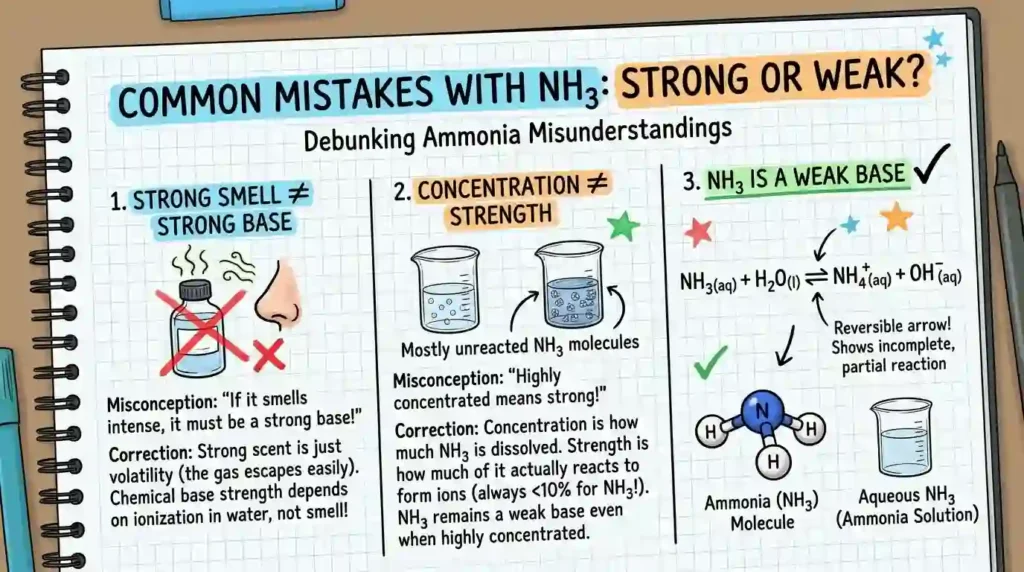
Mistake 1: “It smells strong, so it is a strong base.”
Smell has nothing to do with it. Strength is about how much it splits in water.
Mistake 2: Mixing up strong and concentrated.
A strong base can be diluted. A weak base can be concentrated. Strength is the type. Concentration is the amount.
Mistake 3: “Weak means safe.”
No. Strong household ammonia can burn skin and hurt lungs. Always use it with care.
Mistake 4: Using a one-way arrow.
Write NH3 + H2O ⇌ NH4⁺ + OH⁻. The two-way arrow shows it is weak.
Mistake 5: Thinking NH3 has OH⁻ in it.
It does not. The OH⁻ forms after NH3 takes an H⁺ from water.
Mistake 6: Confusing NH3 with NH4OH.
“Ammonium hydroxide” is just an old name for ammonia in water. No pure NH4OH compound has been found.
NH3 Strong or Weak in Everyday Examples

In a student email:
“Dear Sir, I am confused. Is NH3 a strong or weak base? My book says weak, but it smells very strong.”
In a news story:
“Workers cleaned the tank with diluted ammonia. Experts said that even a weak base can harm skin if the amount is high.”
On social media:
“Chem fact: NH3 is a weak base. Only about 1% reacts with water. Strong ≠ smelly! 🧪”
In formal writing (lab report):
“Ammonia is a weak base with a Kb of 1.8 × 10⁻⁵. It partly ionizes in water, so a 0.1 M solution has a pH near 11.1.”
At home:
Window cleaner often has ammonia. It works well on glass because it is a mild base. It cuts grease but does not harm glass the way a strong base might.
NH3 Strong or Weak Google Trends & Usage Data
I cannot pull live Google Trends numbers here, so I will not invent any. Here is what you can expect, and how to check it yourself.
Who searches: Students mostly. Interest usually rises during exam seasons and school terms. It drops in long holidays.
Where: Countries with large student groups, such as the US, India, Pakistan, the UK, the Philippines, and Nigeria, often show strong interest in chemistry topics.
Why: Teachers repeat this question every year. It is a core topic in acid-base lessons.
How to check: Go to Google Trends. Type “nh3 strong or weak.” Compare it with “is ammonia a base.” Filter by country and by time.
Keyword Variations Side by Side
| Search Phrase | What the Person Wants | Answer |
| nh3 strong or weak | Quick check | Weak base |
| is nh3 a strong base | Yes/no | No |
| nh3 weak acid or base | Which one | Weak base |
| nh3 strong or weak electrolyte | Conductivity | Weak electrolyte |
| is ammonia strong or weak | Same as NH3 | Weak base |
| nh3 strong or weak acid | Acid check | Not an acid; its partner NH4⁺ is a weak acid |
FAQs
Is NH3 a strong or weak base?
NH3 is a weak base. It only partly reacts with water.
Why is NH3 a weak base?
It does not take many H⁺ ions from water. Its Kb is small (1.8 × 10⁻⁵), so most NH3 stays unchanged.
Is NH3 a strong or weak electrolyte?
Weak. Few ions form in water, so it conducts electricity poorly.
Is NH3 an acid or a base?
A base. It takes an H⁺ to become NH4⁺. Its partner NH4⁺ is a weak acid.
What is the pH of ammonia solution?
A 0.1 M solution has a pH of about 11.1. That is basic, but lower than NaOH at the same strength, which is near 13.
Is NH3 harmful if it is weak?
Yes, it can be. Strong fumes can hurt your eyes, nose, and lungs. Chemical strength is not the same as danger.
What is a strong base example to compare?
NaOH, KOH, and Ba(OH)2 are strong bases. They split fully in water.
Conclusion
So, is NH3 strong or weak? NH3 is a weak base.
Ammonia only partly reacts with water. The reaction goes both ways, so write it with the two-way arrow. Its Kb is small, about 1.8 × 10⁻⁵. In a 0.1 M solution, only about 1% turns into ions. That is also why it is a weak electrolyte.
Do not mix up strong with smelly, concentrated, or dangerous. Strength only tells you how much a base splits in water.
Writing for an exam? Say “weak base” and add the equation. Writing a lab report? Add the Kb and pH. Writing for everyday readers? Keep it plain and mention safety.
Remember this: strong bases like NaOH split fully. Weak bases like NH3 do not.

I’m Raheela Rani, a professional content writer and author with 3 years of experience in writing, editing, and storytelling. Through VisitLivo.com, I create clear, engaging, and well-crafted content that helps readers learn, connect, and communicate with confidence.