You are typing a sentence. You reach the word for work, and you stop. Is it labor or labour? Both look right. One looks odd. You are not alone. Many people search this question every month. Students ask it. Writers ask it. Business owners ask it, too.
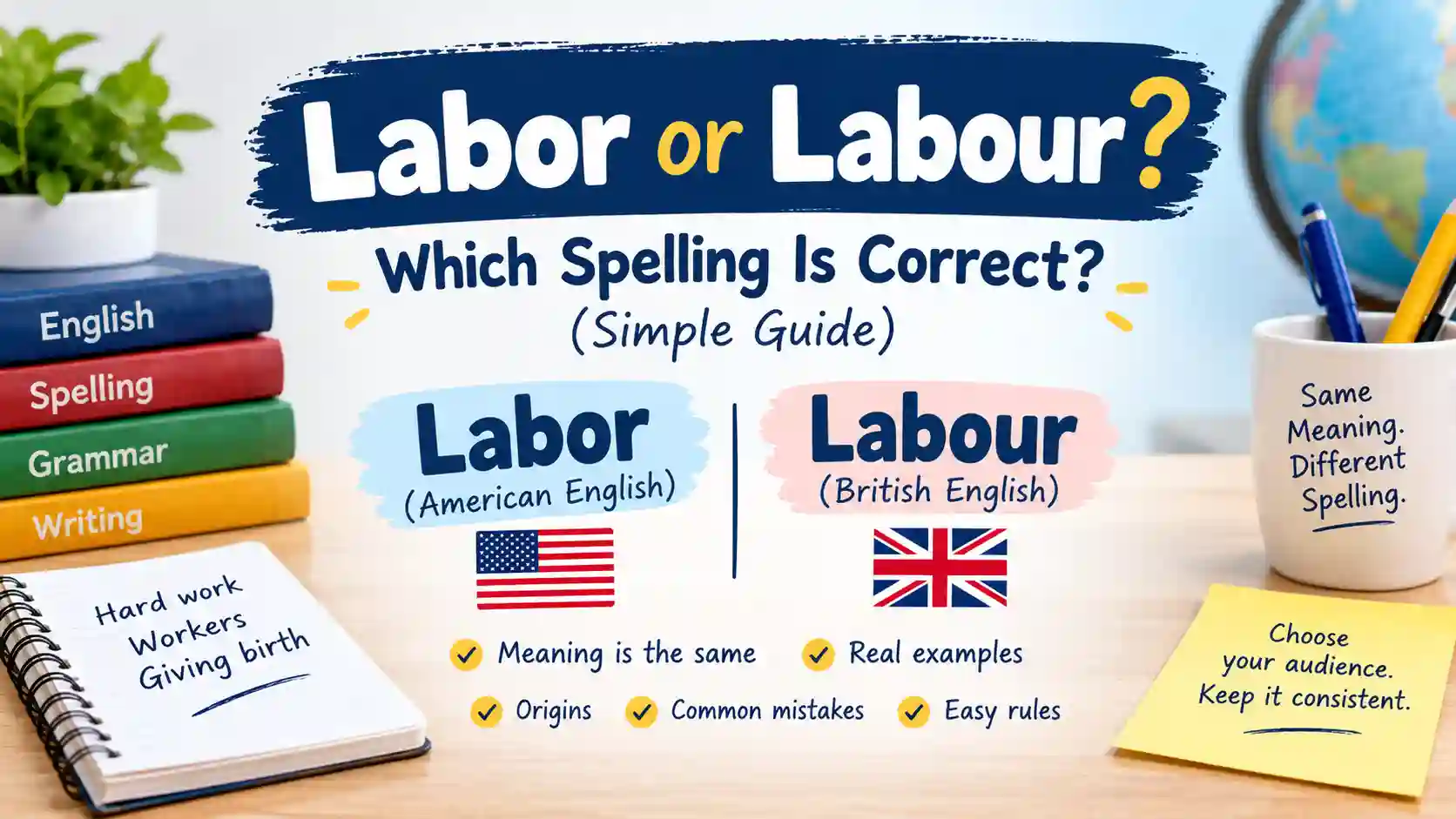
The answer is simple. Both spellings are correct. They mean the same thing. The only difference is where you live and who reads your work. Americans write labor. People in the UK, Canada, and many other places write labour.
This guide clears up the confusion fast. You will get a quick answer first. Then you will learn where the two spellings came from. You will see tables, real examples, common mistakes, and easy rules. You will also learn which spelling fits your reader.
By the end, you will never second-guess this word again. Let’s start with the short answer.
Labor or Labour Quick Answer
- Labor is the American English spelling.
- Labour is the British English spelling.
The meaning is the same. It can mean hard work, workers as a group, or the work of giving birth.
Examples:
- American: “The company needs more skilled labor.”
- British: “The company needs more skilled labour.”
- American: “Labor Day is in September.”
- Canadian: “Labour Day is in September.”
Simple rule: Pick one spelling and use it all the way through your text. Do not mix them.
The Origin of Labor or Labour
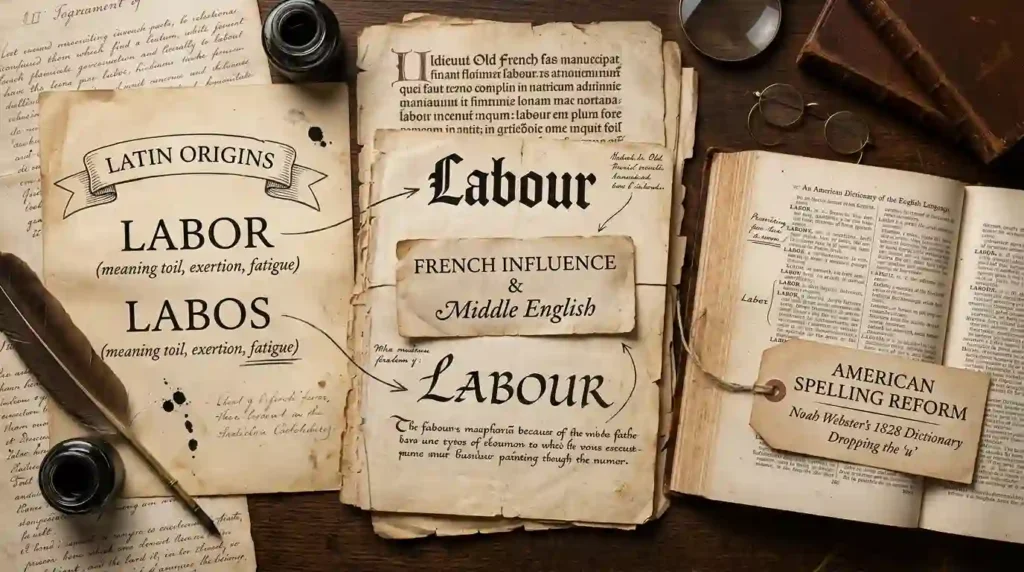
The word started in Latin. The Latin word labor meant toil, effort, or hard work. It later moved into Old French. There it was written as labour or labor. English borrowed it after the Norman Conquest in 1066.
For many years, English writers spelled it labour. Many words that came from French ended in -our. Think of colour, honour, and favour.
Then came Noah Webster. Noah Webster was an American writer who published a well-known dictionary in 1828. He aimed to simplify spelling and give American English its own identity. So he dropped the “u” in many words. Labour became labor. Colour became color.
Britain kept the older -our spelling. Today the two styles live side by side. That is why we have two correct spellings.
British English vs American English Spelling
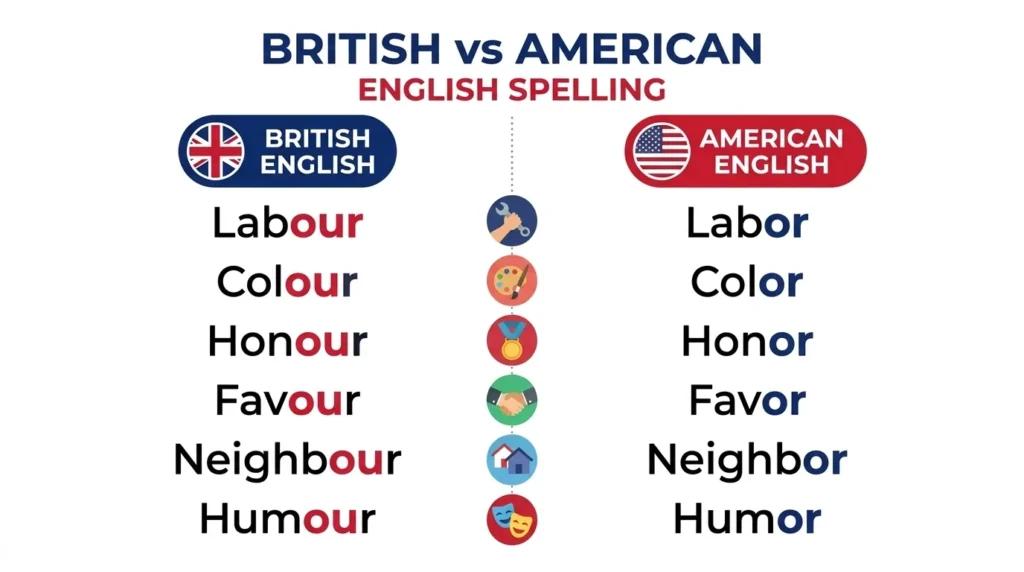
This is not just about one word. It is a pattern. Many words that end in -our in British English end in -or in American English.
| Meaning | American English | British English |
| Hard work | labor | labour |
| Hue | color | colour |
| Respect | honor | honour |
| Kindness | favor | favour |
| Person next door | neighbor | neighbour |
| Fun or joking | humor | humour |
| Smell | odor | odour |
Words that change in the same way: labor, color, honor, favor, neighbor, humor, odor.
Words that do not follow the pattern:
- Laborious has no “u” in either style.
- Laboratory has no “u” in either style.
- Labourer keeps the “u” in British English. In American English, it is laborer.
Which Spelling Should You Use?
Think about your reader. Then choose.
Writing for a US audience? Use labor.
Writing for the UK, Ireland, or Australia? Use labour.
Writing for Canada? Use labour. Canada follows the British style for this word.
Writing for a global audience? Pick one style and stay with it. Many global brands choose American English. Others choose British English. Either is fine.
Writing for a school or company? Follow their style guide. If there is none, use the spelling common in your country.
Tip: Set your spell-check to the right language. Choose English (US) or English (UK). Your tool will then catch errors for you.
Be careful with names. Proper names keep their own spelling. The UK’s Labour Party uses “u.” The Australian Labor Party does not. US Labor Day has no “u.” Canada’s Labour Day does.
Common Mistakes with Labor or Labour
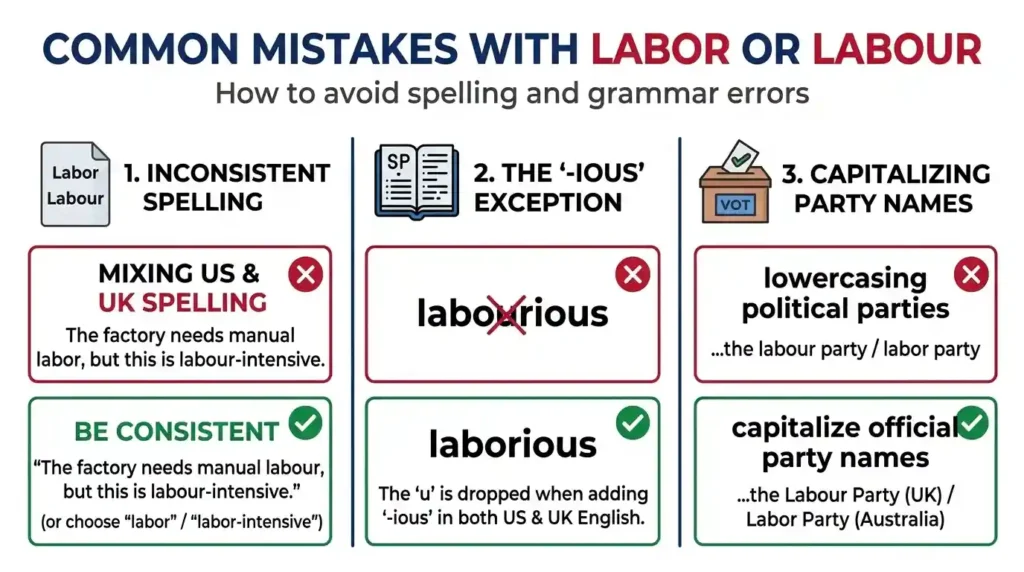
1. Mixing both spellings in one text
- Wrong: “The labor laws protect every labourer.”
- Right (US): “The labor laws protect every laborer.”
- Right (UK): “The labour laws protect every labourer.”
2. Changing a proper name
- Wrong: “Labor Party” when you mean the UK party.
- Right: “Labour Party” for the UK. “Labor Party” for Australia.
3. Adding a “u” to laborious
- Wrong: “labourious”
- Right: “laborious”
4. Thinking one spelling is wrong
- Neither is wrong. Each is right in its own region.
5. Trusting the wrong spell-check
- If your tool is set to US English, it may flag “labour.” It is not an error. Change the language setting.
Labor or Labour in Everyday Examples
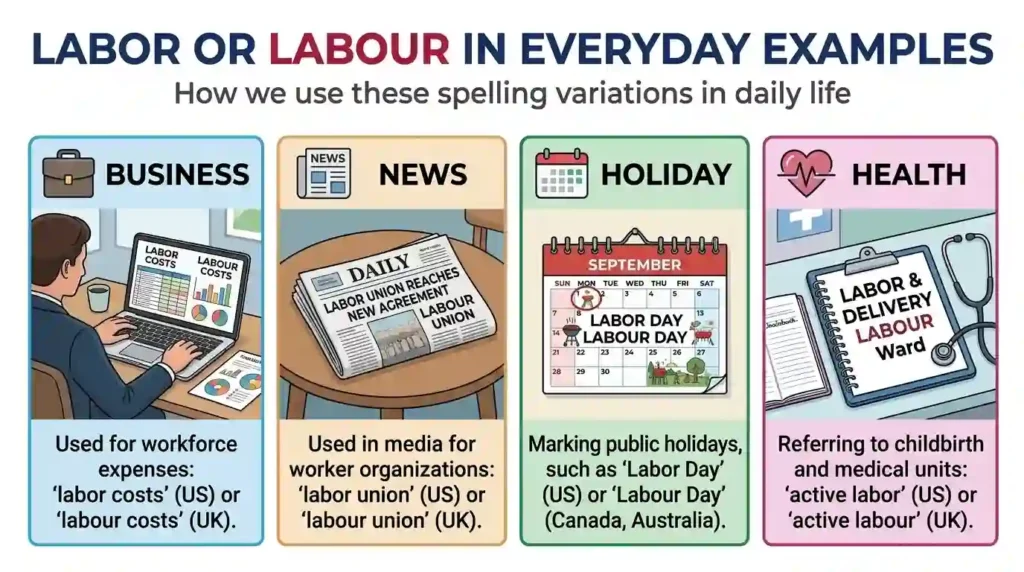
Email (US): “Please review the labor costs in the attached report.”
Email (UK): “Please review the labour costs in the attached report.”
News headline (US): “Labor unions push for higher pay.”
News headline (UK): “Labour leader speaks on new jobs plan.”
Social media (US): “Happy Labor Day! Enjoy the long weekend.”
Social media (Canada): “Happy Labour Day! Enjoy the long weekend.”
Formal writing (US): “The Department of Labor publishes monthly job data.”
Formal writing (UK): “The report studies labour markets across Europe.”
Health (both meanings): “She went into labor at midnight.” (US) “She went into labour at midnight.” (UK)
Labor or Labour Google Trends & Usage Data
This section describes common patterns. For live numbers, check Google Trends yourself. Results change over time.
By country:
- United States: People mostly search “labor.” Interest is strongest around Labor Day in early September.
- United Kingdom: People search “labour,” often tied to politics and the Labour Party. Interest rises near elections.
- Canada: “Labour” is the main spelling. Interest rises around Labour Day.
- Australia and New Zealand: Both forms appear. “Labor” often links to the Australian Labor Party. “Labour” often links to New Zealand’s Labour Party and to Labour Day.
- India and much of the Commonwealth: “Labour” is common, especially in law and government text.
By context:
- Work and jobs: People search “labor market,” “labor laws,” and “labor costs.”
- Politics: People search “Labour Party” and “Labor Party.”
- Holidays: People search “Labor Day” and “Labour Day.”
- Health: People search “labor” or “labour” with pregnancy and birth.
- Spelling help: People search “labor or labour” when they are unsure which to use.
Keyword Variations Side by Side
| Phrase | US Spelling | UK / Commonwealth Spelling |
| Workforce | labor | labour |
| Worker | laborer | labourer |
| Holiday | Labor Day | Labour Day |
| Government office | Department of Labor | Ministry/Department of Labour |
| Job market | labor market | labour market |
| Hard to do | laborious | laborious |
| Birth | in labor | in labour |
| Political party | Labor Party (Australia) | Labour Party (UK, NZ) |
FAQs
Is it labor or labour?
Both are right. Use labor in American English. Use labour in British English.
Is labour spelled wrong in the US?
No. It is not wrong. It is just not the usual US style. Most US readers expect labor.
Why do the British spell it labour?
English took the word from French. French had the “u.” Britain kept it. America dropped it in the 1800s.
Which spelling does Canada use?
Canada uses labour. Canadian Labour Day uses the “u.”
Is it Labour Party or Labor Party?
It depends on the country. The UK has the Labour Party. Australia has the Labor Party.
Is laborious spelled with a “u”?
No. Laborious has no “u” in any style.
Can I use both spellings in one document?
No. Choose one style and keep it the same. The only time to mix is with proper names, like a party or an office.
Which spelling is better for SEO?
Use the spelling your audience searches for. For US readers, use labor. For UK and Commonwealth readers, use labour. If you serve both, make a page for each or mention both once.
Conclusion
So, labor or labour? Both are correct. The choice depends on your reader.
Use labor for American readers. Use labour for readers in the UK, Canada, Ireland, and most Commonwealth countries. The meaning does not change. Only the spelling does.
The difference started long ago. English borrowed the word from French and kept the “u.” Later, Noah Webster dropped it to make American spelling simpler. Both styles stayed.
Remember these key points:
- Pick one spelling and use it all through your text.
- Keep proper names as they are, like Labour Party or Labor Day.
- Do not add a “u” to laborious.
- Match your spell-check to your audience.
Now you know the answer. You also know the reason behind it. Next time you write this word, you can type it with full trust.

“I’m Ibadat Fatima, a professional content writer and author with 3 years of experience in writing, editing, and storytelling. I share my work through visitlivo.com, where I help readers connect with clear, engaging, and well-crafted content.”