Is exocytosis active or passive? It sounds like an easy question. Yet it trips up many students.
Picture a cell as a tiny factory. It makes proteins, hormones, and waste. Then it must ship them out. It does this with exocytosis. But does the cell spend energy on the trip? Or do things just drift out on their own?
People search this keyword for a few reasons. Biology exams ask it often. Textbooks use terms like “bulk transport,” “vesicle,” and “active transport,” and these can blur together. Some pages say transport is passive when molecules move freely. Others say it is active when the cell spends energy. Students want one clear answer.
This article gives it. You will get a quick answer first. Then you will see why it is true, where the word comes from, how to spell it, and which mistakes to avoid. You will also find real examples, trend notes, and FAQs. By the end, you will not mix this up again.
Exocytosis Active or Passive Quick Answer
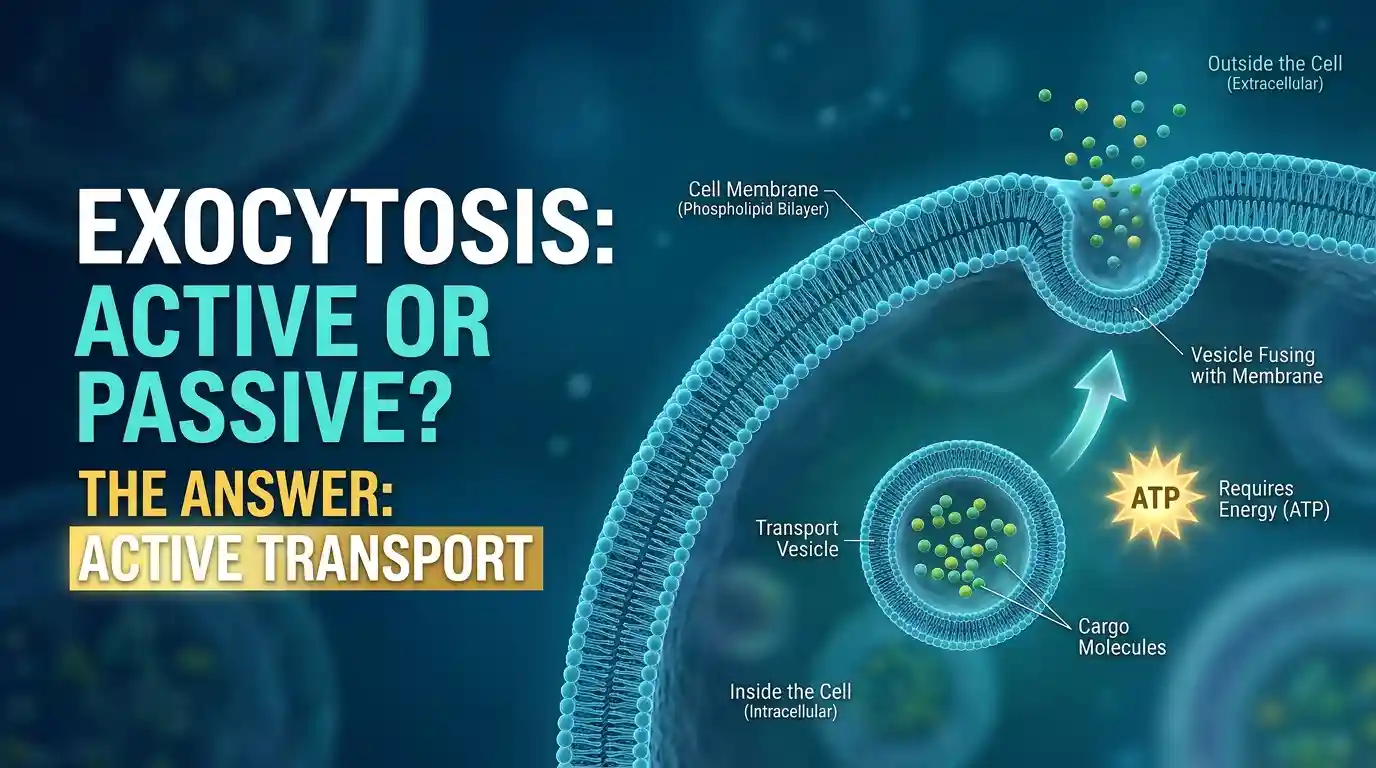
Exocytosis is active transport. The cell must use energy (ATP) to do it.
Here is how it works:
- The cell packs material into a small bubble called a vesicle.
- The vesicle travels to the cell membrane.
- The vesicle fuses with the membrane.
- The contents spill outside the cell.
Each step needs energy. Motor proteins move the vesicle along the cell’s skeleton. Special proteins pull the membranes together. Both jobs use ATP.
Examples of exocytosis:
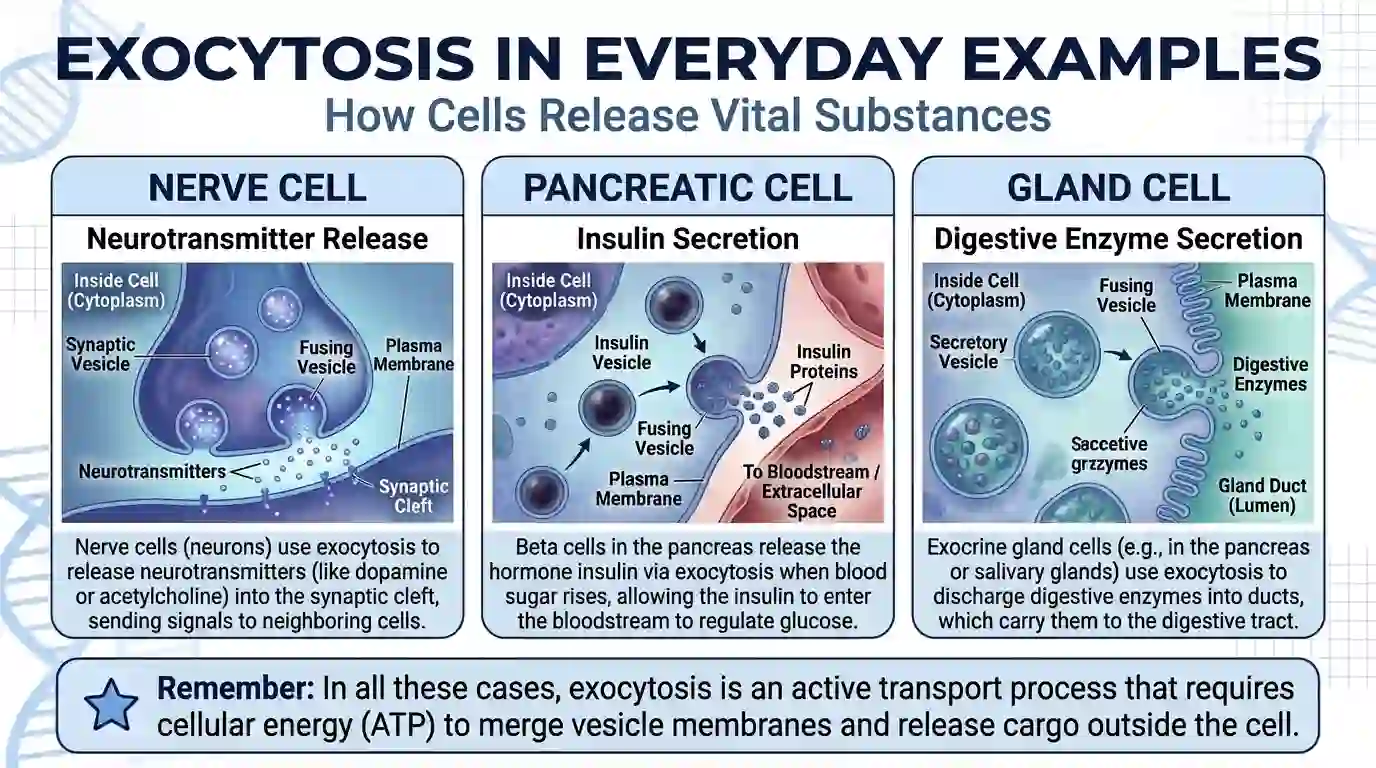
- Nerve cells release chemical signals (neurotransmitters).
- Pancreas cells release insulin.
- Gland cells release digestive enzymes.
- Cells release waste they no longer need.
Passive transport is different. It needs no energy. Diffusion and osmosis are passive. Exocytosis is not.
The Origin of Exocytosis
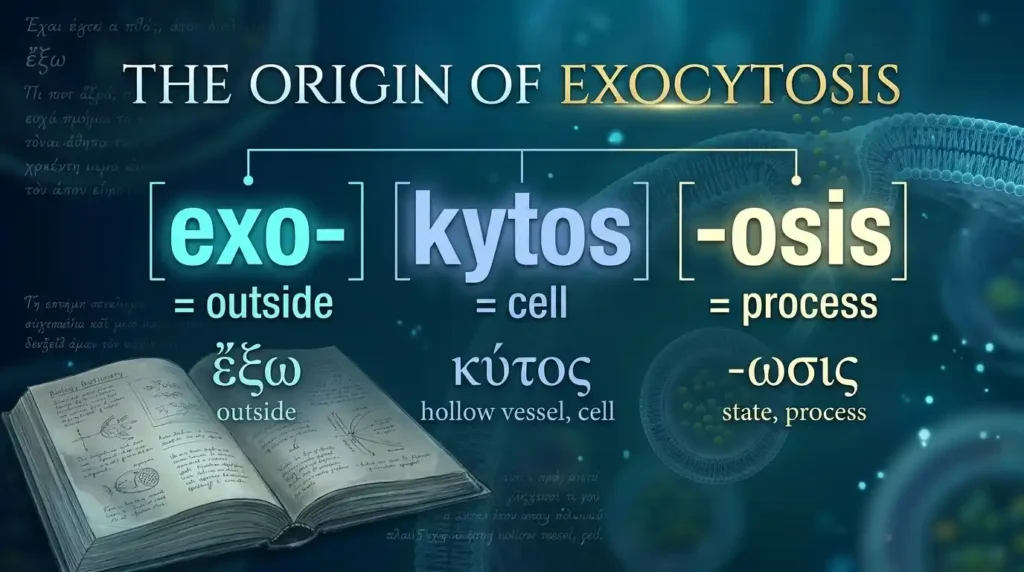
The word comes from Greek. It has three parts:
- exo- means “outside”
- kytos means “hollow vessel,” which later came to mean “cell”
- -osis means “process”
So exocytosis means “the process of moving out of the cell.”
Its twin word is endocytosis. Endo- means “inside.” Endocytosis takes things into the cell. Exocytosis sends things out.
Scientists have studied these ideas for decades. Christian de Duve, a Belgian scientist, helped name and describe these cell processes in the 1960s. He shared a Nobel Prize in 1974 with Albert Claude and George Palade, who mapped how cells make and ship proteins. In 2013, James Rothman, Randy Schekman, and Thomas Südhof won a Nobel Prize for showing how vesicles deliver cargo at the right time and place.
Why do spelling differences exist? For this word, they mostly don’t. Scientists use one shared Greek-based vocabulary worldwide. That keeps “exocytosis” the same in every English-speaking country.
British English vs American English Spelling
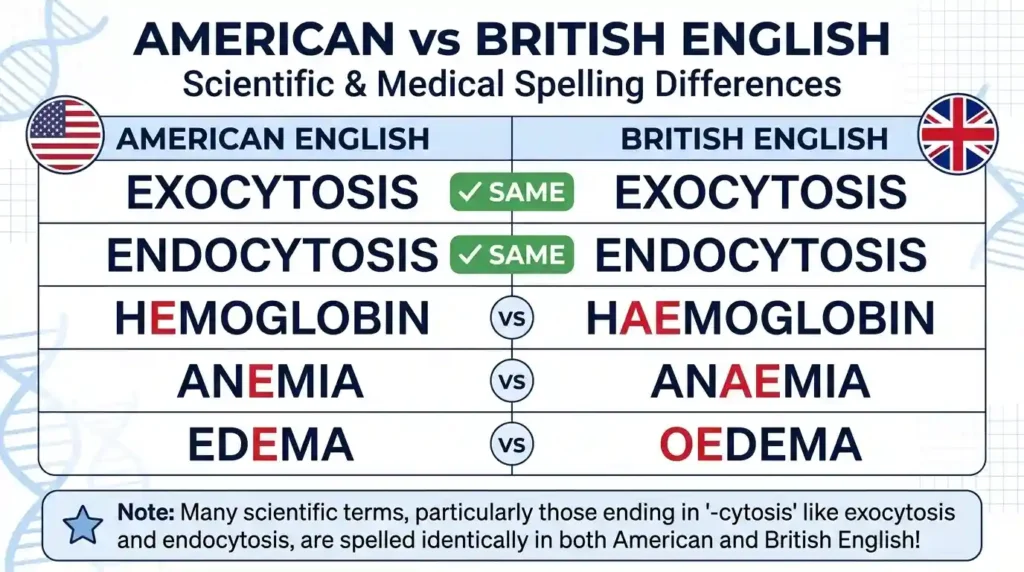
Good news: “exocytosis” is spelled the same in British and American English. There is no “exocytosis” versus “exocytosise” split. Nor is there a “-our” or “-or” change.
Some nearby science words do change between the two. Here is a quick comparison:
| Term | American English | British English |
| Exocytosis | exocytosis | exocytosis |
| Endocytosis | endocytosis | endocytosis |
| Blood protein | hemoglobin | haemoglobin |
| Low iron blood | anemia | anaemia |
| Swelling | edema | oedema |
| Unborn baby | fetus | foetus |
| Throat tube | esophagus | oesophagus |
The rule: Words with Greek “ai” or “oi” sounds often keep ae or oe in British English. American English uses a plain e. “Exocytosis” has no such letters, so it stays the same.
Which Spelling Should You Use?
Use exocytosis everywhere. It is the only correct spelling.
- US readers: Write “exocytosis.” Also write “hemoglobin” and “fetus” in the same paper.
- UK and Commonwealth readers: Write “exocytosis.” Also write “haemoglobin” and “foetus.”
- Global readers: Write “exocytosis.” Pick one style for the other words and stay with it.
Tip: Be consistent. If your paper says “anemia” on page one, do not write “anaemia” on page two.
Common Mistakes with Exocytosis
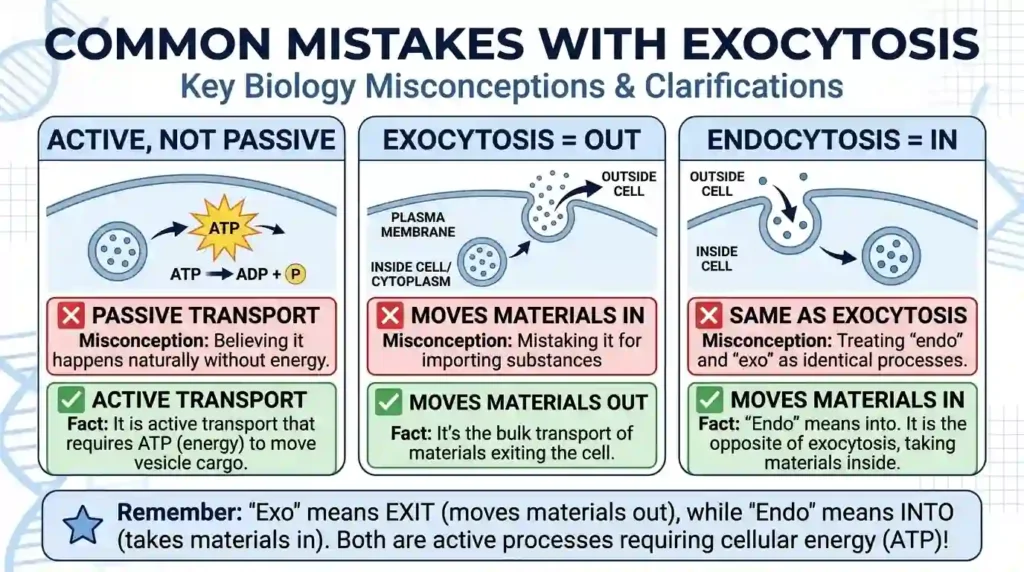
| Mistake | Why it is wrong | Fix |
| “Exocytosis is passive.” | It needs ATP. | Say “active transport.” |
| “Exocytosis needs no energy.” | Moving and fusing vesicles takes energy. | Say “energy-requiring.” |
| Mixing it up with endocytosis | They are opposites. | Exo = out. Endo = in. |
| Spelling it “exocitosis” | That is the Spanish spelling. | Use “exocytosis.” |
| Spelling it “exocytois” or “exocytosys” | Typos. | Use “exocytosis.” |
| Calling it simple diffusion | Diffusion moves small molecules freely. | Exocytosis moves big cargo in vesicles. |
| Saying it is the same as excretion | Excretion is a body-wide waste process. | Exocytosis happens in single cells. |
Memory trick: Exo sounds like exit. Exit takes effort. So exocytosis is active.
Exocytosis in Everyday Examples
In an email (student to teacher):
“Hi Ms. Lee, I have a question about class. Is exocytosis active or passive? I think it is active because it uses ATP.”
In the news:
“Researchers studied exocytosis in nerve cells. They found that faster vesicle release may affect memory.”
On social media:
“Study tip: exocytosis = active transport. Exit = energy. #biology #examprep”
In formal writing:
“Exocytosis is an active transport process. The cell uses ATP to move vesicles to the plasma membrane and release their contents.”
In a lab report:
“Insulin is released from beta cells by regulated exocytosis after blood sugar rises.”
Exocytosis Active or Passive Google Trends & Usage Data
I can’t pull live Google Trends numbers here, so I won’t invent any. But the pattern for this kind of keyword is predictable:
- Seasonal peaks: Searches usually rise during school and exam seasons.
- Who searches: Mostly high school students, college students, and teachers.
- Where: Countries with many English-speaking biology students, such as the United States, India, Pakistan, the United Kingdom, Canada, Australia, the Philippines, and Nigeria, are likely to show the most interest.
- Context: People type it as a question. Many also search “endocytosis vs exocytosis” and “active vs passive transport.”
To see real numbers, visit Google Trends. Compare “exocytosis” with “endocytosis” and “active transport.” Filter by country and time range.
Keyword Variations Side by Side
| Search phrase | Short answer |
| Exocytosis active or passive | Active |
| Is exocytosis active transport | Yes |
| Exocytosis passive transport | No, it is not passive |
| Does exocytosis require ATP | Yes |
| Exocytosis vs endocytosis | Exo sends out. Endo brings in. Both are active. |
| Exocytosis simple definition | A cell releases material by vesicle fusion. |
FAQs
Is exocytosis active or passive transport?
It is active transport. The cell uses ATP to move and fuse vesicles.
Does exocytosis need energy?
Yes. Energy moves the vesicle and helps it fuse with the membrane.
What is the difference between exocytosis and endocytosis?
Exocytosis moves material out of the cell. Endocytosis moves material in. Both are active.
Why is exocytosis called bulk transport?
It moves large amounts or large particles at once, inside vesicles.
What are the types of exocytosis?
Two main types exist. Constitutive exocytosis runs all the time. Regulated exocytosis waits for a signal, often calcium.
Is diffusion the same as exocytosis?
No. Diffusion is passive and moves small molecules. Exocytosis is active and uses vesicles.
Where does exocytosis happen in the body?
It happens in nerve cells, pancreas cells, immune cells, and gland cells, among many others.
Is “exocytosis” spelled differently in the UK?
No. The spelling is the same in the US, the UK, and everywhere else.
Conclusion
So, is exocytosis active or passive? The answer is clear. It is active.
The cell must spend ATP to pack, move, and release material. That makes exocytosis a form of active, bulk transport. It is the opposite of endocytosis, which brings material in. Passive processes like diffusion and osmosis need no energy at all.
Remember the word itself. Exo means out. A cell works hard to send things out. Use the memory trick: exit takes effort.
Spelling is easy. “Exocytosis” is the same in American and British English. Only nearby words like “hemoglobin” and “haemoglobin” change. Pick one style and stay consistent.
Avoid the common slips. Avoid these three slips. Never call exocytosis passive, because it uses energy. Never swap it with endocytosis, because one sends things out and the other brings them in. And always spell it “exocytosis,” not “exocitosis.”
For exams, keep one sentence ready: “Exocytosis is active transport that uses ATP to release vesicle contents outside the cell.” Use it in tests, notes, and reports. You will be right every time.

I’m Raheela Rani, a professional content writer and author with 3 years of experience in writing, editing, and storytelling. Through VisitLivo.com, I create clear, engaging, and well-crafted content that helps readers learn, connect, and communicate with confidence.