A simple guide to one of English’s easiest spelling choices.
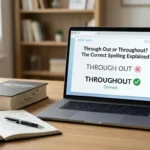
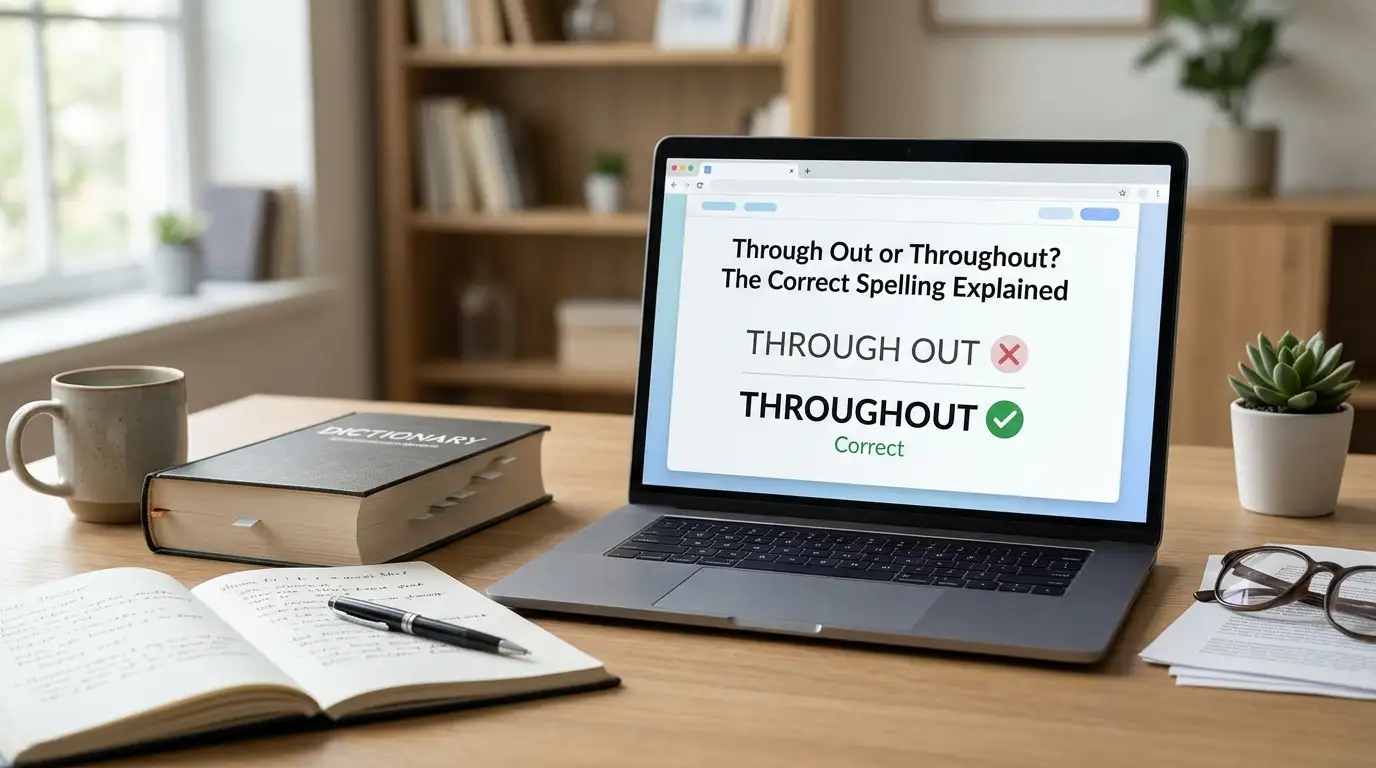
You are writing an email. You type a word, then stop. Is it “through out” or “throughout”? The two look almost the same. One has a space. One does not. That tiny gap makes people doubt themselves.
You are not alone. Many people search this question every month. Many feel sure they have seen both forms. Spell check may not help, because “through out” can look like two real words. So the doubt stays.
This guide ends the confusion. You will get a quick answer first. Then you will learn where the word came from. We compare British and American spelling. We show which form suits your readers. You will also find common mistakes, real examples, and a side-by-side table. At the end, you will find answers to the questions people ask most.
The good news is simple. This is one of the easier spelling questions in English. By the end, you will know the right choice and why it is right.
Through Out or Throughout Quick Answer
Use “throughout.” It is one word.
“Throughout” means in every part of something. It also means during the whole time of something.
Here are some examples:
- The rain fell throughout the night. (the whole time)
- She is known throughout the country. (every part of the place)
- He smiled throughout the meeting. (from start to end)
- We painted throughout the house. (in every room)
Now the other form. “Through out” with a space is almost always wrong. It is a typing slip.
There is one rare case where the two words do sit side by side. That is when “through” and “out” belong to different ideas. Look at this sentence: “We looked through out-of-date files.” Here “out-of-date” is its own phrase. The words are not a pair. This case is rare. If you mean “in every part” or “the whole time,” write “throughout.”
The Origin of Throughout

The word is old. It was built from two small words.
- Through comes from Old English. It meant passing from one side to the other.
- Out also comes from Old English. It meant not inside.
Centuries ago, English speakers joined the two. The new word was “throughout.” It first meant “all the way through” and “from end to end.” Over time it settled into the meanings we use today.
Why do spellings differ? English spelling was not fixed for a long time. Before printing and dictionaries, writers spelled words as they heard them. The word “through” itself had many forms, such as “thurgh” and “thorow.” Joined words like “throughout” went through the same mess.
Dictionaries later fixed the spelling. Today the joined form, “throughout,” is the standard. The spaced form “through out” is not a real variant. It only shows up when people type fast or are unsure.
British English vs American English Spelling
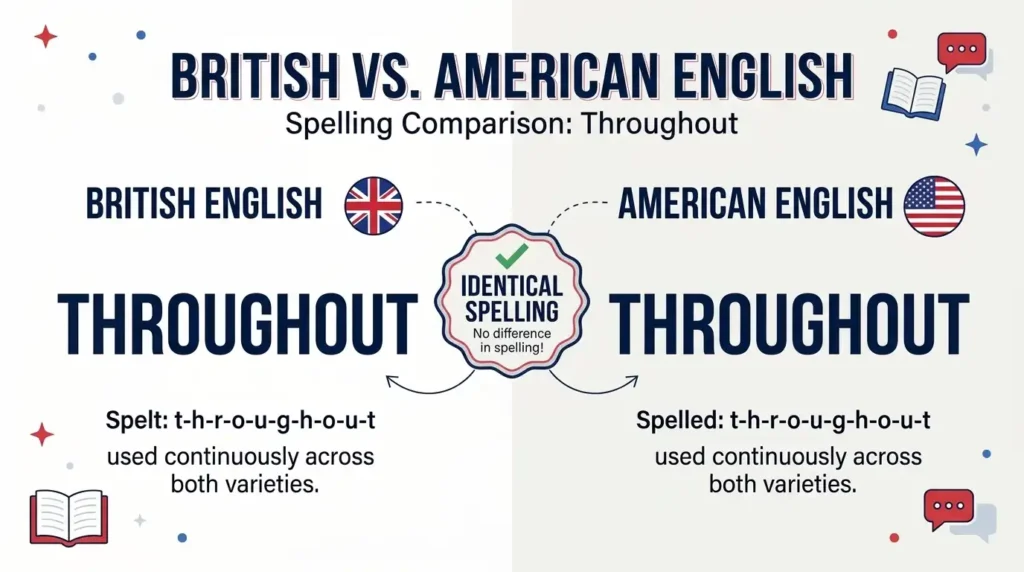
Here is the easy part. British and American English spell this word the same way. Both use “throughout.”
Many words differ between the two. Think of “color” and “colour,” or “center” and “centre.” But “throughout” is not one of them.
There is one small side note. In casual American writing, you may see “thru” for “through.” You may see “thruout” for “throughout.” Both are informal short forms. Do not use them in school, work, or formal writing.
| Form | American English | British English | Verdict |
| throughout | Correct | Correct | Use this |
| through out | Incorrect | Incorrect | Avoid it |
| through-out | Incorrect | Incorrect | Avoid it |
| thruout | Informal only | Informal only | Avoid in formal writing |
Which Spelling Should You Use?
The answer does not change by country. But here is advice for each kind of reader.
US readers. Write “throughout.” Dictionaries, style guides, and teachers all agree.
UK and Commonwealth readers. Write “throughout.” This includes the UK, Australia, India, Pakistan, Nigeria, South Africa, and more. The spelling is the same.
Global readers. Write “throughout.” People who learn English as a second language will know it. Translation tools handle it well.
Quick rule. If you can replace the word with “all over” or “the whole time,” write “throughout.” Put it in one piece. No space. No dash.
Common Mistakes with Through Out and Throughout
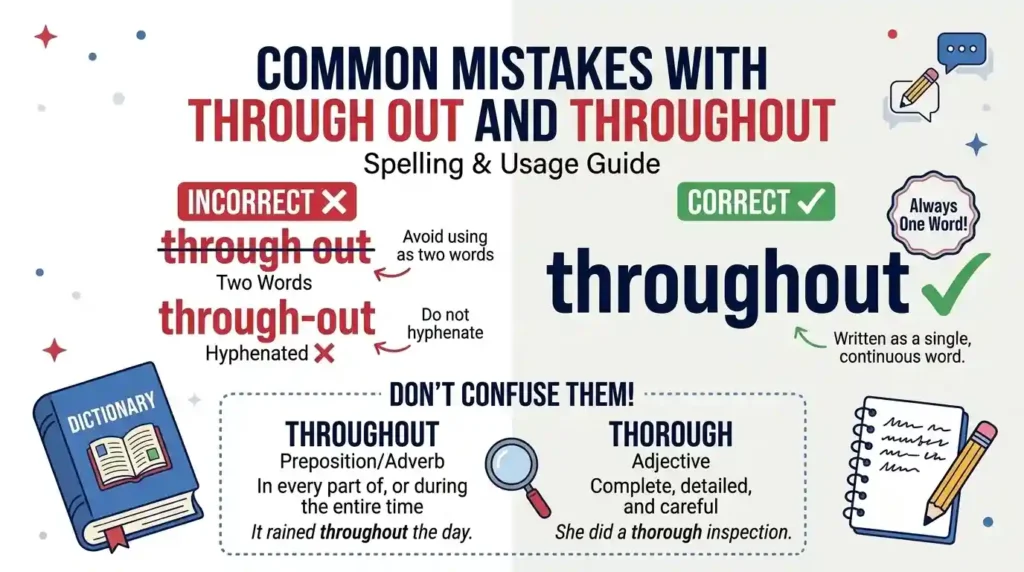
Here are the errors people make most often.
1: Adding a space.
- Wrong: The shop was busy through out the day.
- Right: The shop was busy throughout the day.
2: Adding a dash.
- Wrong: She traveled through-out Europe.
- Right: She traveled throughout Europe.
3: Using the short form in formal writing.
- Wrong: Sales grew thruout the year.
- Right: Sales grew throughout the year.
4: Writing “through-out” because of other words. Some words do take a dash, like “mother-in-law.” “Throughout” does not.
5: Mixing it up with “thorough.” “Thorough” means complete and careful. “Throughout” means in every part. They look alike but mean different things.
- Wrong: He did a throughout job.
- Right: He did a thorough job.
6: Using “throughout” when one place is meant.
- Weak: She searched throughout the drawer.
- Better: She searched through the drawer.
Throughout in Everyday Examples

See how the word looks in real writing.
In emails
- Thank you for your help throughout this project.
- Please keep this file open throughout the call.
In news
- Storms hit towns throughout the region on Monday.
- Prices rose throughout the year.
On social media
- Laughing throughout this whole movie.
- Rain throughout the weekend. Send coffee.
In formal writing
- The policy applies throughout the organization.
- The author uses the same theme throughout the book.
In school essays
- Courage is shown throughout the story.
- The river shapes life throughout the valley.
Notice one thing. In every example, “throughout” is one word. It never needs a space.
Through Out or Throughout Google Trends & Usage Data
A note first. This article does not quote live numbers. Google Trends data changes all the time. You can check it yourself at trends.google.com. Type in “through out” and “throughout” and compare.
Here is what usage patterns usually show.
- “Throughout” is far more common. It appears in books, news, and daily writing all the time. It is a normal everyday word.
- “Through out” is rare in print. It mostly shows up as a typo in quick messages, comments, and drafts.
- People search the question itself. Many searches look like “through out or throughout.” These come from writers who want to check before they publish.
- Interest appears in many countries. Spelling checks are often popular in places where English is a second or shared language, such as India, Pakistan, Nigeria, and the Philippines. They are also common in the US, UK, Canada, and Australia.
- Searches rise with school and work seasons. Students and office workers look up grammar when they write essays, reports, and emails.
The lesson is clear. Careful writers choose “throughout.”
Side-by-Side Comparison of Variations
| Variation | Correct? | Where you see it | Example |
| throughout | Yes | Books, news, email, school | He stayed calm throughout the storm. |
| through out | No | Typos and fast typing | He stayed calm |
| through-out | No | Typos | He stayed calm |
| thruout | Informal | Texts, old ads | Fine in a text. Not in a report. |
| through, out (separate ideas) | Rare yes | Special cases | We read through out-of-date files. |
| thorough | Different word | Careful or complete work | She did a thorough check. |
Frequently Asked Questions
Is it “through out” or “throughout”?
It is “throughout.” Write it as one word. “Through out” is almost always a mistake.
Is “through out” ever correct?
Only in rare cases. That is when “through” and “out” belong to different ideas, as in “We read through out-of-date files.” For normal use, pick “throughout.”
Is “throughout” one word or two?
It is one word. No space. No dash.
What does “throughout” mean?
It can mean “in every part of a place,” as in “Snow fell throughout the region.” It can also mean “from start to end,” as in “He smiled throughout the show.”
Is the spelling different in British and American English?
No. Both use “throughout.” The spelling is the same in the US, UK, Canada, Australia, and other places.
Is “thruout” okay to use?
Only in very casual writing, like a quick text. Avoid it in work, school, and formal writing.
Is “throughout” a preposition or an adverb?
It can be both. As a preposition: “She sang throughout the show.” As an adverb: “The house was painted blue throughout.”
What is the difference between “throughout” and “thorough”?
“Throughout” means in every part or the whole time. “Thorough” means complete and careful. They sound close but are not the same.
Conclusion
The answer to “through out or throughout” is simple. Write throughout. It is one word. It has no space or dash.
- “Throughout” means in every part of something, or during the whole time.
- British and American English spell it the same way.
- “Through out” is a common typo, not a real variant.
- “Thruout” is informal. Keep it out of formal writing.
Here is a trick. If you can say “all over” or “the whole time,” the word is “throughout.” Join the letters. Do not split them.
Before you send an email or hand in an essay, search your draft for “through out.” Fix any you find. It takes ten seconds. It makes your writing look sharp and careful.
Small details build trust. Now you know the right word, and why.

“I’m Ibadat Fatima, a professional content writer and author with 3 years of experience in writing, editing, and storytelling. I share my work through visitlivo.com, where I help readers connect with clear, engaging, and well-crafted content.”