You are typing a sentence. You stop. Is it “the people’s choice” or “the peoples choice”? Or should it be “peoples” with no apostrophe at all?
You are not alone. Many writers search for “people’s or peoples” every day. The two words look almost the same, but they do different jobs. One small mark changes the meaning.
The word “people” is also odd. It already means more than one person. So adding an “s” feels strange. Many writers guess, and many guess wrong. Spell check often fails here, because both forms are real words.
This article clears up the confusion. You will get a quick answer first. Then you will learn where the words came from and how British and American English treat them. You will see common mistakes, real examples, and usage trends. A short FAQ answers the questions people ask most.
By the end, you will know exactly when to write people’s, peoples, or peoples‘. No more guessing. Let’s start.
People’s or Peoples Quick Answer
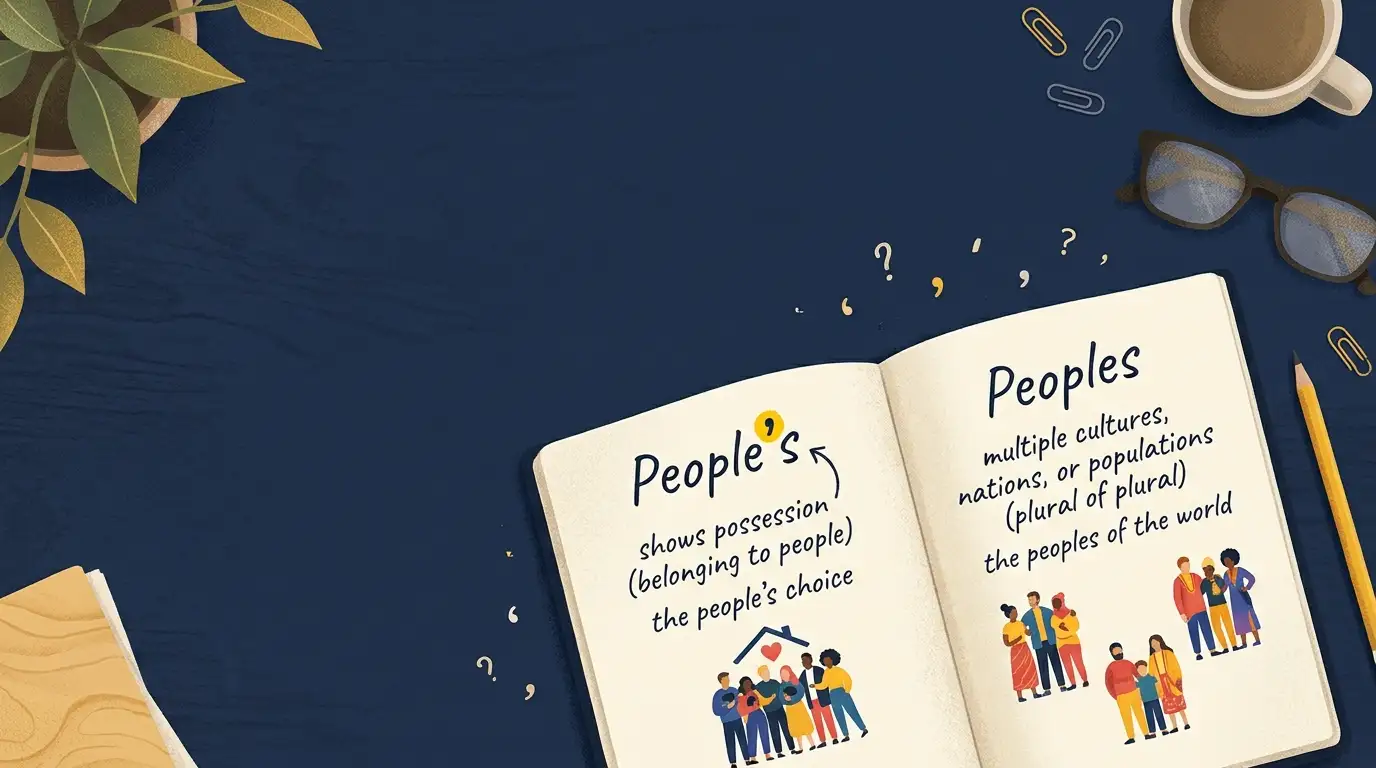
People’s shows ownership. It belongs to the people.
- The people’s voice matters.
- It was the people’s choice.
Peoples refers to multiple communities with distinct cultural, historical, or national identities. It is a plural noun, not a possessive form.
- The peoples of Asia speak many languages.
- Indigenous peoples have rich histories.
Peoples’ shows ownership by more than one group.
- The peoples’ traditions are very old.
Easy trick: Ask, “Do I mean ownership?” If yes, use an apostrophe. If you mean many groups of humans, use peoples with no apostrophe.
The Origin of People’s and Peoples
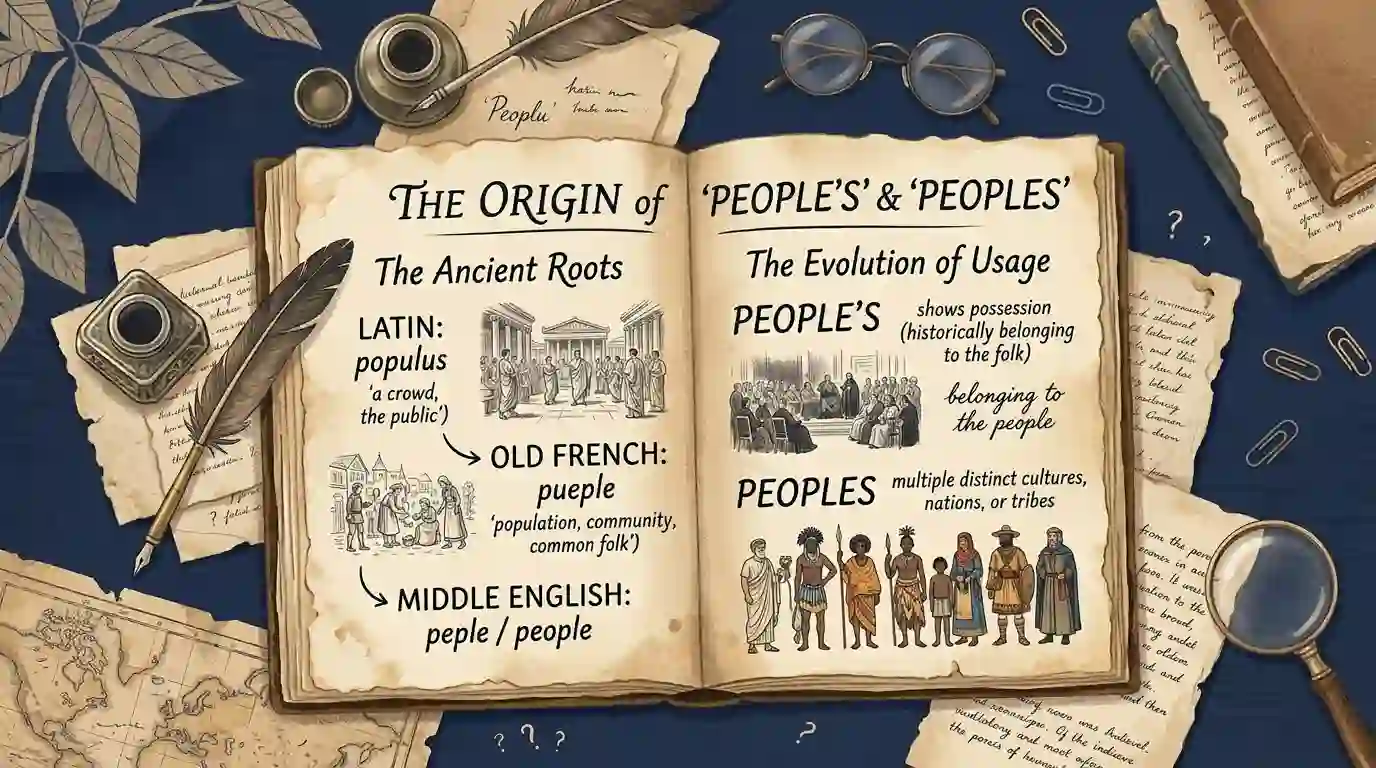
The word “people” comes from the Latin word populus. It meant a community or a nation. Old French turned it into peple. English borrowed it in the 1200s.
Over time, the spelling changed. English added the “o” to match the French peuple. That is why “people” looks so odd. It has an “eo” that does not match how we say it.
So why is there a “peoples”? Because “people” can mean two things:
- Persons in general. This use is already plural. “The people are here.”
- A single nation or group. This use is singular.The phrase “a people” can refer to a community with a shared cultural, historical, or national identity.
If “a people” can be one group, then many groups are “peoples.” That is the whole reason this plural exists.
The apostrophe came later. English writers began using it to show ownership. That gave us people’s and peoples’.
British English vs American English Spelling
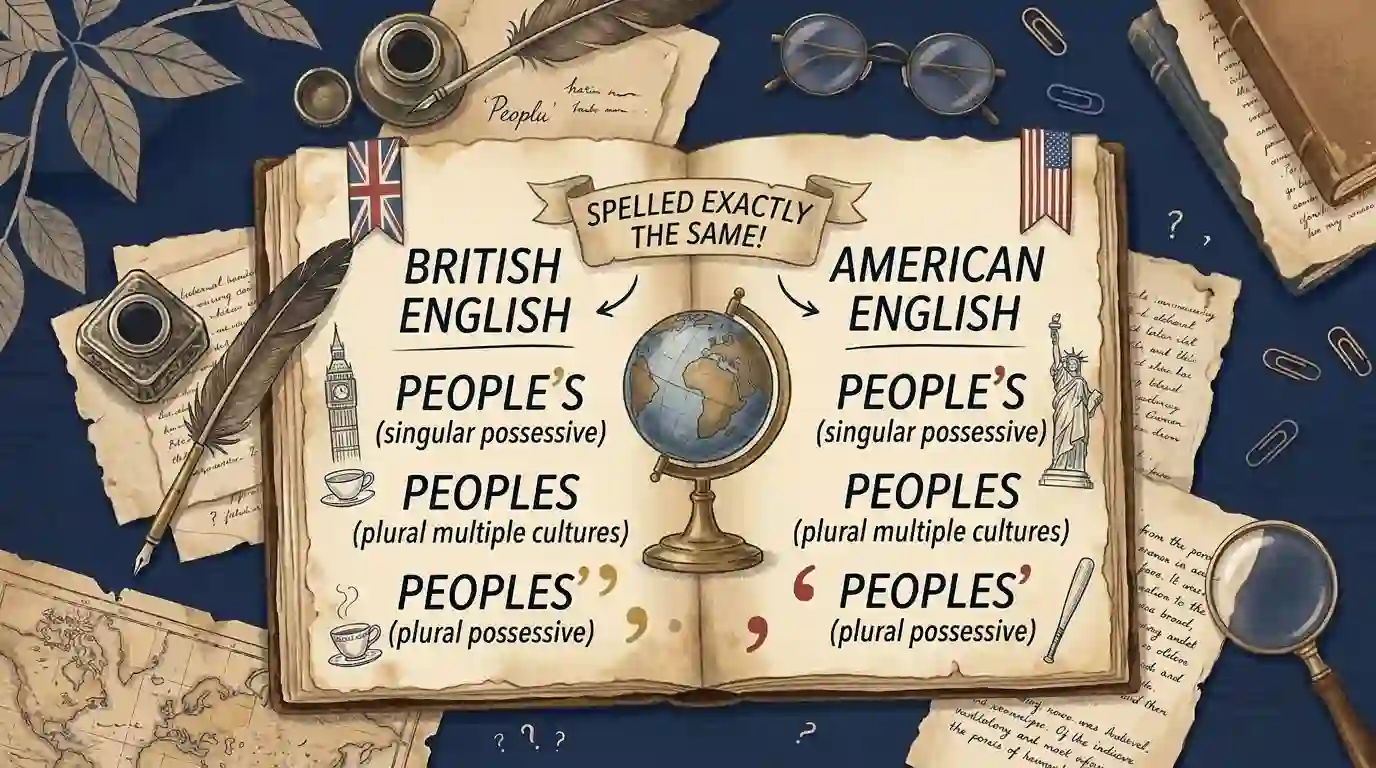
Here is the good news. British and American English spell these words the same way. There is no US or UK split for people’s, peoples, or peoples’.
The rules for apostrophes are also the same in both. Differences appear in other words, like colour and color. This table shows both.
| Word | British English | American English | Meaning |
| people | people | people | Persons in general |
| people’s | people’s | people’s | Belongs to the people |
| peoples | peoples | peoples | Many nations or groups |
| peoples’ | peoples’ | peoples’ | Belongs to many groups |
| Other words for contrast | colour, favourite | color, favorite | Real US/UK differences |
One small note: in the UK, collective nouns can take a plural verb (“the team are winning”). In the US, they usually take a singular verb. But “people” is always plural in both. You say “people are,” never “people is.”
Which Spelling Should You Use?
For US readers: Use people’s for ownership. Use peoples when referring to distinct cultural, ethnic, or national communities.
The rules are the same as in the UK.
For UK and Commonwealth readers: Use the same rules. Some Canadian and Australian writers capitalize Peoples in formal text, such as “Indigenous Peoples.” Follow your local style guide.
For a global audience: Keep it simple. Use people’s most of the time. Use peoples only when you mean different nations or groups. Many readers find peoples formal or academic.
For business writing: Prefer people’s (“our people’s needs”) or just rewrite. “Our team’s needs” is often clearer.
For names: Copy the official spelling. “People’s Republic of China” and “People’s Choice Awards” use the apostrophe.
Common Mistakes with People’s or Peoples
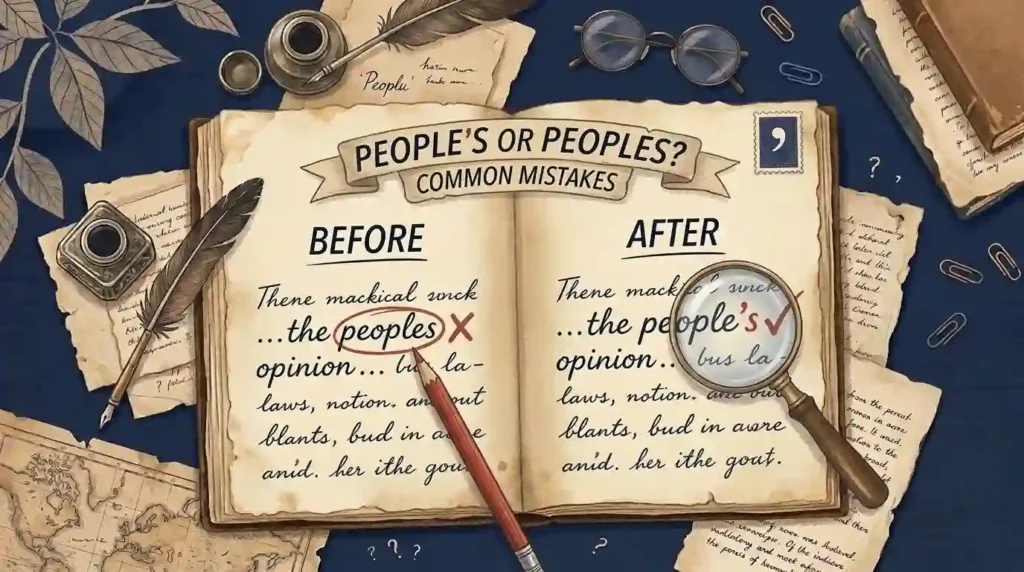
1: Adding an “s” for a normal plural.
- Wrong: “Many peoples came to the party.”
- Right: “Many people came to the party.”
2: Forgetting the apostrophe for ownership.
- Wrong: “The peoples choice won.”
- Right: “The people’s choice won.”
3: Putting the apostrophe after the “s” on “people.”
- Wrong: “The peoples’ choice won.”
- Right: “The people’s choice won.”
4: Writing “people’s” as a simple plural.
- Wrong: “Many people’s attended.”
- Right: “Many people attended.”
5: Using “peoples” when you mean persons.
- Wrong: “Peoples love pizza.”
- Right: “People love pizza.”
Quick fix: If you can swap in “persons” and the sentence still works, use people with no “s.”
People’s or Peoples in Everyday Examples
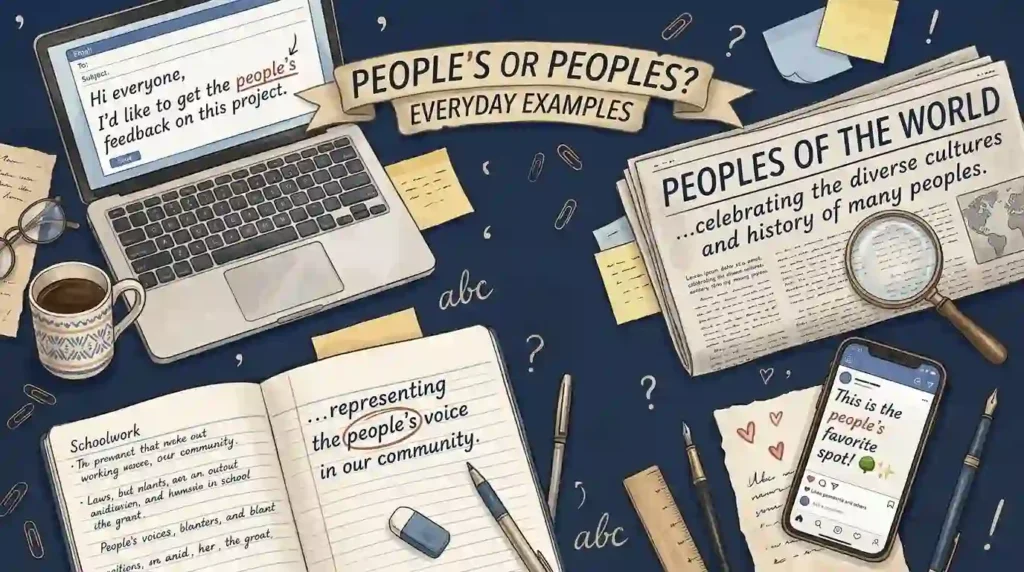
Email:
- “Thank you for your help. It made a real difference to our people’s day.”
- “Please share the people’s feedback with the team.”
News:
- “The leader promised to protect the people’s rights.”
- “The report studies the peoples of the Amazon region.”
Social media:
- “The people’s champion did it again! 🏆”
- “Learning about the peoples of the Pacific has been amazing.”
Formal writing:
- “The treaty respects the rights of Indigenous peoples.”
- “The constitution protects the people’s freedoms.”
School essay:
- “The peoples’ customs were passed down for centuries.”
People’s or Peoples Google Trends & Usage Data
I cannot pull live numbers here, so check Google Trends yourself for current figures. These are the usual patterns:
- People’s is far more common than peoples. Everyday writing needs ownership more than it needs plural nations.
- Peoples shows up most in school, history, law, and politics. Think “Indigenous peoples” or “peoples of the world.”
- Search spikes often happen around elections, awards shows, and school terms. People look up “people’s choice” and “people’s vote.”
- By country: English-speaking countries like the US, UK, Canada, Australia, and India all search this phrase. Spelling rules are the same in each, so the confusion is the same too.
- By context: Grammar questions come from students and writers. Political uses come from news readers.
Tip: In Google Trends, compare “people’s,” “peoples,” and “peoples'” side by side. Switch the region filter to see each country.
Comparison Table: Keyword Variations Side by Side
| Form | Type | Meaning | Example |
| people | Plural noun | Many persons | The people are happy. |
| people’s | Possessive | Belongs to the people | The people’s vote counts. |
| peoples | Plural noun | Many nations or groups | The peoples of Africa are diverse. |
| peoples’ | Possessive plural | Belongs to many groups | The peoples’ languages differ. |
| person’s | Possessive singular | Belongs to one person | A person’s name matters. |
FAQs
Is it people’s or peoples?
Use people’s for ownership. Use peoples for many nations or ethnic groups.
Is “peoples” a real word?
Yes. It refers to multiple peoples, meaning distinct cultural, ethnic, or national communities, each with its own identity and traditions.
Where does the apostrophe go with “people”?
Before the “s.” Write people’s, because “people” is already plural.
When do I use peoples’?
Use it when many groups own something. Example: “the peoples’ traditions.”
Is the spelling different in the UK and US?
No. Both use the same spelling and the same apostrophe rules.
Is “peoples” correct for “more than one person”?
No. Use people. “Peoples” means groups or nations.
Should I capitalize “Peoples”?
Only in names or in formal styles that require it, such as “Indigenous Peoples” in some guides. Check your style guide.
Conclusion
The rule is simple. Use people’s to show that something belongs to people. Use peoples for multiple cultural, ethnic, or national communities, and peoples’ to show that something belongs to those communities. If you just mean many persons, write people, with no “s” and no apostrophe.
British and American English follow the same rules, so you only need to learn them once.
Quick check: Swap in “of the people.” If the sentence still works, use people’s.
Now you can write with confidence in emails, essays, news, and posts.

I’m Raheela Rani, a professional content writer and author with 3 years of experience in writing, editing, and storytelling. Through VisitLivo.com, I create clear, engaging, and well-crafted content that helps readers learn, connect, and communicate with confidence.