Have you ever stopped mid-sentence and wondered: “himself or hisself”? You are not alone. Many people search for this answer every day.
Lots of people hear “hisself” in songs, movies, and daily talk. It sounds right. After all, we say “myself” and “yourself.” So “hisself” seems to fit the pattern. Then you see a red line under it in your email. Now you are not sure.
This article gives you the answer fast. Then it explains the history, the spelling rules, and the common mistakes. You will see real examples from emails, news, and social media. You will also learn which word to use for school, work, and online writing.
The short version: one of these words is standard English. The other is not. By the end of this guide, you will know which is which, why people mix them up, and how to write with confidence every time.
Himself or Hisself Quick Answer
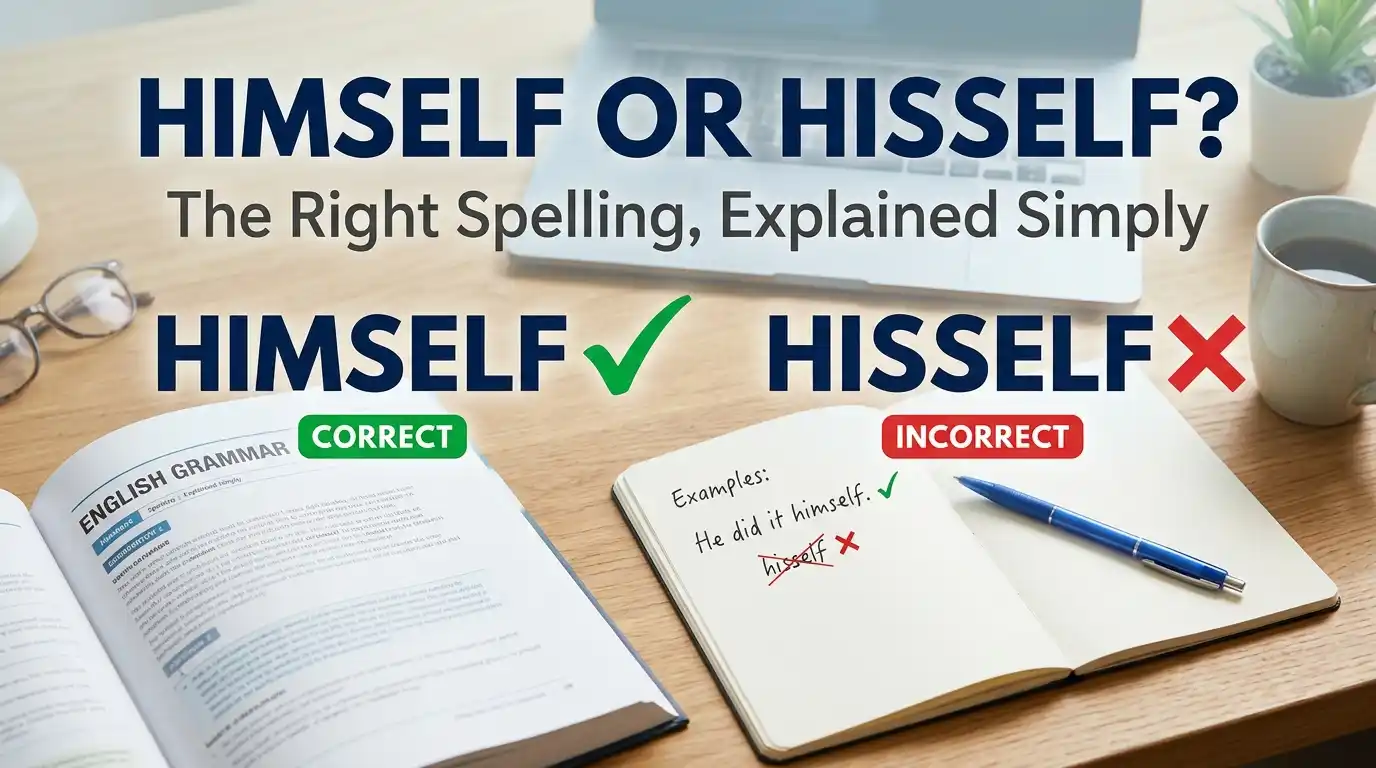
Use “himself.” It is the correct word in standard English. It is correct in the US, the UK, Canada, Australia, and everywhere else.
“Hisself” is nonstandard. You may hear it in some spoken dialects. Dictionaries mark it as dialect or informal. Teachers, editors, and spell checkers will mark it as wrong.
Examples:
- ✅ He taught himself to play guitar.
- ❌ He taught hisself to play guitar.
- ✅ Tom hurt himself at the gym.
- ❌ Tom hurt hisself at the gym.
The Origin of Himself and Hisself
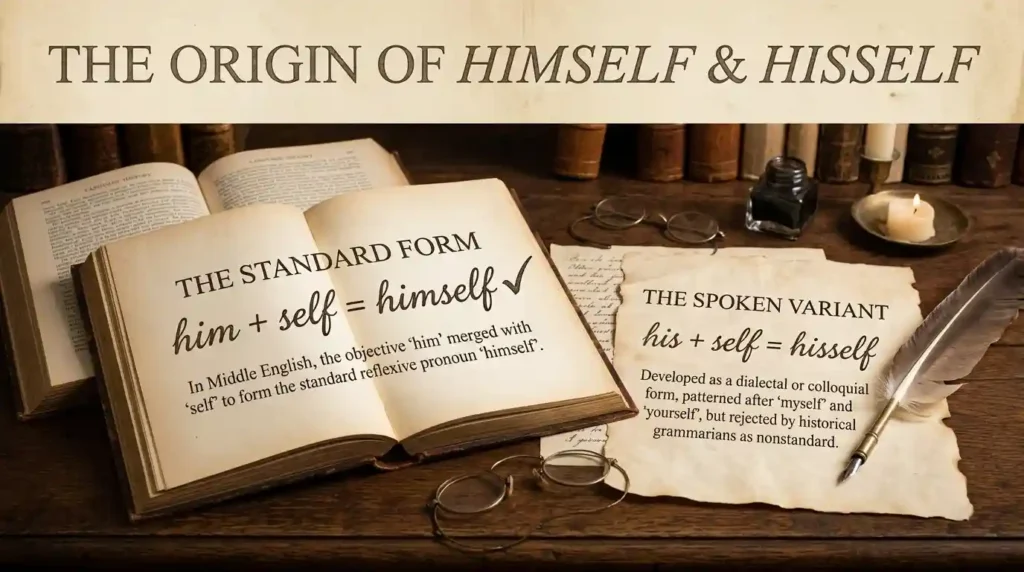
“Himself” is very old. It comes from Old English. Long ago, people said “him selfum,” which means “to him, self.” Over time, the two parts joined into one word: him + self = himself.
Here is the key point. The first part is “him.” That is the object form of “he.” It is not “his.”
So why does “hisself” exist? Look at the other reflexive words:
- my + self = myself
- your + self = yourself
- our + selves = ourselves
- him + self = himself
- her + self = herself
- them + selves = themselves
The first three use “my,” “your,” and “our.” These are possessive words. The others use “him,” “her,” and “them.” These are object words. The pattern is mixed.
Many people try to fix the mix. They think, “My, your, our… so his!” That gives “hisself.” The same idea gives “theirselves.” This form has been around for hundreds of years in spoken English. It never became standard in writing.
Spelling differences exist because spoken English changes faster than written English. Writers and dictionary makers locked in “himself.” Speakers in some regions kept using “hisself.”
British English vs American English Spelling
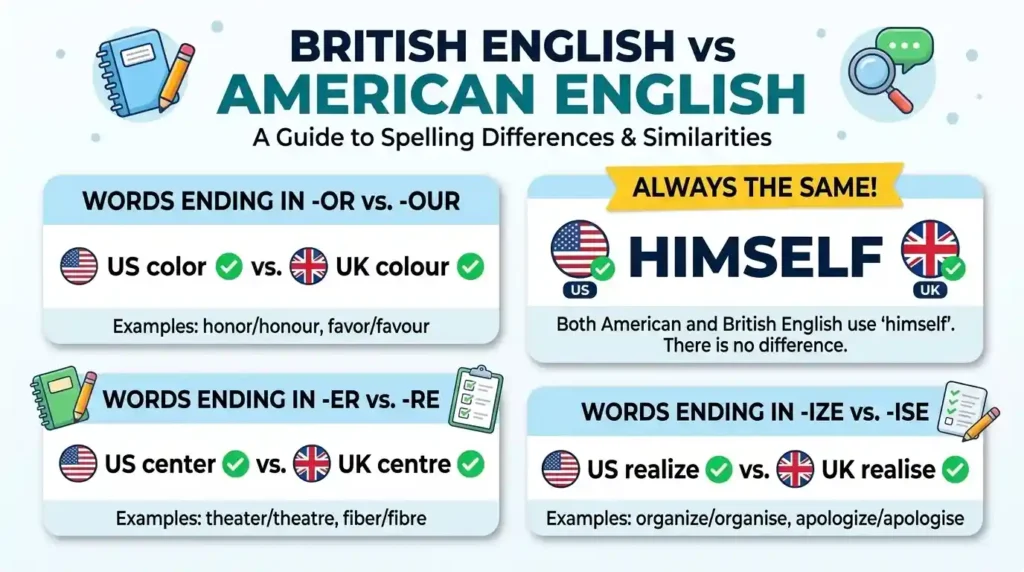
Here is good news. There is no British or American difference for this word. Both sides spell it “himself.” Both sides call “hisself” nonstandard.
The two spellings of English differ in other words. This table shows the difference, and shows that “himself” is not one of them.
| Word | American English | British English |
| Reflexive (he) | himself | himself |
| Nonstandard form | hisself | hisself |
| Color | color | colour |
| Realize | realize | realise |
| Center | center | centre |
| Traveling | traveling | travelling |
Rule to remember: spelling rules for “himself” do not change between countries. Only dialect and speech change.
Which Spelling Should You Use?
The answer is the same for every reader: himself.
- US audience: Use “himself.” Style guides like AP and Chicago agree.
- UK and Commonwealth audience: Use “himself.” Oxford and Cambridge dictionaries agree.
- Global audience: Use “himself.” It is the one form every English learner is taught.
When could “hisself” be okay? Only in fiction. A writer may use it in dialogue to show how a character speaks. Even then, use it with care. It should fit the character and the setting.
For all other writing, such as school, work, blogs, and emails, stick to “himself.”
Common Mistakes with Himself and Hisself
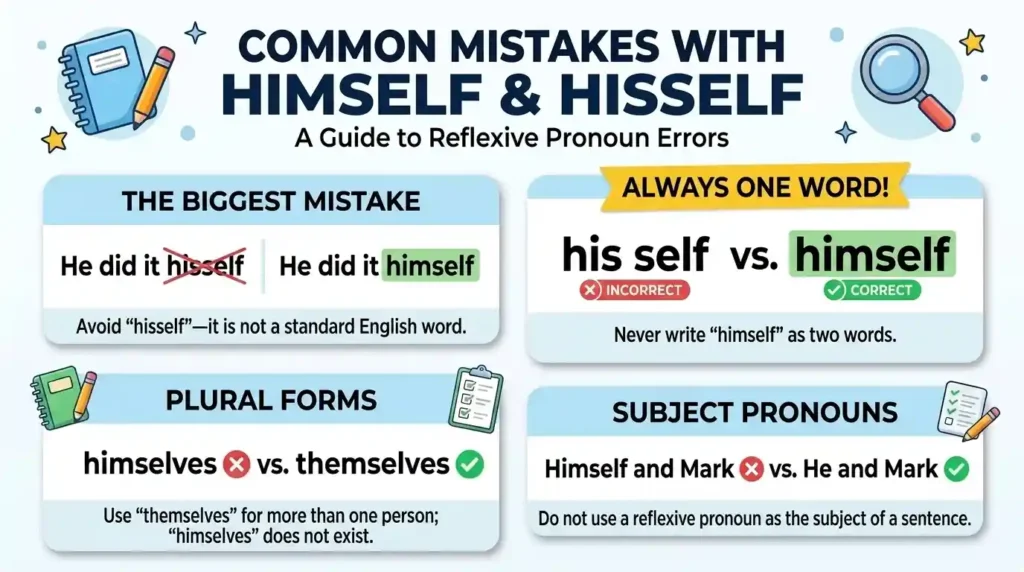
Writing “hisself.”
❌ He did it hisself.
✅ He did it himself.
Writing “his self” as two words.
❌ He looked at his self in the mirror.
✅ He looked at himself in the mirror.
(Use “his self” only when “self” is a noun: “He lost his sense of self.”)
Using “himself” as a plain subject.
❌ Himself and Mark went to the store.
✅ He and Mark went to the store.
Using “himself” to sound fancy.
❌ Please send the form to John or himself.
✅ Please send the form to John or him.
Writing “himselves.”
❌ The boys hurt himselves.
✅ The boys hurt themselves.
Himself in Everyday Examples

Email:
“Mr. Lee will finish the report himself. He asked me to tell you.”
News:
“The mayor himself spoke to the crowd after the storm.”
Social media:
“My dad fixed the car himself. Proud of him! 🔧”
Formal writing:
“The author describes himself as a quiet observer of city life.”
Spoken dialect (what you may hear):
“He built that shed hisself.”
This is common in speech in some places. But when you write it down, change it to “himself.”
Himself or Hisself Google Trends & Usage Data
Exact numbers change all the time, so check Google Trends for the latest picture. Here is what language data usually shows:
- “Himself” is far more common. In books, news, and websites, it appears many, many times more often than “hisself.”
- “Hisself” shows up mostly in speech and casual posts. It is found in lyrics, social media, and written dialogue.
- Interest comes from learners and writers. Many searches come from English learners and people checking spelling.
- Searches come from many countries. Readers in the US, UK, India, Pakistan, Nigeria, the Philippines, and Canada all look this up.
- Context matters. Search interest often rises during school terms and when a song or show uses “hisself.”
Tip: Open Google Trends and type “himself” and “hisself” side by side. Set the region and the date range. You can see the difference for yourself.
Comparison Table: Keyword Variations
| Form | Standard? | Use it? | Example / Note |
| himself | ✅ Yes | Always | He did it himself. |
| hisself | ❌ No | Only in dialogue | Dialect form |
| his self | ⚠️ Rarely | Only when “self” is a noun | His self-image is strong. |
| himselves | ❌ No | Never | Use “themselves” |
| theirselves | ❌ No | Never | Use “themselves” |
| themself | ⚠️ Sometimes | For one person, singular “they” | Each person did it themself. |
FAQs
Is “hisself” a real word?
Yes, people say it. But it is nonstandard. It is not accepted in formal English.
Is “himself” correct in British English?
Yes. British and American English both use “himself.”
Why do people say “hisself”?
They follow the pattern of “myself” and “yourself.” It feels natural, so they use “his.”
Can I use “hisself” in my essay?
No. Use “himself.” Teachers will count “hisself” as an error.
Is “himself” a pronoun?
Yes. It is a reflexive pronoun. It points back to the subject: “He saw himself.”
When should I use “himself” and when “he”?
Use “he” as the subject. Use “himself” when the same person does and receives the action. Also use it for emphasis: “He did it himself.”
What is the plural of “himself”?
It is “themselves.” Do not write “himselves.”
Is “hisself” ever okay?
Only in fiction, when a character speaks in a dialect. Even then, use it with care.
Conclusion
Here are the key points to take with you.
“Himself” is the correct word. It works in the US, the UK, and everywhere English is used. “Hisself” is a dialect form. You may hear it, but you should not write it in school, work, or any formal place.
“Himself” comes from “him” plus “self.” That is why it is not “hisself.” Many people use “his” because “my” and “your” seem to set the pattern. It is an easy mistake. Now you know why it happens.
Watch for other errors too. Do not write “himselves” or “his self” when you mean “himself.” Do not use “himself” as a subject. Say “he” instead.
Want a quick rule? If one man does something to or for himself, write “himself.” That’s it.
Use “hisself” only when you write dialogue for a character. In all other cases, pick “himself” and move on with confidence. Save this guide and share it with a friend who still wonders about the difference.

“I’m Ibadat Fatima, a professional content writer and author with 3 years of experience in writing, editing, and storytelling. I share my work through visitlivo.com, where I help readers connect with clear, engaging, and well-crafted content.”