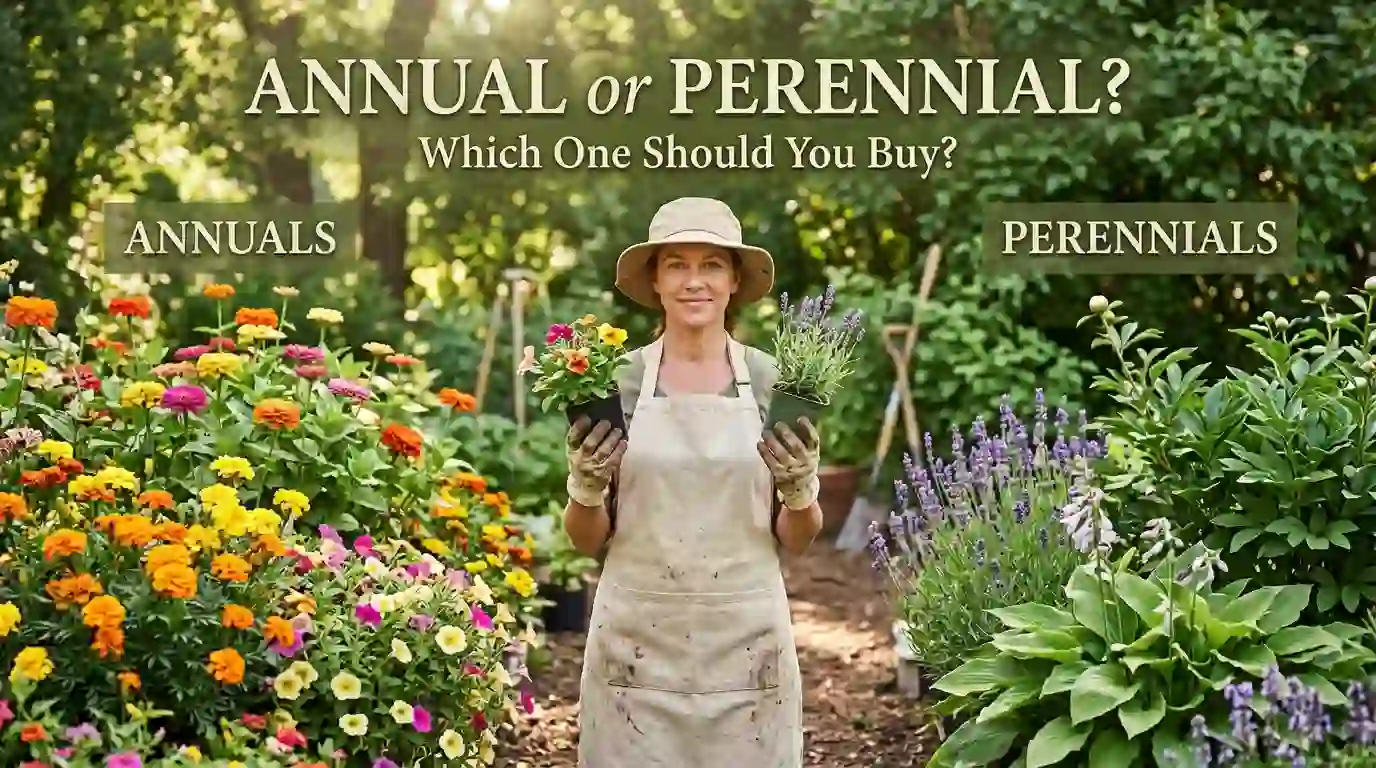
You are in a garden shop. You pick up a pot of bright flowers. The tag says “annual.” The plant next to it says “perennial.” Which one should you buy? Will it come back next year, or will it die?
That is why so many people search “annual or perennial.” They want to know what the two words mean. They want a fast way to tell them apart. Some also wonder if the words are spelled differently in the US and UK. (Good news: they are not.)
The confusion is easy to understand. Both words sound alike. Both show up on plant tags, seed packets, and garden blogs. Some plants even switch roles depending on where you live.
This guide clears it up. You get a quick answer first. Then you learn where the words come from, which mistakes to avoid, and how to choose the right plants for your yard. Everything is written in plain, simple words. Let’s dig in.
Annual or Perennial Quick Answer
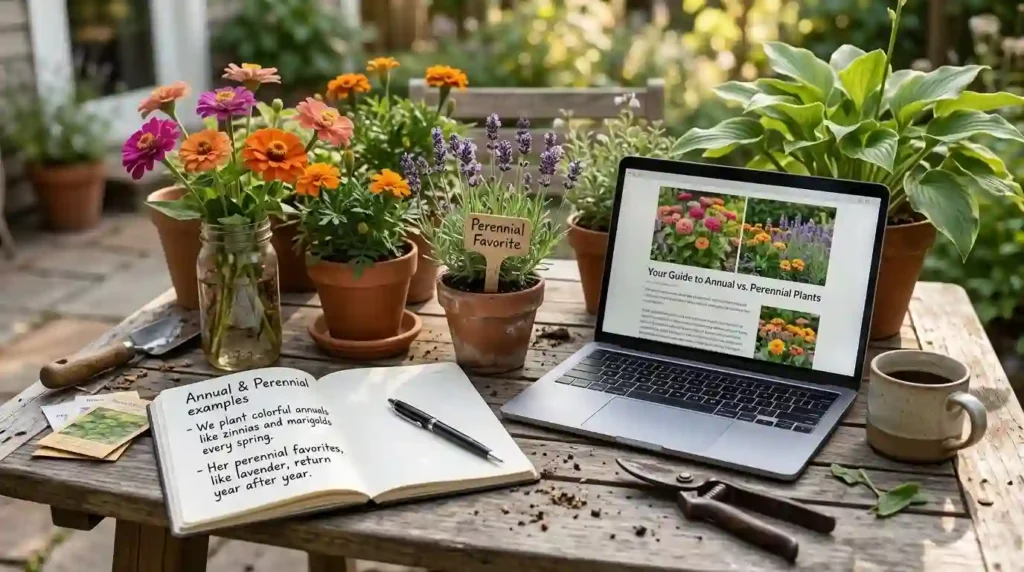
An annual plant lives for one year. It grows, blooms, makes seeds, and dies in a single season. You plant it again next spring.
A perennial plant lives for many years. It may die back in winter, but the roots stay alive. It grows again each spring.
Examples:
- Annuals: marigolds, zinnias, petunias, sunflowers, basil
- Perennials: lavender, peonies, hostas, daylilies, mint
A simple memory trick: annual = once a year. Perennial = year after year.
The Origin of Annual and Perennial

Both words come from the Latin word annus, which means “year.”
- Annual comes from the Latin annualis, meaning “yearly.”
- Perennial comes from the Latin perennis. It joins per (“through”) with annus (“year”). So it means “lasting through the years.”
The words came into English through Old French and Latin. That is why both have a double “n.” The double “n” comes straight from annus.
Do spelling differences exist? Not between countries. British and American writers spell both words the same way. The only “differences” you see are typing mistakes, like perrenial or anual.
British English vs American English Spelling
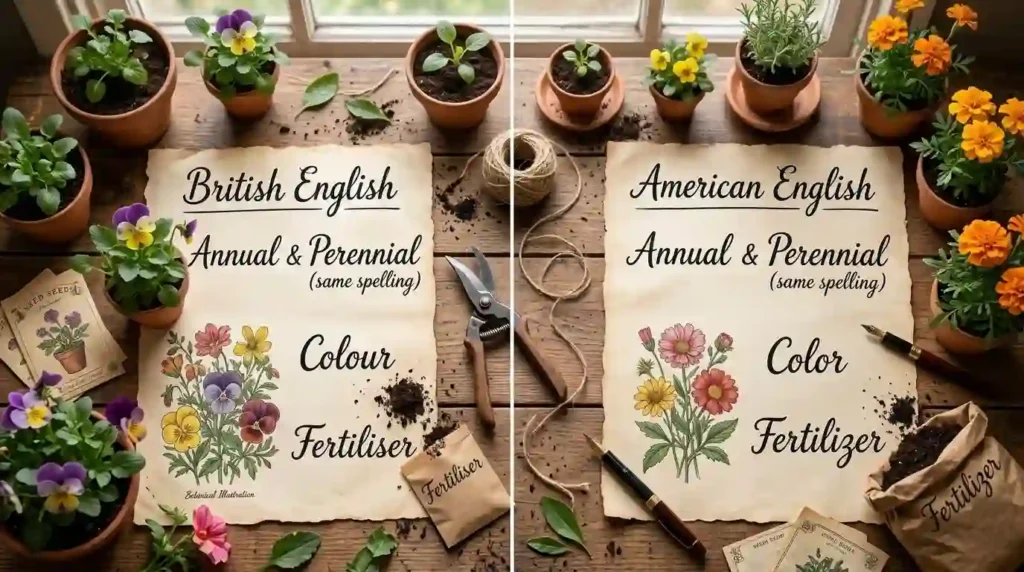
Here is the simple truth: “annual” and “perennial” are spelled the same in British and American English. No change. No special rule.
The differences show up in the words around them. Gardeners often meet these pairs:
| Word | American English | British English |
| Yearly plant | annual | annual |
| Many-year plant | perennial | perennial |
| Two-year plant | biennial | biennial |
| Plant color | color | colour |
| Plant food | fertilizer | fertiliser |
| Plant name | cilantro | coriander |
| Green veggie | zucchini | courgette |
| Cold-tolerance term | cool-season annual | hardy annual |
One small difference in usage: UK gardeners often say “hardy annual” and “half-hardy annual.” US gardeners more often say “cool-season” and “warm-season” annuals, or talk about hardiness zones.
Which Spelling Should You Use?
Use the same spelling everywhere: annual and perennial.
- US readers: Use annual and perennial. Spell color, fertilizer, and cilantro the American way.
- UK and Commonwealth readers: Use annual and perennial. Spell colour, fertiliser, and coriander the British way. “Hardy annual” is a common phrase here.
- Global readers: Stick with annual and perennial. Add a short explanation, like “lives one year” or “lives many years.” Clear words travel well.
Common Mistakes with Annual or Perennial
1. Misspelling “perennial.”
Wrong: perrenial, perenial, perennal.
Right: perennial (one “r,” then “ennial”).
2. Thinking perennial means evergreen.
Many perennials lose their leaves in winter. They are not evergreen. The roots survive and the plant returns.
3. Thinking annuals always die in one year.
Some plants, like tomatoes, live for years in warm places. In cold places, frost kills them. So gardeners treat them as annuals.
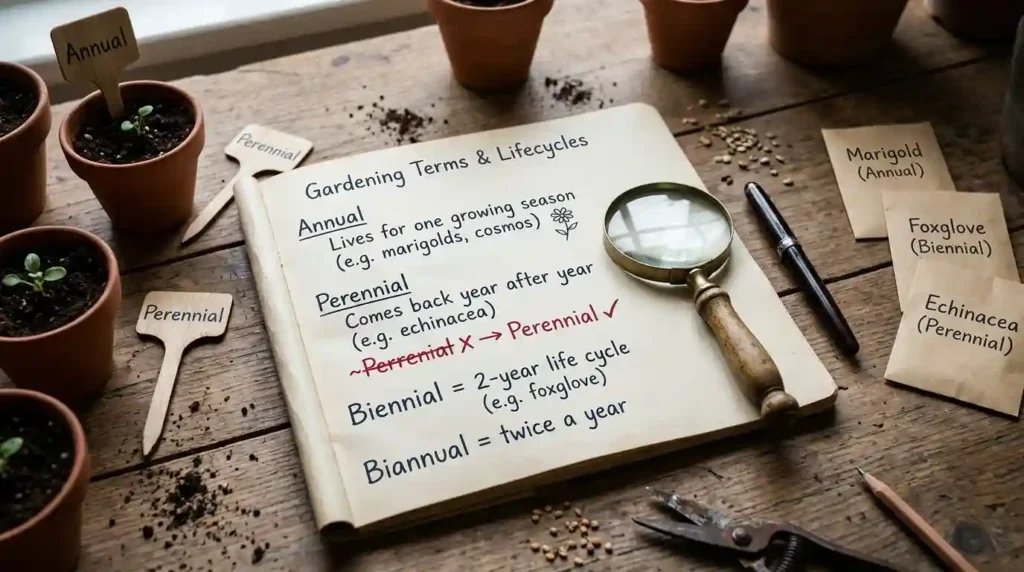
4. Mixing up biennial and biannual.
Biennial means every two years, or a plant that lives two years. Biannual means twice a year.
5. Forgetting that some annuals come back.
Self-seeding annuals, like cosmos, drop seeds. New plants pop up next year. It looks like a perennial, but it is not.
Annual or Perennial in Everyday Examples
Email (garden club):
“Please bring one perennial to our plant swap on Saturday.”
News:
“Gardeners are choosing perennials this year to save money and water.”
Social media:
“Added zinnias this spring. Love annuals for fast color! 🌼”
Formal writing:
“The report compares the cost of annual and perennial crops over ten years.”
Figurative use:
“Traffic is a perennial problem in the city.” Here, perennial means “always coming back.” No plants involved.
Business use:
“The annual report is due in March.” Here, annual means “once a year.”
Annual or Perennial Google Trends & Usage Data
Exact numbers change often, so check Google Trends for the latest data. Here is what the pattern usually looks like:
- Seasonal peaks: Interest rises in spring, when people plan and plant. In the Northern Hemisphere, that means March to May. In the Southern Hemisphere (Australia, New Zealand, South Africa), the peak comes in September to November.
- Top regions: English-speaking countries such as the US, UK, Canada, and Australia show strong interest, along with other gardening-friendly places.
- Context: Most searches are about gardening. A smaller group looks for the figurative meaning of “perennial,” or the difference between “annual” and “biennial.”
- Related searches: People often add words like “flowers,” “vegetables,” “herbs,” or “list.”
Annual or Perennial Comparison Table
| Term | Meaning | Lifespan | Example |
| Annual | Completes its life in one season | 1 year | Marigold |
| Perennial | Returns every year | 3+ years | Lavender |
| Biennial | Grows leaves in year one, blooms in year two | 2 years | Foxglove |
| Hardy annual | Annual that handles cold | 1 year | Sweet pea |
| Tender perennial | Perennial that dies in frost | Many years (warm areas) | Geranium |
| Self-seeding annual | Annual that drops seeds and regrows | Seeds return yearly | Cosmos |
FAQs
What is the main difference between annual and perennial?
Annuals live for one season. Perennials live for many years.
Which is better, annual or perennial?
Neither is always better. Annuals give lots of color all season. Perennials save money and effort over time. Many gardens use both.
Do perennials bloom all year?
No. Most perennials bloom for a few weeks each year. Pick several types to get color in every season.
Is it “perennial” or “perrenial”?
The right spelling is perennial.
Is the spelling different in British and American English?
No. Both use “annual” and “perennial.”
Can an annual become a perennial?
Yes, in some climates. Some plants live for years in warm weather but die in frost. Gardeners in cold places grow them as annuals.
What does “perennial” mean outside gardening?
It means “happening again and again.” For example, “a perennial favorite.”
Are herbs annual or perennial?
Both. Basil and cilantro are annuals. Mint, thyme, and sage are perennials.
Conclusion
So, annual or perennial? Here is the short version. An annual lives for one year and needs replanting. A perennial lives for many years and returns each spring.
Both words come from the Latin word for “year.” Both are spelled the same in British and American English. That means you never need to worry about a spelling difference. Just watch the double “n” in each word, and the single “r” in “perennial.”
Avoid common mistakes. Perennial does not mean evergreen. Biennial does not mean biannual. And a plant’s life can change with your climate.
For your garden, think about your goals. Want fast, bright color? Choose annuals. Want less work and lower cost over time? Choose perennials. Want the best of both? Mix them.
In writing, keep it simple. Use “annual” and “perennial” in every country. Add a short explanation if your readers are new to gardening. Clear words always win.

I’m Raheela Rani, a professional content writer and author with 3 years of experience in writing, editing, and storytelling. Through VisitLivo.com, I create clear, engaging, and well-crafted content that helps readers learn, connect, and communicate with confidence.