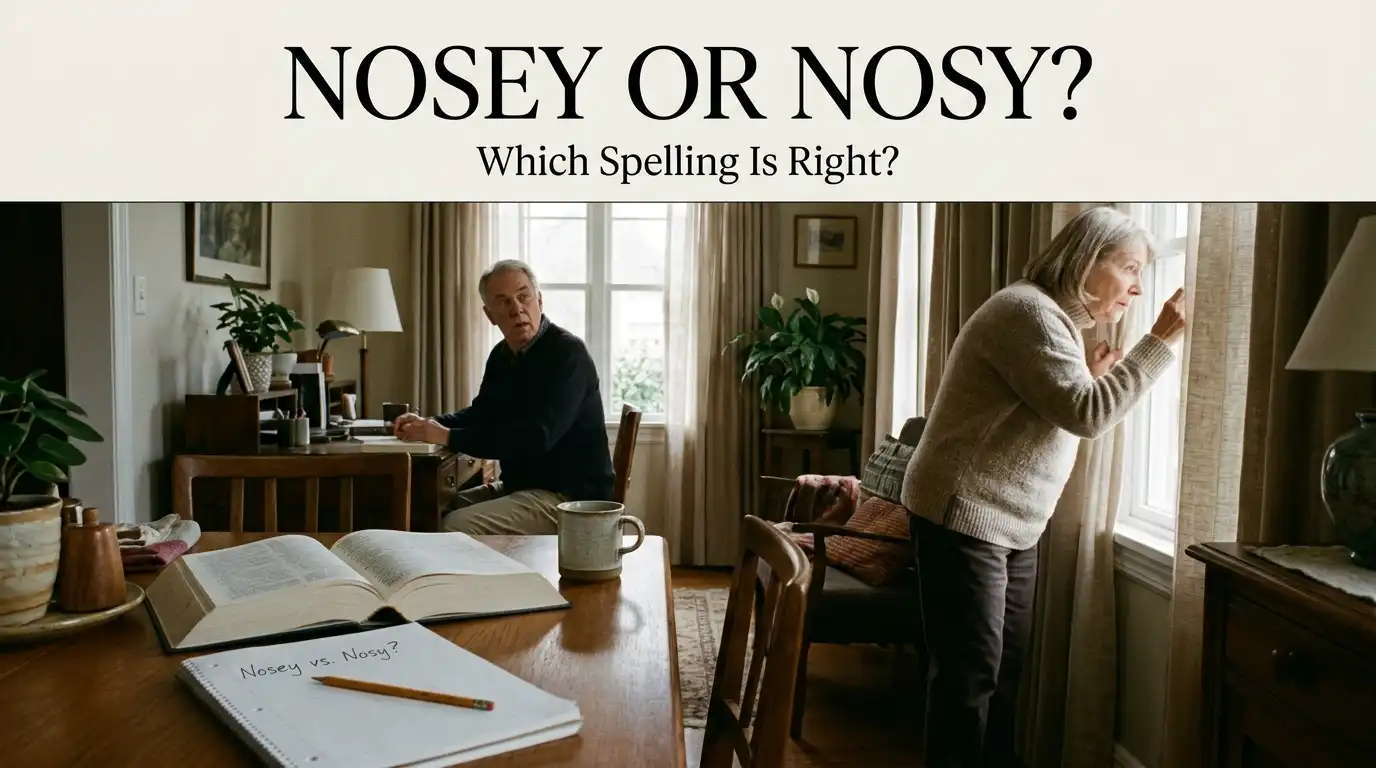
Your neighbor peeks through the curtains. Your coworker asks about your salary. You want to call them out, but you freeze. Is the word “nosey” or “nosy”?
You are not alone. Thousands of people search for the nosey or nosy meaning every month. The word looks simple, but the two spellings make people pause. One looks like it has a missing letter. The other looks like it has an extra one. Spellcheck sometimes accepts both, which makes things worse.
This article clears it up fast. You will get the quick answer first. Then you will learn where the word came from and why two spellings exist. You will see how British and American writers use it. You will also get tips for emails, school work, and social media.
By the end, you will know what the word means, which spelling to pick, and how to avoid common mistakes. Let’s start with the short answer.
Nosey or Nosy Meaning Quick Answer
Nosy and nosey mean the same thing. Both describe a person who asks too many questions or pokes into other people’s business.
- Nosy is the main spelling. Most dictionaries list it first.
- Nosey is an accepted variant. It is not wrong, but it is less common in formal writing.
Examples:
- “My nosy neighbor watches everyone who walks by.”
- “Don’t be so nosey. It’s a private matter.”
- “She felt nosy for reading his messages.”
If you want the safe choice, use nosy.
The Origin of Nosy and Nosey

The word comes from the noun nose. Add the ending -y, and you get a word that means “full of nose” or “having to do with the nose.”
Early on, the word could mean having a big nose. Later, in the 1800s, it took on the meaning we use today: someone who “sniffs around” in other people’s affairs. Think of a dog with its nose in everything. The picture makes sense.
Why two spellings?
English has a habit with words that end in a silent e. Sometimes we drop the e before adding -y:
- nose → nosy
- rose → rosy
- bone → bony
Sometimes we keep it:
- horse → horsey
- home → homey
- price → pricey
Nosy followed the first pattern. Nosey followed the second. Both took hold, and neither disappeared.
A related British phrase is “Nosey Parker.” It means a very nosy person. Writers often spell it with the e. Experts are not sure who the first “Parker” was.
British English vs American English Spelling
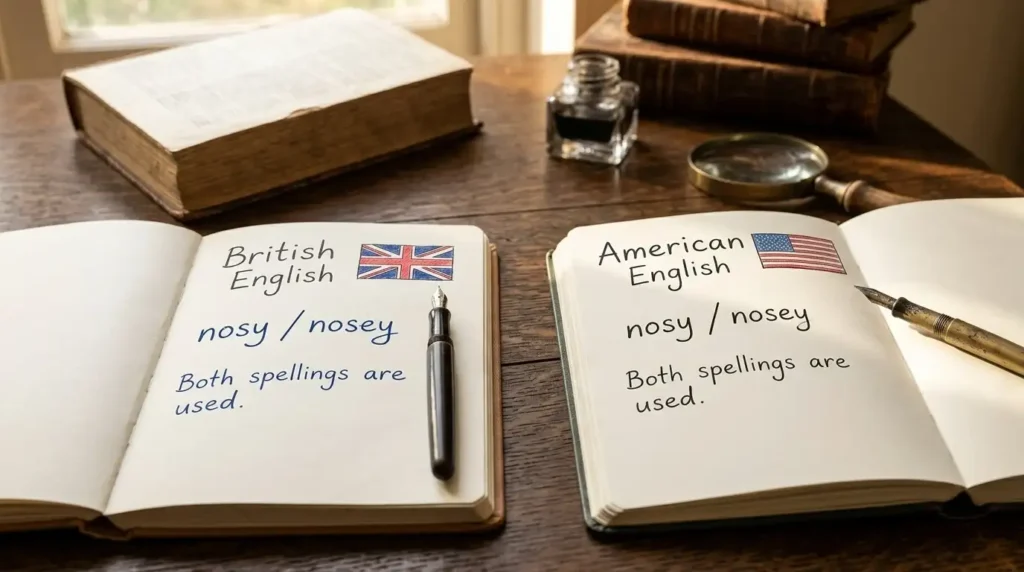
Here is a surprise. This is not a clean US-versus-UK split like color and colour. Both countries use both spellings. The difference is in how often.
| Feature | American English | British English |
| Main spelling | nosy | nosy |
| Accepted variant | nosey | nosey |
| Common in formal writing | nosy | nosy |
| Common in the phrase “Nosey Parker” | rare phrase | nosey is often used |
| Dictionary note | nosy listed first | nosy listed first, nosey as “also” |
What this means: Both dictionaries prefer nosy. The nosey spelling shows up more in casual writing and in the phrase “Nosey Parker.”
Which Spelling Should You Use?
Pick based on your reader.
Writing for a US audience: Use nosy. It is the standard form in newspapers, schools, and style guides.
Writing for a UK or Commonwealth audience: Use nosy for formal work. Nosey is fine in relaxed writing, and it fits well in “Nosey Parker.”
Writing for a global audience: Use nosy. It works everywhere and no editor will flag it.
Quick rule: When in doubt, drop the e. Also, stay consistent. Do not use both spellings in the same piece.
Common Mistakes with Nosy and Nosey
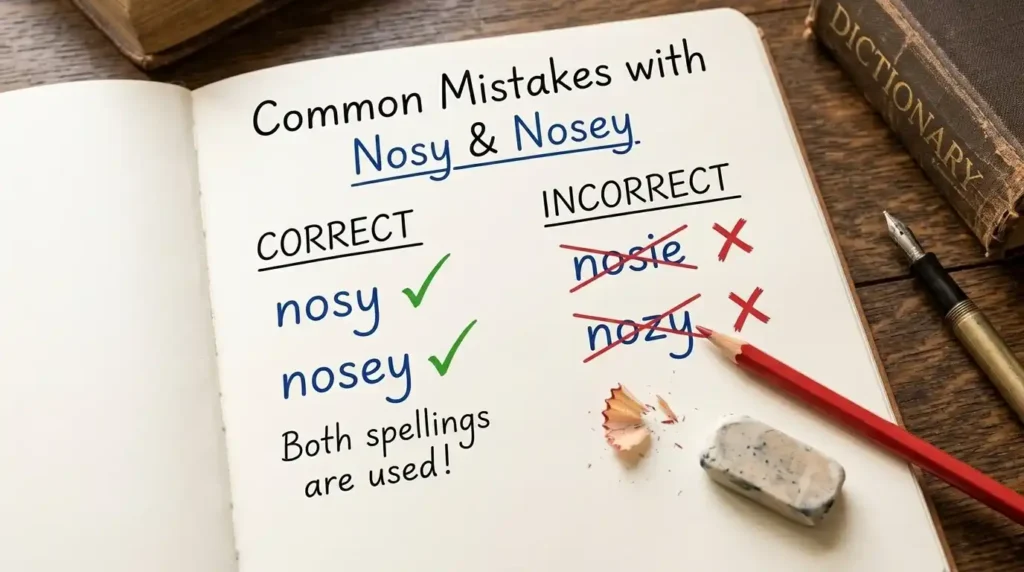
1. Mixing both spellings in one text.
Wrong: “Her nosy friend was too nosey.”
Better: “Her nosy friend was too nosy.”
2. Writing “nosie.”
Wrong: “He is so nosie.”
Right: “He is so nosy.”
3. Writing “knowsy” or “nozy.”
These are typos. The word starts with nos-, like nose.
4. Thinking one spelling is a mistake.
Many people say “nosey” is wrong. It is not. It is just less common.
5. Using it for plain curiosity.
Nosy is not a compliment. It means too curious. If you mean a friendly interest, say “curious” or “interested.”
Nosy and Nosey in Everyday Examples
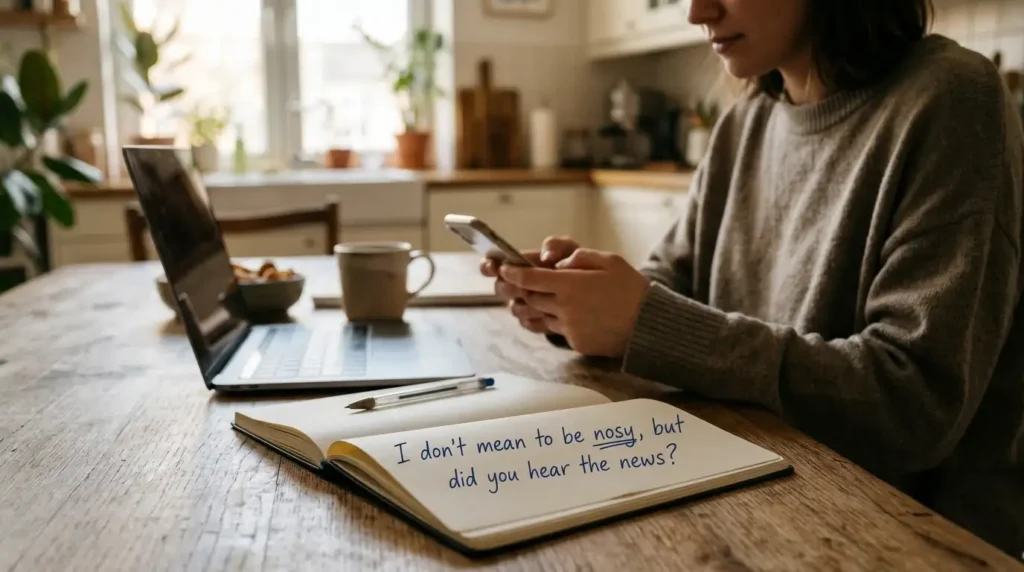
In an email (formal):
“I don’t want to seem nosy, but could you share the project timeline?”
In the news:
“Residents say a nosy visitor kept taking photos of their homes.”
On social media:
“Not to be nosey, but who made that cake? It looks amazing!”
In formal writing:
“The report warns that nosy software can track user habits.”
In casual talk:
“My aunt is a real Nosey Parker. She knows everyone’s business.”
Notice that people often soften the word. They say “I don’t mean to be nosy” before they ask a question. It is a polite way to ask something personal.
Nosy and Nosey Google Trends & Usage Data
Search interest in this keyword is steady. People look it up all year, often when they write emails, essays, or captions and feel unsure.
Here is what usage patterns generally show:
- Nosy is the more common form in published writing in both the US and the UK.
- Nosey appears more in casual posts, texts, and the phrase “Nosey Parker.”
- Searches for the meaning and for the spelling question both rise when the word goes viral in a TV show, a meme, or a news story.
- Many countries with English learners, such as India and Pakistan, search for “meaning” more than for “spelling.”
For exact numbers, open Google Trends and compare “nosy” and “nosey” by country and date range. Results change over time, so check the live data before you quote it.
Nosy vs Nosey: Side-by-Side Comparison
| Variation | Accepted? | Common Use | Best For |
| nosy | Yes (main) | Formal and casual | Work, school, news |
| nosey | Yes (variant) | Casual, “Nosey Parker” | Texts, social media |
| nosie | No | Typo | Never |
| nozy | No | Typo | Never |
FAQs
Is it nosy or nosey?
Both are correct. Nosy is the main spelling and the safest choice.
What does nosy mean?
It means too curious about other people’s private matters.
Is “nosey” a real word?
Yes. It is an accepted variant of nosy in major dictionaries.
Is nosey British and nosy American?
No. Both spellings are used in both places. Nosy is more common in each.
What is a Nosey Parker?
It is a British phrase for a person who pokes into other people’s business.
Is being nosy a bad thing?
Usually, yes. It suggests rude or unwanted curiosity. Sometimes people use it in a playful way.
What is a good word to use instead of nosy?
Try curious, inquisitive, prying, or snoopy. Pick based on tone. Curious is kind. Prying is harsh.
Conclusion
Here is what to remember. Nosy and nosey mean the same thing: being too curious about other people’s business. The word comes from “nose,” and it grew from a picture of someone sniffing around.
The two spellings exist because English does not always agree on what to do with a silent e. Nosy dropped it. Nosey kept it. Neither one is a mistake.
Both the US and the UK use both spellings, but nosy leads in dictionaries and formal writing. Use nosey only when you want a casual tone or when you write “Nosey Parker.”
For professional writing, pick nosy and stick with it. Avoid typos like “nosie” and “nozy.” Be careful with tone too, because the word is not a compliment. If you mean friendly interest, choose “curious.”
Now you have the quick answer, the history, and the advice. Next time a neighbor peeks through the curtains, you will know just how to describe it, and how to spell it.

“I’m Ibadat Fatima, a professional content writer and author with 3 years of experience in writing, editing, and storytelling. I share my work through visitlivo.com, where I help readers connect with clear, engaging, and well-crafted content.”