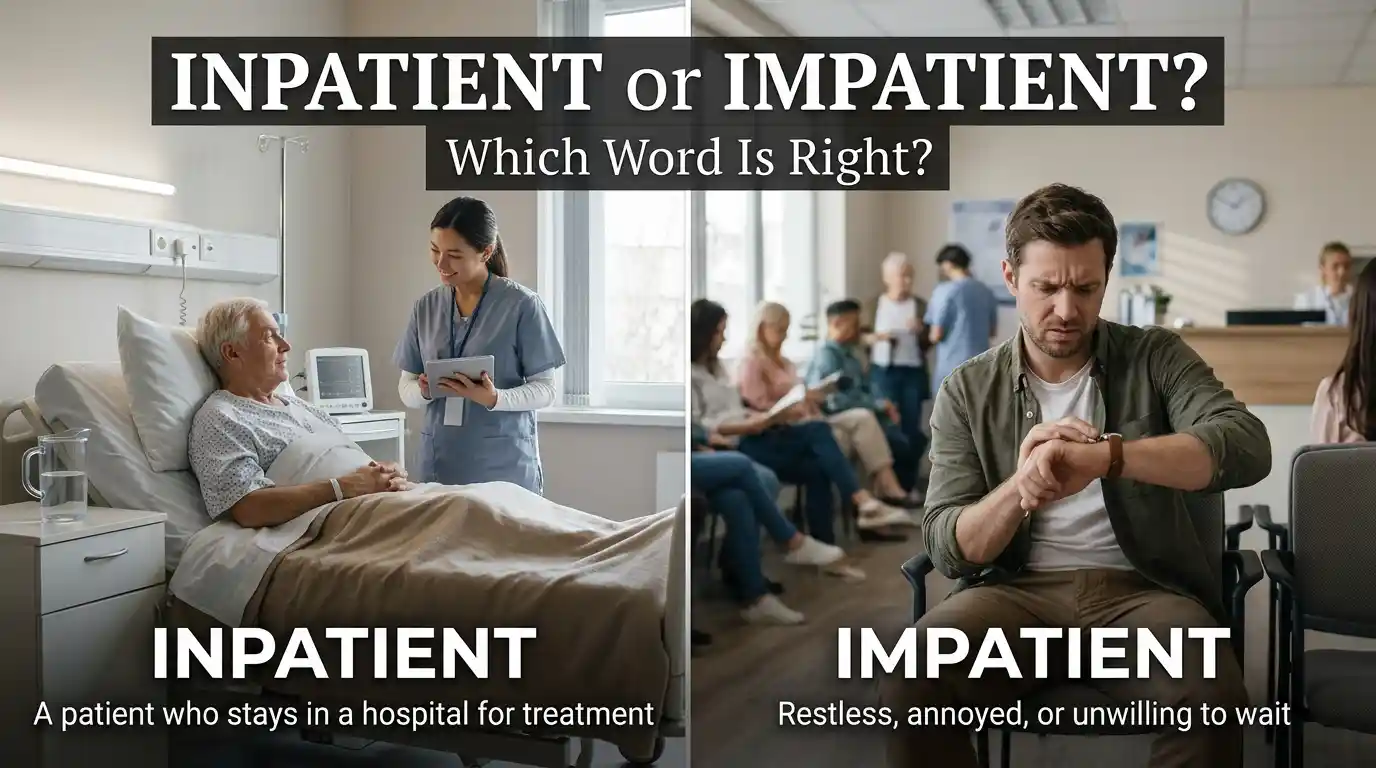
You are typing a sentence. You stop. Is it “inpatient” or “impatient”? You are not alone. Many people ask this every month. The two words look almost the same. They sound almost the same, too. But they mean very different things. One word is about a hospital stay. The other is about waiting and feeling upset.
People search “inpatient or impatient” for many reasons.Some are nurses completing patient charts, some are students writing essays, and others are filling out insurance forms. Others just sent a text and now feel unsure. A wrong word can look silly. In a medical note, it can cause real trouble.
Here is the good news. The fix is easy. Many people think this is a British versus American spelling issue. It is not. These are two different words, not two spellings of one word.
In this guide, you will get a quick answer first. Then you will learn where each word comes from. You will see examples, common mistakes, and a simple memory trick. You will also get answers to common questions. By the end, you will not mix them up again.
Inpatient or Impatient Quick Answer
Inpatient (noun or adjective) means a person who stays in a hospital overnight or longer for care.
- “She is an inpatient at the city hospital.”
- “He needs inpatient care for a few days.”
Impatient (adjective) means not willing to wait. It also means easily annoyed by delays.
- “The kids were impatient in the long line.”
- “I get impatient when the Wi-Fi is slow.”
Memory trick: Inpatient has in for “in the hospital.” Impatient has im for “I am not patient.”
The Origin of Inpatient and Impatient

Both words start with the word patient. It comes from the Latin word patiens. That word means “suffering” or “enduring.” It grew from the Latin verb pati, “to suffer.”
Impatient came into English in the late Middle Ages. It comes from Latin impatiens. The prefix in- here means “not.” So impatient means “not patient.” Latin speakers changed in- to im- before the letter P. This made the word easier to say. You see the same change in words like impossible and impolite.
Inpatient is a newer word. It was built from two English parts: in and patient. Here, “in” means “inside.” It is a person inside a hospital. This word came much later, when hospitals became common places for long care.
So why do the spellings look so close? The reason is simple. Both words use the same base, “patient.” But the “in” has a different job in each word. In impatient, it means “not.” In inpatient, it means “inside.” Only the first one changed to im.
British English vs American English Spelling
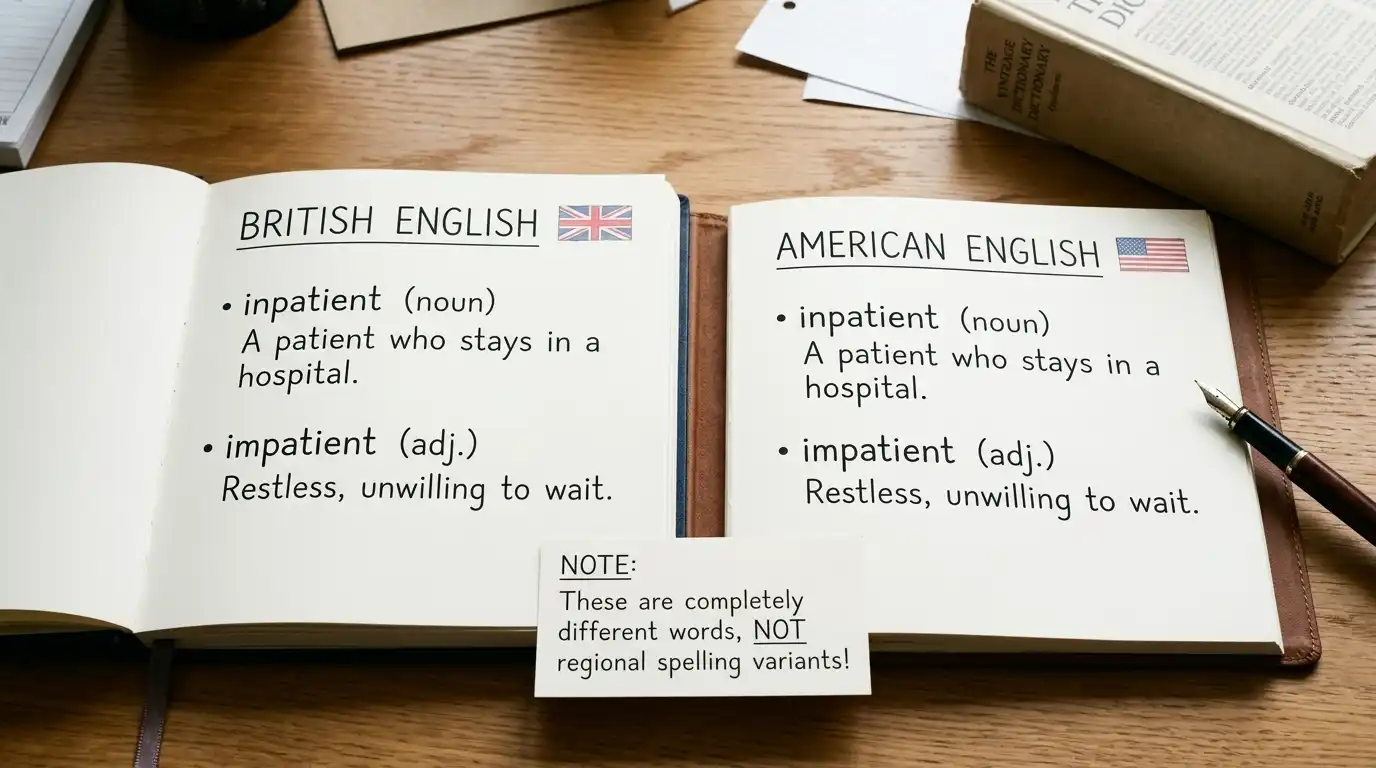
Here is a surprise. There is no spelling difference between British and American English for these two words. Both countries spell them the same way.
Real British and American differences look like this: color and colour, or center and centre. Our two words are not like that. They are different words with different meanings.
One small note: some British writers use a hyphen and write “in-patient.” This is older and less common now. Most medical groups use “inpatient” without a hyphen.
| Word | US English | UK English | Meaning |
| Hospital stay | inpatient | inpatient (sometimes in-patient) | Stays in hospital |
| Not patient | impatient | impatient | Cannot wait calmly |
| Color (example) | color | colour | A real spelling difference |
| Center (example) | center | centre | A real spelling difference |
Which Spelling Should You Use?
Do not choose by country. Choose by meaning.
- Writing about hospitals, health plans, or medical care? Use inpatient. This is true in the US, UK, Canada, Australia, and everywhere else.
- Writing about someone who cannot wait? Use impatient.
- Writing for a US audience? Skip the hyphen. Write “inpatient.”
- Writing for a UK or Commonwealth audience? “Inpatient” is safe. “In-patient” is fine in older style guides, but pick one and stay with it.
- Writing for a global audience? Use “inpatient” and “impatient.” They are clear to all English readers.
Ask yourself one question: “Is this about a hospital or about waiting?” That answer picks the word.
Common Mistakes with Inpatient or Impatient
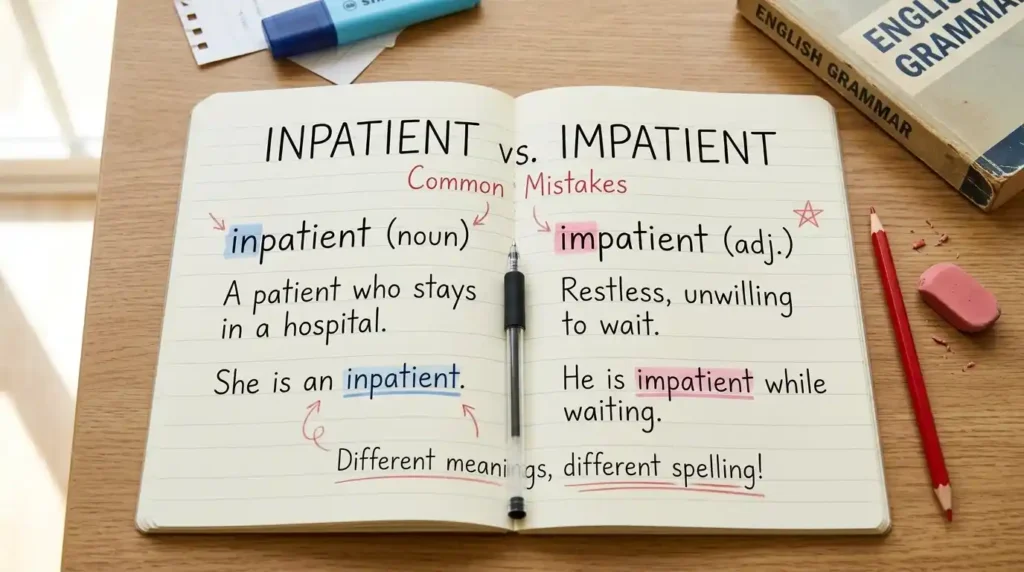
Using “inpatient” for someone who is annoyed.
- Wrong: “I was inpatient waiting for the bus.”
- Right: “I was impatient waiting for the bus.”
Using “impatient” for a hospital stay.
- Wrong: “He is an impatient at the clinic.”
- Right: “He is an inpatient at the clinic.”
Writing “inpatience.” This is not a word. The noun for waiting badly is impatience.
Mixing up “inpatient” and “outpatient.” An outpatient visits for care and goes home the same day. An inpatient stays.
Trusting spell check. Both words are real, so spell check may not catch the error. Read the sentence again.
Inpatient or Impatient in Everyday Examples
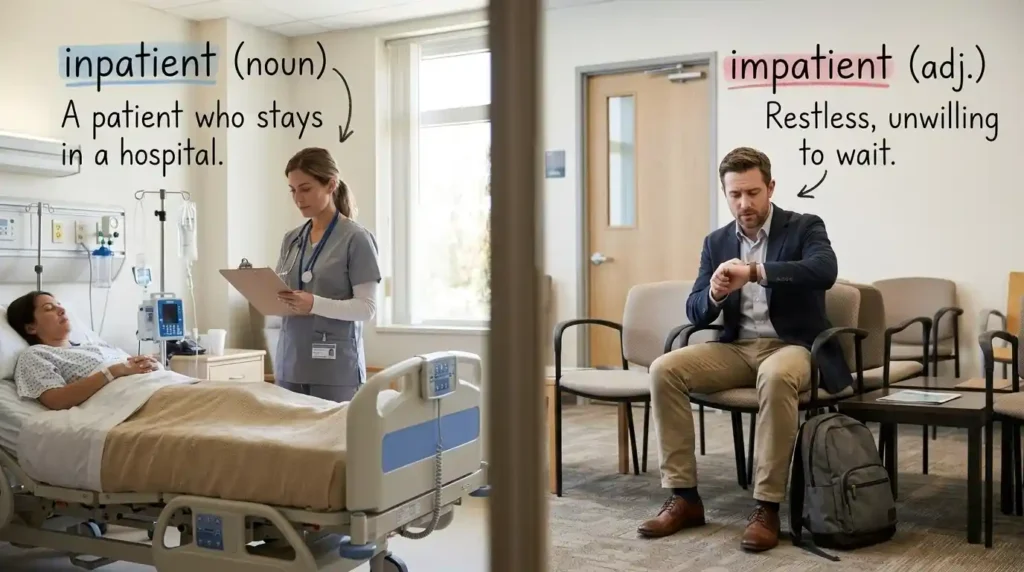
- “Our mother is now an inpatient. Visiting hours start at 10 a.m.”
- “Sorry for the late reply. I know you are impatient for an answer.”
News
- “The hospital added 50 beds for inpatient care.”
- “Fans grew impatient as the game was delayed.”
Social media
- “Day two as an inpatient. The food is not great, but the nurses are kind.”
- “Why is this app so slow? I am so impatient today.”
Formal writing
- “The plan covers inpatient services and surgery.”
- “The board was impatient with the slow progress.”
Inpatient or Impatient Google Trends & Usage Data
I did not pull live numbers for this article, because search data changes all the time. You can check the latest data free at Google Trends. Here is what the usual pattern looks like.
- “Impatient” is used far more often in daily life. People use it for feelings, so it shows up in chats, songs, books, and posts.
- “Inpatient” is more common in health and insurance topics. People look it up when they read a hospital bill or a coverage plan.
- United States: Searches for “inpatient” tend to be higher here. Health insurance in the US uses the word a lot.
- UK, Canada, Australia, India: People search for both words. Many searches are about the difference or about spelling.
- Context: Searches for the two words together, like “inpatient or impatient,” often come from students, writers, and medical office workers.
Tip: In Google Trends, compare “inpatient” and “impatient” side by side. Then filter by country and by date.
Word Variations Side by Side
| Word | Type | Meaning | Example |
| inpatient | noun / adjective | Person staying in hospital | “She is an inpatient.” |
| in-patient | noun / adjective | Older hyphen form of inpatient | “In-patient care is costly.” |
| impatient | adjective | Not willing to wait | “He is impatient.” |
| impatience | noun | The feeling of not wanting to wait | “Her impatience grew.” |
| impatiently | adverb | In a way that shows you cannot wait | “He waited impatiently.” |
| outpatient | noun / adjective | Person who gets care and goes home | “It was an outpatient visit.” |
Frequently Asked Questions
Is it “inpatient” or “impatient”?
Both are correct words, but they mean different things. Use “inpatient” for a hospital stay. Use “impatient” for someone who cannot wait.
Is “inpatient” vs “impatient” a British and American spelling difference?
No. They are two different words. The spelling is the same in the US and UK.
Why does “impatient” use “im” and not “in”?
Latin speakers changed “in-” to “im-” before the letter P. It is easier to say. You see this in impossible too.
Is “in-patient” with a hyphen correct?
Yes, but it is older. Most writers now use “inpatient” with no hyphen.
What is the opposite of inpatient?
The opposite is outpatient. That is a person who gets care and goes home the same day.
What is the opposite of impatient?
The opposite is patient. A patient person can wait calmly.
Can a person be both an inpatient and impatient?
Yes. A hospital patient who wants to go home may be an impatient inpatient. Both words are right in that sentence.
What is a simple way to remember the difference?
Think “in the hospital” for inpatient. Think “I’m not patient” for impatient.
Conclusion
Let’s sum it up. “Inpatient” and “impatient” are two different words. They are not British and American versions of the same word. The spelling is the same in every English-speaking country.
Inpatient is about hospitals. It describes a person who stays overnight or longer to get care. Impatient is about feelings. It describes someone who does not want to wait.
Both words come from the Latin root for “suffering” or “enduring.” But the first part of each word does a different job. In “inpatient,” in means “inside.” In “impatient,” im means “not.”
When you write, ask one easy question: “Is this about a hospital or about waiting?” That will give you the right word almost every time. Do not trust spell check alone, because both words are real. Read your sentence once more before you send it.
For work in health care, insurance, or news, be extra careful. One wrong letter can change the meaning. Use the memory trick: “in the hospital” and “I’m not patient.” With a little practice, it will feel natural.

I’m Raheela Rani, a professional content writer and author with 3 years of experience in writing, editing, and storytelling. Through VisitLivo.com, I create clear, engaging, and well-crafted content that helps readers learn, connect, and communicate with confidence.