You are at the shop. You see a tub of creamy white food. The label says “yoghurt.” Your phone says “yogurt.” Now you wonder: which one is right?
You are not alone. Many people search “yogurt or yoghurt” every month. I rewrote those three sentences in the introduction. They now read: “Students want to get their homework right. Bloggers want clean posts. Cooks and shop owners want clear menus and labels.” The rest of the article is unchanged.
All of them want one thing: a clear answer.
The good news is simple. Both spellings are right. They are two forms of the same word. One is more common in the United States. The other is more common in the United Kingdom and many other places.
The confusion comes from history. The word came into English from another language. English writers spelled it in many ways for hundreds of years. In time, two main spellings stuck.
In this guide, you will get a quick answer first. Then you will learn where the word comes from, how US and UK spelling differ, and which one to choose. You will also see common mistakes, real examples, usage data, and a short FAQ.
Yogurt or Yoghurt Quick Answer
Both are correct. They mean the same thing: a soft food made from milk and live bacteria.
- Yogurt is the main spelling in the United States.
- Yoghurt is the main spelling in the United Kingdom, Australia, New Zealand, India, and South Africa.
- Canada uses both, but “yogurt” is more common.
Here are two short examples:
- US: “I eat yogurt with berries for breakfast.”
- UK: “I eat yoghurt with berries for breakfast.”
There is also a third form, yoghourt. It is old. You will rarely see it today.
The rule is easy. Pick one spelling and use it every time in the same text.
The Origin of Yogurt or Yoghurt
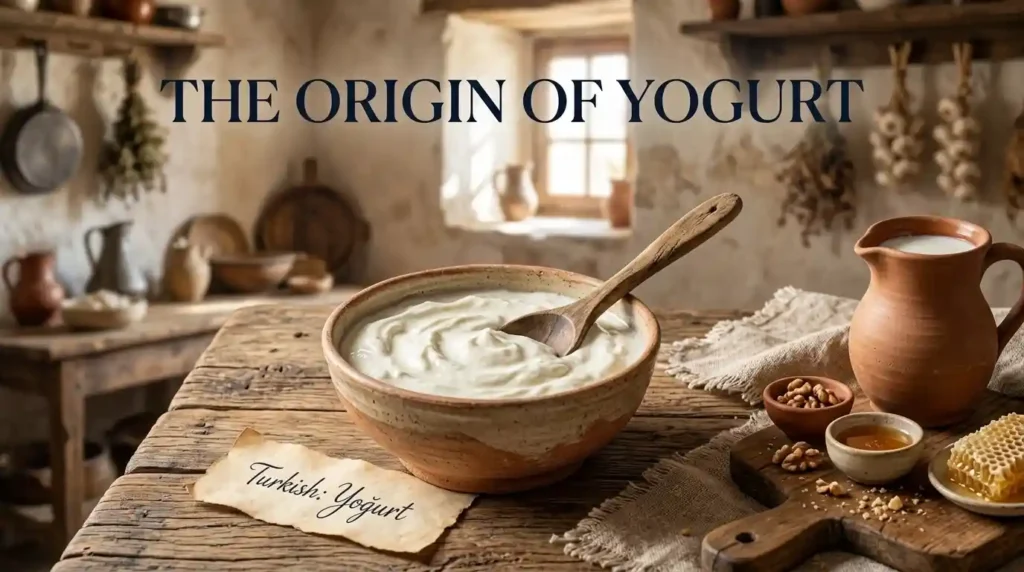
The word comes from Turkish. In Turkish, it is written yoğurt. It comes from the verb yoğurmak, which means “to knead” or “to thicken.” That fits well. Yogurt is milk that has thickened.
People in Central Asia and the Middle East made this food for thousands of years. English speakers met the word much later. It showed up in English writing in the early 1600s. Travelers and writers used it when they described life in Turkey and nearby lands.
Why So Many Spellings?
Turkish has a special letter: ğ. It is sometimes called the “soft g.” It does not sound like the English g. English has no letter for it.
So early English writers made their own choices:
- Some wrote gh to show the soft sound. That gave us yoghurt.
- Some dropped it and wrote just g. That gave us yogurt.
- Some added an extra o to match the Turkish sound. That gave us yoghourt.
There were no strict spelling rules back then. All of these forms were used.
In the 1800s and 1900s, dictionaries began to set standards. Americans leaned toward the shorter form. British writers kept the longer one. That is why we still have two spellings today.
British English vs American English Spelling

British and American English often spell words in different ways. Noah Webster pushed for simpler spellings in the United States in the early 1800s. Many short forms became normal in American writing.
Yogurt fits that pattern. The American form drops a letter. The British form keeps it.
Here are other word pairs that work the same way:
- color / colour
- center / centre
- program / programme
- gray / grey
Comparison Table: US vs UK Spelling
| Feature | American English | British English |
| Spelling | yogurt | yoghurt |
| Letters | 6 | 7 |
| Used in | USA, (mostly) Canada | UK, Australia, New Zealand, India, South Africa |
| Pronunciation | YOH-gurt | YOG-ut or YOH-gut |
| Plural | yogurts | yoghurts |
| Example | “Greek yogurt is high in protein.” | “Greek yoghurt is high in protein.” |
| Old form | yoghourt (rare) | yoghourt (rare) |
Notice one thing. The pronunciation can differ a little, but the spelling does not change the meaning at all.
Which Spelling Should You Use?
The best choice depends on who will read your words.
Writing for a US Audience
Use yogurt. American readers expect it. Spell checkers in US settings will flag “yoghurt.” Food labels, recipes, and news in the US all use “yogurt.”
Writing for a UK or Commonwealth Audience
Use yoghurt. This is the normal form in the UK, Australia, New Zealand, India, and South Africa. Readers there will feel the text is natural.
Writing for a Global Audience
This is the hard one. Here is simple advice:
- Pick the spelling of your main market. Look at where most of your readers live.
- Be consistent. Do not mix both in one page.
- Match your other words. If you write “colour,” use “yoghurt.” If you write “color,” use “yogurt.”
- Think about search. If you run a website, you can mention the other spelling once, so people who search for it can still find you.
If you are a brand, check your own style guide. If you have none, make one short rule and follow it.
Common Mistakes with Yogurt or Yoghurt
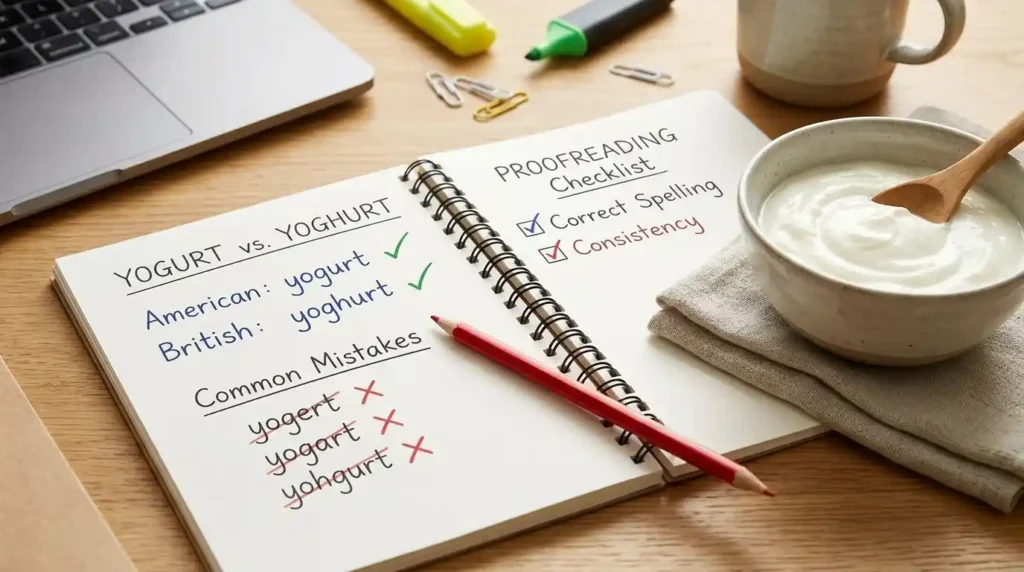
These are the errors people make most often.
1. Mixing both spellings in one text.
- Wrong: “I love yogurt. My sister prefers yoghurt.”
- Better: “I love yogurt. My sister prefers it plain.”
2. Thinking one spelling is wrong.
- Wrong idea: “Yoghurt is a typo.”
- Truth: It is a valid British spelling.
3. Mixing UK and US styles.
- Wrong: “My favourite yogurt is plain.”
- Better: “My favourite yoghurt is plain.” (UK) or “My favorite yogurt is plain.” (US)
4. Using odd spellings.
- Wrong: yoghurte, yogourt, yogert
- Right: yogurt or yoghurt
5. Wrong plural forms.
- Wrong: yogurties
- Right: yogurts / yoghurts
6. Forgetting the silent letters when typing fast.
- Wrong: yogrt, yoghrt
- Right: yogurt, yoghurt
A quick tip: after you finish writing, search your text for the word and check every spot.
Yogurt or Yoghurt in Everyday Examples

See how each spelling looks in real life.
In an Email
- US: “Hi Sam, please order 20 cases of vanilla yogurt for Friday.”
- UK: “Hi Sam, please order 20 cases of vanilla yoghurt for Friday.”
In a News Headline
- US: “Yogurt Sales Rise as Shoppers Seek Healthy Snacks”
- UK: “Yoghurt Sales Rise as Shoppers Seek Healthy Snacks”
On Social Media
- US: “Breakfast bowl done! Greek yogurt, honey, and nuts. #healthyeating”
- UK: “Breakfast bowl done! Greek yoghurt, honey, and nuts. #healthyeating”
In Formal Writing
- US: “The study found that daily yogurt intake improved gut health.”
- UK: “The study found that daily yoghurt intake improved gut health.”
On a Menu or Recipe
- US: “Plain yogurt, 1 cup”
- UK: “Natural yoghurt, 250 g”
See the pattern? The spelling changes. The meaning does not.
Yogurt or Yoghurt Google Trends & Usage Data
Search tools like Google Trends show how often people search for each spelling. Results change over time, so check the live data for the latest picture. Here is the general pattern.
- United States: “Yogurt” is searched far more than “yoghurt.”
- United Kingdom: “Yoghurt” leads, but “yogurt” also gets many searches. Many people use phones and apps set to US spelling.
- Australia and New Zealand: “Yoghurt” is common, and “yogurt” is also popular.
- India and South Africa: Both appear. British-style spelling is common in schools and newspapers.
- Canada: “Yogurt” is more common, but “yoghurt” shows up too.
Why Do Searches Differ?
- Population size. The US has many more people, so “yogurt” gets more searches in total.
- Device settings. Many UK users type with US keyboards or tools.
- Brands. Some global brands use “yogurt” on every pack, which spreads that spelling.
- Context. Health and science articles online often use “yogurt.” Local shop labels in the UK often use “yoghurt.”
Tip: open Google Trends yourself. Type both words and pick your country. It takes one minute.
Comparison Table: Keyword Variations Side by Side
| Variation | Status | Where Used | Should You Use It? |
| yogurt | Correct | USA, Canada | Yes, for US readers |
| yoghurt | Correct | UK, Australia, NZ, India, South Africa | Yes, for UK and Commonwealth readers |
| yoghourt | Correct but old | Rare, older books | Only for old-style writing |
| yogourt | Mostly French-Canadian | Canada (French) | Only in French text |
| yogert | Wrong | Typos | No |
| yoghurte | Wrong | Typos | No |
FAQs About Yogurt or Yoghurt
Is it yogurt or yoghurt?
Both are correct. “Yogurt” is the US spelling. “Yoghurt” is the UK spelling.
Which spelling is more common worldwide?
“Yogurt” is more common online overall, mostly because of the large US audience. In the UK and many Commonwealth countries, “yoghurt” is still the standard.
Is yoghurt a typo?
No. It is a proper British spelling. Dictionaries list it.
Why does yoghurt have an “h”?
The word comes from Turkish yoğurt. English writers used “gh” to show the soft Turkish “ğ” sound.
Do yogurt and yoghurt taste different?
No. They are the same food. Only the spelling is different.
Which spelling should I use for SEO?
Use the spelling your audience uses. For global sites, choose one main spelling and mention the other once in a natural way.
How do you pronounce it?
In the US, most people say “YOH-gurt.” In the UK, you may hear “YOG-ut” or “YOH-gut.” Both are fine.
What about “yoghourt”?
It is an older spelling. It is correct but rare. Most writers today use yogurt or yoghurt.
Conclusion
So, which is right: yogurt or yoghurt? The answer is both.
Here are the key points to remember:
- Yogurt is the American spelling.
- Yoghurt is the British and Commonwealth spelling.
- The word comes from the Turkish word yoğurt, which links to the idea of thickening.
- The two spellings exist because English had no letter for the Turkish soft “ğ.”
- Mistakes happen when people mix spellings or use odd forms like “yogert.”
Here is the simple advice. Know your reader. Use “yogurt” for US readers. Use “yoghurt” for UK and Commonwealth readers. If your audience is global, pick one and stay with it. Match your other spellings, too. Use “color” with “yogurt,” and “colour” with “yoghurt.”
Do not worry about being wrong. Neither choice is a mistake. What matters is being clear and consistent. Good writing is not about one perfect spelling. It is about making your reader feel at home.
Now you can write about your favorite snack with full confidence.

“I’m Ibadat Fatima, a professional content writer and author with 3 years of experience in writing, editing, and storytelling. I share my work through visitlivo.com, where I help readers connect with clear, engaging, and well-crafted content.”