You are typing a message. You pause. Is it “stoped” or “stopped“? You are not alone. Many people stop and ask this very question.
Every month, people search for “stoped or stopped” to check their spelling. The word looks simple. But the extra “p” trips people up. Some think one “p” looks fine. Others think two “p”s look odd.
Here is the good news. The answer is simple. “Stopped” is the correct spelling. It is right in the US and the UK. It is also right in Canada, Australia, and India.
This article clears up the confusion. You get a quick answer first. Then you learn why the word has two “p”s. You see how British and American spelling compare. You also find common mistakes, real examples, a usage table, and answers to common questions.
Read on, and you will never second-guess this word again. if you write emails, essays, or social posts, you will spell it right every time.
Stoped or Stopped Quick Answer
“Stopped” is correct. “Stoped” is a misspelling.
“Stopped” is the past tense of the verb “stop.” It is also the past participle. Use it when something ended or paused.
Examples:
- The bus stopped at the corner.
- She stopped talking when he walked in.
- We have stopped the payment.
There is one rare exception. “Stoped” is a real word in mining. To “stope” means to dig out ore in steps. So a miner might say, “The crew stoped the vein.” You will almost never need this. In daily writing, use “stopped.”
The Origin of Stopped
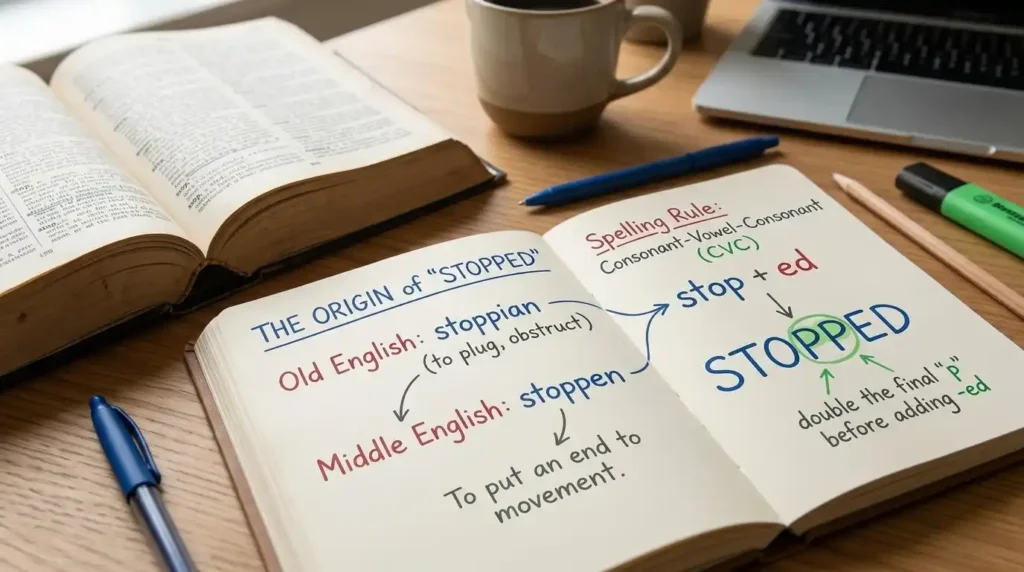
The word “stop” is old. It comes from Old English stoppian. That word came from Late Latin stuppare, which meant “to plug with tow.” Tow is a rough fiber. People used it to block holes. So “stop” first meant “to close a gap.”
Over time, the meaning grew. It came to mean “to halt.”
So why two “p”s? English has a spelling rule for short words. Look at the word “stop.” It has one syllable. It ends in one vowel and one consonant (o + p). When you add “-ed” or “-ing,” you double the last consonant.
- stop → stopped
- hop → hopped
- plan → planned
The doubled letter keeps the vowel short. Without it, “stoped” would look like it rhymes with “hoped.” And that is wrong. “Hoped” and “stopped” sound different. The double “p” tells your eye to say a short “o.”
Spelling differences between countries came later. They grew from dictionaries and habits. But this word is not one of them.
British English vs American English Spelling
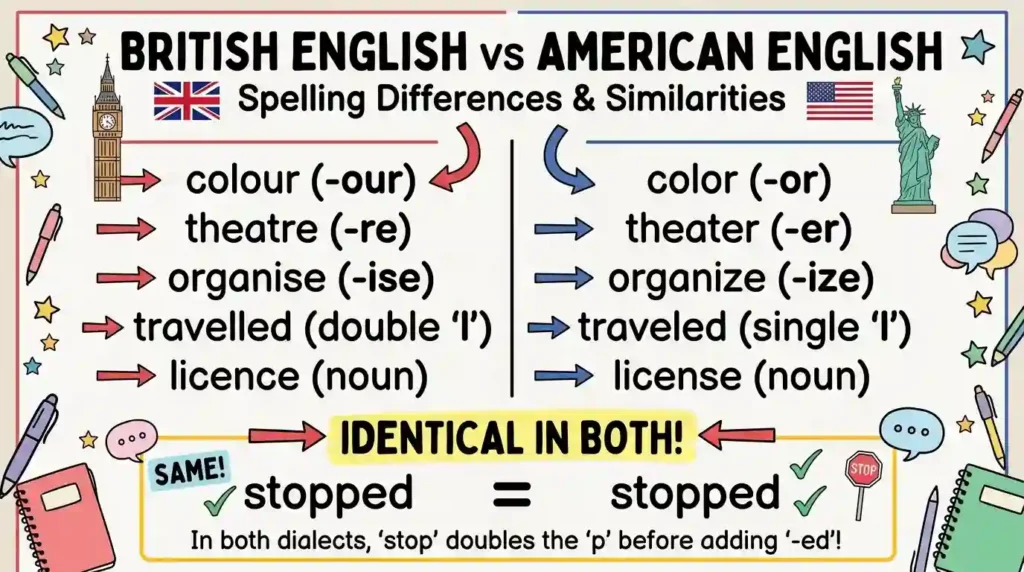
Many English words are spelled differently in the UK and US. “Stopped” is not one of them. Both sides use the same spelling.
Some verbs do differ. This happens when the word has more than one syllable and ends in “l.” British English doubles the “l.” American English often does not.
| Base Word | British English | American English |
| stop | stopped | stopped |
| hop | hopped | hopped |
| travel | travelled | traveled |
| cancel | cancelled | canceled |
| label | labelled | labeled |
| fuel | fuelled | fueled |
See the top two rows. Short words like “stop” and “hop” follow the same rule everywhere. Only the longer “l” words split by region.
So if you see “stoped,” it is not a British spelling. It is not an American spelling. It is just a mistake.
Which Spelling Should You Use?
The answer is easy: always use “stopped.”
- US readers: Use “stopped.”
- UK and Commonwealth readers: Use “stopped.”
- Global readers: Use “stopped.”
You do not need to pick a side. You do not need to check your audience. One spelling works for all.
A good tip: if you write for a global audience, stay consistent with other words. For example, pick either “canceled” or “cancelled” and stick with it. But “stopped” never needs that choice.
Common Mistakes with Stopped
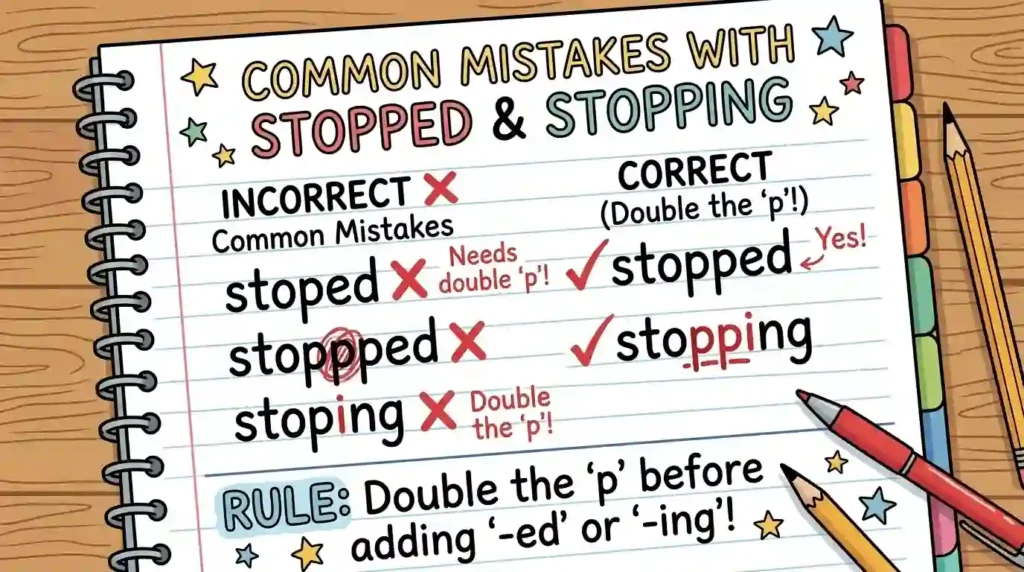
Here are the errors people make most often.
1. Writing “stoped”
- Wrong: The rain stoped at noon.
- Right: The rain stopped at noon.
2. Writing “stoppped” (three p’s)
- Wrong: He stoppped the car.
- Right: He stopped the car.
3. Mixing up “stopped” and “stoped” in “-ing” form
- Wrong: I am stoping now.
- Right: I am stopping now.
4. Confusing “stopped” with “stooped”
- “Stooped” means bent forward. “Stopped” means halted.
- Right: He stooped to tie his shoe.
- Right: He stopped to tie his shoe.
5. Dropping the “-ed” in speech-style writing
- Wrong: The bus stop at the corner yesterday.
- Right: The bus stopped at the corner yesterday.
A quick trick: say “stop” and look at the end. One vowel, one consonant? Double the consonant.
Stopped in Everyday Examples
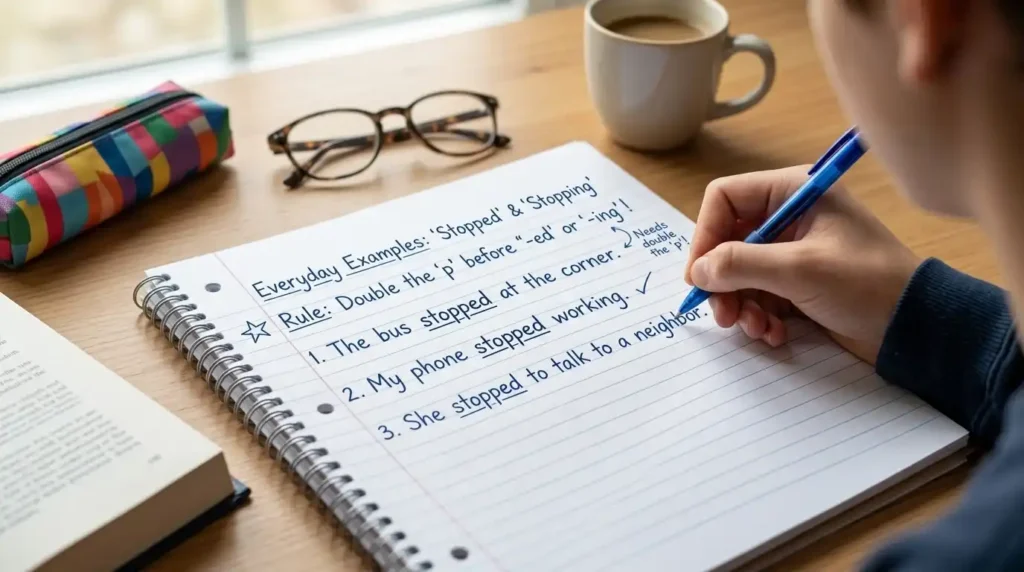
Emails
- “Our team has stopped the old process. Please use the new form.”
- “I stopped by your desk, but you were out.”
News headlines
- “Trains stopped after storm hits the coast.”
- “Police stopped the driver near the bridge.”
Social media
- “My phone just stopped working. Help!”
- “Never stopped believing. We did it!”
Formal writing
- “The committee stopped the review pending further evidence.”
- “Production was stopped on March 3 due to a safety concern.”
In every case, the spelling is the same. Tone changes. Spelling does not.
Stoped or Stopped Google Trends & Usage Data
I can’t pull live Google Trends numbers here, so I won’t make any up. You can check them yourself at trends.google.com by comparing “stoped” and “stopped.” Here is what you should expect to see, and why.
“Stopped” dominates. It is a very common word. People use it every day in writing and speech. Searches and usage for “stopped” are far higher than for “stoped.”
“Stoped” is a typo search. People type “stoped” by mistake. They also search “stoped or stopped” to check themselves. This kind of search rises during school terms, when students write essays.
By country: Interest in this spelling question tends to show up in English-speaking countries and in places where English is a second language, such as India, Pakistan, Nigeria, and the Philippines. Learners often double-check rules like this one.
By context: People search this term when they write emails, reports, school work, and social posts. They want a fast answer. They want to look professional.
Keyword Variations Side by Side
| Variation | Correct? | Where It Is Used | Note |
| stopped | ✅ Yes | US, UK, all English | Past tense of “stop” |
| stoped | ❌ No | Nowhere (typo) | Only valid as a rare mining term |
| stopping | ✅ Yes | US, UK, all English | “-ing” form of “stop” |
| stoping | ❌ No | Nowhere (typo) | Rare mining term only |
| stooped | ✅ Yes | US, UK, all English | Different word: bent over |
| stoppped | ❌ No | Nowhere (typo) | Too many p’s |
FAQs
Is it “stoped” or “stopped”?
It is “stopped.” “Stoped” is a misspelling.
Is “stoped” ever correct?
Only in mining. “Stope” means to dig ore in steps, so “stoped” is its past tense. In normal writing, it is wrong.
Why does “stopped” have two p’s?
The word “stop” is short and ends in one vowel plus one consonant. English doubles that last consonant before “-ed” or “-ing.”
Is “stopped” spelled differently in British and American English?
No. Both use “stopped.”
What is the “-ing” form of stop?
It is “stopping,” with two p’s. “Stoping” is wrong.
What is the difference between “stopped” and “stooped”?
“Stopped” means halted. “Stooped” means bent forward. They look close, but they mean different things.
Is “stopped” a verb or an adjective?
Mostly a verb. It can also act like an adjective, as in “a stopped clock.”
How can I remember the spelling?
Think of the rule: short word, one vowel, one consonant. Double the consonant. Stop → stopped, just like hop → hopped.
Conclusion
Let’s sum it up. The right spelling is stopped. It has two “p”s. That is true in the US, the UK, and everywhere else English is used.
“Stoped” is a common typo. It only counts as a real word in mining, where it means to dig ore in steps. For all other writing, skip it.
The two “p”s come from a simple rule. When a short word ends in one vowel and one consonant, double the consonant before “-ed” or “-ing.” That is why you write “stopped,” “hopped,” and “stopping.”
Here is your quick advice:
- Always write “stopped” for the past tense.
- Write “stopping” for the “-ing” form.
- Do not confuse “stopped” with “stooped.”
- Check any spell-check warning before you hit send.
Spelling well builds trust. Good spelling makes your emails clear, your essays neat, and your posts look polished. With this one small fix, you are ready to write with confidence.

I’m Raheela Rani, a professional content writer and author with 3 years of experience in writing, editing, and storytelling. Through VisitLivo.com, I create clear, engaging, and well-crafted content that helps readers learn, connect, and communicate with confidence.