Reading level: simple and clear. Built for quick answers and deep understanding.
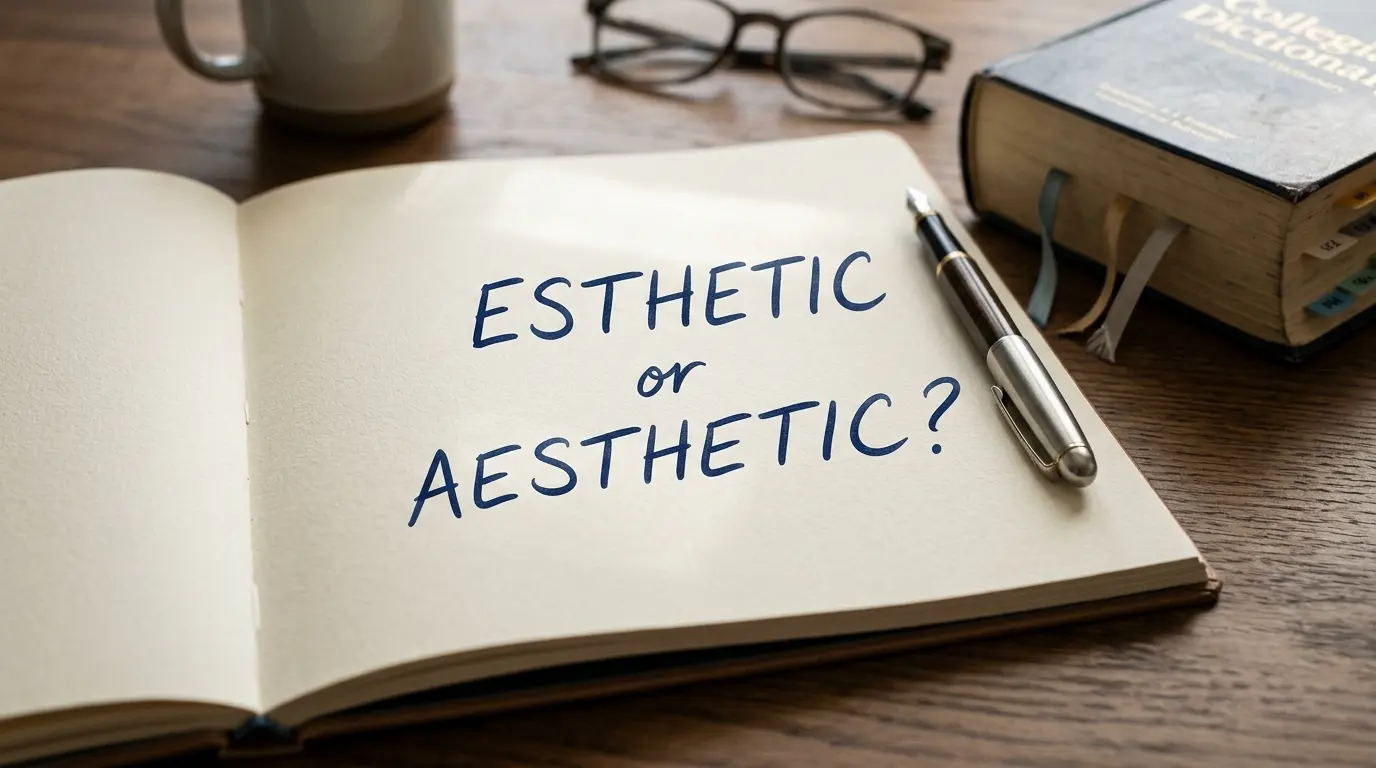
You are typing a sentence. You stop. Is it “esthetic” or “aesthetic”? You look at both. They look right. They look wrong. You are not alone.
Thousands of people search “esthetic or aesthetic” every month. Students want the right spelling for an essay. Writers want to look professional. Business owners want a clean website. Beauty workers want the right title on a license. Social media users want the perfect caption.
The confusion is real. The two words sound the same. They mean the same. They are both in the dictionary. But they are not used the same way. One is far more common. One is a regional choice.
This guide clears it up. You will get a quick answer first. Then you will learn where the words came from.
By the end, you will know which spelling to pick. And you will know why.
Let us start.
Esthetic or Aesthetic Quick Answer
Use “aesthetic.” It is the safe choice almost everywhere.
“Esthetic” is a valid variant. It is mostly American. It is rare. Many readers will think it is a typo.
Both words mean the same thing. They relate to beauty, art, and how things look and feel.
Examples:
- She loves the aesthetic of old Paris cafes. ✔
- The room has a clean, modern aesthetic. ✔
- He studied esthetic theory in college. ✔ (valid in US English, but rare)
- The dentist offers esthetic treatments. ✔ (common in US dental writing)
Rule of thumb: When in doubt, write “aesthetic.”
The Origin of Esthetic and Aesthetic

Both words come from Greek. The Greek word aisthetikos means “able to perceive.” It comes from aisthanesthai, which means “to feel” or “to sense.”
The idea of “aesthetics” as the study of beauty is fairly new. A German thinker named Alexander Baumgarten used the Latin word aesthetica in the 1700s. He used it for the study of sensory taste and beauty. The philosopher Immanuel Kant helped spread the idea.
The word reached English around the late 1700s and early 1800s. It came in with the “ae” spelling. That spelling matched the Greek and Latin roots.
Why two spellings?
Old Latin and Greek words used a joined letter: æ. English kept it for a long time. Over time, writers split it into “ae.” Later, some dropped the “a” and kept just “e.”
In the United States, spelling reform grew in the 1800s. Noah Webster pushed for simpler spellings. That is why Americans write “encyclopedia,” “fetus,” and “esophagus.” Britain kept “encyclopaedia,” “foetus,” and “oesophagus” for longer.
So “esthetic” is the simplified form. “Aesthetic” is the traditional form. Here is the twist. Even in America, “aesthetic” won. It is the standard form in most American writing too.
British English vs American English Spelling
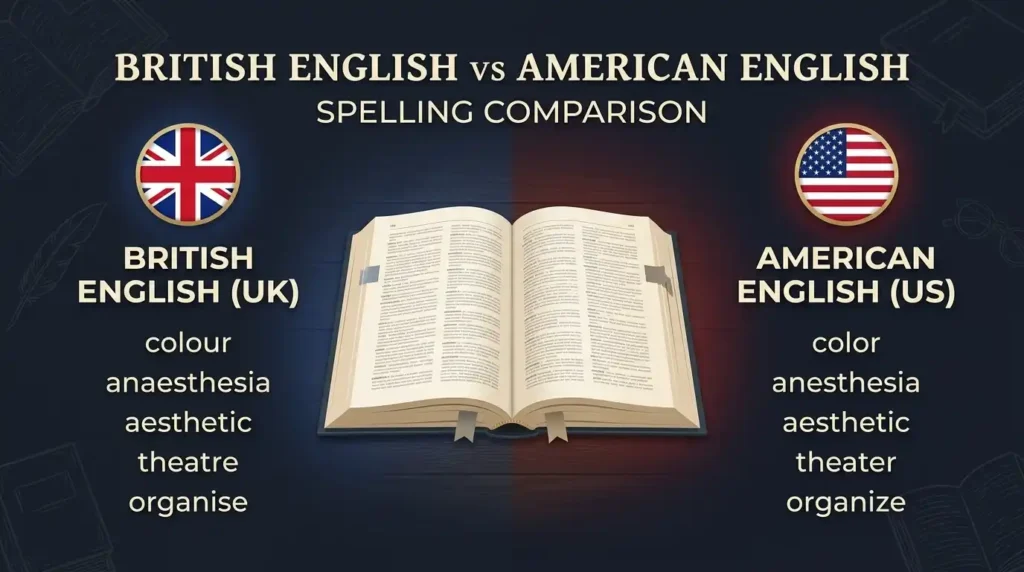
British English tends to keep the old “ae” and “oe” pairs. American English often drops the first letter. But the rule is not strict. Some words keep “ae” on both sides.
| Word Type | American English | British English |
| Beauty-related word | aesthetic (esthetic is a rare variant) | aesthetic |
| Skin care professional | esthetician (also aesthetician) | aesthetician or beautician |
| Study of beauty | aesthetics (esthetics is rare) | aesthetics |
| Study of old things | archeology (archaeology also used) | archaeology |
| Medical term for baby | fetus | foetus |
| Throat tube | esophagus | oesophagus |
| Book of knowledge | encyclopedia | encyclopaedia |
| Loss of feeling | anesthesia | anaesthesia |
Key point: American English accepts both “aesthetic” and “esthetic.” British English does not use “esthetic” in normal writing. UK editors will often mark it as an error.
Also note: “anesthetic” and “anaesthetic” follow the same pattern. But “aesthetic” is the exception. It stayed strong in the US.
Which Spelling Should You Use?
The right choice depends on who will read your work.
If your readers are in the United States
Use “aesthetic” for most writing. It is the norm in books, news, and design. Use “esthetic” only if a style guide or industry asks for it. Dentistry and licensing boards sometimes do.
If your readers are in the UK, Australia, Canada, India, or other Commonwealth countries
Use “aesthetic.” Always. “Esthetic” will look like a mistake.
If your readers are global
Use “aesthetic.” It works everywhere. It is also the form people search for most. That helps your SEO.
If you write for a school or company
Check the style guide. Follow it. If there is none, pick “aesthetic” and stay consistent.
Quick decision guide
| Your Audience | Best Choice |
| USA | aesthetic |
| UK / Commonwealth | aesthetic |
| Global | aesthetic |
| US dental or medical style guide | follow the guide (esthetic may be required) |
| US license or job title | check local rules (esthetician is common) |
Common Mistakes with Esthetic and Aesthetic
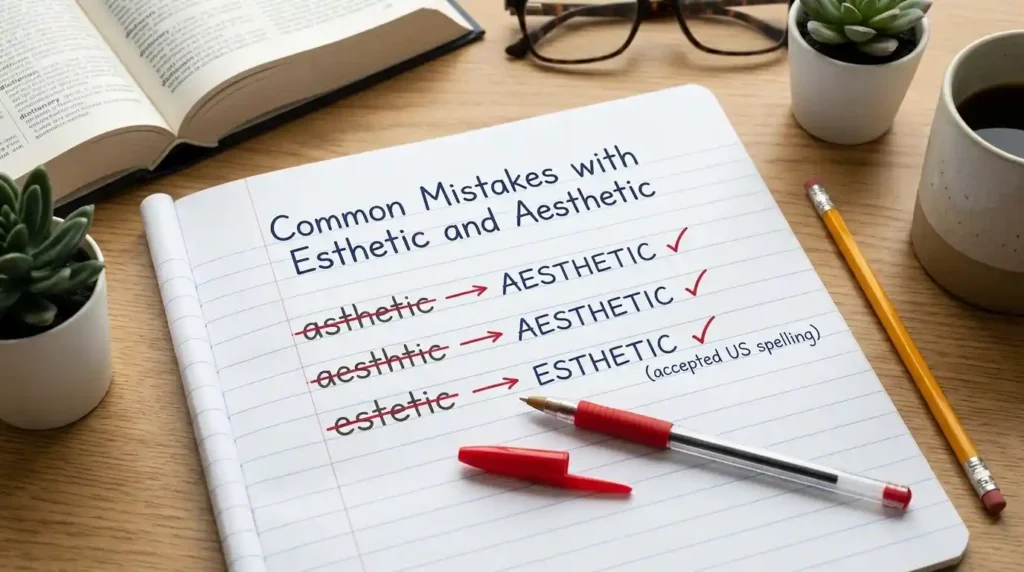
Here are errors people make often. And how to fix them.
1. Mixing both spellings in one piece
❌ The aesthetic of the shop is warm. The esthetic of the menu is simple.
✔ The aesthetic of the shop is warm. The aesthetic of the menu is simple.
Pick one. Stay with it.
2. Dropping the “a” by accident
❌ asthetic, athestic, aesthtic
✔ aesthetic
The word has three vowels in a row at the start: a-e-s. Say it slowly: aes-THET-ic.
3. Using “esthetic” in UK writing
❌ The hotel has a lovely esthetic. (for a UK reader)
✔ The hotel has a lovely aesthetic.
4. Mixing up “aesthetic” and “ascetic”
They look alike. They are not the same.
- Aesthetic = about beauty and style.
- Ascetic = living a simple life with strict self-control.
5. Using it as the wrong part of speech
- Adjective: an aesthetic choice
- Noun: the aesthetic of the film
- Adverb: aesthetically pleasing
❌ The design is aesthetic pleasing.
✔ The design is aesthetically pleasing.
6. Confusing “aesthetic” and “anesthetic”
“Anesthetic” is a drug that blocks pain. It has a different meaning and spelling.
Esthetic and Aesthetic in Everyday Examples

See how the word works in real life.
In emails
- “Our team loved the clean aesthetic of your design.”
- “Please send ideas that match the brand’s aesthetic.”
In news
- “The new stadium has a bold, modern aesthetic.”
- “Critics praised the film’s dark, moody aesthetic.”
On social media
- “Cozy autumn aesthetic 🍂”
- “Rate my room aesthetic 1–10.”
- “That cottagecore aesthetic is everything.”
On social media, “aesthetic” also means a style or vibe. Think “dark academia aesthetic” or “minimalist aesthetic.” People also use it as a slang word, like “This is so aesthetic.”
In formal writing
- “The author explores the aesthetic values of the Romantic period.”
- “Kant’s work shaped modern aesthetic theory.”
- “The committee reviewed both function and aesthetic appeal.”
Where you may see “esthetic”
- “Esthetic dentistry” (US dental clinics)
- “Esthetician license” (US skin care)
- “Esthetic” in older US academic papers
Esthetic or Aesthetic Google Trends & Usage Data
Exact numbers change over time. For live data, check Google Trends yourself. But the pattern has stayed clear for years.
The big picture
- “Aesthetic” is searched far more than “esthetic” worldwide.
- “Esthetic” has a small, steady share of searches.
- Interest in “aesthetic” jumped when social media trends took off. Tags like “aesthetic wallpaper” and “aesthetic outfits” became very popular.
By country (general pattern)
- United States: “Aesthetic” leads. “Esthetic” and “esthetician” show up mostly in beauty, health, and dental searches.
- United Kingdom, Australia, Canada, India, Pakistan: “Aesthetic” dominates. “Esthetic” is very rare.
- Global: “Aesthetic” is the clear leader.
By context
- Social media and fashion: almost always “aesthetic.”
- Art and philosophy: “aesthetic” and “aesthetics.”
- Dental and skin care (US): “esthetic” and “esthetician” appear more often.
- Searches asking “which is correct”: often come from students, writers, and non-native speakers.
Variations side by side
| Term | Common in | Usage Level | Notes |
| aesthetic | Worldwide | Very high | Standard spelling |
| esthetic | Mostly US | Low | Valid variant, often seen as a typo |
| aesthetics | Worldwide | High | Study of beauty, or a style |
| esthetics | Mostly US | Low | Rare variant |
| aesthetically | Worldwide | High | Adverb form |
| esthetically | Mostly US | Very low | Rare variant |
| aesthetician | UK, Commonwealth, some US | Medium | Skin care worker |
| esthetician | Mostly US | Medium to high | Common US license title |
Frequently Asked Questions
Is it “esthetic” or “aesthetic”?
Both are real words. “Aesthetic” is the standard and safest choice. “Esthetic” is a less common US variant.
Is “esthetic” a real word?
Yes. Major US dictionaries list it as a variant of “aesthetic.” But most readers expect the “ae” form.
Do “esthetic” and “aesthetic” mean the same thing?
Yes. They share the same meaning. Both relate to beauty, art, and visual style.
Is “aesthetic” British or American?
It is both. It is standard in the UK and widely used in the US. “Esthetic” is the one that leans American.
Which is correct for SEO and website content?
Use “aesthetic.” People search for it far more. It also looks correct to the widest audience.
What is the difference between “esthetician” and “aesthetician”?
They mean the same job: a skin care professional. “Esthetician” is common in the US. “Aesthetician” is more common in the UK and Commonwealth, and some US readers use it too. Follow your local license or job title.
How do I pronounce it?
Say es-THET-ik. Both spellings sound the same.
What is the difference between “aesthetic” and “ascetic”?
“Aesthetic” is about beauty. “Ascetic” is about a simple, self-disciplined life.
Conclusion
So, esthetic or aesthetic? The answer is simple. Use aesthetic.
Both spellings are real. Both mean the same thing. But “aesthetic” is the standard form. It works in the US, the UK, and across the world. “Esthetic” is a rare US variant. Many readers will see it as a typo.
Here are the key points to remember:
- Aesthetic is the safe, standard choice.
- Esthetic is valid but uncommon, mostly in US dental and skin care fields.
- British and Commonwealth English use “aesthetic.”
- Never mix both spellings in one piece of writing.
- Do not confuse “aesthetic” with “ascetic” or “anesthetic.”
- For SEO, “aesthetic” wins by a wide margin.
If a style guide tells you otherwise, follow it. If it does not, write “aesthetic” and move on with confidence.
Good writing builds trust. A correct spelling shows care. Now you know the right one.

“I’m Ibadat Fatima, a professional content writer and author with 3 years of experience in writing, editing, and storytelling. I share my work through visitlivo.com, where I help readers connect with clear, engaging, and well-crafted content.”