You are writing about someone from El Salvador. You type the word and stop. Is it Salvadoran or Salvadorian? Both look right. Both show up online. So which one is correct?
You are not alone. Many people search this question every month. Writers, students, journalists, and business owners all want to get it right. A wrong word can look careless. It can also upset readers who care about how their identity is named.
Here is the short story. Salvadoran is the main spelling in modern English. Salvadorian is a less common variant. Salvadorean also exists, mostly in British writing. All three point to the same people and the same country.
This guide clears up the confusion. You will learn where the word comes from, how US and UK spelling differ, and which form to pick for your audience. You will see real examples, common mistakes, and a quick FAQ. By the end, you will know exactly which word to use and why. Let’s start with the fast answer.
Salvadoran or Salvadorian Quick Answer
Use “Salvadoran.” It is the standard spelling in American English. It is also the form used by most major style guides, news outlets, and government agencies.
“Salvadorian” is not wrong. Some dictionaries list it as a variant. But it is rarer, and many readers see it as less polished.
Here are simple examples:
- She is a Salvadoran doctor.
- We ate Salvadoran pupusas for dinner.
- The Salvadoran flag is blue and white.
- A Salvadorian neighbor helped us. (Correct, but less common.)
Both words can be a noun or an adjective. A Salvadoran is a person. Salvadoran food is a thing that comes from El Salvador.
The Origin of Salvadoran and Salvadorian
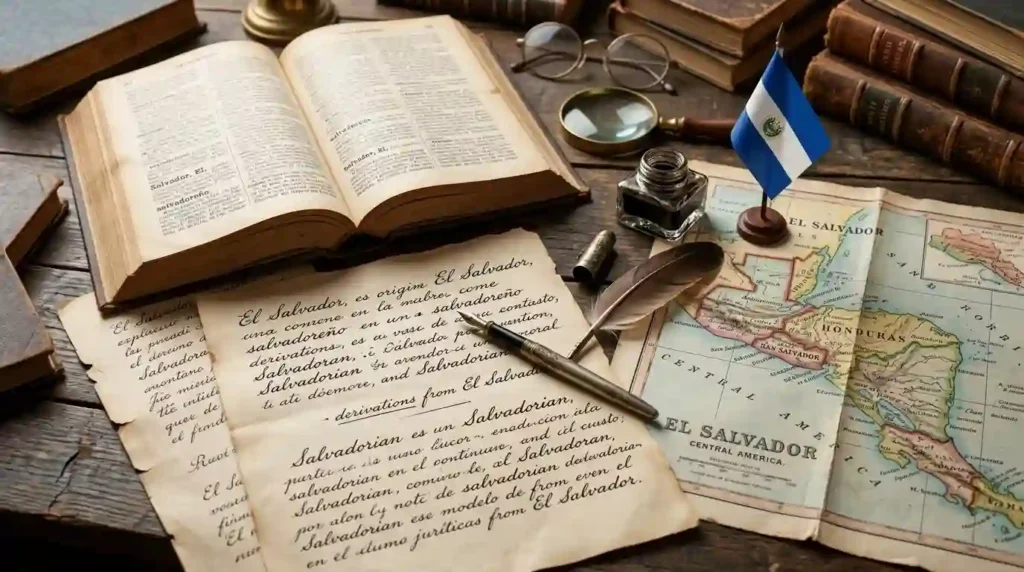
The word comes from the country’s name. “El Salvador” is Spanish for “The Savior.” Spanish explorers used the name in the 1500s. It honors Jesus Christ, “the Divine Savior of the World.” The capital, San Salvador, carries the same root.
In Spanish, a person from the country is a salvadoreño (man) or salvadoreña (woman). English needed its own word. Writers made one by adding an ending to “Salvador.”
That is where the split began. English has two common endings for people and places:
- -an, as in American and Mexican
- -ian, as in Canadian and Brazilian
Writers tried both. Some also tried Salvadorean, which copies the Spanish “-eño” sound more closely. No single rule forced one choice at first. Over time, usage settled. “Salvadoran” became the favorite, and many Salvadorans and Salvadoran-Americans use it too. The other forms stayed around as variants.
So spelling differences exist for a simple reason. English borrowed a Spanish name and shaped it three ways.
British English vs American English Spelling
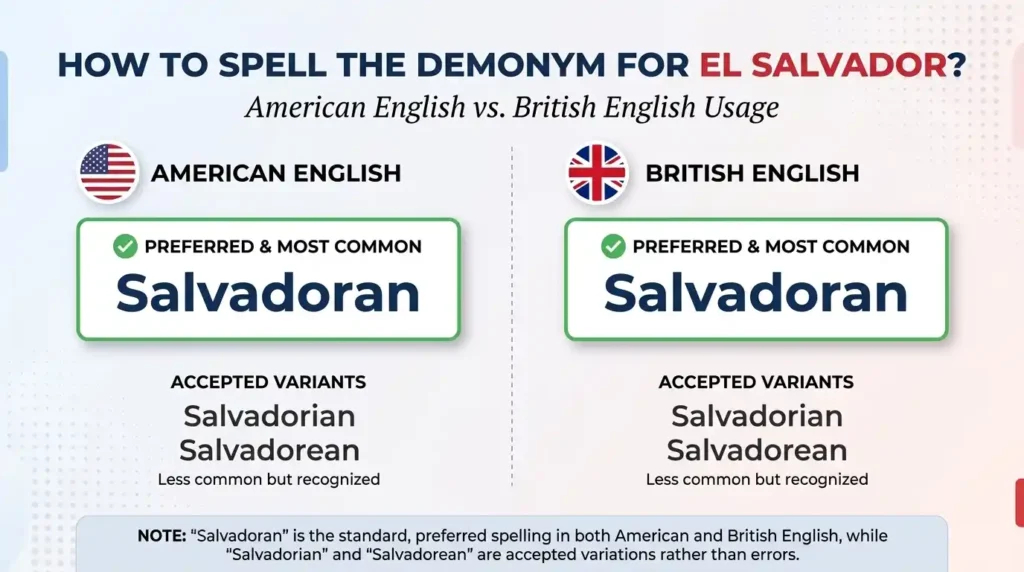
This is not a classic spelling fight like color and colour. It is more about habit and preference. Still, a pattern shows up.
- American English strongly prefers Salvadoran.
- British English accepts Salvadoran and also uses Salvadorean.
- Salvadorian appears in both, but it is the least favored in formal writing.
Note: dictionaries and style guides differ in small ways. Check the one your school, job, or publisher uses.
| Spelling | American English | British English | Formal Use |
| Salvadoran | Standard | Common | Recommended |
| Salvadorean | Rare | Used sometimes | Acceptable |
| Salvadorian | Used, less common | Used, less common | Avoid if unsure |
A simple tip: if you must pick one for everyone, pick Salvadoran. It works in every English-speaking region.
Which Spelling Should You Use?
The best choice depends on your reader.
For a US audience: Use Salvadoran. News outlets, schools, and the government all use it. It is the safe pick.
For a UK or Commonwealth audience: Use Salvadoran or Salvadorean. Either is fine. Pick one and stay with it. Do not mix them in one text.
For a global audience: Use Salvadoran. It is the most widely understood form. It also matches what most readers see online.
For SEO or web content: Use Salvadoran in your main text. If you want to catch searchers who type the other spelling, mention it once, as this article does.
Quote or name rule: If a person or company uses a certain spelling in its name, copy it exactly. Never “fix” someone’s name.
Common Mistakes with Salvadoran and Salvadorian
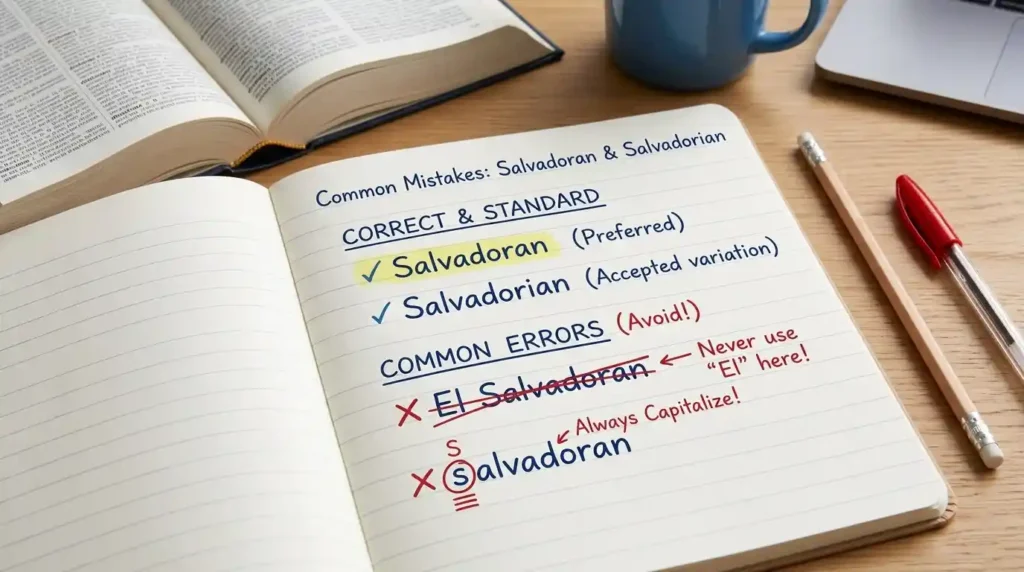
Here are the errors people make most, and how to fix them.
- Mixing spellings in one text. Writing “Salvadoran” in paragraph one and “Salvadorian” in paragraph four looks sloppy. Fix: Pick one and use it throughout.
- Writing “El Salvadoran.” The country is El Salvador. The people are Salvadoran. Fix: Drop the “El” when naming people.
- Using lowercase. Words that come from place names need capitals. Fix: Write “Salvadoran,” not “salvadoran.”
- Confusing the country and the person. “She is from Salvadoran” is wrong. Fix: “She is from El Salvador. She is Salvadoran.”
- Mixing it up with Salvador. Salvador is also a name, and a city in Brazil. Fix: Use “Salvadoran” only for El Salvador.
- Adding extra letters. Typos like “Salvadorian” spelled “Salvadorean” by accident, or “Salvadorran,” are common. Fix: Proofread the word each time.
- Assuming one spelling is an insult. It is not. But “Salvadoran” is the safest choice.
Salvadoran and Salvadorian in Everyday Examples
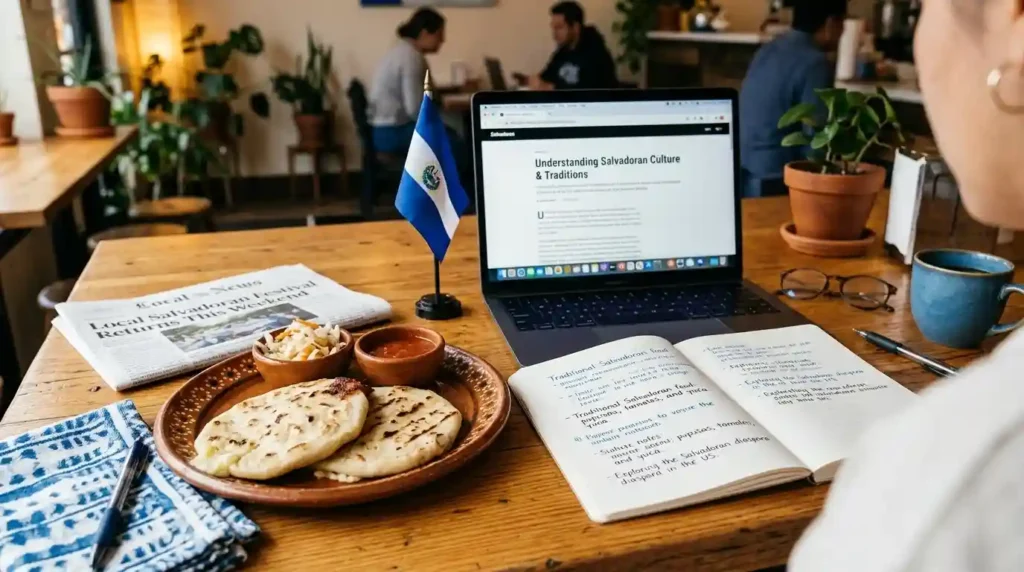
See how the word looks in real writing.
Hi Maria, thank you for the invite. I would love to try the Salvadoran restaurant you mentioned.
News headline
Salvadoran Farmers Report Strong Coffee Harvest
Social media
Best pupusas ever! Shoutout to this Salvadoran family-run spot. 🇸🇻
Formal or academic writing
The study surveyed 400 Salvadoran immigrants about their access to health care.
Business writing
Our Salvadoran suppliers ship fresh goods every week.
Variant use (less common)
My Salvadorian grandmother taught me to cook.
Notice how natural “Salvadoran” looks in each place. It fits formal and casual writing alike.
Salvadoran or Salvadorian Google Trends and Usage Data
Search data tells a clear story. In Google Trends, “Salvadoran” usually draws more interest than “Salvadorian.” The same is true in books and news. “Salvadoran” is the leading form in both.
Why do people search for both? A few reasons:
- The United States: A large Salvadoran-American community lives here. Many searches come from the US, from people writing, studying, or filling out forms.
- Latin America and Spain: Searchers often use Spanish terms like salvadoreño. English searches come from people who use English for work or school.
- UK and Commonwealth: Fewer searches, and more mixed spelling, including Salvadorean.
- Context: Searches rise around news events, elections, travel plans, food, and sports.
The exact numbers change over time. For the freshest picture, open Google Trends and compare the terms yourself. Set the region to your target country. This helps you pick the best word for your readers.
Keyword Variations Side by Side
| Variation | Type | Usage Level | Best For |
| Salvadoran | Standard spelling | Highest | All audiences |
| Salvadorian | Variant spelling | Medium to low | Casual or informal use |
| Salvadorean | Variant spelling | Low | Some UK writing |
| Salvadoreño / Salvadoreña | Spanish word | High in Spanish | Spanish text |
| El Salvadoran | Incorrect form | Low | Avoid |
Frequently Asked Questions
Is it Salvadoran or Salvadorian?
Both appear in English. But Salvadoran is the standard and preferred spelling. Use it when you are unsure.
Is Salvadorian wrong?
No. Some dictionaries list it as a variant. It is just less common and less formal than Salvadoran.
What is the difference between Salvadoran and Salvadorean?
They mean the same thing. Salvadorean is a rarer spelling, seen more in British writing. Salvadoran is safer worldwide.
How do you pronounce Salvadoran?
Say it “sal-vuh-DOR-un.” The stress falls on the third part, “DOR.”
Do I capitalize Salvadoran?
Yes. It comes from a proper name, so it always starts with a capital letter.
What do you call a person from El Salvador?
In English, a Salvadoran. In Spanish, a salvadoreño (man) or salvadoreña (woman).
Which spelling do style guides prefer?
Most major English style guides and news outlets prefer Salvadoran. Always check your own guide if you write for a publisher.
Can I use Salvadoran and Salvadorian in the same article?
It is better not to. Pick one and stay consistent. The only exception is when you explain the difference, as in this guide.
Conclusion
The Salvadoran or Salvadorian question has a simple answer. Use Salvadoran. It is the standard spelling, it is widely accepted, and it works for readers in the US, the UK, and around the world.
Salvadorian is not a mistake. It is a real variant that many people use. Salvadorean is another one, seen mostly in British writing. All three describe people and things from El Salvador, a country whose name means “The Savior” in Spanish.
Remember these key points. Always use a capital letter. Never write “El Salvadoran.” Pick one spelling and keep it the same through your whole text. If a person or brand uses its own spelling, copy it exactly.
When in doubt, ask yourself one question: who is my reader? If you cannot tell, Salvadoran is the safest choice. It looks professional, it matches most dictionaries, and it matches what most people search for.
Now you can write with confidence. if you draft an email, a news story, or a school paper, you know which word to use and why. Bookmark this guide for the next time you need a quick check.

I’m Raheela Rani, a professional content writer and author with 3 years of experience in writing, editing, and storytelling. Through VisitLivo.com, I create clear, engaging, and well-crafted content that helps readers learn, connect, and communicate with confidence.