You are a few days late. Then the bleeding starts. Now you wonder: is this my period or a miscarriage?
You are not alone. Thousands of people type “period or miscarriage” into Google every month. The reason is simple. Early miscarriage can look a lot like a heavy period. Many people lose a pregnancy before they even know they are pregnant. Others have a late or heavy period and fear the worst.
This confusion is stressful. The signs overlap. The words are scary. And it is hard to know who to ask.
This guide gives you clear answers. You will get a quick answer first. Then you will learn about the words, the signs, common mistakes, and when to get help. We use plain language, so you can read it even when you are worried.
One note: this article is for information only. It does not replace a doctor. If you are unsure, test and call a clinician.
Period or Miscarriage Quick Answer
A period is monthly bleeding when you are not pregnant. A miscarriage is the loss of a pregnancy before 20 weeks (some countries use 24 weeks).
Here is how they often differ:
- Timing: A period comes about every 21 to 35 days. A miscarriage bleed often comes after a late period or a positive test.
- Bleeding: A period usually starts light, gets heavier, then fades in 3 to 7 days. A miscarriage can be heavier, with large clots (bigger than a coin).
- Pain: Period cramps are usually mild to moderate. Miscarriage pain can be sharper and stronger, and may come in waves.
- Tissue: Grey or pink tissue, or a sac, can point to miscarriage.
Example 1: Your period is 10 days late. You bleed heavily with strong cramps and big clots. This could be a miscarriage.
Example 2: Your cycle is regular. You bleed on time, for five days, with usual cramps. This is most likely a period.
The only sure way to know is a pregnancy test and a check with a doctor.
The Origin of Period and Miscarriage

Words can add to the confusion, so let’s look at them.
“Period” comes from the Greek word periodos, meaning “a going around” or “a cycle.” Over time, it came to mean a repeating stretch of time. Since the 1800s, it has also meant a monthly cycle.
“Miscarriage” is older English. It comes from the verb miscarry. The prefix mis- means “wrongly,” and carry means to hold. So the word means “to carry wrongly.” Today most people feel this word is harsh. Many doctors and families also say “pregnancy loss” instead.
Doctors also use “spontaneous abortion.” This is the medical term for a miscarriage that happens on its own. It has nothing to do with choosing to end a pregnancy. The term confuses many people, which is why “miscarriage” is the word most used in daily life.
British English vs American English Spelling
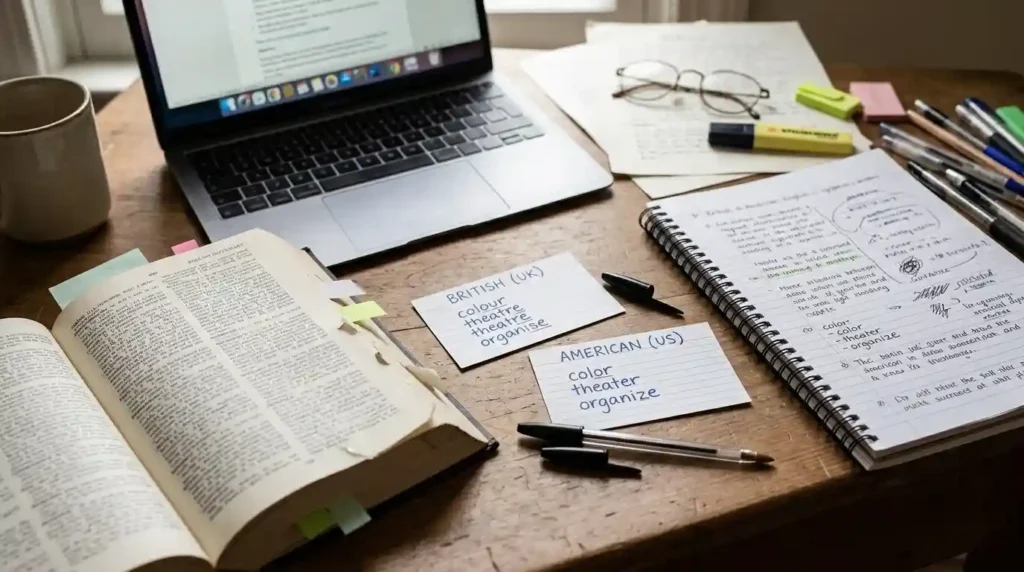
The good news: “period” and “miscarriage” are spelled the same in both British and American English. No spelling fight here.
But other words you will see in this topic do change. Here is a handy table:
| Term | American English | British English |
| Heavy bleeding | hemorrhage | haemorrhage |
| Unborn baby | fetus | foetus |
| Hormone | estrogen | oestrogen |
| Doctor for women’s health | gynecologist | gynaecologist |
| Early pregnancy loss | miscarriage | miscarriage |
| Monthly bleeding | period | period |
| Pad | pad | sanitary towel / pad |
| Hospital clinic visit | OB-GYN | GP or early pregnancy unit |
Tip: Spelling does not change what the words mean. Search results will often show both versions.
Which Spelling Should You Use?
For “period” and “miscarriage,” you can use one spelling worldwide. For the related words, follow your reader:
- US readers: Use fetus, hemorrhage, estrogen, gynecologist.
- UK, Australia, and Commonwealth readers: Use foetus, haemorrhage, oestrogen, gynaecologist.
- Global readers: Pick one style and stay with it. American spelling is the most common online, so it is a safe default. Do not mix the two in one article.
Pro tip for writers: Use gentle words. “Pregnancy loss” is often kinder than “miscarriage.” Pick the term that fits your audience and your tone.
Common Mistakes with Period or Miscarriage

Here are errors people make, with the fix:
- Mistake: “Any heavy bleeding means a miscarriage.”
Fix: Heavy periods are common. Look at timing, clots, and pain, and take a test. - Mistake: “No test is needed if the bleeding is like a period.”
Fix: Early miscarriage can look like a period. If you were late or might be pregnant, test. - Mistake: “A negative home test means I was never pregnant.”
Fix: Tests can be wrong very early. After a loss, hormone levels also fall, so the test may turn negative. - Mistake: “I should wait and see, even if the pain is severe.”
Fix: Severe pain on one side, dizziness, or fainting can mean an ectopic pregnancy. That is an emergency. - Mistake: “A miscarriage is my fault.”
Fix: It is almost never caused by exercise, stress, or something you did. Most are caused by chromosome problems in the embryo. - Mistake: Using the word “abortion” for a miscarriage by mistake.
Fix: Say “spontaneous abortion” only in medical settings. In daily talk, use “miscarriage.”
Period or Miscarriage in Everyday Examples

In a text to a friend:
“My period is a week late and now I’m bleeding with big clots. Could this be a period or miscarriage? I’m calling my doctor.”
In an email to a clinic:
“Hello, I had a positive test five days ago. Today I have heavy bleeding and cramps. I am worried it may be a miscarriage rather than a period. Can I come in today?”
In a news headline:
“Doctors explain how to tell a period from an early miscarriage.”
On social media:
“Was it a period or miscarriage? Nobody told me it could look so alike. Please talk about this more. 💛”
In formal medical writing:
“The patient reported delayed menses followed by heavy bleeding. Differential diagnosis includes menstruation and early pregnancy loss.”
Notice the pattern. People use plain words with friends and careful words with doctors. Both are fine.
Period or Miscarriage Google Trends & Usage Data
I can’t pull live Google Trends numbers here, so I won’t make any up. You can check the real data yourself at trends.google.com. Here is what to look for and why.
Who searches: People search in English-speaking countries such as the US, UK, Canada, Australia, India, Nigeria, and Pakistan. Search phrases often shift by region. For example, you might see “heavy period or miscarriage” in some places and “late period or miscarriage” in others.
When they search: Searches often rise late at night. People tend to look up worrying symptoms when they are alone and cannot call a doctor.
Why it matters: The common themes are heavy bleeding, clots, timing, and fear. A good article should answer these first.
Trend tip: Compare “period or miscarriage” with “heavy period or miscarriage” and “miscarriage symptoms.” The related searches will show what readers truly want to know.
Comparison Table: Keyword Variations Side by Side
| Search phrase | What the person likely wants |
| period or miscarriage | A quick way to tell them apart |
| heavy period or miscarriage | Help with large amounts of blood |
| late period or miscarriage | What late bleeding could mean |
| period or early miscarriage | Signs in the first weeks |
| period or chemical pregnancy | Very early loss, before 5 weeks |
| miscarriage vs period clots | How to judge clots |
| period or miscarriage cramps | if pain is normal |
Period vs. Miscarriage: Signs Side by Side
| Sign | Period | Miscarriage |
| Timing | On time, regular | Often after a late period or positive test |
| Flow | Light, heavier, then light | Can be very heavy, may start suddenly |
| Clots | Small | Large (bigger than a coin), or grey tissue |
| Pain | Mild to moderate cramps | Stronger cramps, back pain, waves |
| Length | 3 to 7 days | Can be longer, or stop and start |
| Pregnancy symptoms | None | Often fade (sore breasts, nausea) |
When to Get Help Right Away
Call emergency services or go to the ER if you have:
- Soaking through two pads in an hour, for two hours
- Severe pain, especially on one side
- Dizziness, fainting, or shoulder pain
- Fever or foul-smelling discharge
Call your doctor the same day if you think you may be pregnant and you are bleeding.
FAQs
How can I tell if it is a period or a miscarriage?
Look at timing, flow, clots, and pain. A late period with heavy bleeding, large clots, and strong cramps may be a miscarriage. A test and a doctor visit give the real answer.
Can a miscarriage look like a normal period?
Yes. Very early losses, often called chemical pregnancies, can look like a slightly late or heavy period.
How heavy is too heavy?
If you soak through two or more pads an hour for two hours in a row, get urgent care.
Should I take a pregnancy test?
Yes, if your period is late or you could be pregnant. If it is negative but you still feel unsure, repeat it in a few days or ask for a blood test.
How long does miscarriage bleeding last?
It varies. Bleeding often lasts from several days to two weeks. Follow your doctor’s advice, especially if bleeding gets heavier or lasts longer.
What causes a miscarriage?
Most are caused by chromosome problems in the embryo. They are not caused by normal activity, lifting, or stress.
When can I try for a baby again?
Many doctors say you can try after one normal period, but some advise waiting. Ask your own doctor. Be kind to yourself, too. Grief is normal.
Conclusion
“Period or miscarriage” is a question many people ask in a scary moment. The signs can look alike, so it is easy to feel lost.
Here is what to remember. A period is regular monthly bleeding. A miscarriage is the loss of an early pregnancy. Timing matters. So do flow, clots, and pain. A late period with heavy bleeding, big clots, and strong cramps should make you test and call a doctor.
The words are spelled the same in British and American English. Related words, such as fetus and foetus, are not. Pick the style your reader uses and stick to it.
Avoid common mistakes. Don’t guess. Don’t blame yourself. And don’t wait to get help if you have strong pain, heavy bleeding, dizziness, or a fever. Those need care right away.
If you have lost a pregnancy, your feelings are real. Talk to someone you trust, or ask your doctor about support. You deserve care and clear answers.

“I’m Ibadat Fatima, a professional content writer and author with 3 years of experience in writing, editing, and storytelling. I share my work through visitlivo.com, where I help readers connect with clear, engaging, and well-crafted content.”