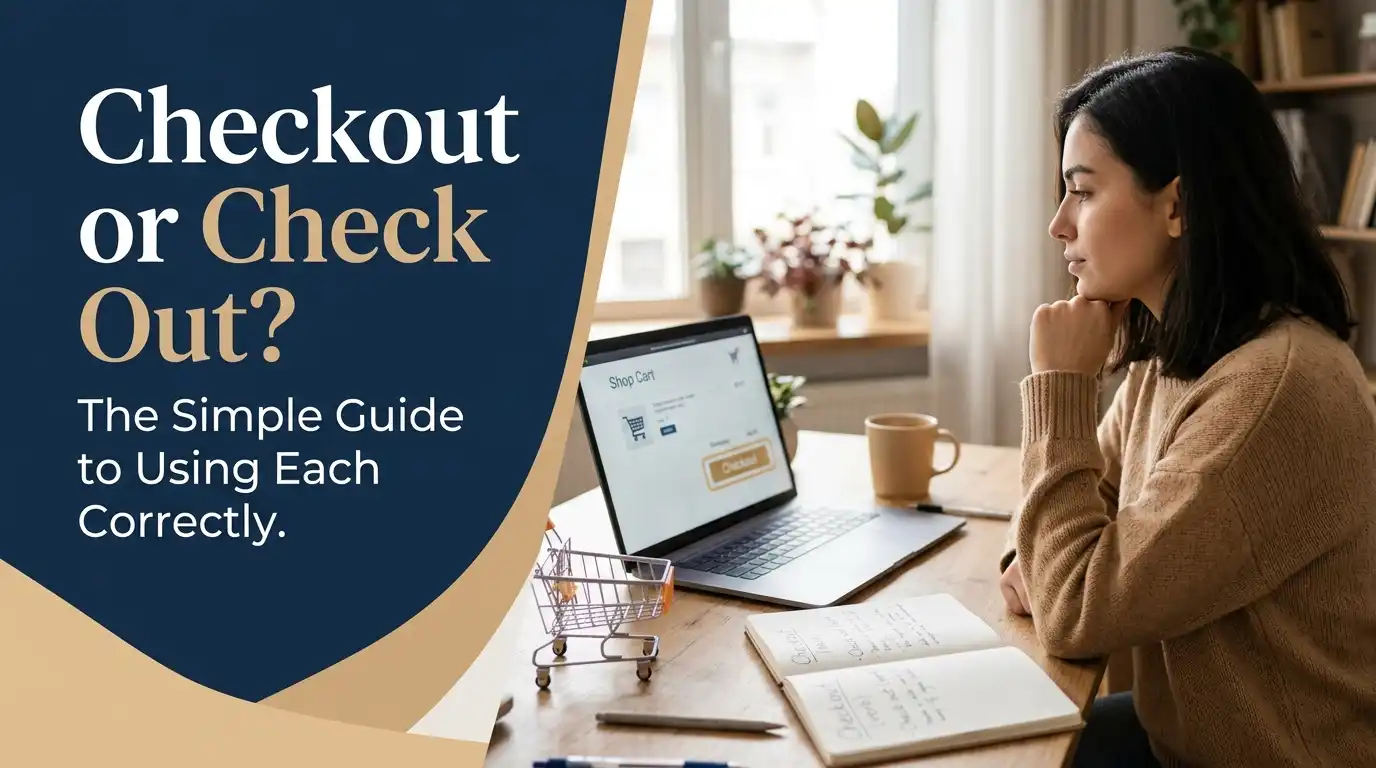
You are shopping online. A button says “Checkout.” Then an email says “Check out our new sale.” Is it the same word? It looks the same. But it is not.
People search “checkout or check out” because the two forms look so close. One small space changes the job of the word. Writers worry about it. Students ask about it. Even store owners get it wrong on their own websites.
This guide clears up the confusion fast. First, you get a quick answer. Then you learn where the words come from. You will see how British and American English treat them. You will also see real examples, common mistakes, and a simple rule you can use every day.
By the end, you will know when to write checkout and when to write check out. No guessing. No stress. Just clear, correct writing that helps you look professional in emails, on websites, and in school or work papers.
Checkout or Check Out Quick Answer
Here is the short rule.
- Checkout (one word) is a noun or an adjective. It names a thing or describes one.
- Check out (two words) is a verb. It is an action.
A good test: can you put “the” or “a” before it? If yes, use checkout. If you can change the tense (checked out, checking out), use check out.
Checkout examples (one word):
- Please go to the checkout.
- The checkout page is slow.
- I waited in the checkout line.
Check out examples (two words):
- We check out at 11 a.m.
- Check out this new video.
- She will check out two books from the library.
The Origin of Checkout and Check Out

The word “check” has an old story. It comes from the game of chess. In old Persian, shah meant king. When you attacked the king, players said “check.” The word moved through Old French and into English.
Over time, “check” took on new meanings. It came to mean stop, test, or control. It also came to mean a mark that shows something was counted or approved.
That is where “check out” comes from. People used it for a kind of control. You checked a book out of a library. You checked out of a hotel. In both cases, you signed off and left with something or left a place.
Then shops changed. Stores began to use a spot where you pay and leave. People called it the checkout. The verb phrase turned into a single noun. This is a common pattern in English. Many two-word verbs become one-word nouns:
- log in (verb) → login (noun)
- back up (verb) → backup (noun)
- set up (verb) → setup (noun)
- check out (verb) → checkout (noun)
So the spelling difference is not random. It follows a rule. The verb has a space. The noun does not.
British English vs American English Spelling
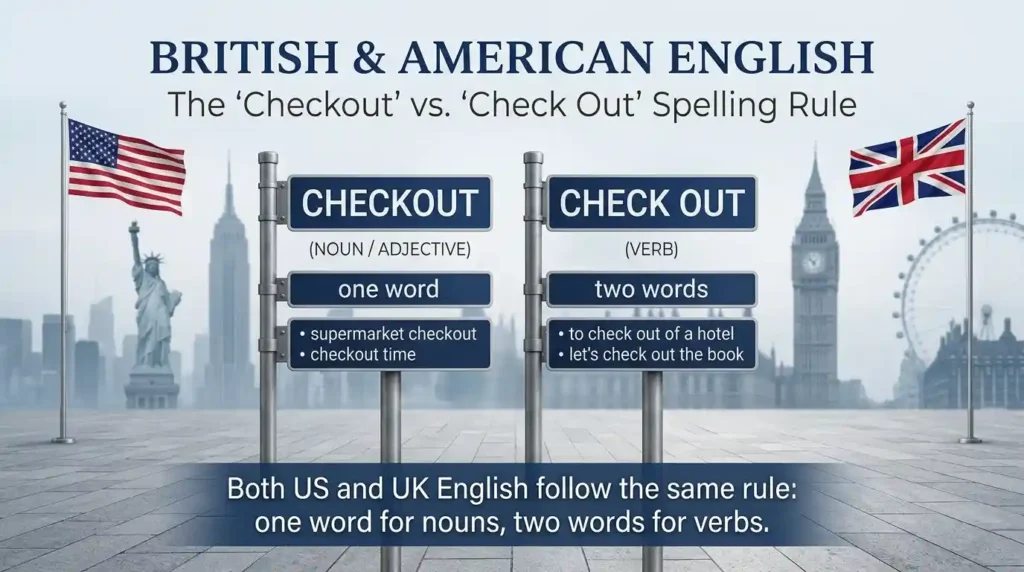
Here is the surprise. This is not a true US versus UK spelling difference.
Most spelling gaps between the two (like color and colour) are about letters. This one is about grammar. Both American and British writers use the same rule. Noun is one word. Verb is two words.
There is one small note. Older British writing sometimes used a hyphen, as in “check-out.” Some UK writers still do this for the noun or for the hotel meaning. Modern dictionaries and most style guides prefer “checkout” for the noun and “check out” for the verb. You will see the hyphen less and less.
| Use | American English | British English | Part of speech |
| Place to pay in a store | checkout | checkout (older: check-out) | Noun |
| Online payment step | checkout | checkout | Noun |
| Checkout counter | checkout counter | checkout counter (also “till” is common in the UK) | Adjective + noun |
| Leave a hotel | check out | check out | Verb |
| Look at something | check out | check out | Verb |
| Borrow a library book | check out | check out (UK also says “borrow”) | Verb |
Tip: in the UK, people often say “till” or “the tills” for the place to pay in a shop. They still say “checkout” online.
Which Spelling Should You Use?
The answer depends on the job of the word, not on where you live. But your audience still matters a little.
If your readers are in the US: Use “checkout” for the noun and “check out” for the verb. This is the standard.
If your readers are in the UK or the Commonwealth: Use the same rule. You may see “check-out” in older books or news. For new writing, skip the hyphen.
If your readers are worldwide: Use the same rule. It is the safest choice. Online stores, apps, and big brands all use “checkout” for the page and “check out” for the action.
Simple choice guide:
- Naming the page, button, line, or counter? Write checkout.
- Telling someone to do something? Write check out.
- Describing a thing with it, like “checkout process”? Write checkout.
Common Mistakes with Checkout and Check Out
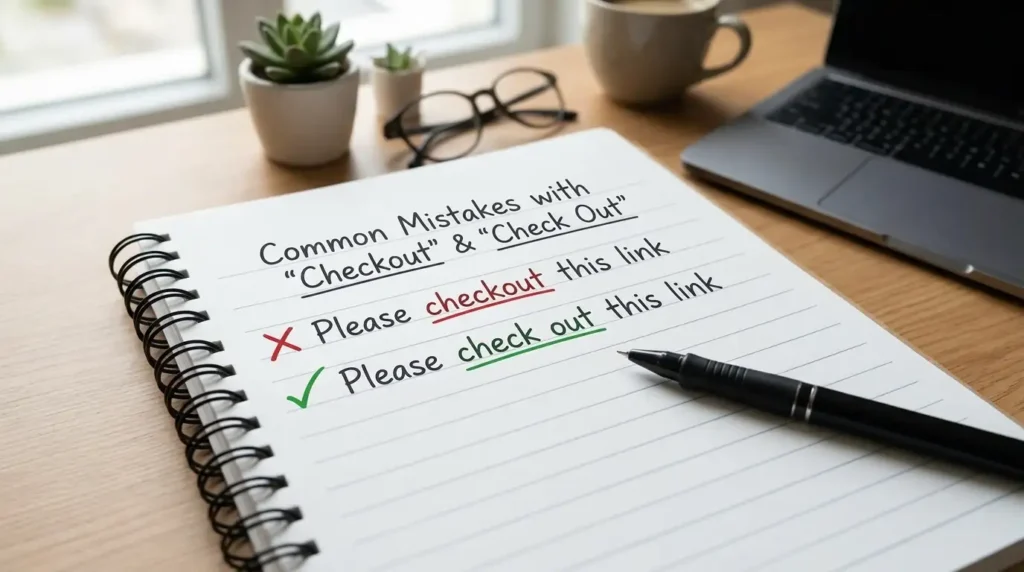
These errors show up all the time. Here is how to fix each one.
Using one word as a verb.
- Wrong: Please checkout this link.
- Right: Please check out this link.
Using two words as a noun.
- Wrong: The check out page is broken.
- Right: The checkout page is broken.
Wrong word in the past tense.
- Wrong: We checkout of the hotel yesterday.
- Right: We checked out of the hotel yesterday.
Writing “checkedout” or “checkingout.”
- Wrong: She is checkingout now.
- Right: She is checking out now.
Wrong button text on a website.
- A button that takes you to pay should say “Checkout.”
- A line that asks you to look at something should say “Check out.”
Mixing the hyphen in.
- Avoid “check-out” in new writing unless your style guide asks for it.
Checkout and Check Out in Everyday Examples
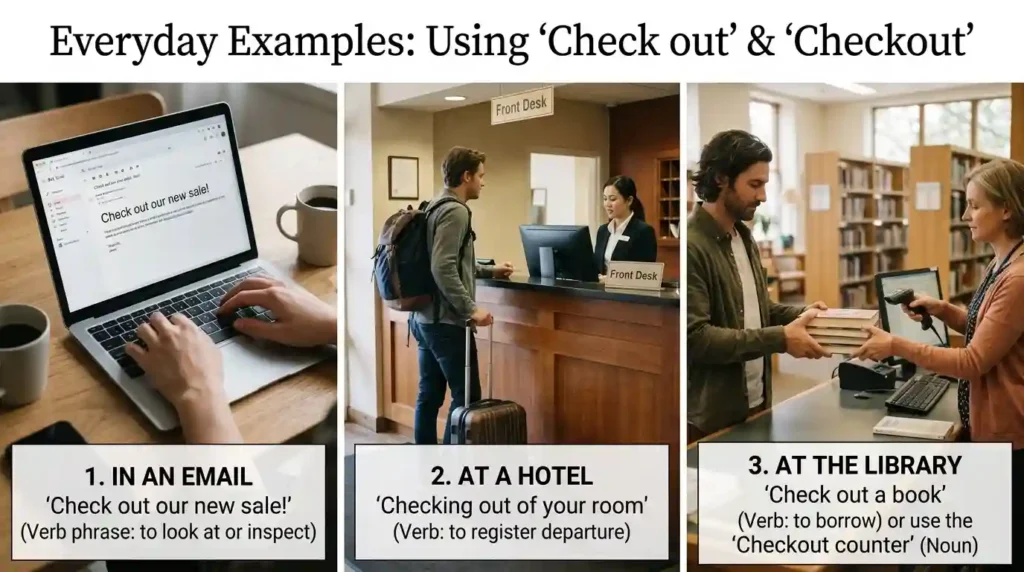
In emails
- “Your cart is waiting. Complete your checkout today.” (noun)
- “Check out our new spring styles.” (verb)
- “Please check out by noon on Friday.” (verb)
In news
- “Shoppers waited in long checkout lines on Friday.” (noun, adjective use)
- “Many stores now offer self-checkout machines.” (noun, adjective use)
- “Guests can check out late with a small fee.” (verb)
On social media
- “Just dropped a new video. Check it out!” (verb)
- “Why is the checkout on this app so slow?” (noun)
- “Quick checkout saved me ten minutes.” (noun)
In formal writing
- “The checkout process must collect only the data it needs.” (noun)
- “Residents may check out books for up to three weeks.” (verb)
- “Staff must check out equipment before use.” (verb)
Notice the pattern. When the word names something, it is one word. When it shows action, it is two.
Checkout or Check Out Google Trends and Usage Data
We do not quote exact numbers here, because search data changes all the time. You can see the latest figures for free in Google Trends. Here is what you will usually find, and why.
Popularity by context
- The one-word form “checkout” is strong in online shopping. It shows up in searches like “checkout page,” “checkout process,” and “guest checkout.”
- The two-word form “check out” is strong in everyday talk and in travel. It shows up in searches like “check out time” and “how to check out of a hotel.”
- Questions about which form is right often rise before big shopping seasons, when many stores update their websites.
Popularity by country
- English-speaking countries with large online retail markets, like the US, the UK, Canada, Australia, and India, tend to search for “checkout” a lot.
- Travel-heavy countries often search for “check out” in hotel and airline settings.
How to check it yourself
- Open Google Trends.
- Type “checkout” and add “check out” to compare.
- Pick a country and a time range.
- Look at the “Related queries” box to see the context.
This simple test shows you which form your own readers search for most.
Checkout vs Check Out – Side-by-Side Comparison
| Form | Part of speech | Meaning | Example |
| checkout | Noun | The place or step where you pay or leave | The checkout is on the left. |
| checkout | Adjective | Describes a noun | Open the checkout page. |
| check out | Verb | To leave, pay and leave, borrow, or look at | We check out at noon. |
| checks out | Verb (he/she/it) | Present tense, third person | She checks out at ten. |
| checked out | Verb (past) | Finished the action | They checked out early. |
| checking out | Verb (ongoing) | Action in progress | He is checking out now. |
| check-out | Hyphenated (older style) | Noun, mostly in older UK writing | The check-out time is 11 a.m. |
| checkedout / checkingout | Not a word | Spelling error | Avoid these. |
FAQs About Checkout and Check Out
Is it checkout or check out?
Both are correct. Use “checkout” as a noun or adjective. Use”check out” as a verb.
Is “checkout” one word or two?
As a noun, it is one word. As a verb, it is two words.
How do you spell the hotel action?
Use two words: “check out.” For example, “We check out at 11 a.m.” The time itself can be called “checkout time.”
Is “check-out” with a hyphen correct?
It is an older style, mostly in UK writing. Today, “checkout” without a hyphen is more common and preferred.
Should the website button say Checkout or Check Out?
Use “Checkout” if the button leads to payment. The button names a step, so it is a noun.
Is there a difference between American and British English?
No big difference. Both follow the same noun and verb rule. Some UK writers use “till” in shops instead of “checkout.”
What is the plural of checkout?
The plural noun is “checkouts.” For example, “The store has ten checkouts.”
Is “self-checkout” correct?
Yes. It is a common noun, such as “self-checkout machine.” Many style guides write it with a hyphen.
Conclusion
Choosing between checkout and check out is easy once you know one rule. If the word names a thing, write checkout. If the word shows an action, write check out.
The rule is the same in the US, the UK, and around the world. It is not a spelling fight between countries. It is a small grammar pattern, just like login and log in, or setup and set up.
Remember these easy points:
- Use “checkout” for the page, line, counter, or process.
- Use “check out” for leaving a hotel, borrowing a book, or looking at something.
- Change the tense? Use two words: checked out, checking out.
- Skip the hyphen in new writing.
- Fix button text on websites. It is one place readers notice mistakes.
Now you can write with confidence. Your emails will look sharper. Your website will feel more trustworthy. And you will never have to stop and wonder again. Save this guide, share it with your team, and check it out whenever a doubt appears.

I’m Raheela Rani, a professional content writer and author with 3 years of experience in writing, editing, and storytelling. Through VisitLivo.com, I create clear, engaging, and well-crafted content that helps readers learn, connect, and communicate with confidence.