Ever stared at a quiz question and felt torn between two simple words? You are not alone. “True or false answers” is one of the most searched phrases online, and it hides more confusion than you might think. Students want to ace their tests. Teachers want to write fair questions. Writers want to know the correct format. Even quiz app developers search this term to build better tools.
The confusion is not really about the words “true” and “false.” It is about how to write them, format them, and use them correctly across different contexts. Should you capitalize them? Is there a British way and an American way? What counts as a trick question?
This guide answers all of that. You will get a quick answer first, then a deep dive into history, spelling habits, common mistakes, and real examples. By the end, you will know exactly how to write, answer, and teach true or false questions with confidence.
True or False Answers Quick Answer
A true or false answer is a response to a statement that can only be correct in one of two ways: true (the statement is accurate) or false (the statement is not accurate). There is no middle ground.
Example 1:
Statement: “The sun rises in the east.”
Answer: True
Example 2:
Statement: “Spiders are insects.”
Answer: False (spiders are arachnids, not insects)
Example 3:
Statement: “Water boils at 100°C at sea level.”
Answer: True
The format stays simple. One statement. One fact-check. One word as your answer.
The Origin of True or False Answers

The words “true” and “false” come from old roots. “True” comes from the Old English word triewe, which meant faithful or trustworthy. “False” comes from the Latin word falsus, meaning deceived or mistaken. Both words entered everyday English by the medieval period.
The true or false question format grew out of early testing methods in schools. Teachers needed a fast way to check if students understood facts. Instead of asking students to write essays, they wrote simple statements. Students only needed to judge them as correct or incorrect.
This method became popular in the early 1900s in American schools. Psychologists and educators liked it because it was easy to grade and easy to score. Over time, it spread to other countries and into games, surveys, and online quizzes.
Spelling and formatting differences did not come from the words themselves. They came from different writing traditions in the US, UK, and other English-speaking countries. Each region built its own habits around capitalization, punctuation, and phrasing.
British English vs American English Spelling
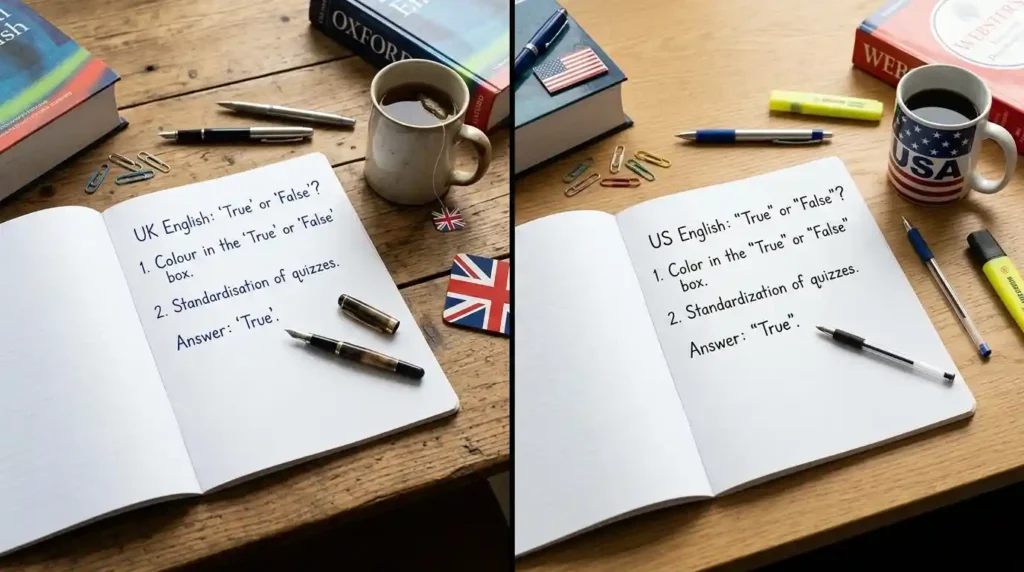
The words “true” and “false” are spelled the same way in both British and American English. There is no spelling split like “colour” versus “color.” But the style of writing true or false questions does differ.
American style tends to use a colon and full capitalization for instructions:
“TRUE or FALSE: The Earth has one moon.”
British style tends to use lowercase and a question mark:
“Is this statement true or false? The Earth has one moon.”
American test writers often place “True” and “False” as answer choices directly under the statement. British and Commonwealth writers often use a sentence format that asks the reader to judge the claim.
Comparison Table: Spelling and Style Differences
| Feature | American English | British English |
| Word spelling | true / false | true / false (no change) |
| Common format | “TRUE or FALSE:” | “True or false?” |
| Capitalization | Often fully capitalized | Often lowercase |
| Punctuation | Colon (:) common | Question mark (?) common |
| Answer style | T / F shorthand common | Full words more common |
| Test culture | Multiple-choice heavy | Essay and short-answer heavy |
Which Spelling Should You Use?
Since the spelling never changes, the real question is which format fits your audience.
If you write for a US audience:
Use “TRUE or FALSE:” with a colon. Capitalize both words. This matches standard American test formatting and feels familiar to US readers.
If you write for a UK or Commonwealth audience:
Use “True or false?” with a question mark. Keep the words lowercase unless they start a sentence. This matches British, Australian, and Canadian school and workplace conventions.
If you write for a global or online audience:
Use the simplest, cleanest format: “True or False” with a question mark or colon, whichever reads better in context. Online quizzes and apps often blend both styles, so consistency within your own content matters more than picking one national style.
Common Mistakes with True or False Answers

Mistake 1: Writing opinion statements instead of fact statements
“Pizza is the best food” cannot be true or false. It is an opinion. Fix this by writing statements based on verifiable facts.
Mistake 2: Using double negatives
“It is not false that cats are not mammals” confuses readers. Fix this by writing statements in plain, positive language.
Mistake 3: Mixing two ideas in one statement
“The French Revolution started in 1789 and ended peacefully” mixes a true fact with a false one. Fix this by testing one idea per statement.
Mistake 4: Vague wording
“Most people think exercise is good” is unclear. Fix this by using precise, checkable claims.
Mistake 5: Answering with anything other than “true” or “false”
Writing “sort of” or “maybe” breaks the format. Fix this by committing to one of the two answers, even when a statement feels tricky.
True or False Answers in Everyday Examples
In emails:
“Quick check before the meeting: True or false, the deadline moved to Friday?”
In news writing:
Fact-checking sites often use this exact format: “Claim: The policy cuts taxes for everyone. Verdict: False.”
In social media:
“True or false: Honey never spoils. Drop your answer below!”
In formal writing:
“The following statement is true or false. Mark your response accordingly: The report was submitted on time.”
In classrooms:
“True or False: Photosynthesis occurs only in sunlight.”
These examples show how flexible the format is. It works in casual chats and formal documents alike.
True or False Answers Google Trends & Usage Data

Search interest in “true or false answers” stays steady year-round, with noticeable spikes during school exam seasons in September and January. The United States drives the largest share of searches, followed by the United Kingdom, India, Canada, and Australia.
Most searches come from students looking for quiz help, teachers building tests, and trivia or quiz app users checking facts. Search volume also rises around major news events, when fact-checking sites publish “true or false” verdicts on viral claims.
Mobile searches make up the majority of this traffic, which suggests people search this phrase while studying, playing games, or scrolling social media rather than at a desktop.
Comparison Table: Keyword Variations
| Variation | Common Use | Region |
| True or false | General, quizzes, tests | Global |
| True/False | Shorthand, forms | US-heavy |
| T or F | Casual, texting, games | US-heavy |
| True false questions | SEO, education content | Global |
| Fact or fiction | Informal alternative | US-heavy |
| Right or wrong | Loose alternative (not exact) | Global |
FAQs
Is it “true or false” or “true/false”?
Both are correct. “True or false” reads better in sentences. “True/false” works well as a label on forms or answer sheets.
Do true or false questions have a trick answer?
Sometimes. Trick statements often hide one false detail inside a mostly true sentence. Read every word carefully before answering.
Can a true or false question have two correct answers?
No. A well-written true or false question has exactly one correct answer. If both seem correct, the question needs rewriting.
Is “True” or “False” capitalized when writing an answer?
Capitalize it if it stands alone as an answer choice, like “True” on a form. Keep it lowercase inside a sentence, like “the statement is true.”
What is the difference between true or false and multiple choice?
True or false gives only two options. Multiple choice gives three or more. True or false is faster to write and grade but easier to guess correctly by chance.
Why do some true or false questions feel confusing?
Confusing questions usually mix multiple facts, use double negatives, or rely on vague wording. Clear, single-fact statements avoid this problem.
Are true or false questions reliable for testing knowledge?
They work well for checking basic facts but not for testing deep understanding, since guessing gives a 50% chance of a correct answer.
Conclusion
True or false answers seem simple, but small details in wording and format can trip up students, teachers, and writers alike. The good news: the spelling of “true” and “false” never changes between American and British English. What changes is style. Americans tend to favor colons and full capitals. British and Commonwealth writers tend to favor question marks and lowercase text.
To write clear true or false questions, stick to one fact per statement, avoid double negatives, and skip vague language. To answer them well, commit fully to “true” or “false,” even when a statement feels tricky.
If you are building a classroom quiz, writing a fact-check article, or creating a trivia app, this format works best when kept simple. Match your style to your audience, keep statements precise, and always base them on checkable facts. Master these basics, and true or false questions become one of the easiest formats to write and answer correctly.

I’m Raheela Rani, a professional content writer and author with 3 years of experience in writing, editing, and storytelling. Through VisitLivo.com, I create clear, engaging, and well-crafted content that helps readers learn, connect, and communicate with confidence.