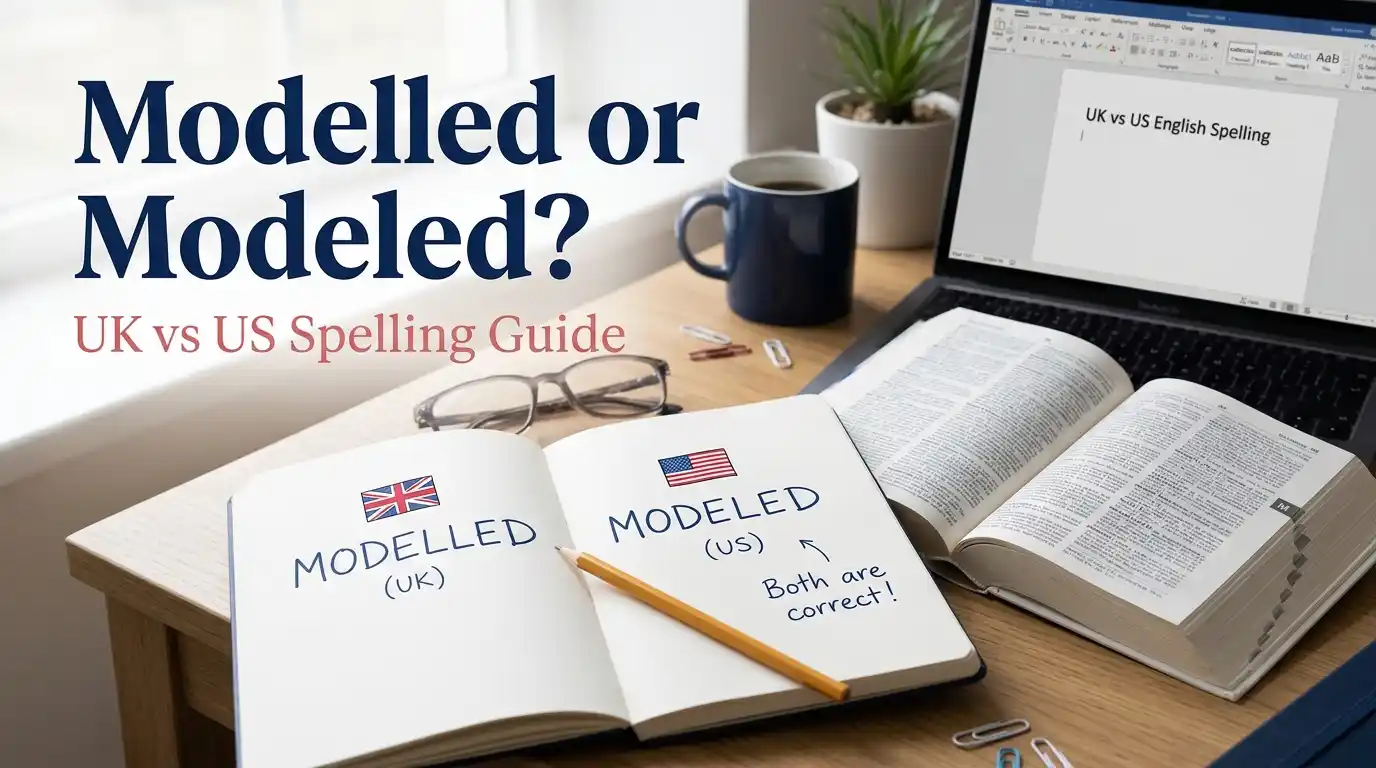
You are writing an email. You type “modeled.” Then you stop. Does it look wrong? You change it to “modelled.” Now that looks odd too. You are not alone. Every day, many people search “modelled or modeled” because they want a fast, clear answer.
The confusion is real. Both spellings look right. Both show up in books, news, and websites. So which one should you use? The short answer is that both are correct. They are just used in different places. One is common in the United States. The other is common in the United Kingdom and many other countries.
This guide clears up the mess. You will learn what the word means, where each spelling came from, and which one to pick for your readers. You will also see real examples, common mistakes, and simple rules you can use right away.
By the end, you will never second-guess this word again. Let’s start with the quick answer.
Modelled or Modeled Quick Answer
Modeled is the American spelling. Modelled is the British spelling. They mean the same thing.
Use modeled if your readers are in the United States. Use modelled if your readers are in the UK, Australia, New Zealand, India, South Africa, or Canada.
Both words are the past tense of the verb “to model.” Here are some examples:
- US: She modeled the new jacket for the photo shoot.
- UK: She modelled the new jacket for the photo shoot.
- US: The team modeled the data to predict sales.
- UK: The team modelled the data to predict sales.
Pick one spelling. Then use it every time in the same piece of writing.
The Origin of Modelled and Modeled
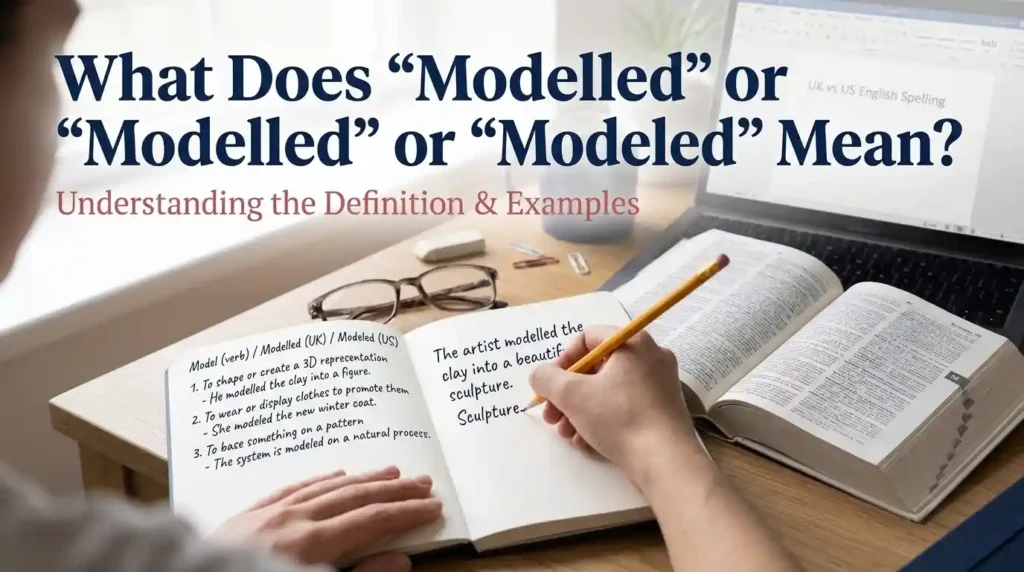
The word starts with the Latin word modulus. It meant “a small measure.” Italian turned it into modello, which meant a small copy or plan. French then used modèle. English borrowed the word in the 1500s. At first, it was a noun. People used it to mean a plan or a small copy of something, like a building.
Later, people began to use “model” as a verb. To model something meant to shape it or copy it. So the past tense was needed: modelled or modeled.
Why two spellings? It comes down to one old rule and one big change.
British English kept the old habit. When a word ends in one vowel plus the letter L, the L gets doubled before -ed or -ing. So travel becomes travelled, and model becomes modelled.
In the early 1800s, an American writer named Noah Webster wanted spelling to be simpler. He cut extra letters. His dictionary helped spread the shorter forms in the US. That is why Americans write modeled, traveled, and canceled.
British English vs American English Spelling
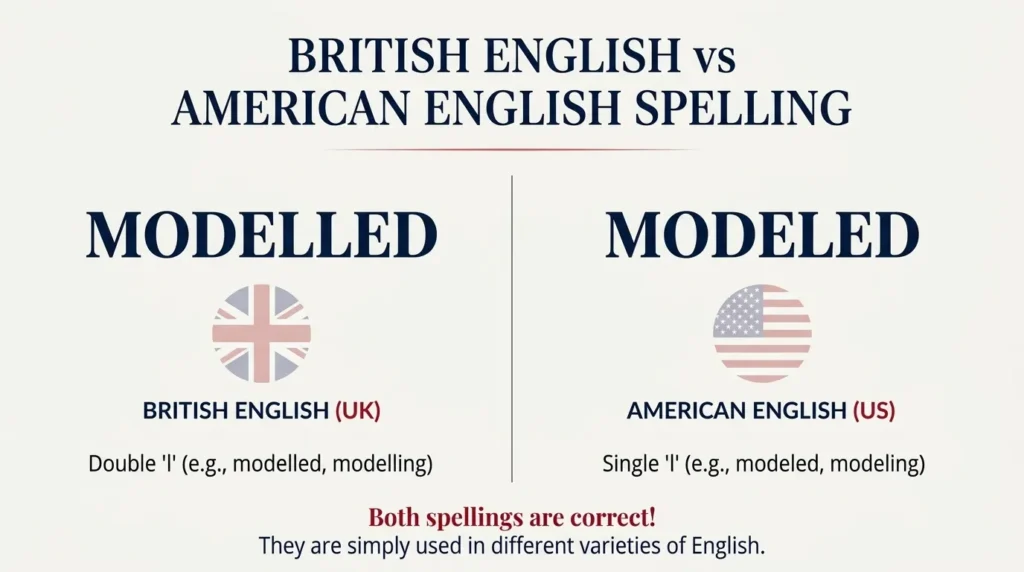
The rule is simple. British English usually doubles the final L. American English usually keeps one L, unless the last syllable is stressed. In “model,” the stress falls on the first syllable (MOD-el). So Americans write one L.
Here are more words that follow the same pattern:
| Base Word | American Spelling | British Spelling |
| model | modeled / modeling | modelled / modelling |
| travel | traveled / traveling | travelled / travelling |
| cancel | canceled / canceling | cancelled / cancelling |
| label | labeled / labeling | labelled / labelling |
| level | leveled / leveling | levelled / levelling |
| signal | signaled / signaling | signalled / signalling |
There are exceptions. Words like compel and rebel have stress on the last syllable. So both US and UK writers double the L: compelled, rebelled.
Which Spelling Should You Use?
Think about who will read your work.
Writing for a US audience: Use modeled and modeling. Most US style guides, like AP and Chicago, prefer these forms.
Writing for a UK or Commonwealth audience: Use modelled and modelling. This is standard in the UK, Australia, New Zealand, India, and South Africa. Canada also tends to use the double L, though you will see both there.
Writing for a global audience: Pick the one that fits most of your readers. If your readers are mixed, choose one and stick with it. Set your spellchecker to match. A mix of both spellings looks careless.
Writing for school or work: Check the style guide first. Your teacher, boss, or client may have a rule. Follow it.
Common Mistakes with Modelled and Modeled

Here are the errors people make most often.
Mixing spellings in one document.
- Wrong: The artist modeled the clay, and then she modelled the dress.
- Right: The artist modelled the clay, and then she modelled the dress.
Using one L in British writing.
- Wrong: The scientist modeled the weather (in a UK paper).
- Right: The scientist modelled the weather.
Using two Ls in American writing.
- Wrong: The firm modelled its costs (in a US report).
- Right: The firm modeled its costs.
Changing only the past tense.
If you write modeled, you should also write modeling. If you write modelled, write modelling.
Thinking one spelling is a typo.
Neither one is. Do not “fix” someone else’s spelling unless you know their audience.
Modelled and Modeled in Everyday Examples
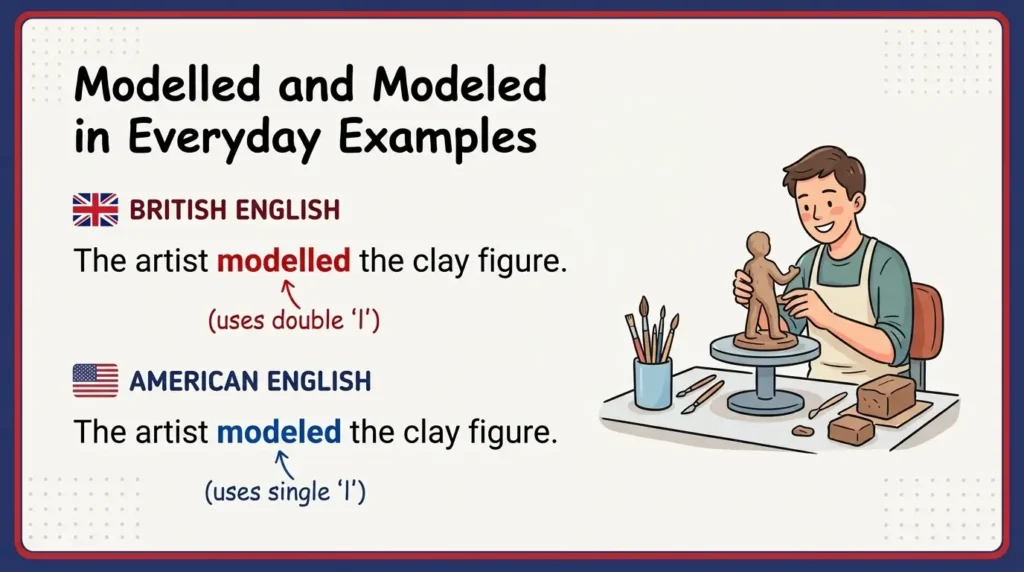
- US: “I modeled the budget in Excel. Please see the file.”
- UK: “I modelled the budget in Excel. Please see the file.”
News headline
- US: “Study Finds Climate Data Was Modeled Correctly”
- UK: “Study Finds Climate Data Was Modelled Correctly”
Social media
- US: “Just modeled my first 3D print design! #makers”
- UK: “Just modelled my first 3D print design! #makers”
Formal writing
- US: “The researchers modeled population growth over ten years.”
- UK: “The researchers modelled population growth over ten years.”
The meaning stays the same. Only the spelling changes.
Modelled or Modeled Google Trends and Usage Data
Search interest in this word follows where people live and what they do.
By country:
- In the United States, people search for modeled far more than modelled.
- In the UK, Australia, New Zealand, India, and South Africa, modelled is the more common choice.
- In Canada, both spellings appear, and modelled has a strong presence.
By context:
- In science, data, and tech, people often write modeled or modelled when talking about data models, weather models, and computer models.
- In fashion and art, people use the word for those who pose or shape things.
- In business, the word shows up in finance and planning.
You can check the latest numbers yourself. Open Google Trends, type in both spellings, and compare them by country and by time. Results change from year to year, so a fresh look is always best.
Keyword Variations Side by Side
| Form | American English | British English | Example |
| Past tense | modeled | modelled | She modeled / modelled for a magazine. |
| Present participle | modeling | modelling | He is modeling / modelling the data. |
| Person who does it | modeler | modeller | The modeler / modeller built a city plan. |
| Base verb | model | model | They model clothes. |
| Noun | model | model | This is a new model. |
Notice that the base word, model, never changes.
Frequently Asked Questions
Is it modelled or modeled?
Both are right. Modeled is American. Modelled is British.
Is “modelled” wrong in American English?
It is not a big error, but it is not standard. US readers may think it looks odd. Use modeled for a US audience.
Is “modeled” wrong in British English?
It is not standard in the UK. British readers expect modelled.
What do Canadians use?
Canadians mix both. Many Canadian style guides prefer modelled, but modeled is common too. Pick one and be consistent.
What about “modeling” and “modelling”?
The same rule applies. Americans write modeling. British writers write modelling.
Why do British writers double the L?
It is an old spelling habit. In British English, a final L often doubles before -ed or -ing, as in travelled and cancelled.
Does the meaning change between the two spellings?
No. The meaning is exactly the same.
Will my spellchecker catch the difference?
Yes, if you set it to the right language. Choose “English (US)” or “English (UK)” in your settings.
Conclusion
So, is it modelled or modeled? The answer is simple. Both are correct. The only difference is where your readers live.
Use modeled for the United States. Use modelled for the UK, Australia, New Zealand, India, South Africa, and often Canada. If your audience is mixed, pick one spelling and use it everywhere. Do not switch back and forth. Also match the other forms: modeling goes with modeled, and modelling goes with modelled.
Remember the rule behind it all. British English doubles the final L. American English keeps it single when the stress is not on the last syllable. This same rule explains traveled and travelled, canceled and cancelled, and labeled and labelled.
When in doubt, check your style guide, set your spellchecker, and think about who is reading. A little care makes your writing look clean and professional.
Now you can type this word with confidence. No more stopping. No more second guesses.

“I’m Ibadat Fatima, a professional content writer and author with 3 years of experience in writing, editing, and storytelling. I share my work through visitlivo.com, where I help readers connect with clear, engaging, and well-crafted content.”