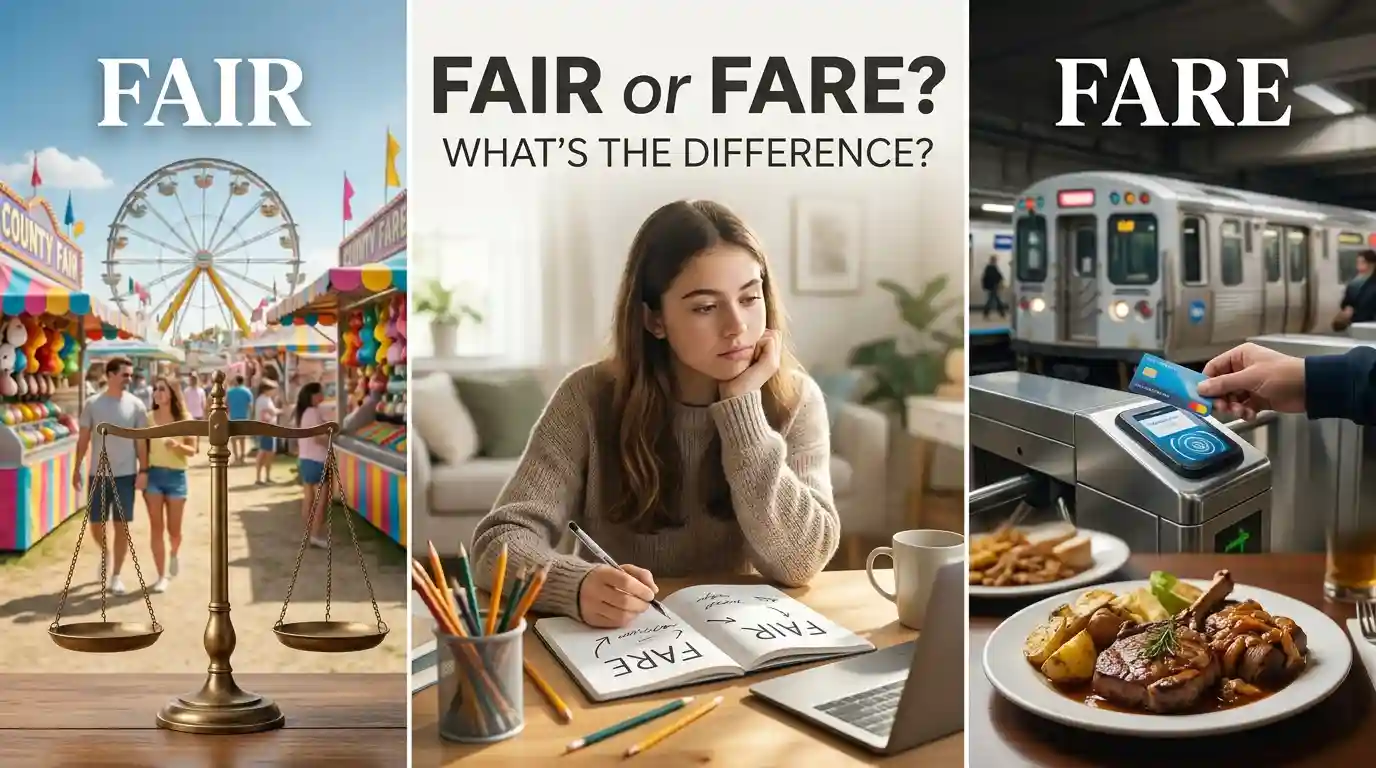
You are writing a sentence. You stop. Is it “fair” or “fare”? You are not alone. Millions of people pause at this exact spot. The two words sound the same. They look almost the same. But they mean very different things.
Pick the wrong one, and your sentence looks odd. “The bus fair is too high” does not work. “That is not fare” does not work either.
People search for “fair or fare” because they want a fast, clear answer. They want to know which word fits their sentence. Many also wonder if it is a UK versus US spelling issue. It is not. These are two separate words, not two spellings of one word.
In this guide, you will get the quick answer first. Then you will learn where each word came from, see real examples, and spot common mistakes. By the end, you will know exactly which word to use, every time. Let’s clear this up for good.
Fair or Fare Quick Answer
Fair describes something just, equal, light, or pleasant. It is also a place with games and rides.
Fare is the money you pay to travel. It is also food that is served. As a verb, it means “to get along.”
Easy trick: fare has “are” in it. Think of “How are you faring?” or “bus fare.” Think of fair as “fairness.”
Examples:
- That rule is fair. (just)
- She has fair skin. (light)
- We went to the county fair. (event)
- The train fare is ten dollars. (travel cost)
- The café serves simple fare. (food)
- How did you fare on the test? (get along)
The Origin of Fair and Fare
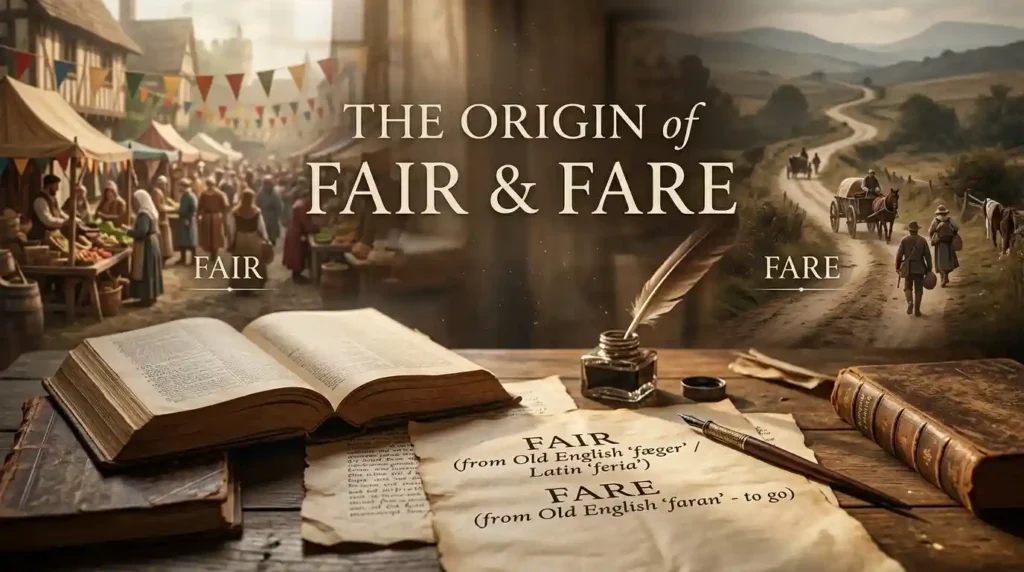
These two words have different roots. They only sound alike by chance.
Fair comes from the Old English word fæger. It meant “beautiful” or “pleasing.” Over time, it also came to mean “just” and “light in color.” The “fair” you visit for rides and food is a different branch. It comes from Old French feire and Latin feria, which meant “holiday” or “market day.”
Fare comes from the Old English word faran, which meant “to travel.” Later, the word grew to mean the price of a trip. It also came to mean the food a traveler ate. That is why you hear “bill of fare” for a menu.
Why do they sound the same? English sounds changed a lot over hundreds of years. Words with different spellings ended up with the same sound. These are called homophones. The spelling kept the old differences alive.
British English vs American English Spelling
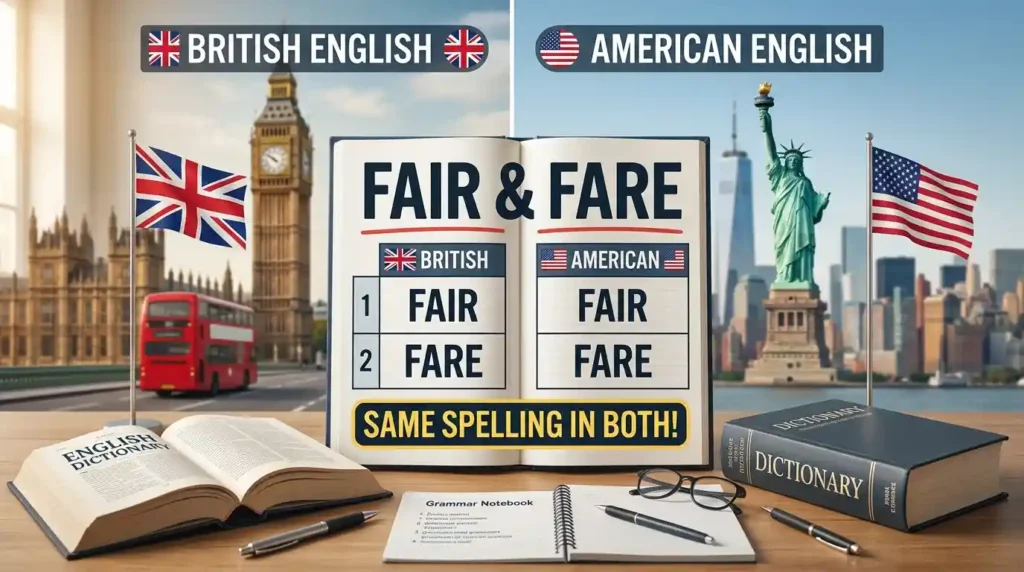
Here is the good news. There is no British or American spelling difference for fair and fare. Both countries spell both words the same way. You do not need to switch spelling based on where your reader lives.
Compare this with true spelling differences like “color” and “colour,” or “center” and “centre.” Those are one word with two spellings. Fair and fare are two words with two meanings.
| Word | Meaning | US Spelling | UK Spelling | Example |
| Fair | Just or equal | fair | fair | That is a fair deal. |
| Fair | Light in color | fair | fair | He has fair hair. |
| Fair | Event with rides | fair | fair | We love the state fair. |
| Fare | Cost of travel | fare | fare | The taxi fare was high. |
| Fare | Food served | fare | fare | The pub serves hearty fare. |
| Fare | To get along | fare | fare | She will fare well. |
A small note on usage: some phrases are more common in one country. “Fair enough” is very common in British speech. “Fair and square” is popular in both. “Fare” for bus or train tickets is common in both countries.
Which Spelling Should You Use?
Choose by meaning, not by country.
- Writing for a US audience: Use “fair” for fairness, looks, and events. Use “fare” for tickets and food.
- Writing for a UK or Commonwealth audience: The rule is the same. Nothing changes.
- Writing for a global audience: The rule is still the same. This makes it one of the easy pairs to learn.
Ask yourself two quick questions:
- Is it about money for travel, food, or how someone is doing? Use fare.
- Is it about justice, light color, okay quality, or an event? Use fair.
Money, food, or doing okay? Fare. Justice, light color, or rides? Fair.
Common Mistakes with Fair and Fare
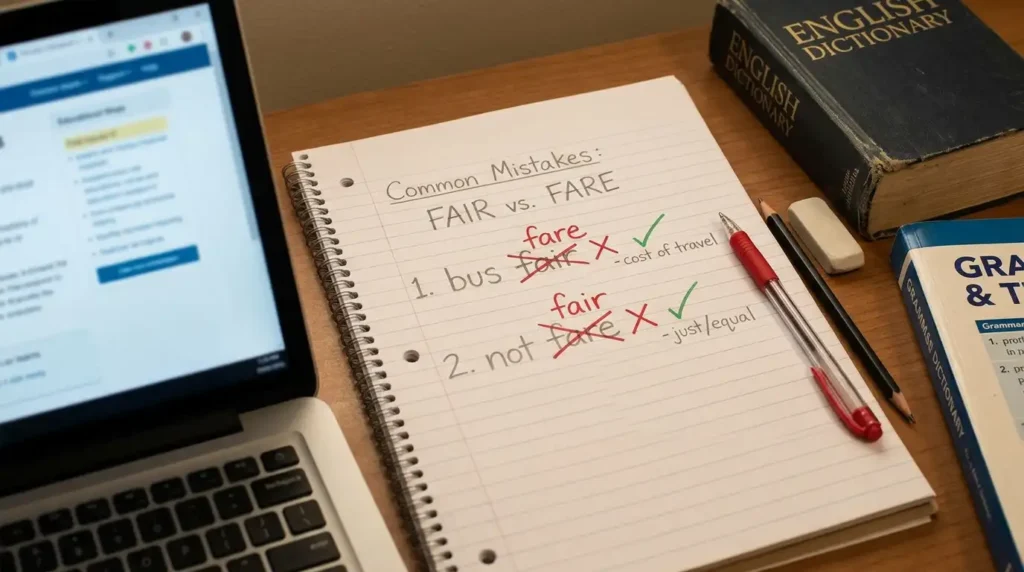
Most errors happen because the two words sound the same. Here are the five mistakes people make most, with the fix for each.
1. Using “fair” for a ticket price
- ❌ The airline fair went up again.
- ✅ The airline fare went up again.
- Why: A ticket price is a fare.
2. Using “fare” for equal treatment
- ❌ That is not fare to me.
- ✅ That is not fair to me.
- Why: Equal and just means fair.
3. Writing “fare” for the event with rides
- ❌ We rode the Ferris wheel at the fare.
- ✅ We rode the Ferris wheel at the fair.
- Why: The event with games and rides is a fair.
4. Mixing up “farewell” and “fare well”
- ✅ Farewell (one word) means goodbye.
- ✅ Fare well (two words) means to do well. Example: “I hope you fare well on your trip.”
- Why: One word is a goodbye. Two words are advice.
5. Getting fixed phrases wrong
- ❌ Fare enough. / Fare game. / Fare and square.
- ✅ Fair enough. / Fair game. / Fair and square.
- Why: All three phrases are about fairness.
- ✅ But it is bill of fare (menu) and fare thee well (be well). Those use fare.
Quick check before you hit send: If the word is about money for travel, food, or doing well, use fare. If it is about justice, light color, or an event, use fair.
Fair and Fare in Everyday Examples
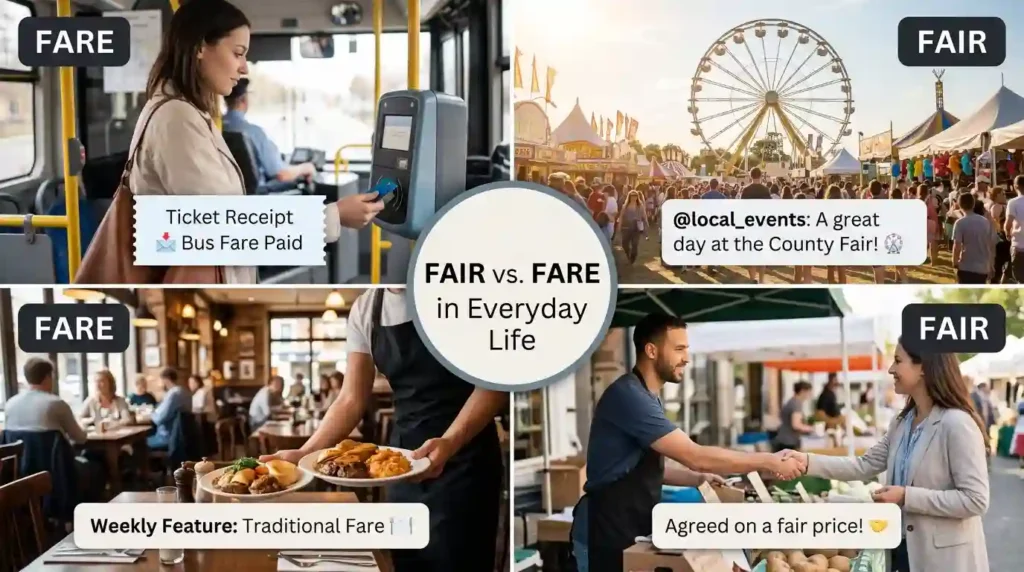
Email:
- “Please check that the train fare is covered by the budget.”
- “I think this is a fair price for the work.”
News headlines:
- “Bus Fares to Rise Next Month”
- “Judge Promises a Fair Trial”
Social media:
- “Spent all day at the fair. Corn dogs for the win!”
- “Okay, fair point. I did forget the tickets.”
Formal writing:
- “The committee will ensure fair treatment of all applicants.”
- “The restaurant offers traditional regional fare.”
Fair or Fare Google Trends & Usage Data
I can’t pull live Google Trends numbers here. So please check the latest data yourself at trends.google.com. Here is what the pattern usually looks like.
People search for “fair or fare” in English-speaking countries such as the US, UK, Canada, Australia, India, and Pakistan. Students and writers are a big part of this group. Searches often rise during school terms and exam seasons.
Usage differs by context. “Fare” appears often in travel news in cities with buses and trains. “Fair” appears more in everyday talk, school writing, and news about courts and events. In summer, “fair” searches can rise because of county and state fairs in the US.
Try this in Google Trends: compare “fair or fare” with “fare or fair.” Then filter by country and by year. You will see which order people type most.
Fair vs Fare: Side-by-Side Comparison
| Feature | Fair | Fare |
| Part of speech | Adjective, noun | Noun, verb |
| Main meaning | Just, equal, or light | Cost of travel or food |
| Other meaning | Event with rides and games | To get along or do |
| Memory trick | Think “fairness” | Think “are” in “fare” |
| Example | It is a fair game. | The bus fare is low. |
| Common phrase | Fair enough | Bill of fare |
| Sound | /fɛr/ | /fɛr/ |
| UK vs US spelling | Same | Same |
Frequently Asked Questions
Is “fair” or “fare” correct for bus tickets?
“Fare.” It is the price you pay to ride.
Is “fair” or “fare” correct for a county event?
“Fair.” The event with rides, games, and food is a fair.
Do the British and Americans spell these words differently?
No. Both countries use the same spelling for both words.
What does “fare thee well” mean?
It is an old way to say “goodbye” or “be well.” It uses “fare” because it comes from the old word meaning “to travel” or “to get along.”
Is it “fair enough” or “fare enough”?
“Fair enough.” It means “that seems reasonable.”
What does “fare” mean in food?
It means the food that is served. For example, “pub fare” means typical pub meals.
How can I remember the difference?
Link “fare” with “are” in “How are you faring?” and with travel costs. Link “fair” with “fairness.”
Are fair and fare homophones?
Yes. They sound the same but have different spellings and meanings.
Conclusion
“Fair or fare” feels tricky because the words sound the same. But the rule is simple once you see it. Fair is about justice, light color, or an event with rides and games. Fare is about travel costs, food served, or how someone gets along.
Remember these key points:
- Fair and fare are two different words, not two spellings of one word.
- There is no US or UK spelling difference. Both countries use the same spelling.
- Use the memory trick: fare has “are” in it, like in “How are you faring?” Think “bus fare” and “pub fare.”
- Think “fairness” when you need fair.
- Check your meaning first. Then pick the word.
Before you hit send or publish, take two seconds to double-check. Ask yourself: Is this about money, food, or doing well? Then it’s fare. Is it about justice, looks, or an event? Then it’s fair. A small check like this makes your writing look sharp and professional.
With these tips, you will not need to search “fair or fare” again.

“I’m Ibadat Fatima, a professional content writer and author with 3 years of experience in writing, editing, and storytelling. I share my work through visitlivo.com, where I help readers connect with clear, engaging, and well-crafted content.”