
Your tooth hurts. Your dentist says it is badly damaged. Now you hear two words: root canal or extraction. Which one is right?
Many people type “root canal or extraction” into Google late at night.They feel nervous. They want answers fast. And they have big questions about pain, cost, and what their smile will look like later.
The confusion is simple. A root canal saves your tooth. An extraction removes it. Both can stop the pain. But they lead to very different paths. Online, people also mix up the terms, the names, and even the spelling. Some say “root canal treatment.” Others say “root canal therapy.” Some say “pulling a tooth.”
This article clears it all up. You will get a quick answer first. Then you will learn the words, the facts, common mistakes, and real examples. You will also see a side-by-side table and answers to common questions. Let’s make this choice easier. Read on, and walk into your dentist’s office with confidence.
Root Canal or Extraction Quick Answer
Save the tooth when you can. Pull it when you can’t.
A root canal removes the sick nerve and germs inside your tooth. The dentist cleans the inside, fills it, and seals it. Then a crown usually covers it. You keep your own tooth.
An extraction takes the whole tooth out. You may then need an implant, bridge, or partial denture to fill the gap.
Examples:
- A tooth has a deep cavity but a strong structure. A root canal is often best.
- A tooth is cracked below the gum line. Extraction is often the only choice.
- A wisdom tooth is stuck and causes pain. Extraction is common.
- You have little money right now. Extraction costs less today, but replacing the tooth later can cost more.
Only your dentist can say for sure after an exam and X-ray.
The Origin of Root Canal and Extraction
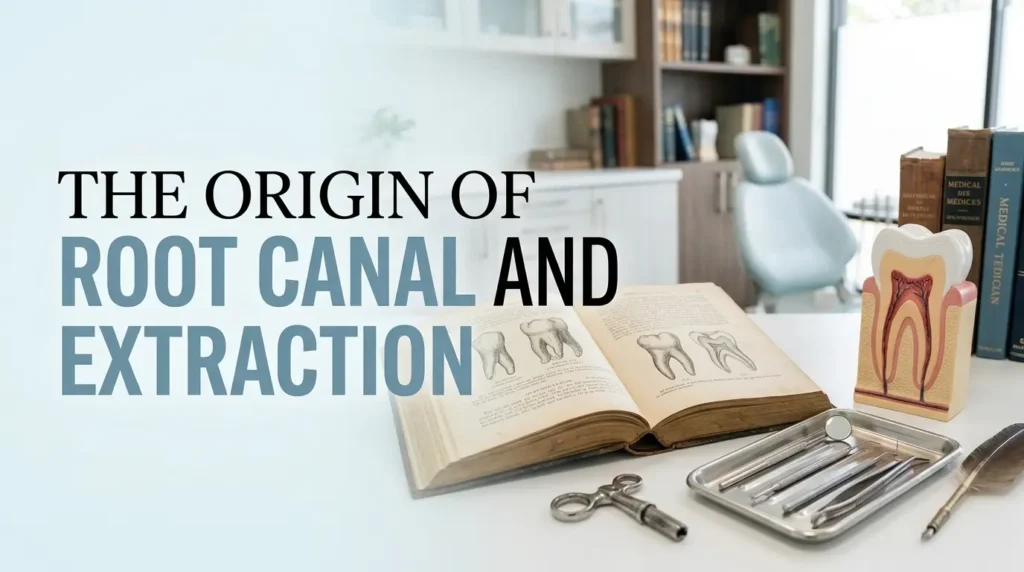
Root canal. Your tooth has roots under the gum. Inside each root is a thin tunnel called a canal. It holds the nerve and blood vessels. That is why the treatment is called a “root canal.”
Extraction. This word comes from the Latin extrahere, which means “to draw out.” That is exactly what the dentist does.
A short history. People have pulled teeth for thousands of years. Saving a tooth by cleaning its inside came much later. Modern root canals became common in the 1900s. Better tools, X-rays, and numbing medicine made them safe and comfortable.
Why do the words vary? Dentists and patients use different names. “Extraction” sounds formal. “Pulling a tooth” sounds casual. “Root canal” is often shortened to “RCT” or just “a root canal.”
British English vs American English Spelling and Terms

“Root canal” and “extraction” are spelled the same in both countries. The differences show up in related words and in common phrases.
| Word or Phrase | American English | British English |
| Treatment name | Root canal therapy | Root canal treatment |
| Numbing medicine | Anesthetic | Anaesthetic |
| Dentist’s workplace | Dentist’s office | Dental surgery / practice |
| Gum swelling | Swelling | Swelling (same) |
| Tooth removal | Extraction / pulling | Extraction / taking out |
| Nerve specialist | Endodontist | Endodontist (same) |
| Fake tooth cover | Crown | Crown (same) |
| Painkiller | Pain reliever | Painkiller / analgesic |
Quick rule: Americans write “anesthetic” and say “office.” Brits write “anaesthetic” and say “surgery” or “practice.”
Which Term Should You Use?
Choose the words that match your reader.
- US readers: Use “root canal therapy” and “dentist’s office.”
- UK and Commonwealth readers: Use “root canal treatment” and “anaesthetic.”
- Global readers: Use “root canal” and “extraction.” Everyone understands them.
- Talking to a dentist: Say “extraction” or “tooth removal.”
- Talking to a friend: “Pulling a tooth” is fine.
When in doubt, keep it short. “Root canal” and “extraction” work everywhere.
Common Mistakes with Root Canal or Extraction
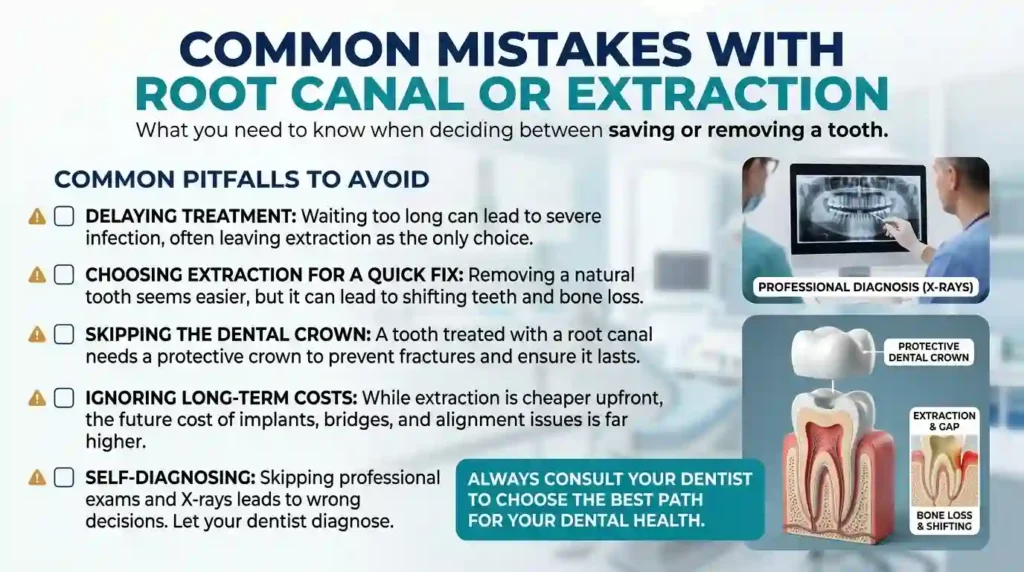
Mistake 1: Thinking a root canal is always painful.
Fix: The tooth hurts because of the infection. The treatment itself is done with numbing medicine and often feels like getting a filling.
Mistake 2: Thinking extraction is the “easy” choice.
Fix: It may cost less today. But a missing tooth can cause shifting teeth, bite problems, and bone loss over time.
Mistake 3: Waiting too long.
Fix: Infection can spread. Swelling, fever, or a bad taste in your mouth means you should call a dentist right away.
Mistake 4: Skipping the crown after a root canal.
Fix: A treated tooth can become weak. A crown protects it.
Mistake 5: Confusing “root canal” with “root canal tooth.”
Fix: The root canal is the treatment. The tooth is still a normal tooth.
Mistake 6: Believing myths from social media.
Fix: Ask your dentist. Do not trust random posts.
Root Canal or Extraction in Everyday Examples

Email to a dentist:
“Hello Dr. Khan, my molar hurts when I chew. Do I need a root canal or extraction? Please share my options.”
News style:
“Dentists say many patients choose a root canal or extraction without knowing the long-term costs.”
Social media:
“Dentist said root canal or extraction. Not how I planned my Tuesday. 😩”
Formal writing:
“The patient was advised to consider root canal therapy or extraction based on the extent of the decay.”
Insurance note:
“Coverage differs for root canal treatment and tooth extraction. Please check your plan.”
Root Canal or Extraction Google Trends and Usage Data
I did not pull live Google Trends numbers for this article. Check Google Trends directly for current figures. These are the general patterns you can expect.
- Why people search: Most searches come from people in pain or people who just heard bad news at the dentist. Many also search about cost.
- By country: English-speaking countries such as the US, UK, Canada, Australia, and India search this topic often. The US tends to use “root canal therapy,” and the UK often uses “root canal treatment.”
- Related searches: People often add words like “cost,” “pain,” “recovery,” “cheaper,” and “which is better.”
- Timing: Searches often rise in the evenings and on weekends, when dental offices are closed.
Tip: Open Google Trends, type “root canal vs extraction,” and compare countries and dates.
Keyword Variations Side by Side
| Search Phrase | Common Region | Typical Intent |
| Root canal or extraction | Global | Decide which to choose |
| Root canal vs extraction | US | Compare pros and cons |
| Root canal treatment or tooth removal | UK | Understand NHS options |
| Pull tooth or root canal | Casual, global | Quick, simple answer |
| Root canal or extraction cost | Global | Price check |
| Is root canal better than extraction | Global | Long-term results |
Root Canal vs Extraction at a Glance
| Factor | Root Canal | Extraction |
| Keeps your natural tooth | Yes | No |
| Number of visits | Often 1–2, plus a crown visit | Often 1 |
| Upfront cost | Usually higher | Usually lower |
| Long-term cost | Often lower | Can be higher if you replace the tooth |
| Recovery | Mild soreness for a few days | A few days to a week or more |
| Needs replacement later | No (crown only) | Often yes (implant, bridge, denture) |
| Best for | Salvageable teeth | Badly broken or infected teeth |
FAQs
Is a root canal better than an extraction?
Often yes, if the tooth can be saved. Keeping your own tooth helps your bite and jaw stay healthy. But some teeth cannot be saved.
Does a root canal hurt?
You get numbing medicine, so you should feel pressure but not sharp pain. Some soreness after the visit is normal.
Which costs less?
Extraction usually costs less at first. But replacing the tooth with an implant or bridge can cost more than a root canal and crown. Prices vary by country and dentist.
How long does a root canal last?
With good care, many root canal teeth last for many years, even a lifetime. Brushing, flossing, and a crown help.
What happens if I don’t treat a bad tooth?
The infection can grow. It may cause an abscess, spread to your jaw, or affect your health. See a dentist soon.
Can I replace a pulled tooth?
Yes. Options include a dental implant, a bridge, or a partial denture. Ask your dentist which one fits you.
Which one has the faster recovery?
Root canal recovery is often quick. Extraction healing takes longer, especially for back teeth or wisdom teeth.
Can I choose extraction even if the tooth can be saved?
Yes, it is your choice. Just ask about the long-term costs and what you will do about the gap.
Conclusion
Choosing between a root canal or extraction does not have to feel scary. Here are the key points.
A root canal saves your natural tooth. It removes the infected nerve, seals the tooth, and usually ends with a crown. It is often the best choice when the tooth is strong enough.
An extraction removes the tooth. It is needed when the tooth is too broken, too infected, or cannot be repaired. It often costs less today, but you may need a replacement later.
The spelling of both terms is the same in the US and UK. Just remember small differences like “anesthetic” and “anaesthetic,” and “office” and “surgery.”
Do not wait if you have pain, swelling, or fever. Call a dentist soon. Ask about all your options, the total cost, and the recovery time. A good dentist will explain the choice in simple words.
In short: save the tooth when you can, pull it when you must, and always get a professional opinion.

I’m Raheela Rani, a professional content writer and author with 3 years of experience in writing, editing, and storytelling. Through VisitLivo.com, I create clear, engaging, and well-crafted content that helps readers learn, connect, and communicate with confidence.