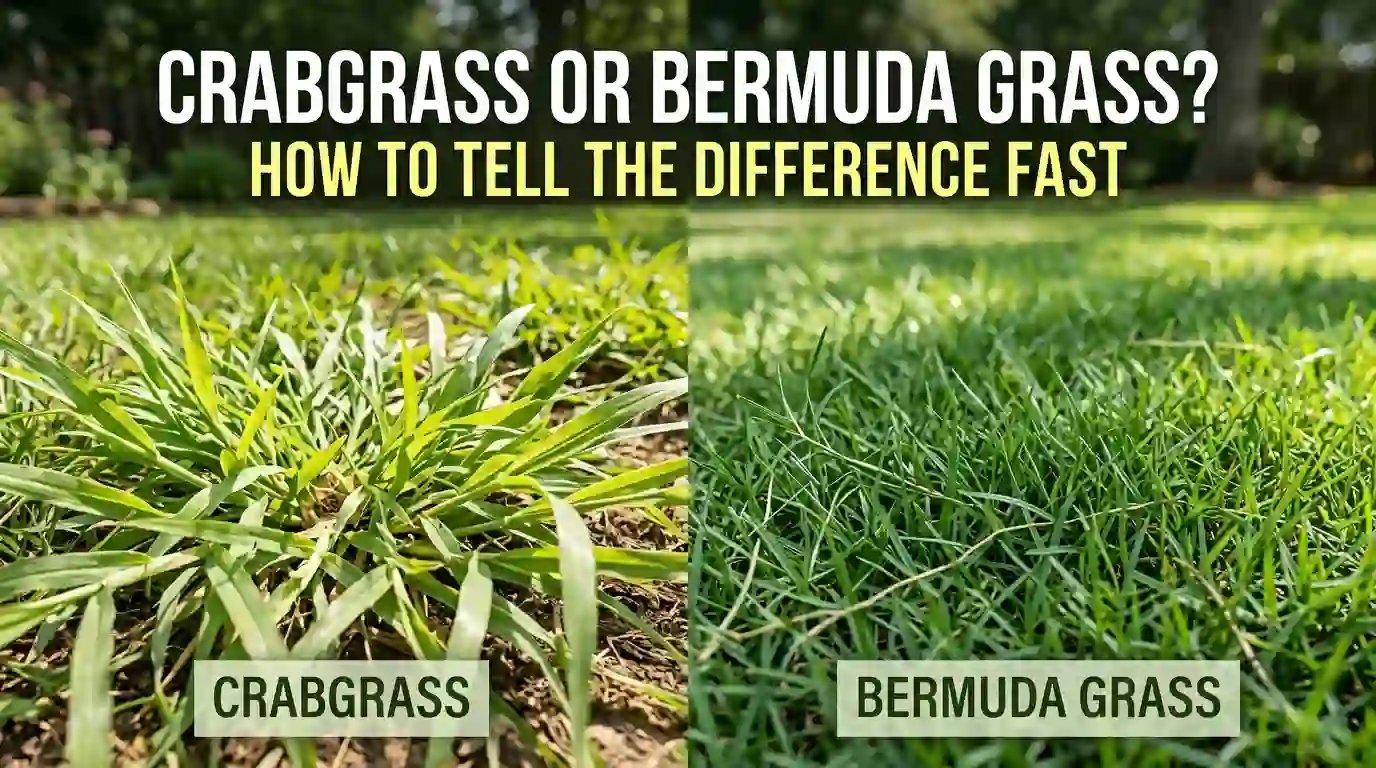
You walk out to your lawn. A wide, bright green patch has popped up. It spreads fast. It looks messy. Is it crabgrass or Bermuda grass?
You are not alone. Many people search this question every summer. The two grasses look alike at first. Both grasses love the heat and grow fast in warm weather. Left alone, either one can take over your lawn.
But they are not the same. One is a weed that dies each year. The other is a tough grass that lives for years. Some people pay to plant it. Others pay to kill it.
This confusion matters. If you treat the wrong one, you waste money and time. You may even harm your lawn.
This guide clears it up. You get a quick answer first. Then you learn the names, the spelling, the signs, and the fixes. You also get simple examples and a clear table. By the end, you will know what is growing in your yard and what to do next.
Crabgrass or Bermuda Grass Quick Answer
Crabgrass is an annual weed. Bermuda grass is a perennial grass.
- Crabgrass grows from seed each spring. It dies after the first hard frost. It has wide, flat, light green blades. It spreads out like a star.
- Bermuda grass comes back every year. It spreads under and over the soil. It has thin, fine, gray-green blades. It forms a thick, dense mat.
Example: You see a light green clump with wide blades in your tall fescue lawn in July. That is likely crabgrass. You see a dense, fine lawn on a golf course. That is likely Bermuda grass.
A simple test: Look at the blades. Wide and coarse means crabgrass. Thin and fine means Bermuda grass.
The Origin of Crabgrass and Bermuda Grass
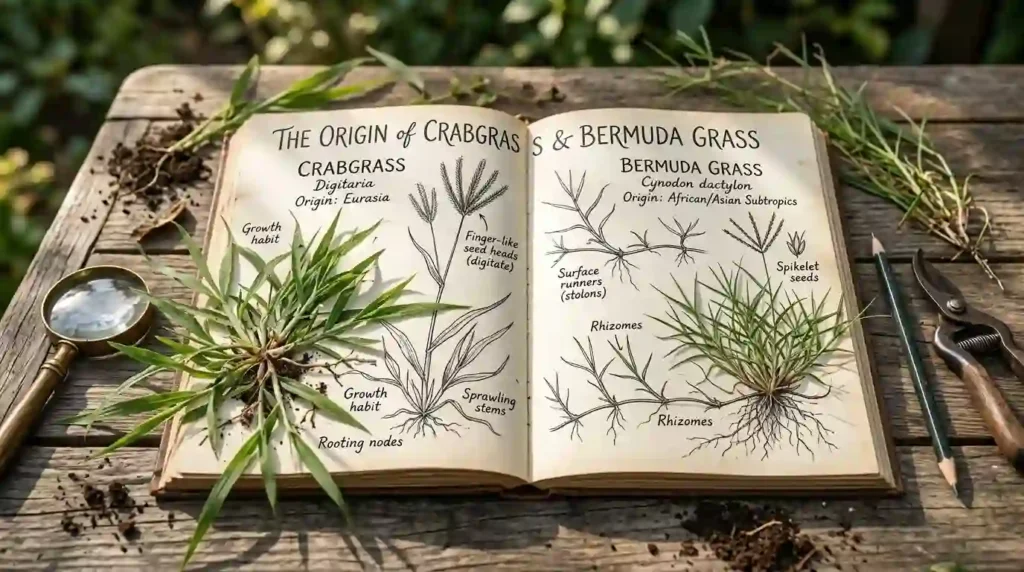
Crabgrass got its name from how it grows. Its stems spread out from the center. They look like crab legs. Its science name is Digitaria. That comes from the Latin word for “finger.” The seed heads look like fingers.
Bermuda grass has a name that misleads. Many think it comes from the island of Bermuda. It does not. Experts believe it began in Africa and parts of Asia. It reached the Americas hundreds of years ago. Its science name is Cynodon dactylon. Cynodon comes from Greek words meaning “dog tooth.” Dactylon means “finger.”
Why the names look different in writing: Plant names are not fixed. People write them in many ways.People spell these names in different ways. You may see “Bermuda grass” or “bermudagrass.” You may also see “crab grass” or “crabgrass.” Each region picked its own habit.
British English vs American English Spelling
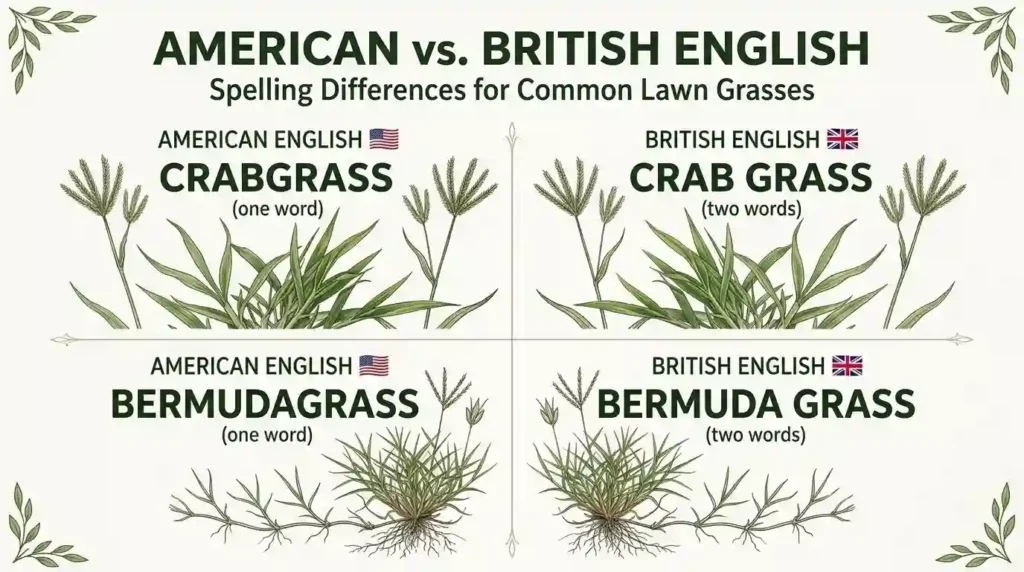
Spelling of these names differs by place. The rules are not strict. They are habits.
- Americans often write crabgrass as one word.
- Many British writers use crab grass or crabgrass. Both are seen.
- Turf experts in the US often write bermudagrass as one word, with a small “b.”
- Many British writers use Bermuda grass, with a capital “B” because it names a place.
- In Australia, South Africa, and New Zealand, people often call Bermuda grass couch grass.
| Term | American Usage | British / Commonwealth Usage |
| Crabgrass | crabgrass (one word) | crab grass or crabgrass |
| Bermuda grass | Bermuda grass or bermudagrass | Bermuda grass |
| Other names | wiregrass (some regions) | couch grass, common couch (Australia, South Africa) |
| Capital letter? | Often “bermudagrass” in science writing | Often “Bermuda” with capital B |
Which Spelling Should You Use?
Pick the style your reader expects.
- US readers: Use crabgrass and Bermuda grass. Use bermudagrass for science or turf writing.
- UK readers: Use crab grass or crabgrass and Bermuda grass.
- Australia, South Africa, New Zealand: Say couch grass or common couch. Add “Bermuda grass” once so global readers follow you.
- Global readers: Use crabgrass and Bermuda grass. These are the most common forms online.
Pro tip: Stay consistent. Pick one style and keep it through the whole page.
Common Mistakes with Crabgrass and Bermuda Grass

Mistake 1: Thinking they are the same plant.
Fix: Crabgrass is an annual weed. Bermuda grass is a perennial.
Mistake 2: Using a crabgrass killer on a Bermuda lawn without checking the label.
Fix: Read the product label. Some products are safe on Bermuda grass. Some are not.
Mistake 3: Spraying crabgrass preventer too late.
Fix: Apply it in early spring, before seeds sprout. Soil should be near 55°F (13°C).
Mistake 4: Mowing too short.
Fix: Short grass lets sunlight reach the soil. Weed seeds love that. Mow at the right height for your grass type.
Mistake 5: Thinking Bermuda grass is always bad.
Fix: It is a top choice for hot, sunny lawns. It is only a weed when it invades another grass.
Mistake 6: Writing “Bermuda” with a small “b” in formal text.
Fix: Use a capital “B” for “Bermuda grass.” Use “bermudagrass” only in science style.
Crabgrass or Bermuda Grass in Everyday Examples

In an email to a lawn company:
“Hi, I have light green weeds in my front lawn. Is this crabgrass or Bermuda grass? Can you help?”
In a news headline:
“Why crabgrass pops up every summer, and how to stop it.”
On social media:
“Just planted Bermuda grass. Can’t wait for a thick green lawn by July! #lawncare”
In formal writing:
“Bermudagrass tolerates drought and heavy foot traffic. Crabgrass is a common annual weed in thin turf.”
In a garden center sign:
“Crabgrass preventer. Apply in early spring.”
Crabgrass or Bermuda Grass Google Trends & Usage Data
I can’t pull live Google Trends numbers here. You can check them free at trends.google.com. These patterns are common for lawn topics:
- Season: Searches usually rise in late spring and summer. That is when both grasses grow fast in the northern hemisphere.
- Country: The US leads in interest. Lawn care is a big topic there. Australia and South Africa show interest too. They often use “couch grass” instead.
- Context: People search for “how to kill crabgrass” more than for ways to grow it. People search for “Bermuda grass” to plant it, to fix it, or to remove it.
- Related searches: Common ones include “crabgrass vs Bermuda grass,” “how to get rid of Bermuda grass in my lawn,” and “crabgrass killer safe for Bermuda.”
Tip: Try your own terms in Google Trends. Compare “crabgrass” and “Bermuda grass” by country and by month.
Crabgrass vs Bermuda Grass Side-by-Side Comparison
| Feature | Crabgrass | Bermuda Grass |
| Life cycle | Annual (dies each fall) | Perennial (returns each year) |
| How it spreads | Seeds | Stolons, rhizomes, and seeds |
| Blade width | Wide and coarse | Thin and fine |
| Color | Light, yellow-green | Gray-green to deep green |
| Growth shape | Spreads out like a star | Dense, carpet-like mat |
| Best weather | Hot, sunny | Hot, sunny |
| Winter | Dies after frost | Goes dormant and turns brown |
| Usually seen as | A weed | A lawn grass (or a weed in cool-season lawns) |
| Best control | Early spring pre-emergent, thick lawn | Careful removal or a selective product |
FAQs
Is crabgrass the same as Bermuda grass?
No. Crabgrass is an annual weed. Bermuda grass is a perennial grass.
How can I tell them apart quickly?
Check the blades. Crabgrass blades are wide and light green. Bermuda blades are thin and gray-green. Bermuda grass also forms a denser mat.
Is Bermuda grass a weed?
It depends. In a Bermuda lawn, it is the lawn. In a fescue or bluegrass lawn, it is a weed.
When does crabgrass grow?
It sprouts in spring when the soil warms to about 55°F (13°C). It dies after the first hard frost.
Will crabgrass preventer harm Bermuda grass?
Many products are safe on established Bermuda grass. Always read the label first. Do not use them when seeding.
Why does my Bermuda grass turn brown in winter?
Cold weather puts it to sleep. It is not dead. It will turn green again in spring.
How do I stop crabgrass from coming back?
Apply a pre-emergent in early spring. Keep your lawn thick. Mow at the right height. Water deeply but not often.
Conclusion
So, crabgrass or Bermuda grass? Now you know. Crabgrass is a wide-bladed annual weed that grows from seed and dies each fall. Bermuda grass is a fine-bladed perennial that returns every year and spreads fast.
Here are the key takeaways:
- Look at the blades. Wide means crabgrass. Thin means Bermuda grass.
- Crabgrass needs an early spring plan. Use a pre-emergent before seeds sprout.
- Bermuda grass is a great lawn choice for hot places. It is a problem only when it spreads where you don’t want it.
- Spelling varies. Use crabgrass and Bermuda grass for most readers. Use couch grass in Australia and South Africa.
- Always read product labels before you spray.
When in doubt, take a clear photo of the plant to a local garden center. They can confirm what you have. The right ID leads to the right fix. That saves you time, money, and a lot of work. A healthy, thick lawn is your best defense against any weed.

I’m Raheela Rani, a professional content writer and author with 3 years of experience in writing, editing, and storytelling. Through VisitLivo.com, I create clear, engaging, and well-crafted content that helps readers learn, connect, and communicate with confidence.