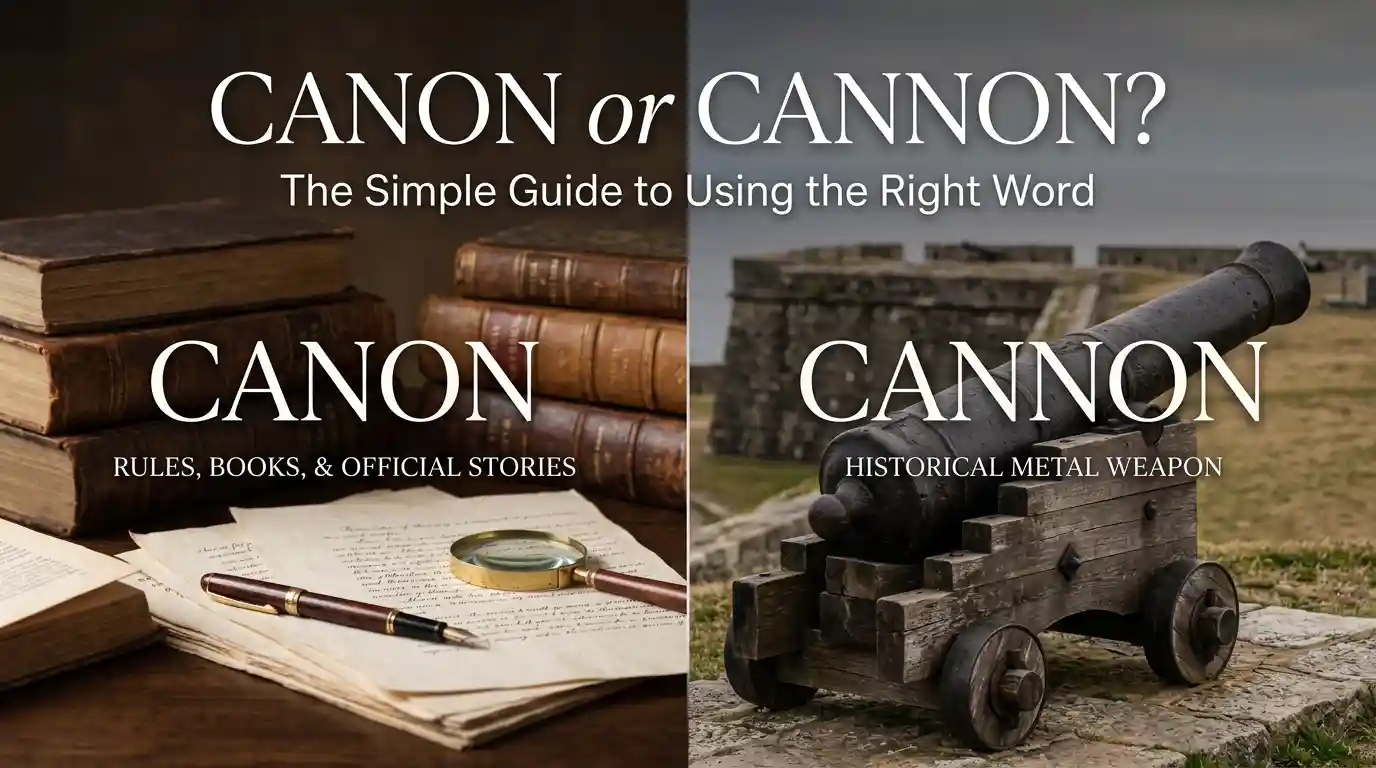
Have you ever stopped mid-sentence and wondered, “Is it canon or cannon?” You are not alone. Millions of people type this question into Google every year. The two words look almost the same. They sound exactly the same. But they mean very different things.
Maybe you are writing about a movie and want to say the story is “official.” Maybe you are writing about history and need a word for a big gun. Or maybe you are just writing a review of your new camera. One missing letter can change your whole message. It can also make your writing look careless.
People search for “canon or cannon” for a simple reason. Spell check will not always save them. Both words are real, so the computer sees no error. Only you can pick the right one.
This guide clears up the confusion fast. You will get a quick answer first. Then you will learn where each word came from, how to use it, and which mistakes to avoid. You will see real examples and handy tables. By the end, you will never mix these words up again.
Canon or Cannon Quick Answer
Canon (one n) means a rule, a standard, or an official list. Cannon (two ns) means a large gun, or a hard, fast hit.
Here is an easy trick: cannon has two ns, like two big barrels. Picture a gun with two tubes. Cannon, two ns.
Canon examples:
- “That episode is not canon. The writers never made it official.”
- “The church follows canon law.”
- “Shakespeare is part of the literary canon.”
- “She sang a song as a canon, a round.”
Cannon examples:
- “The soldiers fired the cannon.”
- “He is a loose cannon. No one knows what he will do.”
- “The ball shot out like a cannonball.”
- “The runner cannoned into the wall.”
The Origin of Canon and Cannon

These two words are cousins. Both trace back to the idea of a reed, a long, hollow plant.
Canon comes from the Greek word kanōn, meaning a straight rod, a ruler, or a rule. People used reeds and rods to measure. So the word grew to mean “a standard.” Latin took it, and Old English borrowed it. It was first used for church rules.
Cannon comes from the Italian word cannone, meaning “big tube.” That comes from canna, a reed or pipe. A cannon is a big tube that shoots a heavy ball. The word came into English through French.
So why two spellings? Early English writers were not strict about spelling. Some wrote the gun as canon too. Over time, the double n won for the weapon, and the single n stayed for the rule. This split helped readers tell the words apart.
British English vs American English Spelling
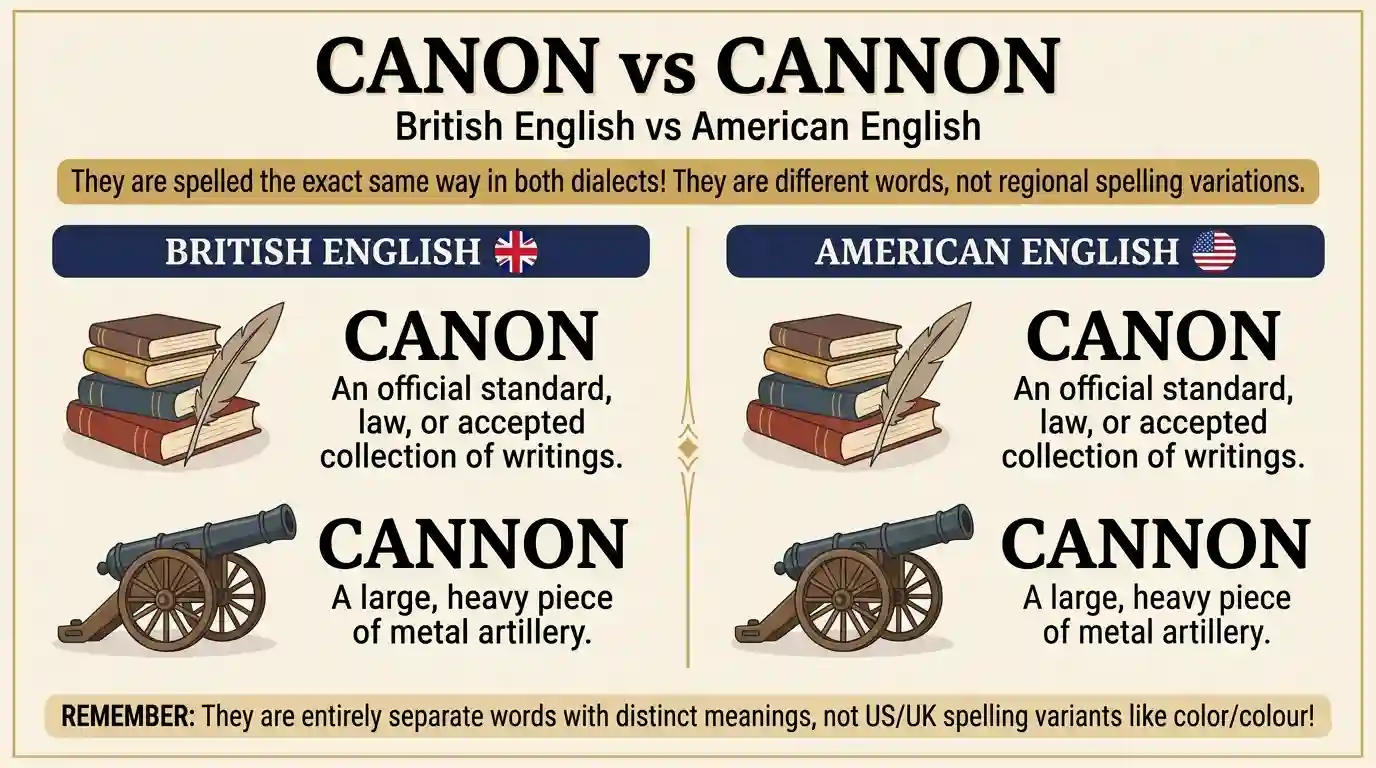
Here is the key point: canon and cannon are not British and American spellings of the same word. They are two different words. Both the US and the UK use both spellings the same way.
A few other facts help:
- The camera brand Canon is a proper name. It always has one n.
- In the UK, cannon also has a pool and snooker meaning: hitting two balls with one shot. Americans call this a carom.
- Plural of cannon can be cannon or cannons. Both are fine.
| Word | US English | UK English | Meaning |
| Canon (rule) | canon | canon | Rule, standard, official list |
| Canon (music) | canon | canon | A round, like “Row, Row, Row Your Boat” |
| Canon (clergy) | canon | canon | A church official |
| Cannon (gun) | cannon | cannon | Large gun |
| Cannon (billiards) | carom | cannon | A shot that hits two balls |
| Cannon (verb) | cannon | cannon | To crash into something |
| Canon (brand) | Canon | Canon | Camera and printer company |
Real US and UK spelling differences look like this: color/colour, center/centre. Canon and cannon are not in that group.
Which Spelling Should You Use?
The answer depends on your meaning, not your country.
If you write for a US audience: Use canon for rules and official stories. Use cannon for guns and crashes.
If you write for a UK or Commonwealth audience: Same rules. Just remember that cannon is also a billiards shot in British English.
If you write for a global audience: Same rules again. Skip regional slang like carom and cannon shot unless your readers know it. Simple words travel best.
Quick test before you hit publish:
- Does it mean a rule, a list, or “officially true”? Use canon.
- Does it mean a gun or a hard hit? Use cannon.
- Is it a brand? Use Canon with a capital C.
Common Mistakes with Canon and Cannon
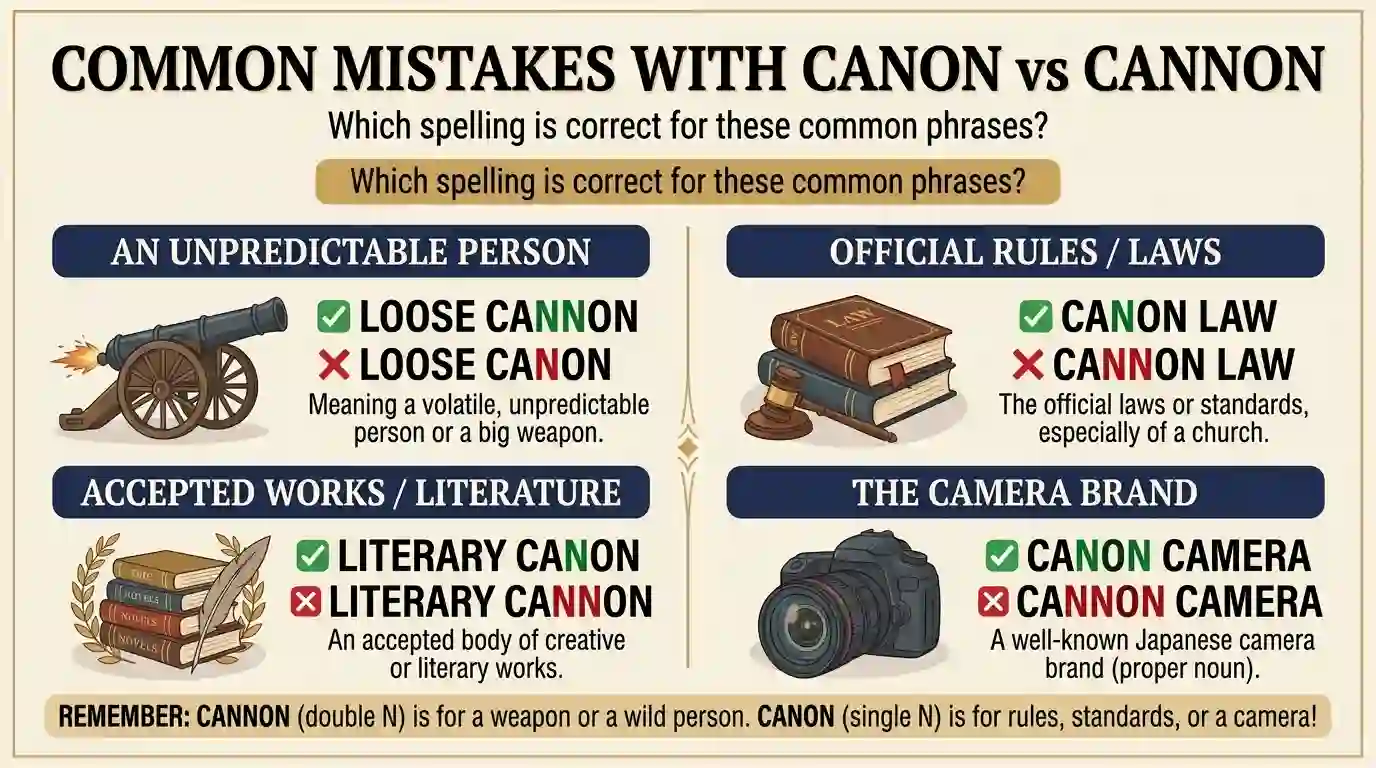
| Wrong | Right | Why |
| The soldiers fired the canon. | The soldiers fired the cannon. | A gun needs two ns. |
| That scene is cannon in the movie. | That scene is canon in the movie. | Official story means canon. |
| He is a loose canon. | He is a loose cannon. | The phrase comes from a runaway gun on a ship. |
| Cannon law says no. | Canon law says no. | Church law is canon law. |
| I bought a Cannon camera. | I bought a Canon camera. | The brand has one n. |
| It was a canon ball. | It was a cannonball. | A ball for a gun. |
Tip: “Loose cannon” is the most common mistake. Think of the heavy gun rolling around on a ship deck. That is the picture.
Canon and Cannon in Everyday Examples
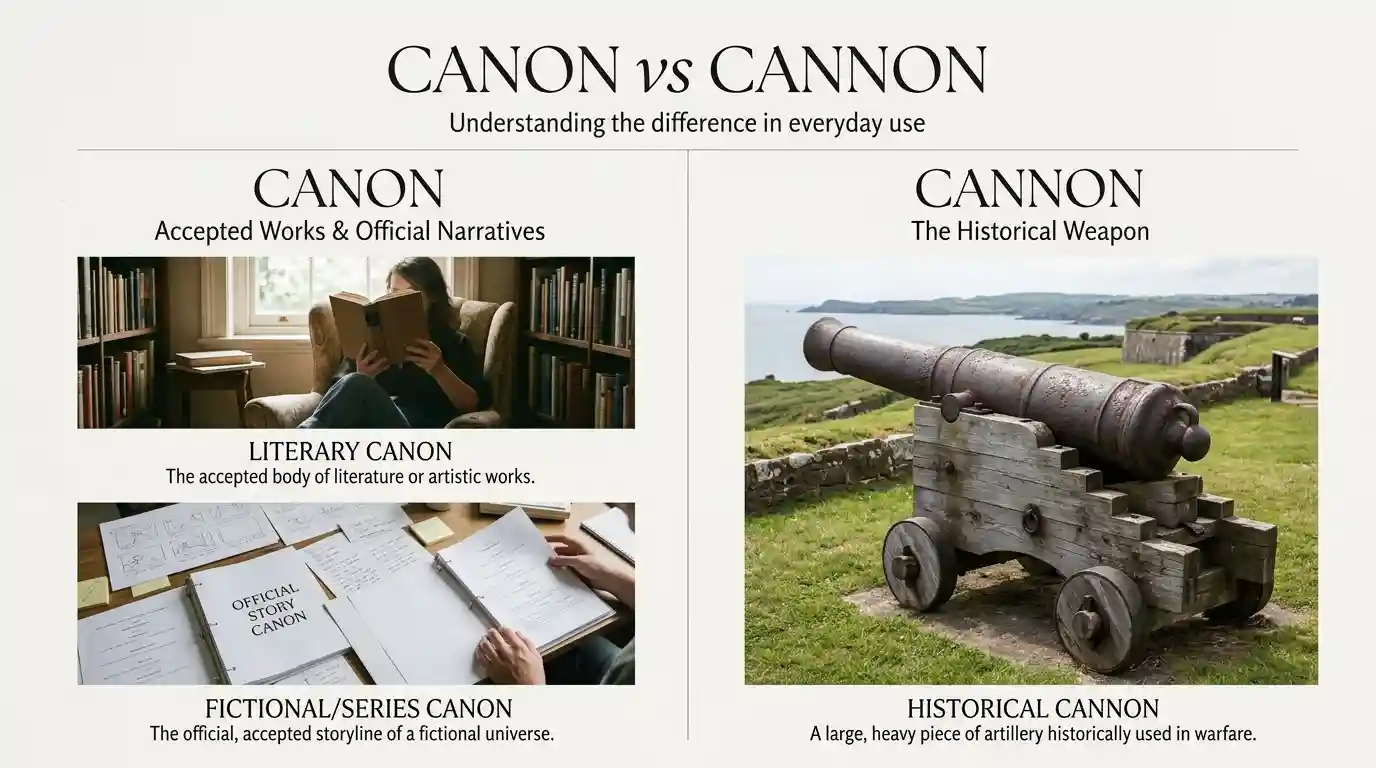
Email:
- “Please follow the canon of our brand rules.” (rule or standard)
- “Our new product is a cannon shot at the market.” (a bold, powerful move)
News:
- “The city fired a cannon to start the festival.”
- “Critics argue the book belongs in the literary canon.”
Social media:
- “Is the new series canon? Fans are fighting about it.”
- “My boss is a loose cannon today.”
Formal writing:
- “The council reviewed the canon of laws.”
- “A bronze cannon stands in the town square.”
Canon or Cannon Google Trends & Usage Data
I cannot pull live Google Trends numbers here, so no exact figures are listed. You can check them for free at trends.google.com. Here is how the two words generally behave:
- Canon gets steady searches all year. Many people look for the camera brand. Others search for “is it canon” about movies, shows, and games.
- Cannon gets searches for history, military topics, and phrases like “loose cannon.”
- “Canon or cannon” as a spelling question gets smaller but steady searches. It tends to rise when big stories or new movie and show releases spark “is it canon?” debates.
- English-speaking countries like the US, UK, Canada, Australia, and India all search these words. The spelling question is the same everywhere.
Tip: Compare “canon,” “cannon,” and “canon or cannon” in Google Trends. Set the region and the time range that match your audience.
Side-by-Side Comparison
| Feature | Canon | Cannon |
| Letters | One n | Two ns |
| Main meaning | Rule, standard, official list | Large gun |
| Part of speech | Noun | Noun and verb |
| Plural | Canons | Cannons or cannon |
| Common phrases | Canon law, literary canon, not canon | Loose cannon, cannonball, cannon fodder |
| Memory trick | One n, one rule | Two ns, two barrels |
| Origin | Greek kanōn (rod, rule) | Italian cannone (big tube) |
| Used in the US? | Yes | Yes |
| Used in the UK? | Yes | Yes |
Frequently Asked Questions
Is it “canon” or “cannon”?
It depends on the meaning. Use canon for rules or official stories. Use cannon for a large gun or a hard crash.
Is “loose cannon” spelled with one n or two?
Two. It is loose cannon. The phrase comes from a heavy gun that broke free on a ship.
Is canon or cannon the British spelling?
Neither. They are different words. The UK and US use both the same way.
What does “canon” mean in movies and books?
It means the official story. If something is canon, the creators say it really happened in that world.
How do I remember the difference?
Cannon has two ns, like two barrels on a gun. Canon has one n, like one rule.
Is Canon the camera brand spelled with one n?
Yes. Canon is a proper name, so it also takes a capital C.
Can spell check catch this mistake?
Not always. Both are real words, so most tools will not flag the wrong one. Read your sentence and check the meaning.
Is “cannon” ever a verb?
Yes. To cannon into something means to crash into it hard. It is common in British English.
Conclusion
So, canon or cannon? The answer is simple once you know the trick. Canon is about rules, standards, and official facts. Cannon is about big guns and hard hits.
Remember these key points. First, the two words are not regional spellings. The US and UK use both the same way. Second, both words grew from the idea of a reed or tube, but they split into different meanings long ago. Third, the most common error is writing “loose canon” when you mean “loose cannon.” Fourth, the camera brand is always Canon with one n.
Before you publish, run a quick check. Ask yourself, “Is this about a rule or a gun?” If it is a rule, use one n. If it is a gun or a crash, use two. If it is the brand, use a capital C.
Good writing is about small choices. Picking the right word shows care and builds trust with your readers. Keep this guide handy, and you will get it right every time.

I’m Raheela Rani, a professional content writer and author with 3 years of experience in writing, editing, and storytelling. Through VisitLivo.com, I create clear, engaging, and well-crafted content that helps readers learn, connect, and communicate with confidence.