You are writing a quick message. You type, “I lunch for the team today.” Then your fingers stop. Is it brought or bought?
Many people search “brought or bought” for this reason. The two words look alike. They end the same way. They sound close when you speak fast. Even native speakers mix them up when they type in a hurry.
The fix is simple. These are not two spellings of one word. They are two different words with two different jobs. Bought is about paying. Brought is about carrying. One has money in the story. The other has movement.
This guide gives you the quick answer first. Then you will learn where each word came from and how it works in US and UK English. You will see common mistakes and real examples from emails, news, and social media. You will also get answers to popular questions. By the end, you will pick the right word every time, and you will not need to stop and guess again.
Brought or Bought Quick Answer
- Bought is the past tense of buy. You paid for something.
- Brought is the past tense of bring. You carried or took something somewhere.
Examples with bought:
- I bought coffee on my way to work.
- They bought a house in the city.
- She bought a gift for her mom.
Examples with brought:
- I brought coffee for the whole team.
- They brought their kids to the party.
- She brought a gift to the dinner.
Memory trick: Bought has a u, like buy. Brought has an r, like bring.
The Origin of Brought and Bought
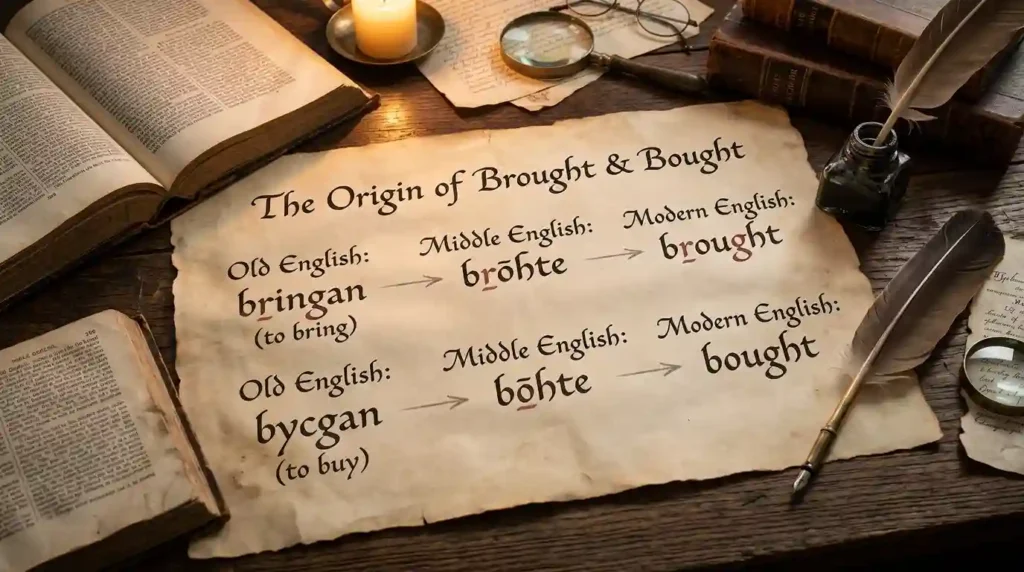
Both words are very old. They come from Old English, the language of England over a thousand years ago.
Bought grew from the Old English word bycgan, which meant “to buy.” Its past form, bohte, slowly changed into the word we write today.
Brought grew from bringan, which meant “to bring.” Its past form, brohte, changed in the same way.
Why do both end in “ought”? Old English verbs often changed their inside sounds to show the past. Most of those verbs now add “ed” instead. But buy and bring kept the old pattern. That is why we say bought, not buyed, and brought, not bringed.
The odd “gh” has a story, too. Long ago, it made a throat sound. That sound faded away. When printing spread in the 1400s, printers locked the old spelling in place. The letters stayed, but the sound did not. This is why the words look harder than they sound.
British English vs American English Spelling
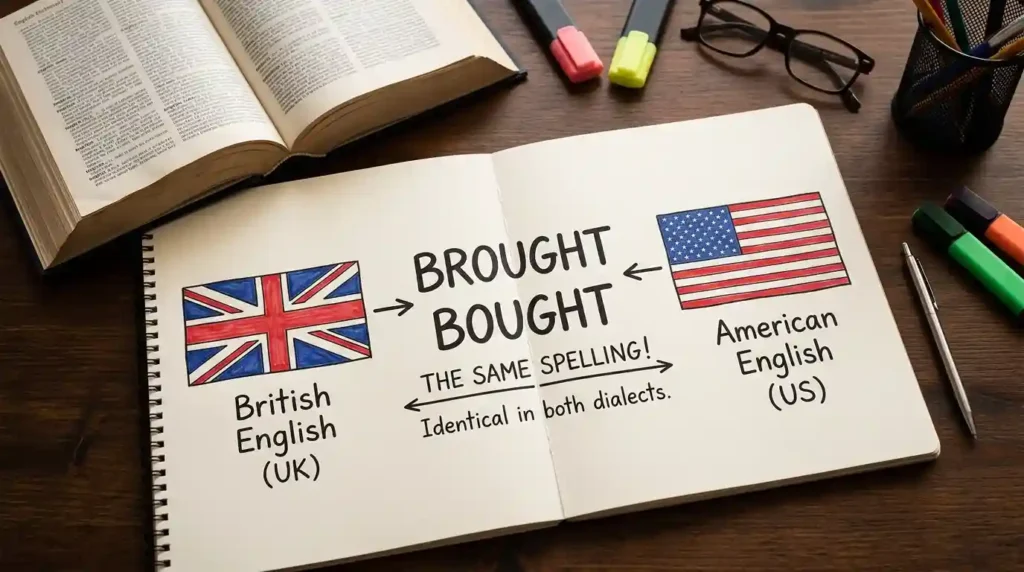
Here is the key point: there is no British or American difference for these words. Both countries spell and use bought and brought the same way.
Many learners expect a split because some words do change between the US and UK. But not these two.
| Word | Comes From | Meaning | US English | UK English |
| Bought | Buy | Paid for | bought | bought |
| Brought | Bring | Carried or took | brought | brought |
| Color / Colour | n/a | A shade | color | colour |
| Learned / Learnt | Learn | Gained knowledge | learned | learned or learnt |
Look at the last two rows. Those are real US and UK differences. The first two rows show that bought and brought stay the same everywhere.
Which Spelling Should You Use?
Your meaning decides the word. Your country does not.
- US readers: Use bought for paying and brought for carrying.
- UK and Commonwealth readers: Use the same rule.
- Global readers: Use the same rule. These words work in every English-speaking place.
Ask one question: “Did I pay?”
- If yes, write bought.
- If no, and something moved or arrived, write brought.
Common Mistakes with Brought and Boug
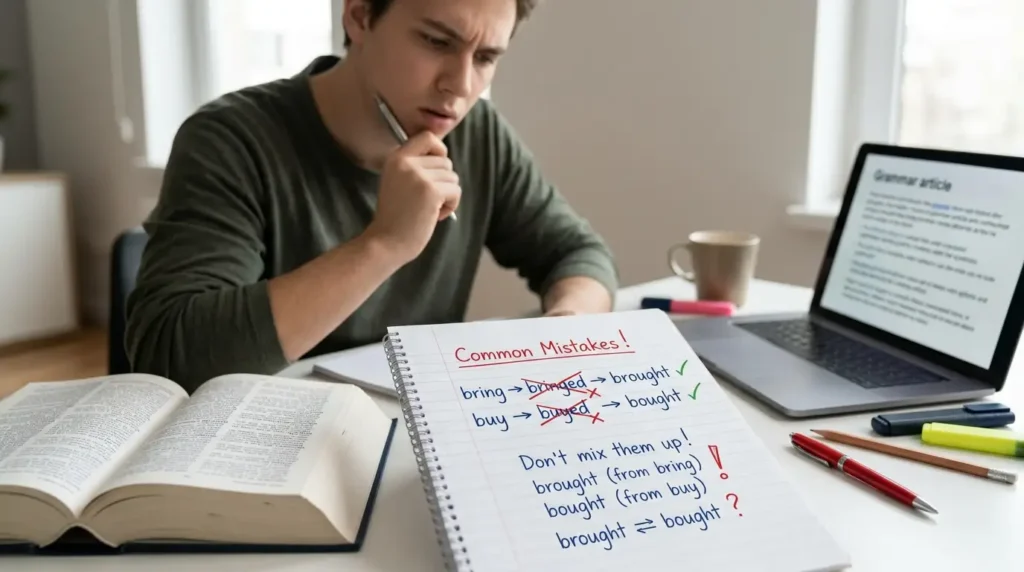
Even strong writers mix up these two words. Here are the most common errors, with a simple fix for each.
| # | Mistake | ❌ Wrong | ✅ Right | Fix |
|---|---|---|---|---|
| 1 | Using “brought” when you paid | I brought a new laptop yesterday. | I bought a new laptop yesterday. | Money changed hands, so use bought. |
| 2 | Using “bought” when you carried | She bought her lunch to work. | She brought her lunch to work. | She carried it from home. Carrying means brought. |
| 3 | Using one word when you need both | I brought a cake and brought it to the party. | I bought a cake and brought it to the party. | Paying and carrying are two actions. Use two words. |
| 4 | Adding “ed” to the verb | I buyed milk. I bringed milk. | I bought milk. I brought milk. | Buy and bring are irregular verbs. They never take “ed.” |
| 5 | Writing “brung” | He brung his friend. | He brought his friend. | Brung is slang. Skip it in school, work, and formal writing. |
| 6 | Mixing up “bought” and “bough” | The bird sat on the bought. | The bird sat on the bough. | A bough is a tree branch. It has nothing to do with buying. |
| 7 | Mixing up “bring” and “take” | Please bring this to the office. (said when you are already at the office) | Please take this to the office. | Bring means toward the speaker. Take means away from the speaker. |
| 8 | Dropping the helper verb | I have bring the report. | I have brought the report. | After have, has, or had, use the past form: bought or brought. |
Quick Check Before You Send
| Question | Use |
|---|---|
| Did money change hands? | bought |
| Did something move to a place? | brought |
| Is it a tree branch? | bough |
Memory trick: Bought has a u like buy. Brought has an r like bring.
Brought or Bought in Everyday Examples
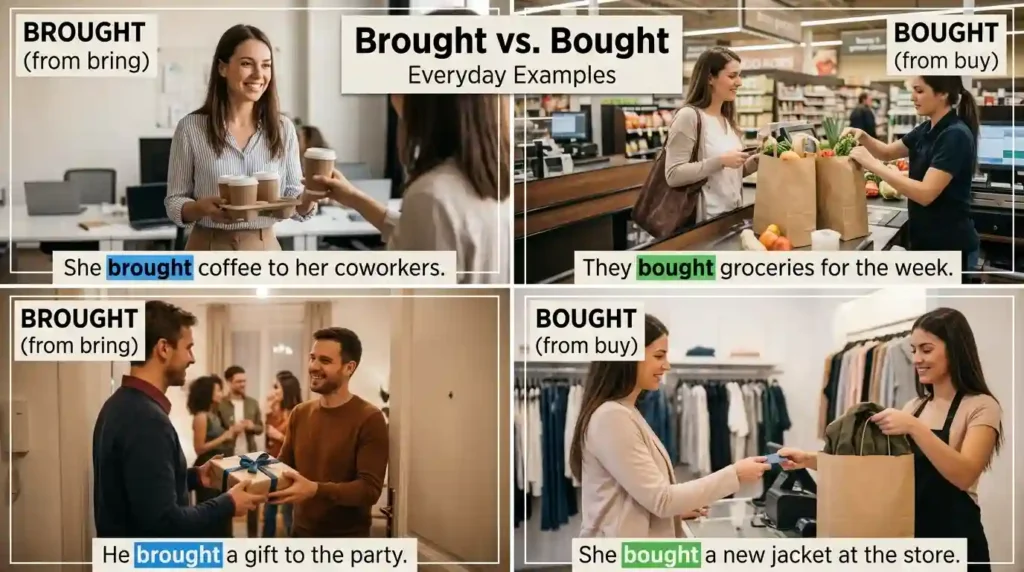
In emails:
- “I brought the signed forms to the front desk.”
- “We bought the new software last week.”
In news headlines:
- “Tech firm bought rival for $2 billion.”
- “Storm brought heavy rain to the coast.”
On social media:
- “Just bought these sneakers. So happy!”
- “Brought my dog to the beach today.”
In formal writing:
- “The company bought three buildings in 2020.”
- “The new law brought major changes to trade.”
In stories:
- “She bought a lantern at the market.”
- “She brought the lantern into the dark cave.”
Notice that brought can work with ideas, too. A storm brought rain. A law brought change. No money is involved, so brought is right.
Brought or Bought Google Trends & Usage Data
I can’t pull live Google Trends numbers here, and I won’t invent any. You can check current data for free at trends.google.com. Here are the patterns you can expect to see:
- By country: Interest is strongest where English is widely used or taught, such as the US, UK, India, Pakistan, Nigeria, the Philippines, and Canada.
- By context: Students, job seekers, and non-native writers search most. They want to be sure before they send an email or hand in an essay.
- By season: Searches often rise during school terms and exam time.
- Related searches: People also look up “brought vs bought,” “bought and brought sentences,” and “bought or brought meaning.”
Tip: In Google Trends, compare “brought or bought” with “bought or brought.” You will see which order people type more.
Keyword Variations Side by Side
| Word or Phrase | Correct? | Meaning | Example |
| Bought | Yes | Past tense of buy | I bought a hat. |
| Brought | Yes | Past tense of bring | I brought a hat. |
| Buyed | No | Not a real word | ~~I buyed a hat.~~ |
| Bringed | No | Not a real word | ~~I bringed a hat.~~ |
| Brung | No (slang) | Informal, not standard | ~~I brung a hat.~~ |
| Bough | Yes (different word) | A tree branch | The bough is strong. |
| Brought up | Yes | Raised, or mentioned | She was brought up in Texas. |
| Bought into | Yes | Believed or accepted | He bought into the plan. |
Frequently Asked Questions
What is the difference between brought and bought?
Bought means paid for. Brought means carried or took along.
Is it “I brought a car” or “I bought a car”?
Write “I bought a car.” You paid for it.
Is there a UK vs US difference?
No. Both countries use the same spelling and meaning.
What are the present tense forms?
Bought comes from buy. Brought comes from bring.
Are they past tense or past participle?
Both. You can say “I bought it” (past) and “I have bought it” (past participle). The same goes for brought.
Can I say “brought” if I paid for something?
Only if you mean the carrying. “I bought a cake and brought it to the party” uses both words correctly.
Is “brung” a real word?
It is regional slang. Avoid it in formal writing.
How do I remember which is which?
Bought has a u like buy. Brought has an r like bring.
Conclusion
Brought and bought look alike, but they do very different jobs. Bought is the past tense of buy. It means you paid. Brought is the past tense of bring. It means you carried something, or caused something to happen.
There is no British or American split here. Both countries use these words the same way. You do not need to change your spelling for your audience. You only need to check your meaning.
Use the simple test: “Did I pay?” If yes, write bought. If no, and something moved or arrived, write brought.
Keep the memory trick close, too. Bought has a u like buy. Brought has an r like bring.
Stay away from buyed, bringed, and brung. They are never right in formal writing. And do not confuse bought with bough, the tree branch.
Both words come from old English verbs, which is why they share the “ought” ending. Now you know the history, the rule, and the trick. Next time you write an email, a post, or an essay, you can choose with confidence. Save this guide for a quick check anytime.

I’m Raheela Rani, a professional content writer and author with 3 years of experience in writing, editing, and storytelling. Through VisitLivo.com, I create clear, engaging, and well-crafted content that helps readers learn, connect, and communicate with confidence.