You are writing an email. You type, “It may rain tomorrow.” Then you stop. Should it be “might”? Do the two words mean the same thing?
You are not alone. Many people search “may or might” because the two words look so close. Both talk about things that could happen. Both are short. Many people use them in the same way, so the rule is hard to see.
Here is the good news. The rule is simple. Most of the time, you can use either word and nobody will mind. But in a few cases, one word is better. “May” is the word for asking permission. “Might” is the word for weak chances and for the past.
Some people think this is a spelling problem. It is not. May and might are spelled the same everywhere. The confusion is about meaning and use. Writers in the US and UK also lean toward different habits.
This guide clears it up in plain words. You will get a quick answer, easy examples, tables, common mistakes, and FAQs. By the end, you will know which word to pick.
May or Might Quick Answer
Use may when something is fairly possible, or when you ask or give permission.
Use might when something is less likely, or when you talk about an unreal or past situation.
Examples with “may”:
- It may rain today. (Good chance.)
- May I sit here? (Permission.)
- You may leave now. (Permission.)
Examples with “might”:
- It might rain, but I doubt it. (Small chance.)
- I might have won if I had tried harder. (Did not happen.)
- She said she might come. (Past report.)
Short rule: May = more likely or allowed. Might = less likely or unreal.
In daily talk, the two words often swap with no problem. “It may snow” and “It might snow” both work.
The Origin of May and Might

Both words come from the same Old English root. The verb magan meant “to be able” or “to have power.” May grew from forms like mæg, which meant “I am able.” Might grew from mihte, the past form of the same verb.
So might began as the past tense of may. That is why “She said she might come” works. It is the past form of “She may come.”
Over time, the words split. May kept the sense of ability, then possibility, then permission. Might kept the past sense, and it also took on the sense of “less likely.” The noun might (“great power”) comes from the same root. Think of “with all his might.”
Why do people think spelling differs? They do not, really. Some people mix up might with mite (a tiny bug) because they sound alike. That is a homophone mistake, not a British or American spelling gap. The -gh- in might is a leftover from older English, when it was a real sound.
British English vs American English Usage
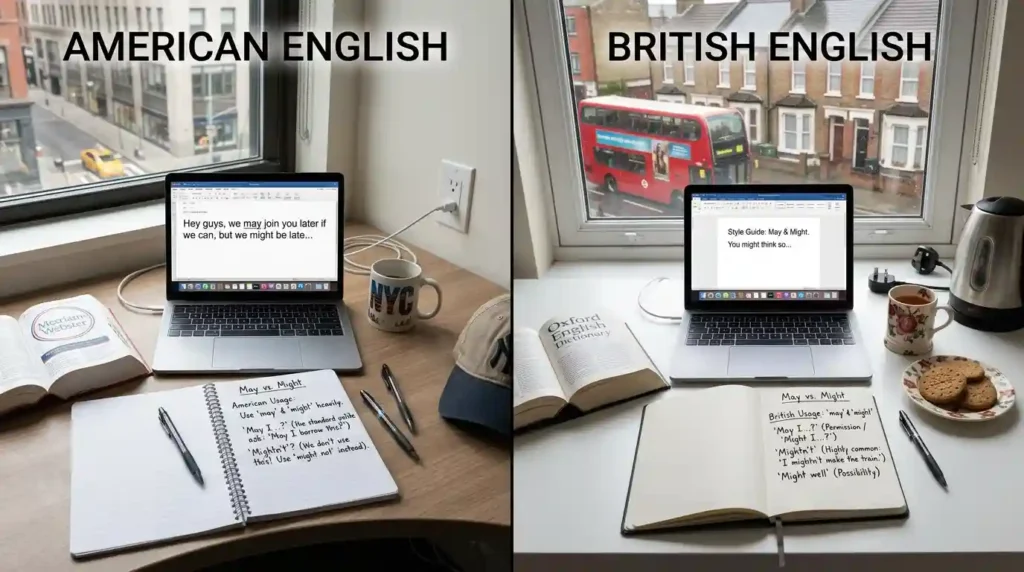
The spelling is the same. The habits are a little different.
| Feature | American English | British English |
| Spelling of may / might | may / might | may / might |
| Weak possibility | Often “may” or “might” | Often “might” |
| Permission | “May I…?” (formal) / “Can I…?” (casual) | “May I…?” (formal) / “Can I…?” (casual) |
| Short negative | “might not” | “mightn’t” is more common |
| Polite suggestion | “You might want to…” | “You might like to…” / “You might want to…” |
| Past sense | “might have” | “might have” |
Key points:
- Both countries use the two words in similar ways.
- Many UK writers pick might for small chances.
- Many US writers use may and might more freely as equals.
- “Mightn’t” sounds more British. It is rare in the US.
Which Spelling (and Word) Should You Use?
Writing for a US audience:
Either word is fine for possibility. Use may for permission in formal writing. Use might for weak chances.
Writing for a UK or Commonwealth audience:
Lean toward might for small chances. Use may for formal permission and for real possibility.
Writing for a global audience:
Be simple and clear.
- Use may for “it is possible” and “you are allowed.”
- Use might for “it is unlikely” or “it did not happen.”
- Use can for casual permission and ability.
Safe tip: If you feel unsure, use might for chance. It is rarely wrong.
Common Mistakes with May and Might
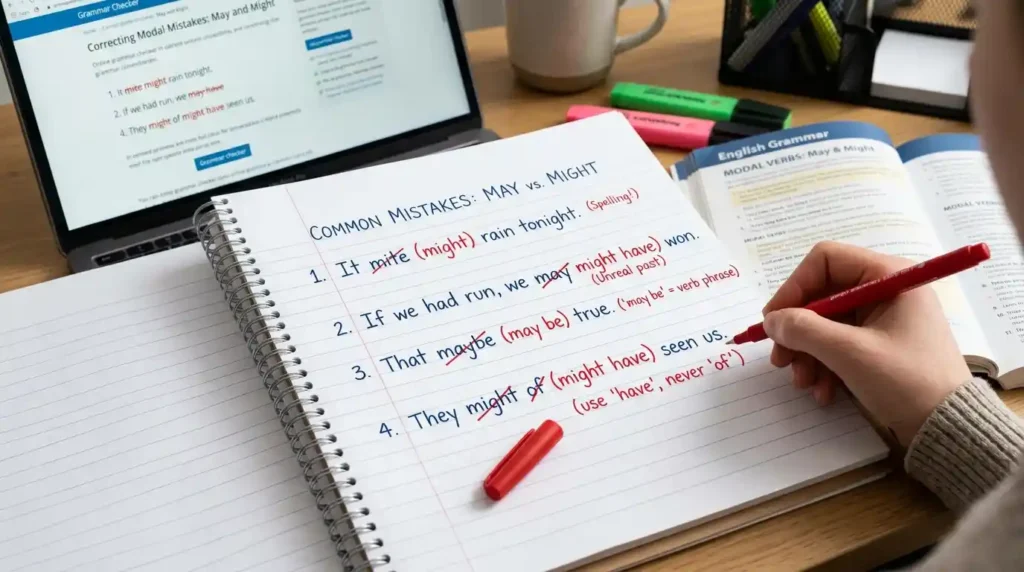
1. Using “may” for something that did not happen
- Wrong: “I may have died if I had not stopped.”
- Right: “I might have died if I had not stopped.”
2. Mixing up “may be” and “maybe”
- “Maybe” is one word. It means “perhaps.” Maybe it will rain.
- “May be” is two words. It is a verb. It may be true.
3. Spelling “might” as “mite”
- Wrong: “It mite rain.”
- Right: “It might rain.”
4. Using “may” to talk about the past
- Wrong: “She said she may come.”
- Better: “She said she might come.”
5. Using “may” for ability
- Wrong: “I may swim very fast.”
- Right: “I can swim very fast.”
6. Writing “mights” or “mayes”
- These are not words. Modal verbs do not take -s. Say “she may” and “he might.”
May and Might in Everyday Examples
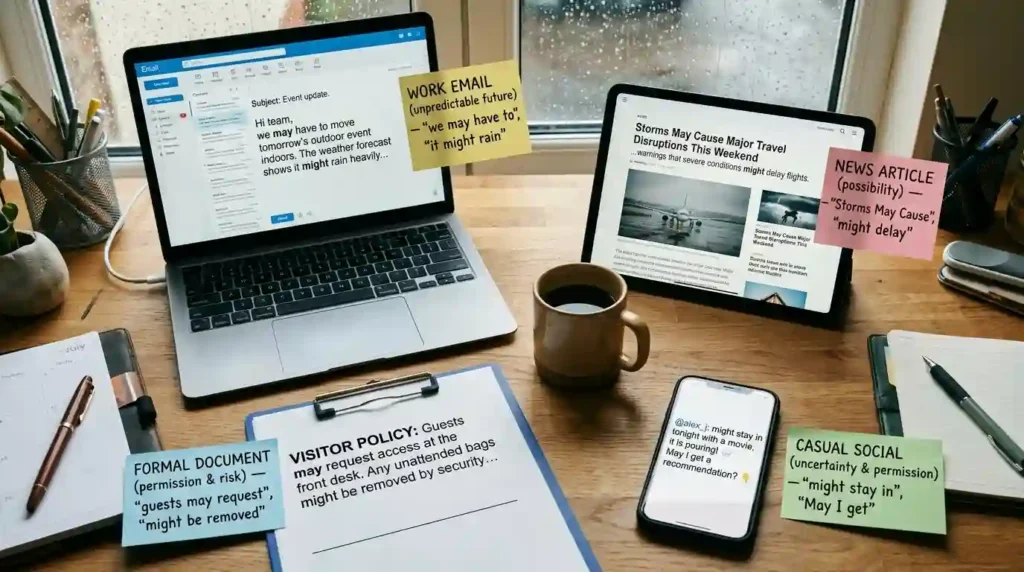
Emails
- “I may be late for the meeting. I will text you.”
- “We might need more time to finish the report.”
- “May I send you the file tomorrow?”
News
- “Rain may hit the city on Friday.”
- “The company might cut jobs next year, sources say.”
Social media
- “I might go to the gym. Or nap. Who knows.”
- “This may be the best pizza ever.”
Formal writing
- “Visitors may enter only with a pass.”
- “The results might differ in other cases.”
- “Students may not use phones during the test.”
May or Might Google Trends and Usage Data
I can’t pull live Google Trends numbers here, so I won’t make up figures. Check the current data yourself at trends.google.com. Here is what you can expect to see and why.
Popularity by country:
Searches for “may or might” tend to come from places where English is widely learned and taught. Common examples include the US, UK, India, Pakistan, the Philippines, Nigeria, and Canada. Search interest often rises during school and exam seasons.
Popularity by context:
- Students search it for tests and homework.
- Workers search it before sending emails or reports.
- Learners of English search it to understand grammar.
- Writers and editors search it to polish their text.
Why people search:
The words look alike, mean almost the same thing, and have a few special rules. That mix creates doubt, and doubt creates searches.
Keyword Variations Side by Side
| Phrase | Meaning | Example | Correct? |
| may | Likely or allowed | It may rain. | ✅ |
| might | Less likely or unreal | It might rain. | ✅ |
| may have | Possible in the past (could be true) | He may have left. | ✅ |
| might have | Unreal past or weak chance | I might have won. | ✅ |
| may be | Verb phrase | It may be true. | ✅ |
| maybe | Adverb (“perhaps”) | Maybe it is true. | ✅ |
| mite | Tiny bug | A mite is on the leaf. | ✅ (different word) |
| mite (as “might”) | Spelling error | It mite rain. | ❌ |
FAQs
Is there a difference between “may” and “might”?
Yes, but it is small. May shows a stronger chance or permission. Might shows a weaker chance or an unreal case.
Can I use “may” and “might” in the same way?
Often, yes. In casual speech, they swap with little change in meaning.
Which one is more polite?
May is more polite for permission. “May I come in?” sounds more formal than “Can I come in?”
Is “might” the past tense of “may”?
It began that way. Today it still works as a past form in reported speech: “She said she might come.” But it is also used in the present for weak chances.
Is “may or might” a British vs. American spelling difference?
No. Both words are spelled the same in all English-speaking countries. Only small habits of use differ.
What is the difference between “may have” and “might have”?
“May have” talks about something that could be true. “Might have” can also talk about something that did not happen. He may have missed the bus (we don’t know). He might have missed the bus if he had waited (he did not miss it).
What is the difference between “maybe” and “may be”?
Maybe means “perhaps.” May be is a verb phrase. “Maybe it is true” and “It may be true” mean the same thing, but the words are used in different ways.
Conclusion
May and might look like twins, but they have small differences. May is for real chances and for permission. Might is for weak chances, past reports, and things that did not happen.
Here is what to remember:
- Spelling is not the issue. Both words are spelled the same in the US, UK, and everywhere else.
- Use “may” for “it is possible” and “you are allowed.”
- Use “might” for “it is not very likely” and for unreal situations.
- Use “might have” for things that did not happen in the past.
- Do not confuse “maybe” with “may be,” or “might” with “mite.”
- When unsure, pick “might.” It fits most chance-based sentences.
In casual talk, people swap the two words all the time, and it is fine. In formal writing, tests, and professional emails, follow the simple rules above. You will sound clear and sure.
Now you know the difference. Next time you type “it may rain” or “it might rain,” you can choose with confidence.

“I’m Ibadat Fatima, a professional content writer and author with 3 years of experience in writing, editing, and storytelling. I share my work through visitlivo.com, where I help readers connect with clear, engaging, and well-crafted content.”