You are writing an email. You want to say you will skip something. Then you stop. Is it “forego” or “forgo”?
You are not alone. Many people get stuck on this pair. The two words look almost the same. They sound the same. Only one letter sets them apart. But they do not mean the same thing.
People search for “forego or forgo” for a simple reason. They want to get it right. A wrong word in a work email or a school essay can look careless. Spell check will not always help. Both spellings are real words, so the software stays quiet.
This article clears up the confusion. You will get a quick answer first. Then you will learn where the words came from. You will see how US and UK writers use them. You will also learn which mistakes to avoid. There are real examples, comparison tables, and a short FAQ too. By the end, you will know which word to pick every time.
Forego or Forgo Quick Answer
Forgo means to do without. It means to give up or skip something.
Forego means to go before. It means to come first in time or place.
Here is a simple trick. Forgo has no “e.” Think of “for” as in “give up forever.” Or think “forgo = go without.”
Examples of forgo:
- I will forgo dessert tonight.
- She chose to forgo a big salary for a job she loved.
- We had to forgo our trip because of the storm.
Examples of forego:
- The calm foregoes the storm.
- The foregoing paragraph explains the rule.
- A good plan should forego any action.
If you mean “skip” or “give up,” use forgo. That is what you want about 95% of the time.
The Origin of Forego and Forgo
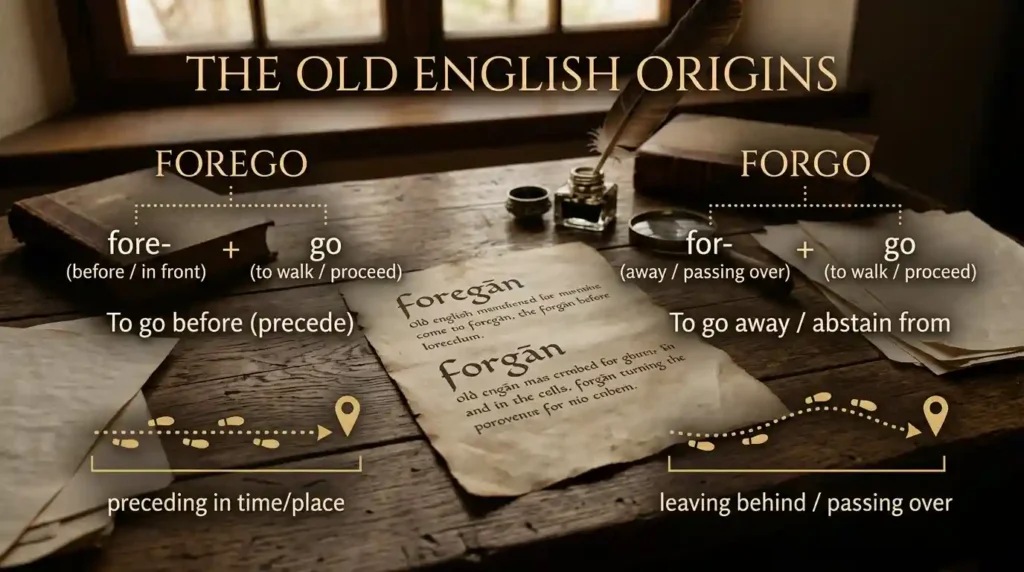
Both words are very old. They come from Old English. Both end in “go.” The difference is in the first part.
Forego comes from the Old English foregān. “Fore” means “before.” So forego means “to go before.” You see the same “fore” in words like forehead, foresee, and forecast.
Forgo comes from the Old English forgān. Here, the prefix “for-” means “away” or “to pass over.” So forgo means “to go without” or “to pass by.” You see the same “for-” in words like forbid, forgive, and forsake.
So why do the spellings look so close? Because the prefixes “fore-” and “for-” look and sound alike. Over time, writers mixed them up. The mix-up still happens today.
Some dictionaries list “forego” as a less common spelling of “forgo.” But many style guides ask writers to keep the two words apart. That keeps your meaning clear.
British English vs American English Spelling
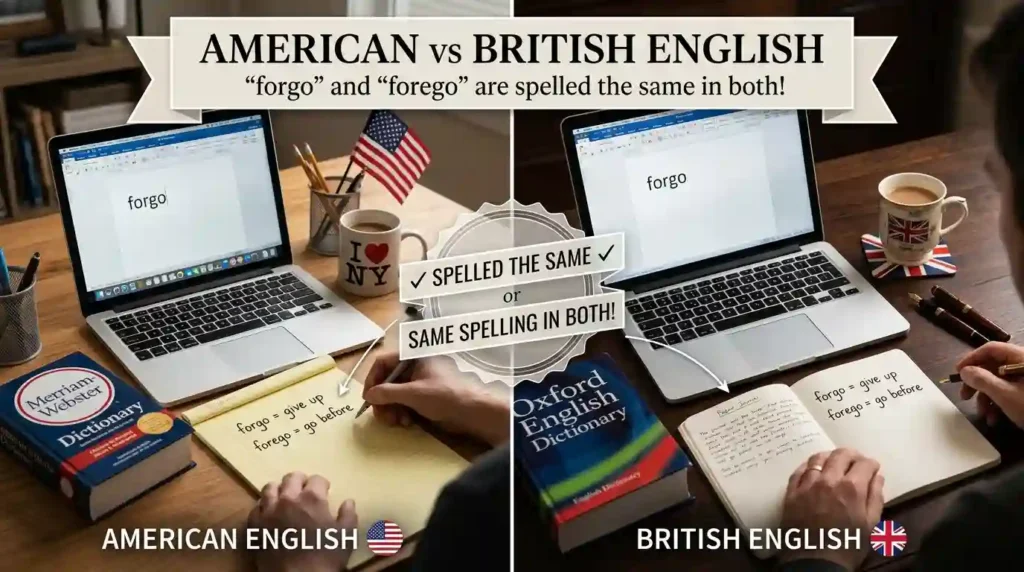
Here is a key point. This is not a US vs UK spelling issue. Both countries use both words. Both countries treat them as two different words.
Many people expect a split like color and colour. But “forgo” and “forego” do not work that way. A British writer and an American writer would both write “forgo” to mean “give up.”
Some words really do change across the Atlantic. Here is a quick table so you can see the difference.
| Word type | American English | British English | Same in both? |
| Give up / do without | forgo | forgo | ✅ Yes |
| Come before | forego | forego | ✅ Yes |
| Color | color | colour | ❌ No |
| Center | center | centre | ❌ No |
| Judgment | judgment | judgement (also judgment) | ❌ Mostly |
| Organize | organize | organise (also organize) | ❌ Mostly |
The lesson is simple. Do not change “forgo” to “forego” because you are in the UK. Do not change it because you are in the US either. Choose the word by its meaning, not by your country.
Which Spelling Should You Use?
Use the word that matches your meaning. Here is a simple guide by audience.
US readers: Use “forgo” to mean “give up.” Use “forego” only for “go before.” Most US style guides support this rule.
UK and Commonwealth readers: Use the same rule. Britain, Canada, Australia, India, and New Zealand all treat the words as two separate terms.
Global readers: Keep it simple. Use “forgo” when you mean “skip” or “give up.” If you need to say “come before,” try “precede.” It is clearer and has no spelling trap.
Business and legal writing: You may see “the foregoing.” It means “the thing just mentioned.” That one is correct and common in contracts.
Safe rule: When in doubt, write “forgo.”
Common Mistakes with Forego and Forgo
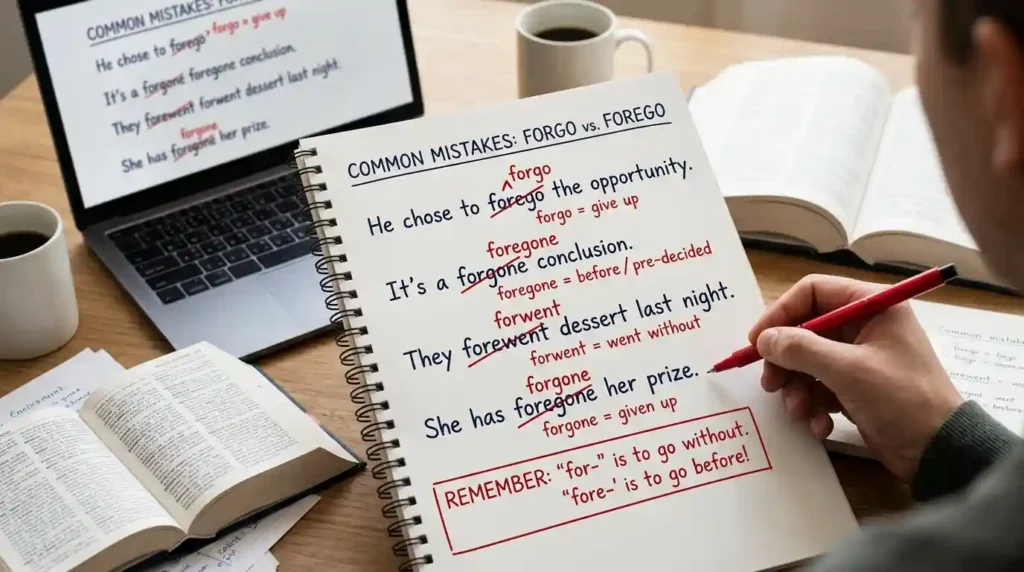
Even good writers trip on these two words. Here are the five mistakes people make most, with easy fixes.
Mistake 1: Using “forego” when you mean “give up”
This is the most common error. If you are skipping or giving up something, you need “forgo.”
- ❌ I will forego sweets this month.
- ✅ I will forgo sweets this month.
Quick fix: No “e” in “forgo.” Think “go without.”
Mistake 2: Using “forgo” when you mean “come before”
This one is rarer. “Forgo” never means “come first.”
- ❌ Lightning forgoes thunder.
- ✅ Lightning foregoes thunder.
- ✅ Even better: Lightning comes before thunder.
Quick fix: “Fore” means “before.” If you mean “before,” keep the “e.”
Mistake 3: Writing “forgone conclusion”
The phrase for a result you already know is “foregone conclusion.” It means the end was clear from the start.
- ❌ The winner was a forgone conclusion.
- ✅ The winner was a foregone conclusion.
“Forgone” is a real word too. It just means “given up.”
- ✅ The bonus was forgone.
Mistake 4: Using the wrong past tense
The past tense of “forgo” is forwent. The past participle is forgone. Many people guess “forgoed,” which is not a word.
- ❌ She forgoed her lunch.
- ✅ She forwent her lunch.
- ✅ Her lunch was forgone.
Mistake 5: Mixing up “forgoing” and “foregoing”
These look alike but do different jobs.
- ❌ Foregoing sugar is hard. (You mean giving it up.)
- ✅ Forgoing sugar is hard.
- ❌ Please read the forgoing note. (You mean the note before.)
- ✅ Please read the foregoing note.
Fast Check
Ask yourself one question: Am I giving something up, or is something coming first?
- Giving up → forgo
- Coming first → forego
Forego and Forgo in Everyday Examples
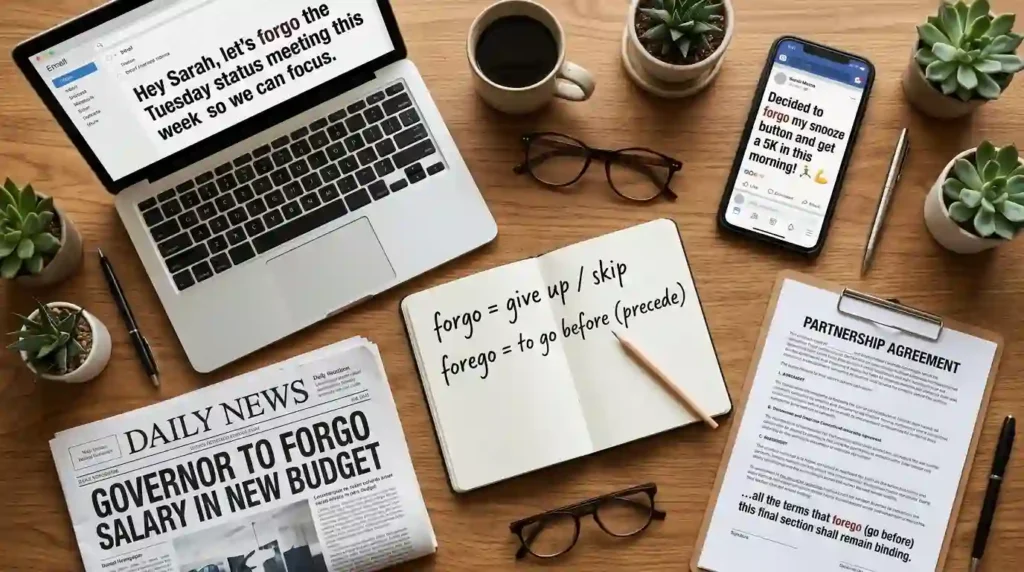
Here is how the words look in real life.
In an email:
- “I’ll forgo the meeting today. Please send me the notes.”
- “Please see the foregoing message for the full details.”
In the news:
- “The mayor will forgo her salary this year.”
- “Many shoppers forgo big purchases when prices rise.”
On social media:
- “Forgoing coffee for a week. Wish me luck! ☕”
- “Pizza night. I’m not forgoing carbs today. 🍕”
In formal writing:
- “The company agreed to forgo its right to appeal.”
- “In the foregoing section, we described the method.”
- “The result was a foregone conclusion.”
Forego or Forgo Google Trends and Usage Data
I can’t pull live Google Trends numbers for you. So I won’t make any up. But we know some patterns about how people search for grammar pairs like this one.
- Who searches: People in English-speaking countries search most. This includes the United States, the United Kingdom, Canada, Australia, India, and Nigeria.
- When they search: Interest often rises during school and exam seasons. Writers also search when they edit work documents.
- Why they search: Most people want a fast answer. They search with phrases like “forego or forgo” or “forgo vs forego.”
- Which word is bigger: In general writing, “forgo” is far more common than “forego” when the meaning is “give up.” The word “foregone” is also popular, mostly because of the phrase “foregone conclusion.”
Want the exact data? Go to Google Trends. Enter “forgo” and “forego” as two terms. Then filter by country and date range. You can compare them in seconds.
Quick Comparison Table: Word Variations Side by Side
| Word | Meaning | Example |
| forgo | give up, do without | I’ll forgo dessert. |
| forgoing | giving up | She is forgoing a raise. |
| forwent | gave up (past) | He forwent his lunch. |
| forgone | given up (past participle) | The bonus was forgone. |
| forego | go before, come first | Thunder may forego rain. |
| foregoing | the thing just mentioned; coming before | See the foregoing page. |
| forewent | went before (past) | Light forewent the sound. |
| foregone | gone before; decided ahead of time | A foregone conclusion. |
Frequently Asked Questions
Is it forego or forgo?
Both are real words, but they mean different things. “Forgo” means to give up. “Forego” means to go before. Most of the time, you want “forgo.”
Is “forego” ever correct for “give up”?
Some dictionaries list it as a less common variant. But most style guides say to avoid it. Use “forgo” to be safe.
What does “foregone conclusion” mean?
It means a result that was clear from the start. Everyone knew how it would end. The correct spelling has an “e”: foregone.
What is the past tense of forgo?
The past tense is forwent. The past participle is forgone. Example: “She forwent dessert. The dessert was forgone.”
Is “forgo” American or British?
Neither. People in both countries use it the same way. It is not a US vs UK spelling difference.
How can I remember the difference?
Think of the “e” in “fore” as “earlier.” Forego = go before. No “e” in forgo, just like no treats when you forgo them.
What is the difference between “forgoing” and “foregoing”?
“Forgoing” means giving up something. “Foregoing” often means “the one before,” as in “the foregoing paragraph.”
Conclusion
Here is what to remember. “Forgo” and “forego” are two different words. They share almost the same letters. But they do not share the same meaning.
Use forgo when you mean to give up or do without. Use forego when you mean to go before. If you are not sure, pick “forgo.” It is the safer and more common choice.
This is not a British vs American spelling issue. Writers in both places follow the same rule. You do not need to change your spelling based on where your readers live.
Watch out for the related pairs too. “Foregone conclusion” has an “e.” “Forgone” (given up) does not. The same goes for “foregoing” and “forgoing.”
A quick memory trick can help. Think “for” = “away.” Think “fore” = “before.” If you want to skip the problem entirely, use simple swaps. Write “give up” instead of “forgo.” Write “precede” instead of “forego.”
Now you know the answer. Next time you write that email, essay, or post, you can type with confidence.

I’m Raheela Rani, a professional content writer and author with 3 years of experience in writing, editing, and storytelling. Through VisitLivo.com, I create clear, engaging, and well-crafted content that helps readers learn, connect, and communicate with confidence.