You are writing an email. You want to say the sun is bright. Your fingers stop. Is it “shinning” or “shining“? You are not alone. Many people ask this every month. The two words look almost the same, and one extra letter can make you doubt yourself.
People search for “shinning or shining” for a simple reason. They want a fast answer they can trust. They also want to know if one spelling is British and the other is American. Many spelling pairs work that way, like “color” and “colour,” so the question makes sense.
Here is the short version. “Shining” is the right spelling for light, glory, and success. “Shinning” is a different word. It is real, but it is rare. It means to climb using your hands and legs.
This guide clears up the confusion. You will learn the quick answer, the history, the rules, and common mistakes. You will also see real examples, a comparison table, and an FAQ. By the end, you will never second-guess this word again.
Shinning or Shining Quick Answer
Use “shining.” It is the correct spelling in almost every case.
“Shining” comes from the verb shine. It means giving off light or being bright.
- The sun is shining.
- She has a shining example to follow.
- His shoes were shining after he cleaned them.
“Shinning” comes from a different verb, shin. It means to climb by gripping with your legs and arms.
- The boy was shinning up the pole.
If you mean light, shine, or sparkle, write shining. If you mean climbing like a monkey, write shinning.
The Origin of Shinning and Shining
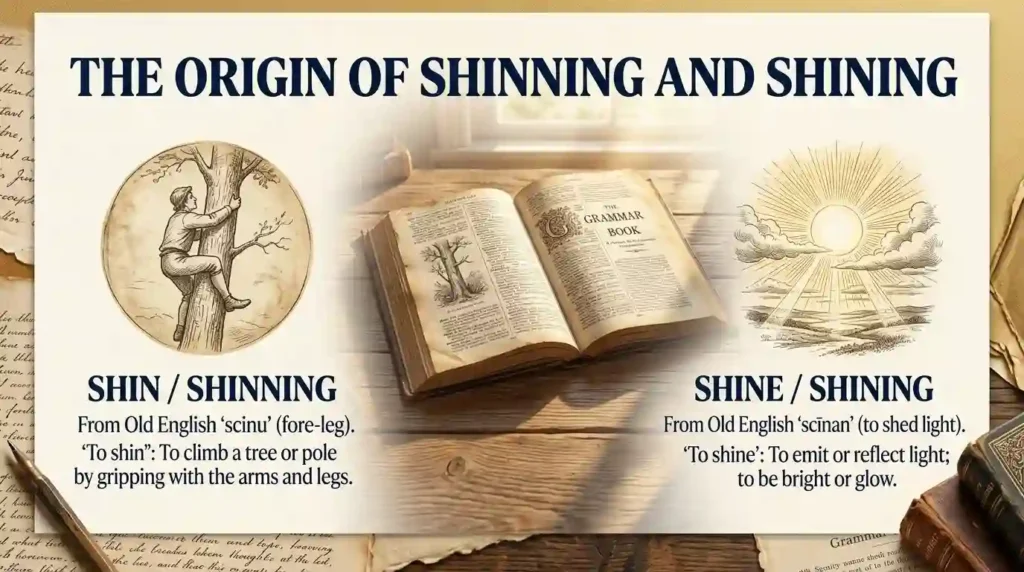
The verb shine is very old. It comes from the Old English word scīnan, which meant “to give off light.” People have used it for over a thousand years.
The verb shin comes from the body part, the shin, the front of your lower leg. To “shin up” a tree means to climb it using your legs. This use is much newer and much less common.
So why do two spellings exist? It comes down to one English spelling rule.
- Shine ends in a silent e. When you add -ing, you drop the e. That gives shining.
- Shin ends in one vowel and one consonant. When you add -ing, you double the last letter. That gives shinning.
Compare these pairs:
- hope → hoping (drop the e)
- hop → hopping (double the p)
- shine → shining
- shin → shinning
The spelling difference is not a mistake. It shows two different base words.
British English vs American English Spelling
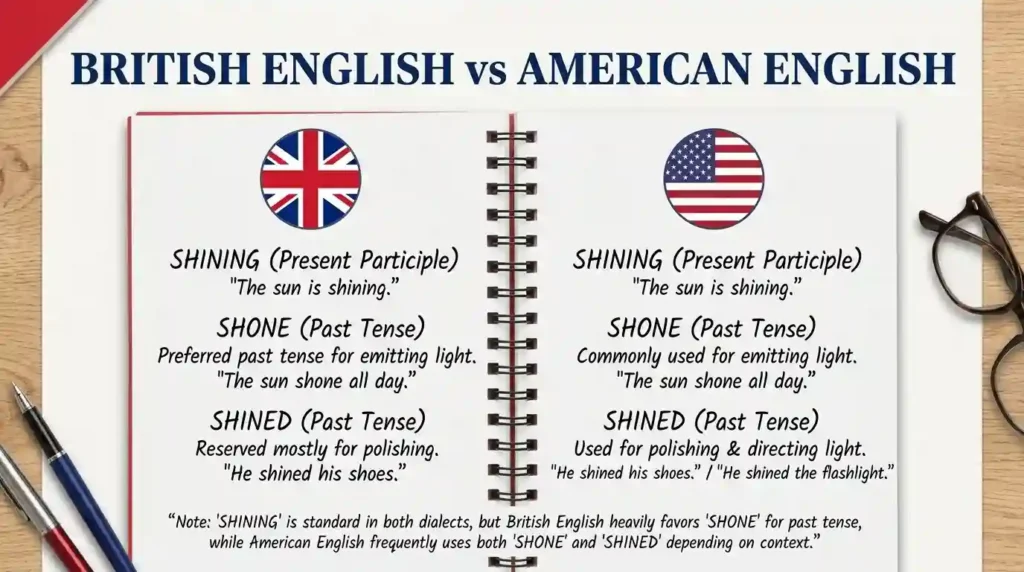
Here is the good news: there is no British or American split for this word. Both use “shining.” Both use “shinning” for climbing.
Where UK and US English do differ is the past tense of shine:
| Meaning | American English | British English |
| The sun gave off light | The sun shone (or shined) | The sun shone |
| He polished his shoes | He shined his shoes | He shone or shined his shoes |
| He pointed a light | He shined the light | He shone the light |
| Right now, giving off light | shining | shining |
| Climbing with legs and arms | shinning | shinning |
Rules to remember:
- The -ing form is shining everywhere.
- The past tense is where UK and US writers sometimes differ. Shone is safe in both places when something gives off light.
- Americans often use shined when someone polishes something or points a light.
Which Spelling Should You Use?
Writing for a US audience: Use shining for light. Use shined if someone polished or aimed something. Example: “He shined his boots.”
Writing for a UK or Commonwealth audience: Use shining for light. Use shone for the past. Example: “The moon shone all night.”
Writing for a global audience: Use shining and shone. They are clear and widely understood. Avoid shinning unless you truly mean climbing.
Simple rule: When in doubt, pick shining.
Common Mistakes with Shinning or Shining

Most errors with this word come from one habit: people double the n when they should not. Here are the mistakes you will see most often, with simple fixes.
1. Doubling the n out of habit
- Wrong: The stars are shinning tonight.
- Right: The stars are shining tonight.
- Why: Shine ends in a silent e. Drop the e, add -ing. No extra n.
2. Using “shinning” for something bright
- Wrong: He wore shinning armor.
- Right: He wore shining armor.
- Why: “Shinning” means climbing. Bright things always take shining.
3. Keeping the silent e
- Wrong: The lights were shineing.
- Right: The lights were shining.
- Why: Words that end in a silent e lose it before -ing, like hope → hoping.
4. Applying the “double the letter” rule to every word
- Short words like run and hop double their last letter (running, hopping). Words with a silent e do not. Shine is one of those words.
5. Using “shined” when you mean light
- Less common: The sun shined all day.
- Better: The sun shone all day.
- Note: Americans use shined for polishing shoes or aiming a light. For light itself, shone is the safer choice.
6. Trusting spell check too much
- Spell check will not flag “shinning” because it is a real word. It cannot tell if you meant light or climbing. Always read the sentence yourself.
Quick test: Is the sentence about light or brightness? Write shining. Is it about climbing with your arms and legs? Write shinning.
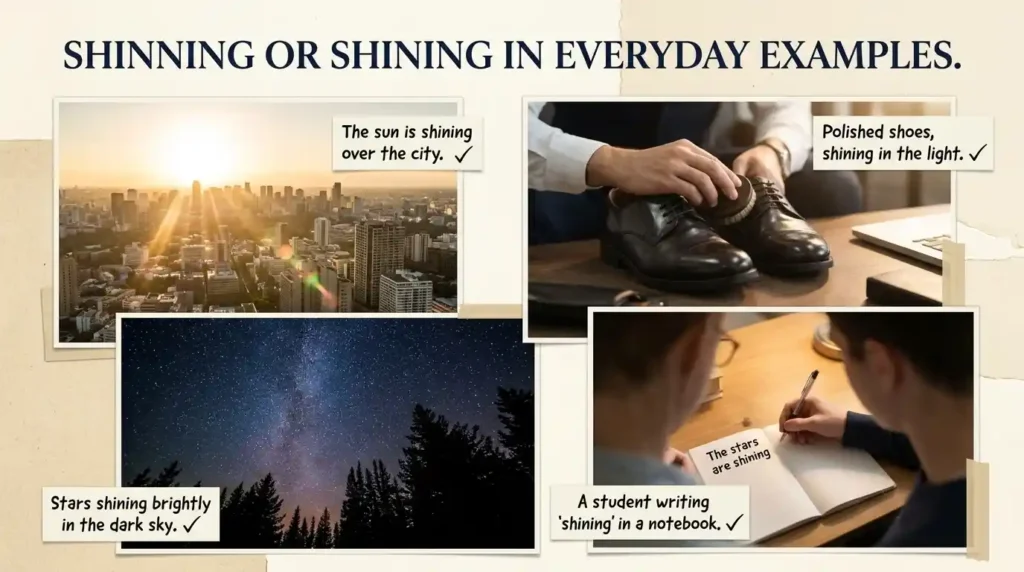
Shinning or Shining in Everyday Examples
In an email
- “Thank you for your help. Your support was a shining example for the team.”
In the news
- “The sun was shining over the city as crowds gathered.”
On social media
- “Out here shining like a star. ✨”
In formal writing
- “Her work remains a shining achievement in the field of science.”
With the rare word “shinning”
- “The children spent the afternoon shinning up the old oak tree.”
Notice how “shinning” almost never appears in daily writing. If you see it in an email or a post about light, it is almost always a typo.
Shinning or Shining Usage and Trends Data
I don’t have live search numbers, so this section describes general patterns. For exact figures, open Google Trends and compare the two terms yourself.
What usually shows up:
- “Shining” is far more common than “shinning” in books, news, and web content.
- “Shinning” searches are often people checking their spelling, not people looking for the climbing word.
- Searches for “shining” get extra lift from pop culture, like The Shining, and from phrases like “shining star” and “shining armor.”
- Spelling-check searches tend to be higher in places where English is a second language, and on phones, where autocorrect and fast typing cause errors.
- In the US, UK, Canada, Australia, and India, people search for both, but “shining” wins by a large margin.
How to check it yourself:
- Go to Google Trends.
- Type “shining” and “shinning” as two search terms.
- Choose a country and a time range.
- Look at “Interest by region” to see where each term is popular.
Quick comparison table
| Variation | Correct? | Meaning | Example |
| shining | Yes | Giving off light; excellent | The sun is shining. |
| shinning | Yes, but rare | Climbing with arms and legs | He is shinning up a pole. |
| shineing | No | Misspelling | |
| shined | Yes (mostly US) | Polished or aimed a light | She shined the lamp. |
| shone | Yes | Past tense of shine | The moon shone brightly. |
Frequently Asked Questions
Is it shinning or shining?
It is shining in almost every case. “Shinning” is a rare word that means climbing.
Is “shinning” a real word?
Yes. It comes from the verb shin, meaning to climb using your legs and arms. It is just not common.
Is shining British or American spelling?
Neither. Both British and American English use shining.
What is the past tense of shine?
It is shone (UK and US) or shined (mostly US, for polishing or aiming a light).
Why is there only one n in shining?
The base word shine ends in a silent e. You drop the e and add -ing. You do not double the n.
When should I use “shinning”?
Only when you mean climbing by gripping with your legs and arms, as in “shinning up a tree.”
Is “shineing” ever correct?
No. It is always a misspelling. Write shining.
Conclusion
The answer is simple. Write shining when you mean light, glow, brightness, or excellence. Write shinning only when you mean climbing with your arms and legs. That second word is rare, so most of the time you will want the first.
Remember the rule behind the spelling. Shine has a silent e, so you drop it and add -ing. Shin has no silent e, so you double the n. One rule explains both words.
Remember, too, that this word has no US and UK spelling split. The only real difference is the past tense. Americans may say shined when they polish or aim something, while shone works well everywhere for light.
When you write for a global audience, stay safe. Use shining and shone. Check your sentence with a quick test: is it about light or climbing? That one question settles it every time.
Now you can write with confidence. Your emails, posts, and reports will look sharp and professional, and your spelling will be shining.

“I’m Ibadat Fatima, a professional content writer and author with 3 years of experience in writing, editing, and storytelling. I share my work through visitlivo.com, where I help readers connect with clear, engaging, and well-crafted content.”