You are doing homework, and the question stops you. Is density a physical property or a chemical property? Thousands of students, parents, and teachers search “density physical or chemical” every month. The confusion makes sense. Density tells you what a material is like. That sounds chemical. But the real answer is simple.
This article gives you the quick answer first. Then it shows why the answer is right. You will learn where the words come from, how people spell them in the US and UK, and what mistakes to avoid. You will also see real examples and a clear FAQ.
By the end, you will know the answer. You will also know how to explain it to anyone.
Density Physical or Chemical Quick Answer
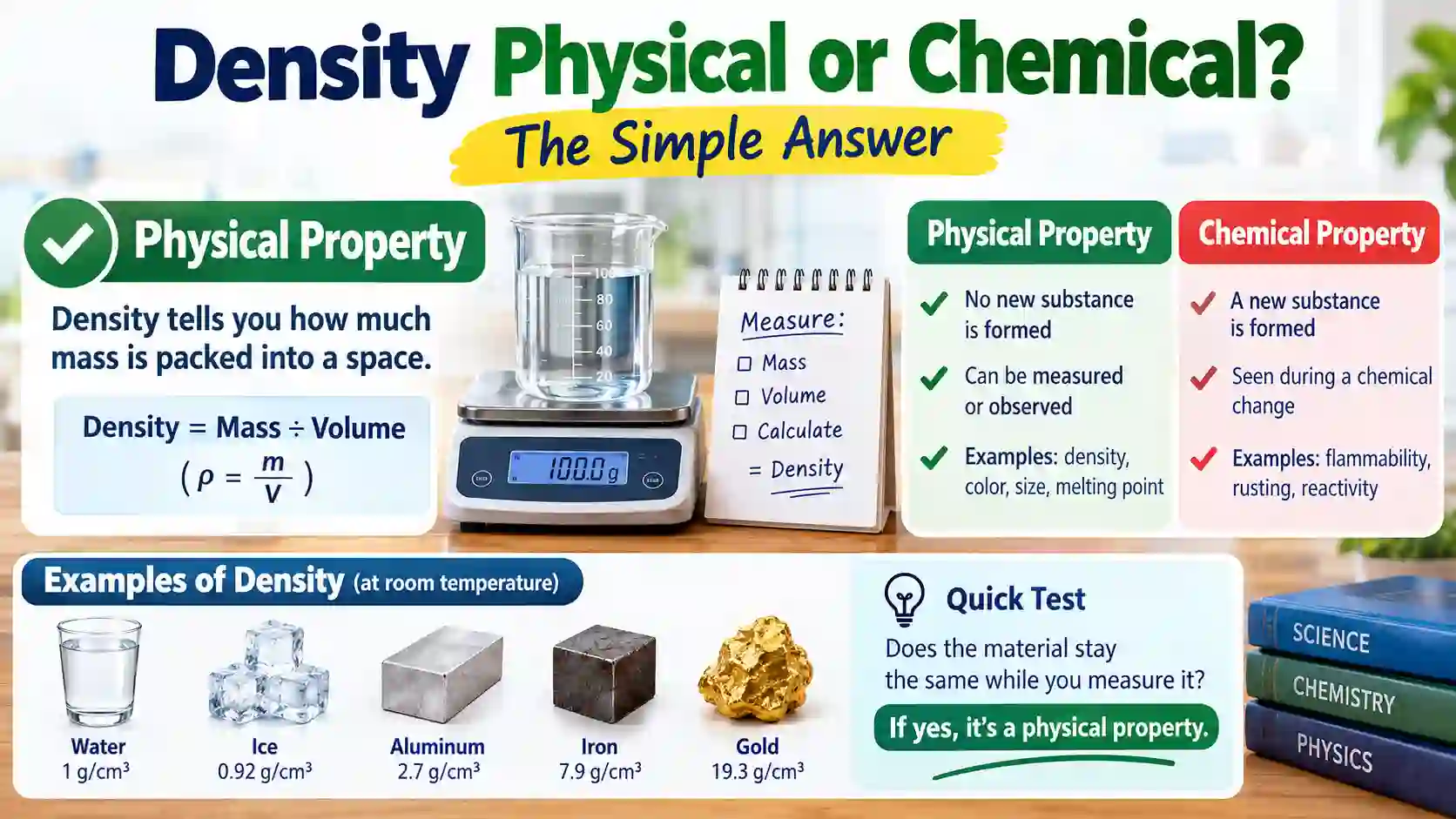
Density is a physical property. It shows how much stuff is squeezed into a space. Here is the formula:
Density = Mass ÷ Volume
You can measure density without changing what the material is. Weigh it. Measure its size. Do the math. The material stays the same.
A chemical property is different. You can only see it when the material turns into something new. Burning wood is an example. Rusting iron is another.
Examples of density (about, at room temperature):
- Water: 1 g/cm³
- Ice: 0.92 g/cm³ (this is why ice floats)
- Aluminum: 2.7 g/cm³
- Iron: 7.9 g/cm³
- Gold: 19.3 g/cm³
Quick test: Does the material stay the same while you measure it? If yes, it is a physical property.
The Origin of Density Physical or Chemical
Each word in this keyword has its own story.
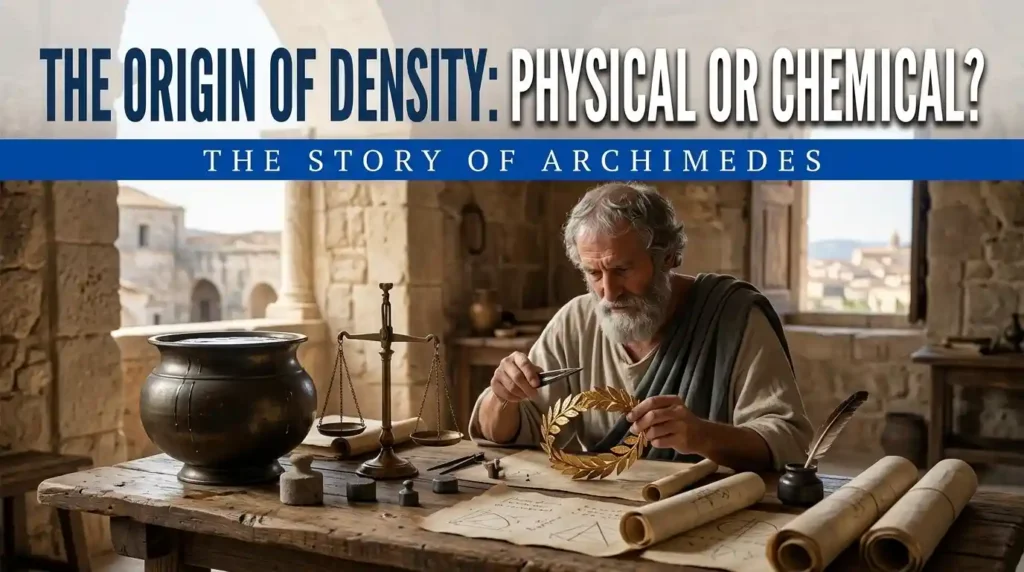
Density comes from the Latin word densus. It means “thick.” Long ago, people used it to say something was packed close together. A famous story says the Greek thinker Archimedes used density to test a king’s crown. The story may be a legend, but the idea is real.
Physical comes from the Greek word physikos. It means “of nature.” Physical properties are the things we can see, measure, or feel.
Chemical comes from “chemistry.” Chemistry grew out of alchemy. Alchemy is an old practice that tried to change one material into another. That is why chemical properties are about change.
Why do spellings differ? For most of these words, they do not. “Density,” “physical,” and “chemical” are spelled the same everywhere. Spelling differences show up in nearby science words. English changed over time. Britain and the US went in slightly different directions after the 1800s.
British English vs American English Spelling
Good news: “density physical or chemical” has the same spelling in British and American English.
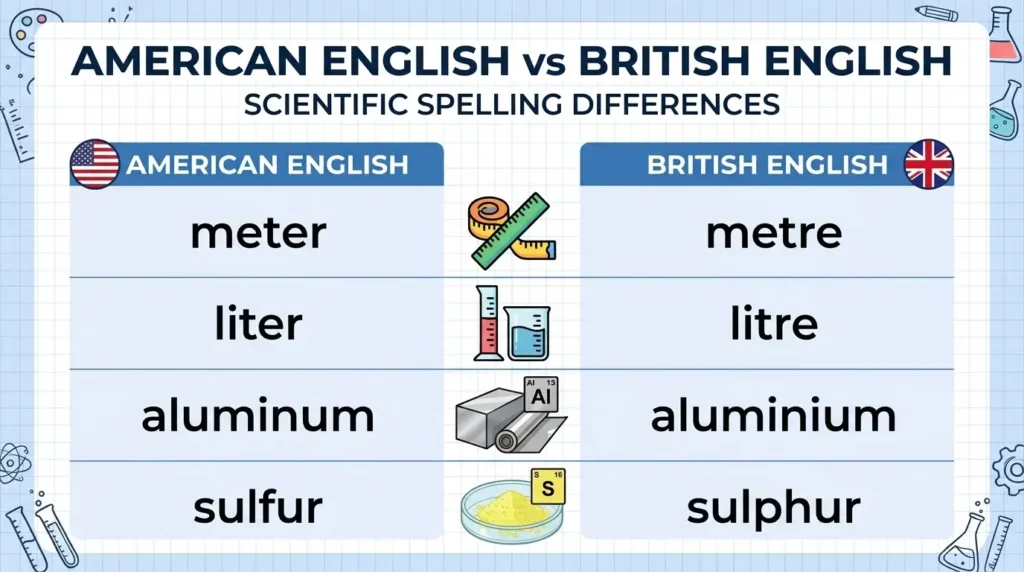
But density problems often use other words. Those words can differ. Here is a simple table.
| Word | American English | British English |
| Density | density | density |
| Physical | physical | physical |
| Chemical | chemical | chemical |
| Unit of length | meter | metre |
| Unit of volume | liter | litre |
| Metal | aluminum | aluminium |
| Element | sulfur | sulphur |
| Unit of mass | gram | gram (gramme is old) |
Simple rule: Words ending in “-er” in the US often end in “-re” in the UK. Examples are meter/metre and liter/litre.
Note that “sulfur” is now the standard spelling in science worldwide. Many UK schools use it too.
Which Spelling Should You Use?
For “density,” “physical,” and “chemical,” you have no choice to make. Use them as written.
For related words, think about your reader.
- US readers: Use meter, liter, aluminum, sulfur.
- UK, Australia, and most Commonwealth readers: Use metre, litre, aluminium. Use sulfur in science writing.
- Global readers: Pick one style and stay with it. Do not mix them in one article.
Pro tip: If you write for a school or a journal, check its style guide first. Many science journals use US spelling, but not all.
Common Mistakes with Density Physical or Chemical
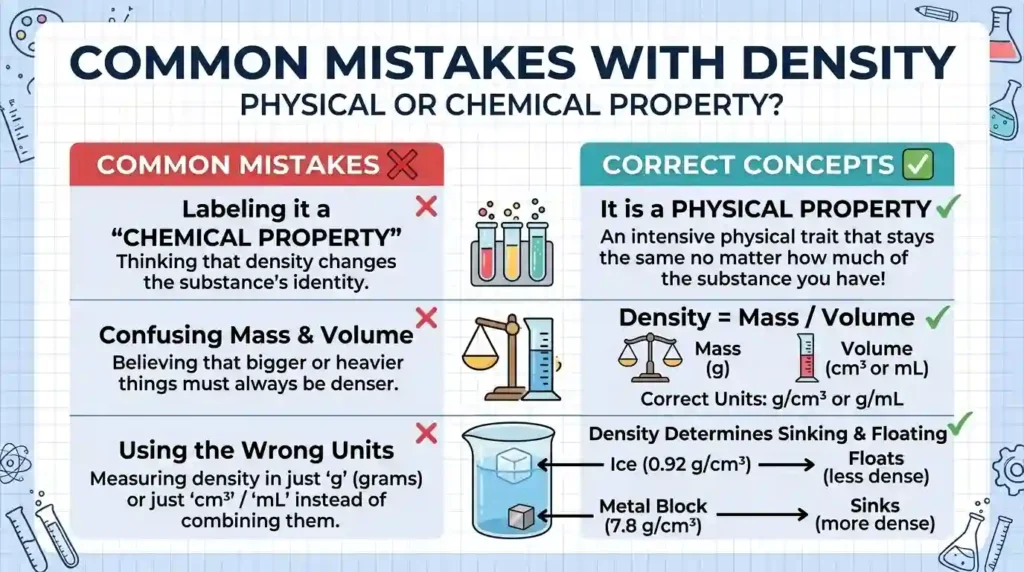
Mistake 1: Saying density is chemical.
It feels chemical because it describes the material. But measuring it does not change the material. It is physical.
Mistake 2: Mixing up density and weight.
Weight depends on how much you have. Density does not. A small gold ring and a big gold bar have the same density.
Mistake 3: Thinking changing density means a chemical change.
Heat a liquid and its density drops. It expands. But it is still the same liquid. This is a physical change.
Mistake 4: Thinking floating or sinking is chemical.
Floating happens when something is less dense than the liquid. No new material forms.
Mistake 5: Mixing up “physical property” and “physical change.”
A property is something you can measure. A change is something that happens.
Mistake 6: Wrong units.
Use g/cm³ or kg/m³. Do not write “g/cm” or leave the units off.
Mistake 7: Misspelling.
It is “density,” not “dencity.”
Density Physical or Chemical in Everyday Examples

In an email from a teacher:
“Please remember, density is a physical property. Bring your lab notes on Friday.”
In a news article:
“Scientists said the oil spill floated because oil has a lower density than seawater.”
On social media:
“Why does ice float? Because its density is lower than water. Physical property, not chemical! #science”
In formal writing:
“Density is an intensive physical property. It does not change with the amount of substance.”
In a quiz question:
“Is the density of copper a physical or chemical property? Answer: physical.”
Density Physical or Chemical Google Trends & Usage Data
I cannot pull live Google Trends numbers here, so I will not invent any. Here is what is commonly true for science-homework searches like this one. You can confirm it yourself on Google Trends.
- Who searches: Mostly students, plus teachers and parents helping with homework.
- When: Interest usually rises during school terms and exam seasons. It dips during long school holidays.
- Where: English-language searches come from places with many students learning science in English. These include the US, India, Pakistan, the UK, Canada, Australia, the Philippines, and Nigeria.
- Context: People often search it with other words, like “property,” “example,” or “quiz.”
Keyword variations side by side:
| Search phrase | What the person wants |
| density physical or chemical | Quick yes/no answer |
| is density a physical or chemical property | Same answer, asked as a full question |
| density chemical property | Checking if the chemical idea is right |
| density physical property | Looking for proof or examples |
| physical vs chemical properties | The bigger lesson |
All of these have one answer: physical.
Tip: Open Google Trends and compare these phrases. Set the region and date range you care about.
FAQs
Is density a physical or chemical property?
Density is a physical property.
Why is density not a chemical property?
You can measure it without changing the material into something new.
Does density change with temperature?
Yes. Most materials get less dense when heated. The material is still the same, so it is still a physical property.
Is density an intensive or extensive property?
It is intensive. It does not depend on how much material you have.
What are examples of chemical properties?
Flammability, rusting, and reactivity with acid.
What is the formula for density?
Density = mass ÷ volume.
Why does ice float on water?
Ice is less dense than liquid water. Water expands as it freezes.
Is spelling different in the UK and US for “density”?
No. It is spelled the same. But words like “metre” and “meter” differ.
Conclusion
So, is density physical or chemical? The answer is physical. That is the key point to remember.
Density tells you how much mass fits in a space. You find it with mass and volume. You do not need to change the material to measure it. Chemical properties are different. They only show up when a material becomes something new, like wood burning or iron rusting.
Here are the main takeaways:
- Density = mass ÷ volume.
- Density is a physical, intensive property.
- Heat can change density, but that is a physical change.
- The spelling of “density,” “physical,” and “chemical” is the same in the US and UK.
- Watch related words, like meter/metre and aluminum/aluminium.
- Always use the right units, such as g/cm³ or kg/m³.
Usage advice: If you are answering a test, write “physical property” and show the formula. If you are writing for readers, pick one spelling style and keep it.
Now you can answer this question quickly. You can also explain why.

“I’m Ibadat Fatima, a professional content writer and author with 3 years of experience in writing, editing, and storytelling. I share my work through visitlivo.com, where I help readers connect with clear, engaging, and well-crafted content.”