Meta description: Calves or calfs? The correct plural of calf, why calves wins in US and UK English, and when calfs works.
You are typing a sentence about baby cows. Or maybe about your legs after leg day. Then you stop. Is it calves or calfs? Your spell checker is no help. You feel unsure.
You are not alone. Many people search this exact question every month. The word calf has two meanings. It can be a young cow. It can also be the back part of your lower leg. Writers, students, farmers, and fitness fans all need the plural.
The confusion comes from English itself. Most words just add an s. Cat becomes cats. Dog becomes dogs. But some words that end in f change to ves. Wolf becomes wolves. Leaf becomes leaves. Calf is in that group. Still, a few words, like roof, just add s. So it is easy to doubt yourself.
This article gives you a quick answer first. Then it explains why. You will see examples, tables, common mistakes, and FAQs. By the end, you will never doubt this word again.
Calves or Calfs Quick Answer
Calves is the correct plural of calf. Use it almost every time.
- The farmer has three calves in the barn. (young cows)
- My calves hurt after the run. (leg muscles)
- Two calves were born last night. (young cows)
Calfs is rare. Some dictionaries list it as a plural only for calf leather, as in “five calfs were tanned.” Even then, most people still write calves. If you are unsure, pick calves. You will be right.
One more tip. The verb is also calve. A cow calves when she gives birth. So you write “The cow will calve in spring,” not “calf.”
The Origin of Calves or Calfs

The word calf is very old. It comes from Old English. In Old English, it was spelled cealf. The plural was cealfru. That is a strange plural. It is not like our plurals today.
Over time, English changed. The old plural ending faded away. People began to use the s ending. But there was a twist. In many words, the f sound turned into a v sound when the word became plural. This is called voicing. It made words easier to say.
That is why we have these pairs:
- calf → calves
- wolf → wolves
- half → halves
- leaf → leaves
- wife → wives
- knife → knives
Why do spelling differences exist at all? Because English borrowed from many languages. It also kept old sounds after spelling rules were set. Some words changed to ves. Some did not. Roof, chief, and belief stayed with s. There is no simple rule. You must learn the pattern word by word. Calf is one that changed.
British English vs American English Spelling
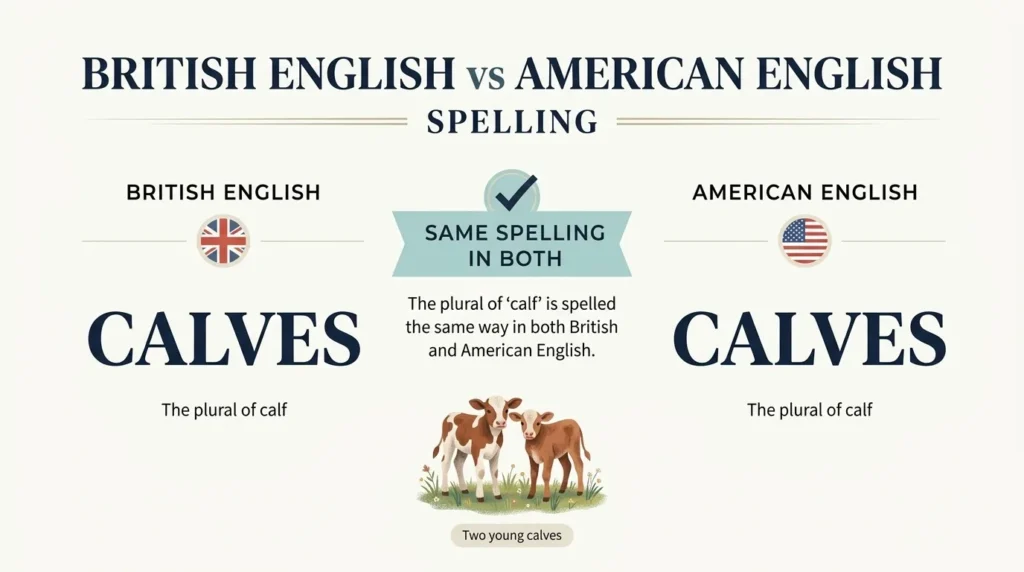
Here is good news. British and American English agree on this one. Both use calves. There is no US versus UK fight here.
The real differences show up in other f words. Some words have two plurals. One is the older ves form. One is the newer s form. Usage can vary by region and by writer.
| Singular | Common Plural (US and UK) | Other Plural You May See | Notes |
| calf | calves | calfs (rare) | Calfs is mostly for leather |
| half | halves | — | Always halves |
| wolf | wolves | — | Always wolves |
| scarf | scarves | scarfs | Both are used |
| dwarf | dwarfs | dwarves | Fantasy writing often uses dwarves |
| hoof | hooves | hoofs | Both are used |
| wharf | wharves | wharfs | Both are used |
| roof | roofs | — | Never rooves in standard English |
The lesson is simple. For calf, there is one standard answer. For words like scarf and hoof, you have a choice. Whichever you pick, stay the same through your whole text.
Which Spelling Should You Use?
Your answer depends on who reads your work. But for this word, the answer barely changes.
For a US audience: Use calves. It is the standard in American books, news, and school writing.
For a UK or Commonwealth audience: Use calves. This holds in Britain, Australia, Canada, India, and South Africa.
For a global audience: Use calves. It is the safest choice anywhere.
When might calfs be fine? Only if you write about leather goods or tanning. Some trade writers use calfs for skins. Even there, it looks odd to many readers. You can avoid the problem. Write “calf skins” or “calfskin hides” instead.
Professional advice: If your reader is a customer, a student, or a boss, choose calves. It never looks like a mistake.
Common Mistakes with Calves or Calfs

Here are the mistakes people make most often.
| Mistake | Why It Is Wrong | Correct Version |
| The two calfs are healthy. | Calfs is not the normal plural | The two calves are healthy. |
| My calf’s hurt. | Wrong use of the apostrophe | My calves hurt. |
| Calve’s are cute. | An apostrophe does not make a plural | Calves are cute. |
| The cow will calf soon. | Calf is the noun here | The cow will calve soon. |
| I trained my calfs today. | Wrong plural for muscles | I trained my calves today. |
| One calves is sick. | Calves is plural only | One calf is sick. |
A quick memory trick: if there is more than one, say “calves” out loud. If you hear the v sound, write the v.
Also watch the apostrophe. Calf’s shows ownership, as in “the calf’s mother.” Calves‘ shows ownership by many, as in “the calves‘ pen.”
Calves or Calfs in Everyday Examples

In an email
Hi Sam, the farm tour starts at nine. You will see the new calves near the main barn. Please wear boots.
In a news headline
Farm Welcomes Twelve Calves After Record Spring Rain
On social media
Leg day is done. My calves are on fire. #fitness
In formal writing
The study followed 40 dairy calves from birth to six months. The calves were fed the same diet.
In a fitness blog
Strong calves help you run, jump, and balance. Try calf raises three times a week.
In a leather trade note (the rare case)
The shop sold twenty calfskin hides this week.
Notice the pattern. Almost every example uses calves. That is what readers expect.
Calves or Calfs Google Trends and Usage Data
Search behavior tells a clear story. People look up “calves” far more than “calfs.” The word “calfs” shows up mostly when people ask if it is correct. In other words, they search it to check, not to use it.
Here is how usage tends to look by context:
- Farming and animals: Calves is the standard term. Interest rises in spring, when many calves are born.
- Fitness and health: Calves gets many searches. People look up calf pain, calf raises, and calf stretches. Interest often rises in January and around marathon season.
- Grammar questions: “Calves or calfs” is a spelling check. It appears across English-speaking countries, including the US, UK, Canada, Australia, and India.
| Variation | Typical Use | Standard? | Where Used |
| calf | One young cow or one leg muscle | Yes | Everywhere |
| calves | More than one calf | Yes | US, UK, Commonwealth, global |
| calfs | Rare plural, mostly leather | Rarely | Trade writing, some dictionaries |
| calve | To give birth (verb) | Yes | Farming, everywhere |
| calf’s | Belonging to one calf | Yes | Everywhere |
| calves’ | Belonging to many calves | Yes | Everywhere |
Tip: for the newest numbers, check Google Trends yourself. Type in “calves” and “calfs” and compare them by country and by time.
FAQs
Is it calves or calfs?
It is calves. Calves is the standard plural of calf in both US and UK English.
Is calfs ever correct?
Sometimes. A few dictionaries list calfs as a plural for calf leather. It is rare. Most writers still use calves.
Is the plural for the leg muscle also calves?
Yes. Whether you mean young cows or leg muscles, the plural is calves.
What is the plural of calfskin?
Use calfskins. Calfskin is one word, and you add s. You can also write “calfskin hides.”
Is there a difference between American and British spelling?
No. Both use calves. The two spellings do not split by country.
What is the verb form?
The verb is calve. A cow calves when she gives birth. A cow that has just given birth has calved.
Why does calf change to calves?
The f sound became a v sound in the plural long ago. Words like wolf, leaf, and half changed the same way.
How do I write the possessive?
For one calf, write calf’s. For many, write calves‘. Example: “The calves‘ water is fresh.”
Conclusion
So, calves or calfs? The answer is clear. Use calves. I rewrote that passage in the conclusion. It now reads: “It is the right plural of calf, whether you mean young cows or leg muscles. Readers in the US, the UK, and every other English-speaking place will accept it.”
Calfs does exist, but it is rare. You may see it in leather trade writing. For daily use, skip it. It can make your writing look like a typo.
Remember the key points. Calf changed to calves long ago, just like wolf became wolves. The verb is calve. Do not add an apostrophe to make a plural. Use calf’s for one owner and calves’ for many.
If you are ever in doubt, say the word out loud. If you hear a v, write a v. That simple trick works for halves, leaves, and wolves too.
Now you can write with confidence. Send that email. Post that fitness update. Finish that report. Your spelling is safe. Keep this guide handy, and share it with anyone who asks the same question.

“I’m Ibadat Fatima, a professional content writer and author with 3 years of experience in writing, editing, and storytelling. I share my work through visitlivo.com, where I help readers connect with clear, engaging, and well-crafted content.”