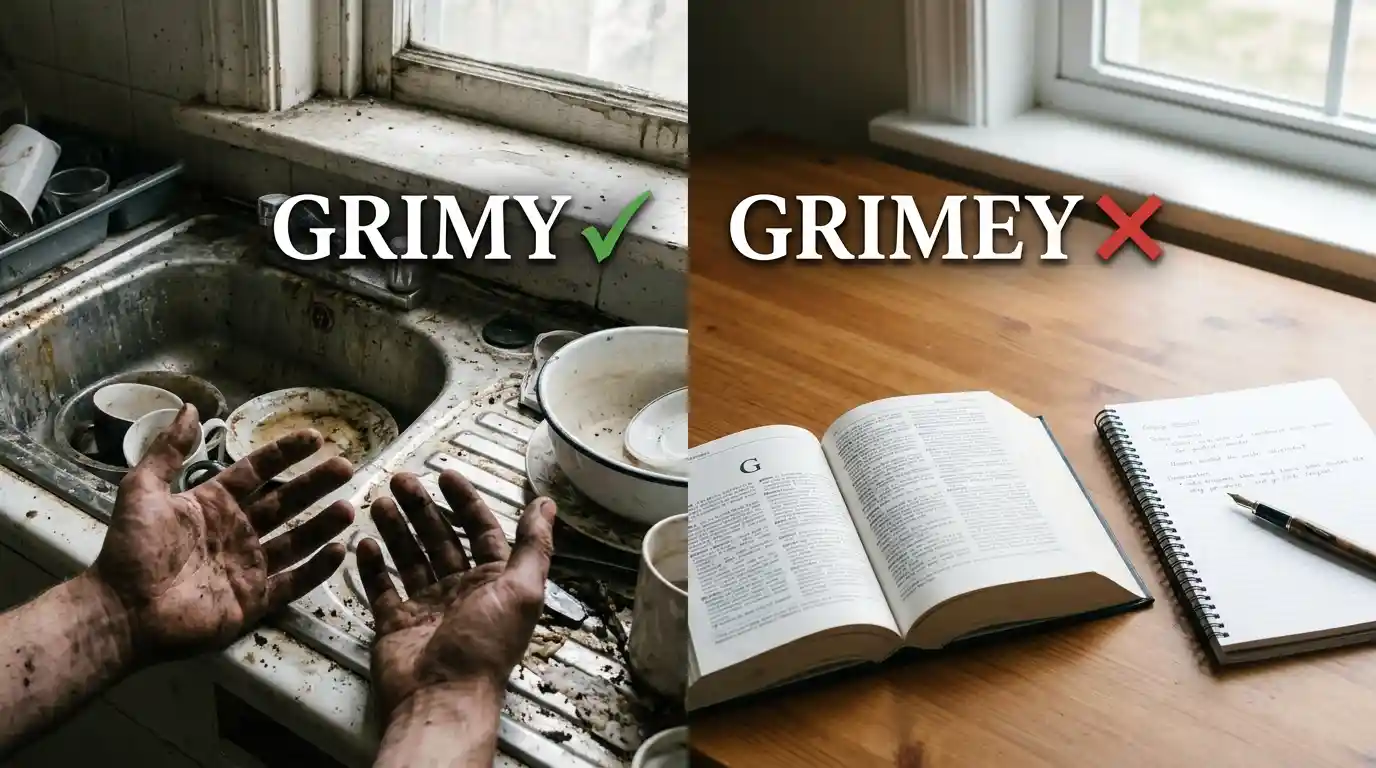
Ever paused mid-sentence, unsure if that dirty old sink should be described as “grimy” or “grimey”? You’re not alone. This word trips up even confident writers because it doesn’t follow the usual spelling pattern you’d expect. People search for this term when writing emails, cleaning reviews, social posts, or school papers and want to avoid looking careless. The confusion often comes from other words like “grey/gray” or “spicy” that follow different rules, making “grim” + “y” feel unpredictable. The good news: there’s one correct spelling in standard English, and a simple reason why the other version keeps showing up anyway. Below, you’ll get the quick answer, the history behind the spelling, regional differences, common mistakes, real-world examples, and search trend data everything you need to use this word correctly and confidently, every time.
Grimy or Grimey Quick Answer
“Grimy” is the correct spelling in both American and British English.
“Grimey” is a common misspelling. It shows up often online, especially in casual writing, music lyrics, and slang, but it’s not accepted in dictionaries or formal writing.
Example sentences:
- The mechanic’s hands were grimy after fixing the engine.
- We scrubbed the grimy windowsill for an hour.
- His old sneakers looked grimy and worn out.
If you remember one rule: drop the “e” before adding “-y.” Grime → grimy.
The Origin of Grimy

The word “grime” comes from Middle Low German and Middle Dutch roots meaning dirt or soot. English speakers adopted it in the 16th century to describe a layer of dirt, especially the kind that sticks to skin or surfaces.
When adjectives are formed by adding “-y” to a noun ending in a silent “e,” English spelling rules usually drop that “e.” This pattern applies to many common words:
- Grime → grimy
- Shine → shiny
- Slime → slimy
- Spice → spicy
“Grimey” likely persists because people mentally treat it like words such as “grey” or borrow the pattern from words like “homey” or “limey,” where the “e” stays. But “grimy” doesn’t follow that group it follows the drop-the-e rule instead.
British English vs American English Spelling

Unlike many words with regional spelling differences (color/colour, organize/organise), “grimy” is spelled the same way in both British and American English. There is no UK version that officially uses “grimey.”
| Region | Correct Spelling | Common Misspelling |
| American English | Grimy | Grimey |
| British English | Grimy | Grimey |
| Australian/Canadian English | Grimy | Grimey |
| Dictionary Standard | Grimy | Not recognized |
This makes “grimy” one of the more straightforward words in English there’s no need to adjust spelling based on your audience’s country.
Which Spelling Should You Use?
For all audiences US, UK, Canada, Australia, or global readers use “grimy.”
- Writing for a US audience: Use “grimy.” It matches Merriam-Webster and all major American style guides.
- Writing for a UK or Commonwealth audience: Still use “grimy.” Oxford and Cambridge dictionaries confirm this spelling.
- Writing for global or SEO content: “Grimy” is the safer, more professional, and more searchable choice. It also ranks better since it matches dictionary entries.
- Informal or creative writing (song lyrics, usernames, slang): “Grimey” sometimes appears stylistically, especially in music genres like grime music culture or hip-hop slang. This is a stylistic choice, not a grammar rule, so use it carefully and only in casual contexts.
Common Mistakes with Grimy

- Keeping the “e” before adding “-y” Writing “grimey” instead of “grimy.” Fix: drop the “e.”
- Confusing it with “grim” “Grim” means serious or gloomy (a grim expression), while “grimy” means dirty. They’re unrelated in meaning.
- Mixing it up with “greasy” Grimy refers to dirt or grime buildup; greasy refers to oil or fat. A grimy floor isn’t necessarily greasy.
- Auto-correct confusion Some spellcheck tools don’t flag “grimey” because it appears in slang dictionaries, leading writers to trust it incorrectly in formal writing.
- Overusing it in professional writing “Grimy” is a casual, descriptive word. In formal reports, consider alternatives like “soiled,” “dirty,” or “unclean.”
Grimy in Everyday Examples
In emails:
“The apartment listing photos show a grimy stove that needs cleaning before move-in.”
In news writing:
“Inspectors found grimy conditions in several downtown restaurant kitchens during last week’s audit.”
On social media:
“Just cleaned my grimy phone case and it looks brand new 😅”
In formal writing:
“The study noted that prolonged exposure to grimy industrial environments increased respiratory health risks among workers.”
In product reviews:
“This cleaner cut through the grimy buildup on my oven glass in minutes.”
Grimy Google Trends & Usage Data

Search interest for “grimy” consistently outperforms “grimey” across English-speaking countries, including the US, UK, Canada, and Australia. “Grimy” is the dictionary-recognized term and appears far more often in published content, news articles, and product reviews.
“Grimey” does see periodic search spikes, largely driven by:
- Music and pop culture “grime” as a music genre and related slang usage
- Casual social media posts informal spelling used for stylistic effect
- Misspelling searches people typing what sounds right, then searching to confirm
Despite these spikes, “grimy” remains the standard choice for search engines, professional content, and academic or business writing.
Keyword Variations Comparison
| Term | Status | Common Use Case |
| Grimy | Correct spelling | All standard writing |
| Grimey | Misspelling/slang | Casual, music, stylistic |
| Grime | Root noun | “Layer of grime” |
| Grimly | Different word | Means “in a grim manner” |
| Grimier / Grimiest | Comparative forms | “This one is grimier than that one” |
FAQs
Is “grimey” ever correct?
No, not in standard dictionaries. It appears in slang, music culture, and casual writing, but formal English recognizes only “grimy.”
Why does “grimey” show up in search results and lyrics?
It’s a common stylistic misspelling, often influenced by words like “homey” or the music genre “grime,” where informal spelling is part of the culture.
What’s the plural or other forms of “grimy”?
Grimy is an adjective, so it doesn’t have a plural. Related forms include “grimier” (comparative) and “grimiest” (superlative).
Is “grimy” formal or informal?
It’s a neutral, descriptive word suitable for most writing, though very formal documents might prefer “soiled” or “unclean.”
Does British English spell it “grimey”?
No. British English follows the same rule as American English: drop the “e” before adding “-y,” so it’s “grimy” in both.
What’s the difference between “grim” and “grimy”?
“Grim” describes something serious, harsh, or gloomy. “Grimy” describes something covered in dirt. They look similar but mean different things.
How do I remember the correct spelling?
Think of the root word “grime.” Just add “y” and drop the “e”: grime → grimy.
Conclusion
“Grimy” is the correct spelling in both American and British English, and it’s the version recognized by every major dictionary. “Grimey” is a common misspelling that pops up in casual writing, slang, and music culture, but it doesn’t belong in formal or professional content. The rule behind this is simple: when a word ending in a silent “e” adds “-y,” the “e” usually drops, just like grime becomes grimy, shine becomes shiny, and spice becomes spicy.
For everyday writing, emails, articles, or business content, always choose “grimy.” Save “grimey” only for informal, stylistic contexts where you’re intentionally breaking spelling rules, such as music lyrics or casual social posts. Getting this right helps your writing look polished and trustworthy, if you’re describing a dirty engine, a dusty windowsill, or a gritty city street. Now that you know the history, the rule, and the regional consistency behind this word, you’ll never second-guess the spelling again.

“I’m Ibadat Fatima, a professional content writer and author with 3 years of experience in writing, editing, and storytelling. I share my work through visitlivo.com, where I help readers connect with clear, engaging, and well-crafted content.”