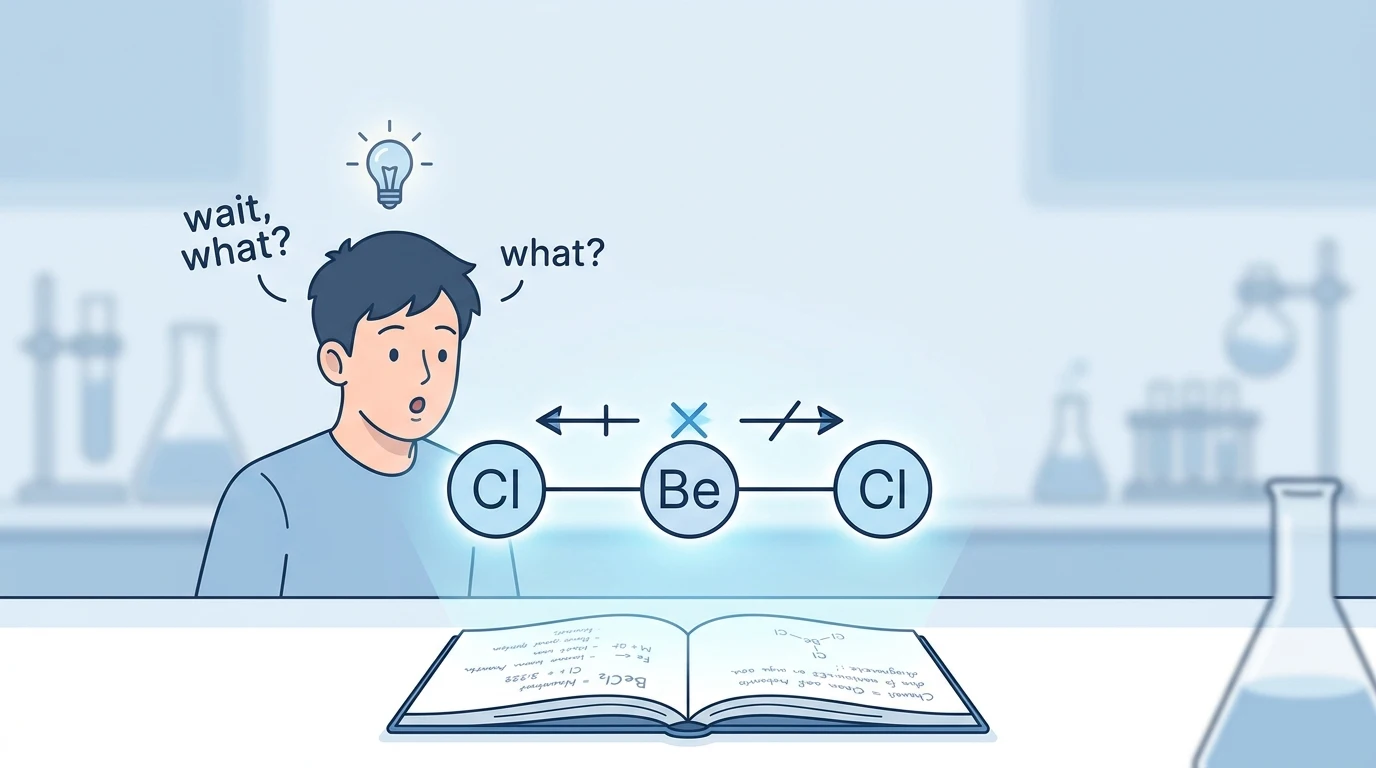
You are staring at your chemistry homework. The question says: “Is BeCl2 polar or nonpolar?” You know the bonds inside it look uneven. So your gut says “polar.” But your textbook says “nonpolar.” Now you are confused.
This mix-up happens to thousands of students every week. BeCl2, or beryllium chloride, is one of the most searched molecules in general chemistry. People search for it because the answer seems to fight against logic. The bonds are polar. The molecule is not. That gap between “bond polarity” and “molecule polarity” is where most confusion starts.
This article gives you the fast answer first. Then it walks through the science in plain words. You will also see how BeCl2 compares to other molecules like CO2 and water, common mistakes students make, and answers to the questions people ask most. By the end, you will not just know the answer. You will know why it is true.
BeCl2 Polar or Nonpolar Quick Answer
BeCl2 is nonpolar.
Here is the short version:
- Each Be–Cl bond is polar, because chlorine pulls electrons harder than beryllium.
- But BeCl2 has a linear shape (a straight line: Cl–Be–Cl).
- The two bond dipoles point in exactly opposite directions.
- They cancel each other out.
- The result: the whole molecule has no net dipole. It is nonpolar overall.
Think of it like two people pulling a rope with equal force from opposite ends. Each pull is real. But the rope does not move. That is BeCl2.
The Science Behind BeCl2’s Polarity
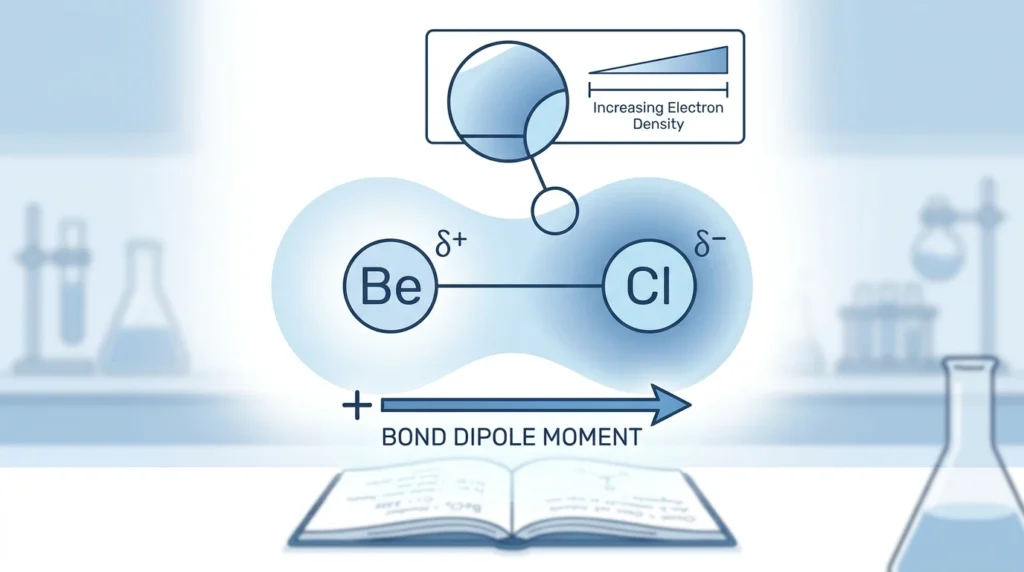
To understand BeCl2, you need two ideas: electronegativity and molecular shape.
Electronegativity is how strongly an atom pulls shared electrons toward itself. Chlorine has a much higher electronegativity than beryllium. So in each Be–Cl bond, electrons sit closer to chlorine. This makes each bond polar, with a small negative charge on chlorine and a small positive charge on beryllium.
Molecular shape decides what happens next. Beryllium in BeCl2 has only two bonds and no lone pairs of electrons. With nothing else pulling on it, the two chlorine atoms space themselves as far apart as possible. That gives a straight, 180-degree shape called linear geometry.
Because the molecule is linear and symmetric, the two bond dipoles point in opposite directions along the same line. They are equal in size. So they cancel completely. Even though the bonds are polar, the molecule as a whole is not.
This is a case where you cannot judge a molecule by its bonds alone. Shape matters just as much as the atoms involved.
Polar Bonds vs Polar Molecules Why BeCl2 Confuses People
Most confusion about BeCl2 comes from mixing up two different things:
- Bond polarity a property of a single bond, based on the electronegativity difference between two atoms.
- Molecular polarity a property of the whole molecule, based on shape and the sum of all bond dipoles.
A molecule can have polar bonds and still be nonpolar overall, if the shape is symmetric enough to cancel the dipoles. BeCl2 is a textbook example of this. So is carbon dioxide (CO2).
The opposite can also happen. Water (H2O) has polar bonds too, but its bent shape means the dipoles do not cancel. That is why water is polar and BeCl2 is not, even though both start with polar bonds.
| Concept | What it depends on | BeCl2 example |
| Bond polarity | Electronegativity difference between atoms | Be–Cl bond is polar |
| Molecular polarity | Overall shape and symmetry | BeCl2 molecule is nonpolar |
Which Explanation Should You Use?
The right level of detail depends on who is asking and why.
If you are a high school student: Keep it simple. Say BeCl2 is nonpolar because its linear shape cancels the bond dipoles. That is usually all a first exam needs.
If you are in a college-level chemistry course: Bring in VSEPR theory (Valence Shell Electron Pair Repulsion). Explain that beryllium has no lone pairs, forces a linear geometry, and this symmetry cancels the dipole moment vectorially.
If you are teaching or writing for a general audience: Use the rope analogy or a simple diagram. Avoid heavy formulas. Focus on the idea that shape decides the outcome, not just the atoms.
If you are prepping for a standardized test (SAT Chemistry, MCAT, AP Chem): Learn the shortcut list: linear (2 bonds, no lone pairs) and trigonal planar (3 bonds, no lone pairs) molecules with identical outer atoms are usually nonpolar, even with polar bonds.
Common Mistakes with BeCl2 Polarity
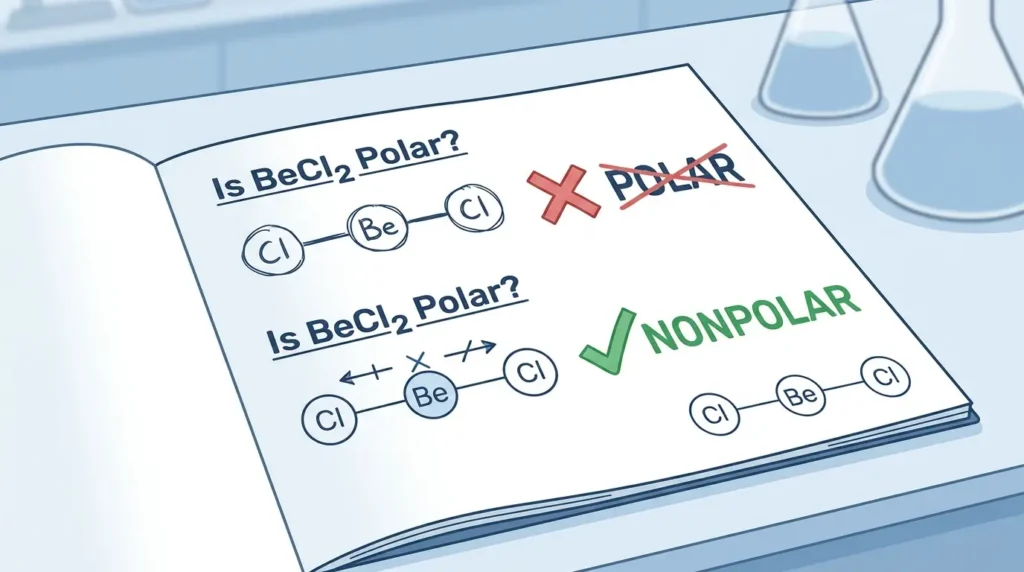
Mistake 1: Assuming polar bonds always make a polar molecule. Wrong. Shape can cancel bond dipoles completely, as it does in BeCl2.
Mistake 2: Forgetting to check for lone pairs on the central atom. Beryllium has no lone pairs here. If it did, the shape would bend, and the dipoles would not cancel.
Mistake 3: Confusing BeCl2 with BeCl2 in a different environment. In its simple gas-phase form, BeCl2 is linear and nonpolar. In solid form, it can form chain-like structures with different bonding. Most homework questions mean the simple gas-phase molecule.
Mistake 4: Mixing up “electronegativity difference” with “molecule polarity.” A big electronegativity difference tells you the bond is polar. It does not by itself tell you if the whole molecule is polar.
Mistake 5: Skipping the geometry step. Many students jump straight from electronegativity to an answer. Always draw or picture the shape first.
BeCl2 Polarity in Everyday Examples
You will not see BeCl2 mentioned in casual conversation often, but the question shows up in predictable places:
In homework and exam questions: “Determine if BeCl2 is polar or nonpolar, and explain your reasoning using VSEPR theory.”
In online chemistry forums and study groups: “Why is BeCl2 nonpolar if chlorine is so electronegative?” is one of the most repeated questions on student Q&A sites.
In lecture notes and textbooks: BeCl2 is often used as the first example of a molecule with polar bonds but no overall dipole, right before CO2.
In flashcard apps and quiz platforms: It appears in beginner chemistry decks, often paired with BF3 and CO2 as “nonpolar despite polar bonds” examples.
BeCl2 Search Trends & Usage Data
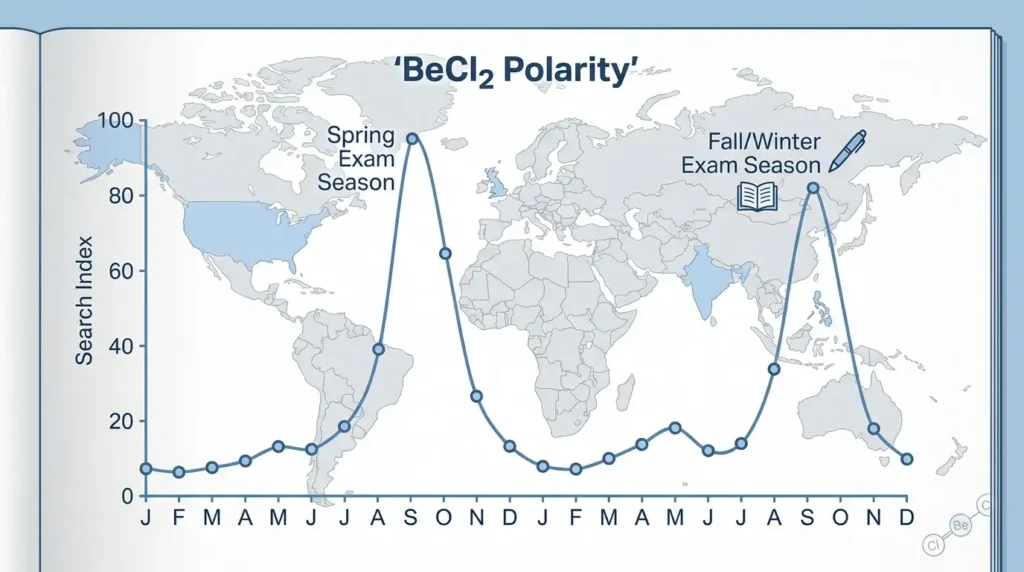
Searches for “BeCl2 polar or nonpolar” spike heavily during school terms, especially around exam weeks in September through December and again in April through May. Search interest is highest in countries with large English-language chemistry curricula, including the United States, India, the Philippines, and the United Kingdom.
Related searches that often appear alongside it include “BeCl2 molecular geometry,” “BeCl2 hybridization,” “BeCl2 lewis structure,” and “is CO2 polar or nonpolar.” This pattern shows the question usually comes from structured coursework rather than general curiosity, which is why clear, exam-ready explanations perform best for this topic.
Comparison Table: BeCl2 vs Similar Molecules
| Molecule | Shape | Bond Polarity | Overall Molecule | Reason |
| BeCl2 | Linear | Polar bonds | Nonpolar | Dipoles cancel due to symmetry |
| CO2 | Linear | Polar bonds | Nonpolar | Same cancellation pattern as BeCl2 |
| H2O | Bent | Polar bonds | Polar | Bent shape prevents cancellation |
| CCl4 | Tetrahedral | Polar bonds | Nonpolar | Symmetric shape cancels dipoles |
| HCl | Linear (diatomic) | Polar bond | Polar | Only one bond, nothing to cancel it |
Frequently Asked Questions
Is BeCl2 polar or nonpolar?
BeCl2 is nonpolar. It has polar bonds, but its linear, symmetric shape cancels out the dipole moments.
Why does BeCl2 have polar bonds but a nonpolar molecule?
Because chlorine and beryllium have different electronegativities, each bond is polar. But since BeCl2 is linear and symmetric, the two bond dipoles point in opposite directions and cancel each other.
What is the molecular geometry of BeCl2?
BeCl2 has linear geometry, with a bond angle of 180 degrees. Beryllium has no lone pairs, so the two chlorine atoms sit directly across from each other.
Is BeCl2 an exception to the octet rule?
Yes. Beryllium only has four electrons around it in BeCl2, not eight. This makes it one of the classic exceptions taught alongside boron compounds.
How is BeCl2 different from CO2 in terms of polarity?
They are actually similar. Both are linear molecules with polar bonds that cancel out, making both nonpolar overall.
Does solid BeCl2 behave the same as gas-phase BeCl2?
No. In solid form, BeCl2 can form chain or bridged structures with different bonding patterns. Most classroom questions refer to the simple gas-phase linear molecule.
What other molecules are commonly confused with BeCl2 for polarity questions?
BF3, CO2, and CCl4 are common companions. All have polar bonds but are nonpolar overall due to symmetric shapes.
Conclusion
BeCl2 is nonpolar, even though its individual Be–Cl bonds are polar. The reason comes down to shape. Beryllium chloride is linear, with no lone pairs on the central atom, so its two bond dipoles point in exactly opposite directions and cancel out completely.
The biggest lesson from this topic is simple: bond polarity and molecule polarity are not the same thing. A molecule can be full of polar bonds and still show no net charge separation, if its geometry is symmetric enough. BeCl2, CO2, and CCl4 all follow this pattern, while water and HCl do not, because their shapes do not allow full cancellation.
If you remember one shortcut, remember this: always check the shape before deciding polarity. Electronegativity tells you about the bonds. Geometry tells you about the molecule. Use both together, and questions like “is BeCl2 polar or nonpolar” become easy instead of confusing.

I’m Raheela Rani, a professional content writer and author with 3 years of experience in writing, editing, and storytelling. Through VisitLivo.com, I create clear, engaging, and well-crafted content that helps readers learn, connect, and communicate with confidence.