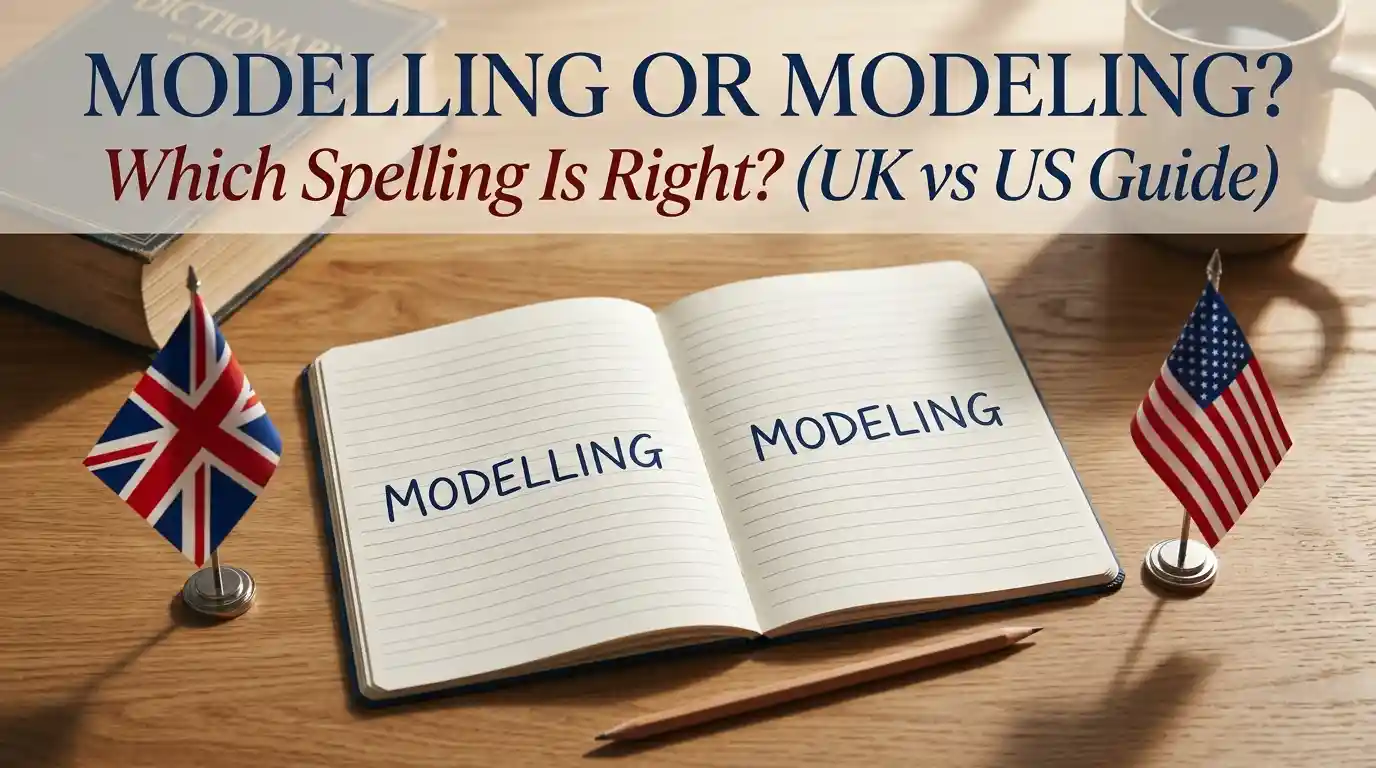
You are typing a message. You stop. Is it “modelling” or “modeling”? Both look right. Both look wrong. You are not alone. Millions of people ask this each year.
The word is common. It shows up in fashion, math, science, art, business, and tech. Data modeling. Fashion modelling. 3D modeling. Climate modelling. The word is everywhere, so the spelling question is too.
People search for this keyword for one reason. They want a fast, clear answer. They also want to know if one spelling is wrong. Here is the good news: neither is wrong. One is American. One is British. The right choice depends on who will read your words.
This guide clears up the confusion. You will get a quick answer first. Then you will learn where the spellings came from, how they differ, and which one to use. You will also see common mistakes, real examples, usage data, and FAQs. By the end, you will never second-guess this word again.
Modelling or Modeling Quick Answer
Both are correct.
- Modeling (one “l”) is American English.
- Modelling (two “l”s) is British English.
Use “modeling” for a US audience. Use “modelling” for a UK, Australian, New Zealand, Irish, or South African audience. Canada uses both, but “modelling” is common.
Examples:
- US: She is modeling the new coat.
- UK: She is modelling the new coat.
- US: We are building a data modeling tool.
- UK: We are building a data modelling tool.
The meaning is the same. Only the spelling changes.
The Origin of Modelling and Modeling
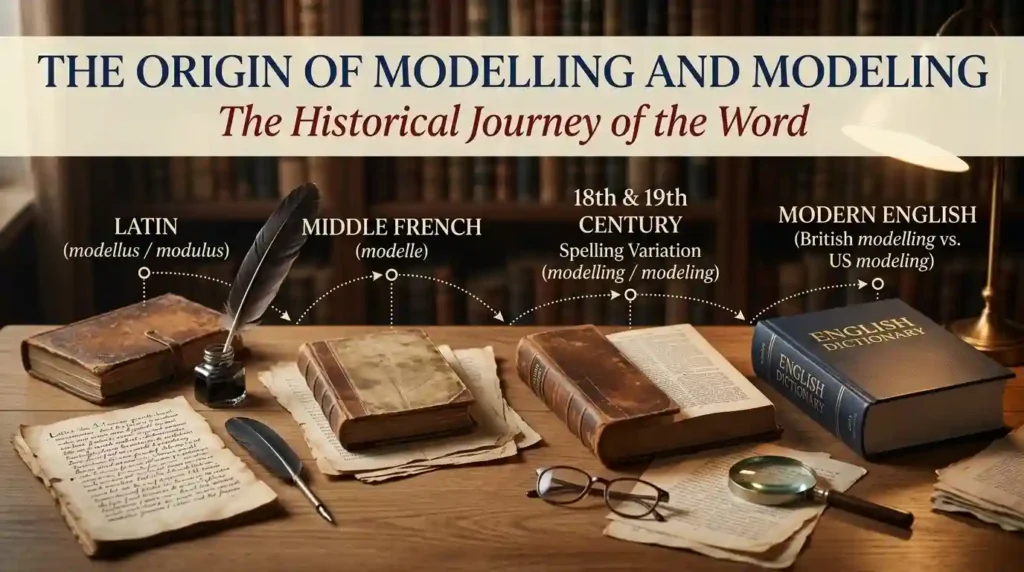
The story starts with Latin. The Latin word modulus meant “a small measure.” Italian turned it into modello. French turned it into modèle. English borrowed it in the 1500s as “model.”
At first, “model” was a noun. It meant a small copy or a plan of something. Later, people used it as a verb. To “model” meant to shape something or to show it off. Then came the -ing form: modeling or modelling.
So why two spellings? The answer is in the rules for adding endings.
In British English, you often double the last letter before -ing or -ed. This happens even if the last syllable is not stressed. Think of travelling and labelled.
In the early 1800s, an American writer named Noah Webster wanted simpler spelling. His dictionary (1828) helped drop extra letters. Americans only double the last letter when the stress falls on the last syllable. In “model,” the stress is on the first syllable (MOD-el). So Americans write “modeling.”
British English vs American English Spelling
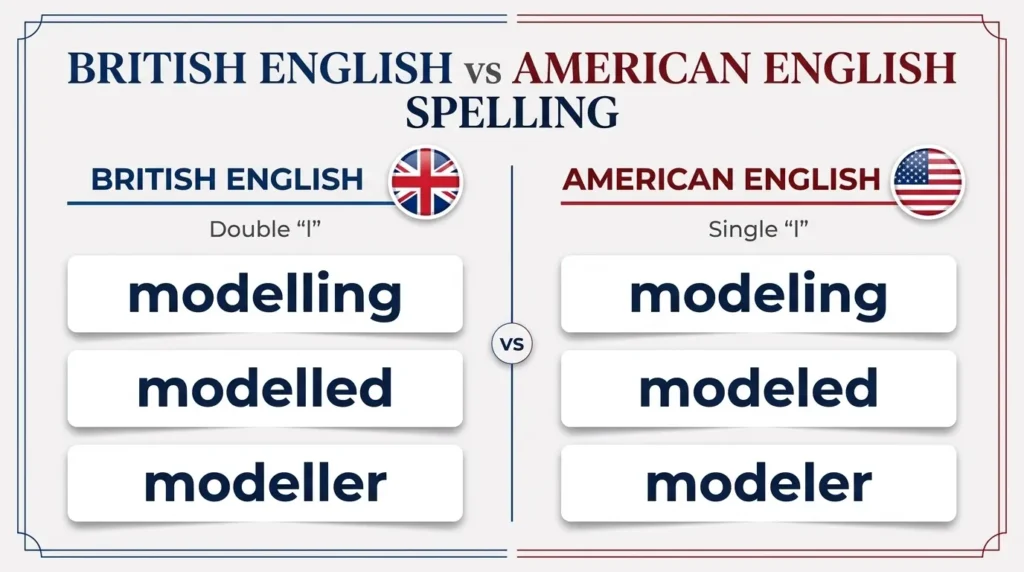
Here is the simple rule:
- British English: double the “l” at the end of a word before -ing, -ed, or -er.
- American English: keep one “l” unless the last syllable is stressed.
| Base Word | American English | British English |
| model | modeling, modeled, modeler | modelling, modelled, modeller |
| travel | traveling, traveled, traveler | travelling, travelled, traveller |
| label | labeling, labeled | labelling, labelled |
| cancel | canceling, canceled | cancelling, cancelled |
| fuel | fueling, fueled | fuelling, fuelled |
| level | leveling, leveled | levelling, levelled |
Watch out for exceptions. When the stress is on the last syllable, both styles double the “l.” Examples: controlling, patrolling, rebelling. So the rule only applies to words like “model.”
Which Spelling Should You Use?
Pick the spelling that matches your readers.
For a US audience: Use modeling. This is the standard in American books, news, schools, and websites.
For a UK or Commonwealth audience: Use modelling. This works for the UK, Ireland, Australia, New Zealand, India, South Africa, and many other places.
For a global audience: Choose one and stay with it. Look at where most of your readers live. If you are not sure, “modeling” is the more common choice online, since the US has the largest web audience.
For Canada: Canadians often use “modelling,” but “modeling” is also seen. Follow your company or school style guide.
For school, work, or publishing: Follow the style guide. Many guides say “use American spelling” or “use British spelling.” Do what they say.
The golden rule: Be consistent. Do not use “modeling” in one paragraph and “modelling” in the next.
Common Mistakes with Modelling and Modeling
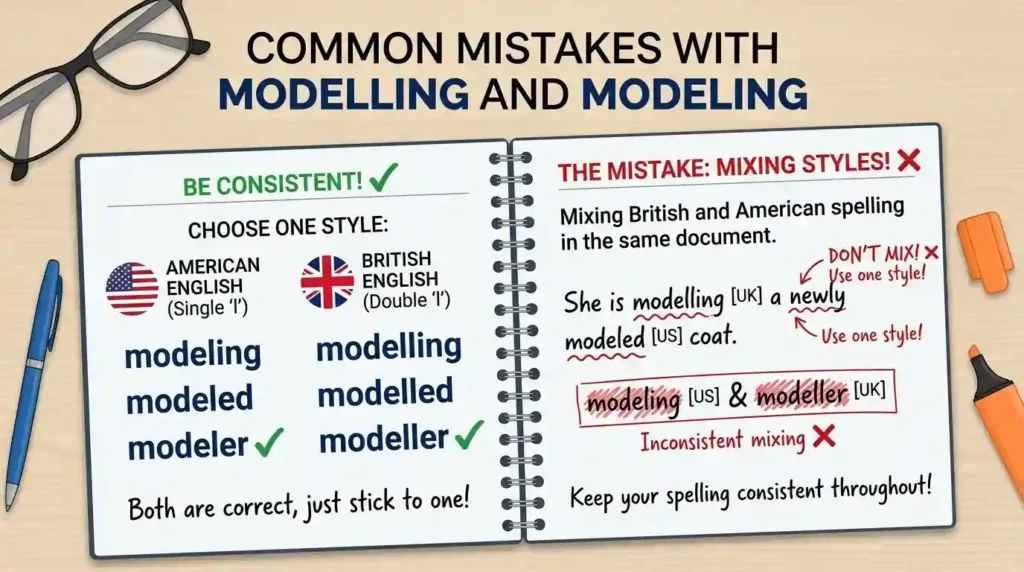
Mistake 1: Mixing spellings in one document.
❌ Our modelling team uses modeled data.
✅ Our modeling team uses modeled data. (US)
✅ Our modelling team uses modelled data. (UK)
Mistake 2: Thinking one spelling is a typo.
Neither is a typo. Do not “correct” a UK writer’s “modelling” to “modeling” unless the style guide says so.
Mistake 3: Using one “l” in the past tense for UK writing.
❌ The scientist modeled the climate. (in a UK paper)
✅ The scientist modelled the climate.
Mistake 4: Writing “modelling” for a US audience.
It may look odd or wrong to American readers. Use “modeling.”
Mistake 5: Mixing up spellings of related words.
Keep the whole family matched: modeling/modeled/modeler for US, modelling/modelled/modeller for UK.
Mistake 6: Trusting spell check blindly.
Your spell check may be set to the wrong language. Check it is set to US or UK English.
Modelling and Modeling in Everyday Examples

Email (US):
Hi Sam, I finished the financial modeling. Please review it by Friday.
Email (UK):
Hi Sam, I’ve finished the financial modelling. Please review it by Friday.
News headline (US):
Scientists use new modeling to predict storms.
News headline (UK):
Scientists use new modelling to predict storms.
Social media (US):
Just started 3D modeling. So fun!
Social media (UK):
Just started 3D modelling. So fun!
Formal writing (US):
The study used statistical modeling to test the results.
Formal writing (UK):
The study used statistical modelling to test the results.
Job post:
Looking for an experienced data modeler. (US)
Looking for an experienced data modeller. (UK)
Modelling or Modeling Google Trends & Usage Data
Exact search numbers change over time. For live numbers, check Google Trends yourself. But the overall pattern is steady and easy to explain.
By country:
- United States: “Modeling” leads by a wide margin.
- United Kingdom, Ireland, Australia, New Zealand: “Modelling” leads.
- India and South Africa: “Modelling” is common, since they follow British spelling. But “modeling” also shows up often in tech and online content.
- Canada: Both are used. “Modelling” is common in print.
By context:
- Tech and data work: “Modeling” is very common worldwide, because many tools and software terms come from the US (data modeling, machine learning modeling).
- Fashion: UK sites tend to use “modelling,” US sites tend to use “modeling.”
- Science and school: The spelling follows the country and the journal’s style.
Why “modeling” is bigger overall: The US has a very large online audience. So “modeling” gets more total searches. That does not make it more correct.
Spelling variations side by side:
| Word Form | American English | British English |
| Noun (activity) | modeling | modelling |
| Past tense | modeled | modelled |
| Person | modeler | modeller |
| Example phrase | data modeling | data modelling |
| Example phrase | fashion modeling | fashion modelling |
| Example phrase | 3D modeling | 3D modelling |
| Common regions | US | UK, Ireland, Australia, NZ, South Africa |
FAQs About Modelling or Modeling
Is it modelling or modeling?
Both are right. “Modeling” is American. “Modelling” is British.
Which spelling is more common?
“Modeling” is more common worldwide online, mostly because of the large US audience. In the UK and Commonwealth, “modelling” is more common.
Is “modelling” a typo?
No. It is the standard British spelling.
What is the past tense: modeled or modelled?
US: modeled. UK: modelled.
What do Canadians use?
Canadians use both. “Modelling” is common, but follow your style guide.
Does the meaning change with the spelling?
No. The meaning is the same in both.
Which should I use for my website?
Use the spelling your main readers use. If your readers are mostly American, use “modeling.” If they are mostly British or Commonwealth, use “modelling.”
Can I use both on one page?
Only if you are comparing them, as in this article. Otherwise, pick one and stay consistent.
Conclusion
So, is it modelling or modeling? Now you know. Both are correct. The difference comes from British and American spelling habits.
Here are the key points to remember:
- Modeling (one “l”) is American English.
- Modelling (two “l”s) is British English.
- The same rule applies to modeled/modelled and modeler/modeller.
- The word comes from Latin modulus, meaning “a small measure.”
- British English doubles the “l.” American English does not, because the stress falls on the first syllable.
- Neither spelling is a mistake.
Your best move is simple. Think about your reader. Writing for Americans? Use “modeling.” Writing for the UK, Australia, Ireland, or most Commonwealth countries? Use “modelling.” Writing for the world? Pick one and keep it the same all the way through.
Consistency matters more than which spelling you choose. Set your spell check to the right language. Follow your style guide. Then write with confidence.

I’m Raheela Rani, a professional content writer and author with 3 years of experience in writing, editing, and storytelling. Through VisitLivo.com, I create clear, engaging, and well-crafted content that helps readers learn, connect, and communicate with confidence.