Trigonometry can feel like a maze of rules. One phrase trips up students and professionals alike: the sum or difference formula. Some see it in a textbook. Some hear it in a lecture. Others find it while solving a physics problem at 11 p.m.
People search this term for a few reasons. “Some want the formula to copy. Some want the backstory. Others just need to double-check it against a similar-looking rule.” And some just want to know if “sum formula” and “difference formula” are two different things or one rule with two faces.
This confusion is common. The sum and difference formulas look similar. They use the same building blocks sine, cosine, and tangent but flip a sign here and there. One wrong sign, and the whole answer breaks.
This guide gives you the fast answer first. Then it breaks down the history, the common mix-ups, real-world use, and how often people actually search for it. By the end, you’ll know exactly which version to use and when.
Sum or Difference Formula Quick Answer
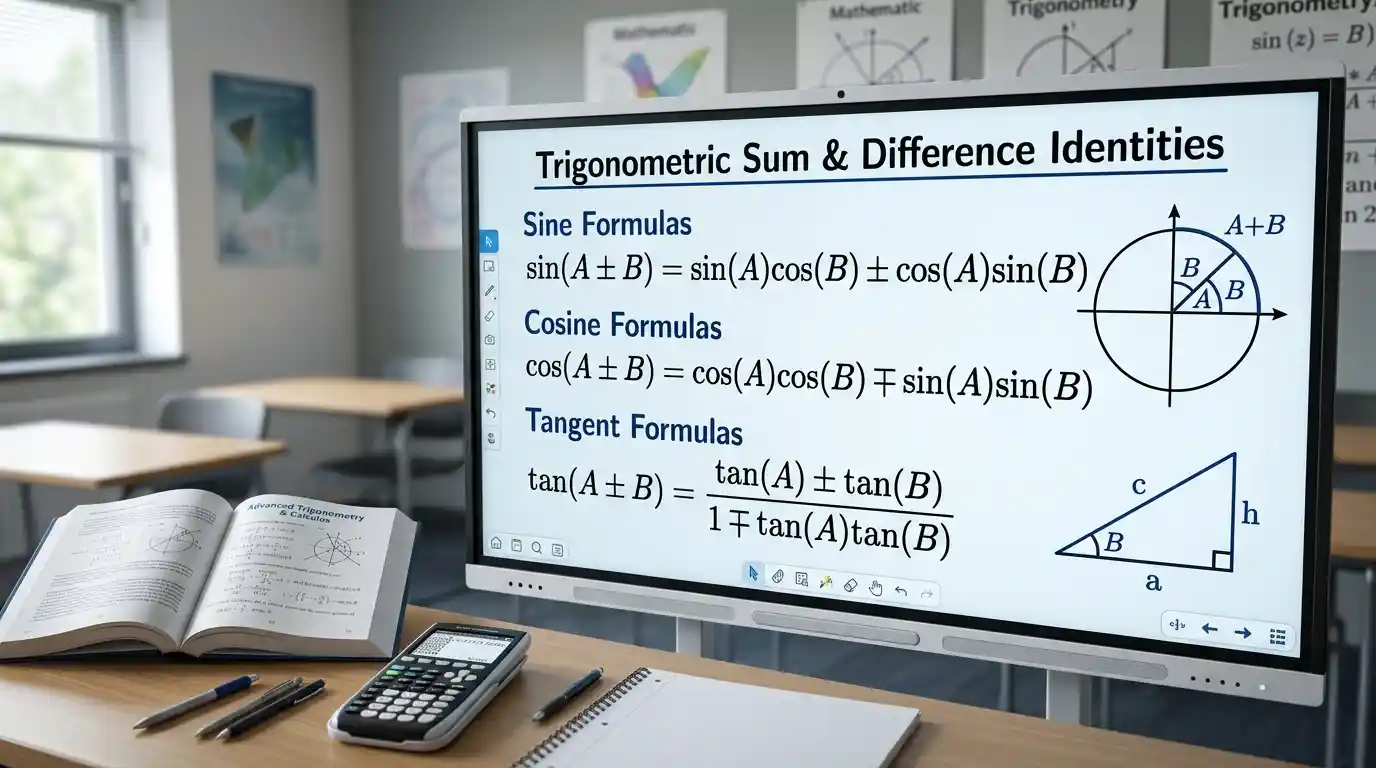
The sum or difference formula lets you find the sine, cosine, or tangent of two angles added or subtracted without a calculator. Here are the three core rules:
Sine:
sin(A ± B) = sinA cosB ± cosA sinB
Cosine:
cos(A ± B) = cosA cosB ∓ sinA sinB
Tangent:
tan(A ± B) = (tanA ± tanB) / (1 ∓ tanA tanB)
Notice the pattern. The top sign on the left matches the sign inside the formula for sine. For cosine, the sign flips. That flip is the number one source of mistakes.
Example:
Find sin(75°) using sin(45° + 30°).
sin(45° + 30°) = sin45°cos30° + cos45°sin30°
= (√2/2)(√3/2) + (√2/2)(1/2)
= (√6 + √2) / 4
That’s the exact value of sin(75°). No calculator needed.
The Origin of the Sum or Difference Formula

These formulas are old. Really old.
Ancient Greek astronomers needed a way to calculate angles for star charts and eclipses. Around 150 AD, the mathematician Ptolemy worked out an early version of the sum and difference rules to build his table of chords a precursor to modern trig tables.
Later, Indian mathematicians like Bhaskara I and Brahmagupta refined these ideas between the 5th and 7th centuries. Islamic scholars, including Al-Battani, translated and expanded the work between the 9th and 10th centuries. By the time European mathematicians picked it up in the Renaissance, the formulas looked close to what we use today.
The “sum” and “difference” naming simply describes what the formula does: it handles the sine, cosine, or tangent of an angle that is a sum (A + B) or a difference (A − B) of two smaller angles. There’s no competing spelling or dialect issue here the name describes the math, not a language quirk.
Sum Formula vs Difference Formula Same Rule, Different Sign
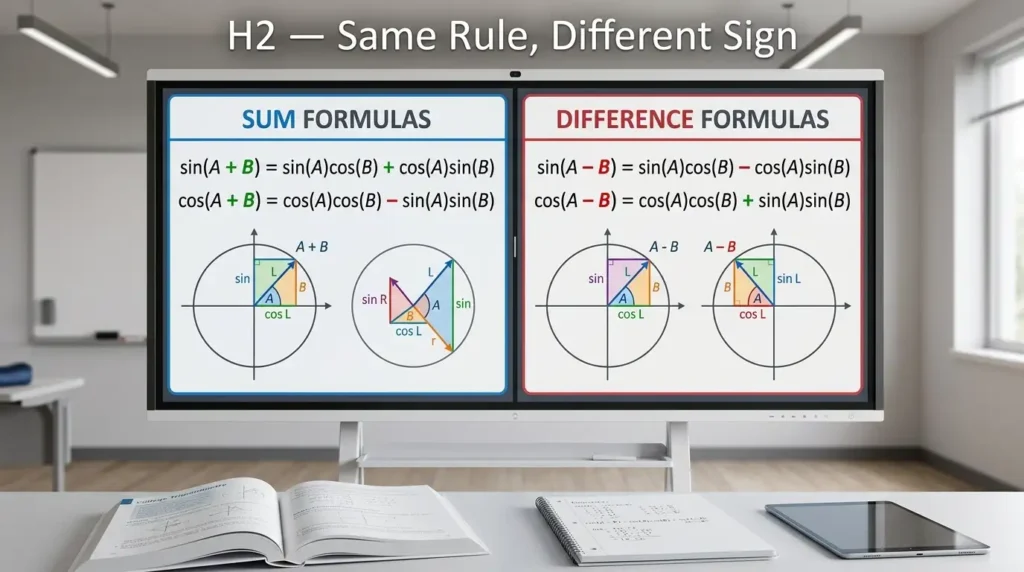
Many learners think these are two separate formulas to memorize. They aren’t. They’re one formula with a sign that flips depending on if you’re adding or subtracting angles.
| Version | Formula | When to Use |
| Sum formula | sin(A + B) = sinA cosB + cosA sinB | Angles are added |
| Difference formula | sin(A − B) = sinA cosB − cosA sinB | Angles are subtracted |
| Sum formula (cosine) | cos(A + B) = cosA cosB − sinA sinB | Angles are added |
| Difference formula (cosine) | cos(A − B) = cosA cosB + sinA sinB | Angles are subtracted |
The key detail: for sine, the sign stays the same as the operation (+ stays +, − stays −). For cosine, the sign always flips.
Which Formula Should You Use?
The right formula depends on what you’re solving, not on region or preference.
- Students in exams: Use the exact formula that matches your angle operation. If the problem says “A + B,” use the sum version. If it says “A − B,” use the difference version.
- Engineers and physicists: Use these formulas to break complex waveforms into simpler sine and cosine terms, especially in signal processing and mechanics.
- Programmers building graphics or games: Use them to rotate points and calculate angles in 2D and 3D space.
- Anyone estimating angles by hand: Use them to find exact trig values for angles like 15°, 75°, or 105° without a calculator.
There’s no “correct dialect” here just the correct version for your operation.
Common Mistakes with the Sum or Difference Formula
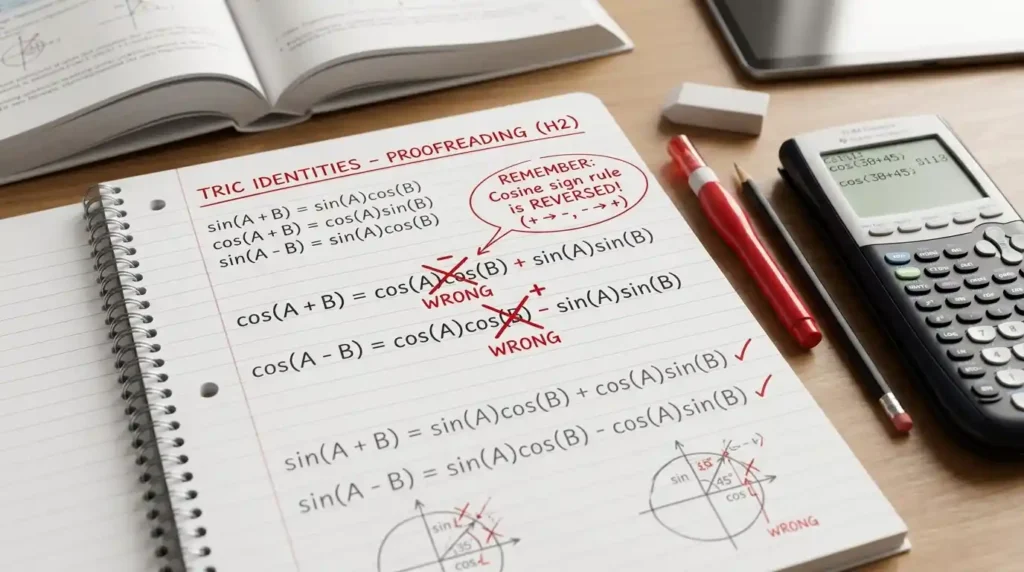
- Flipping the cosine sign wrong. Remember: cosine always flips the sign. Sine never does.
- Mixing up sine and cosine terms. In the sine formula, both terms use one sine and one cosine. In the cosine formula, both terms use the same pair twice (cos-cos, then sin-sin).
- Forgetting the angle order. A and B must stay in the same order across every term.
- Using degrees and radians in the same problem. Always convert to one unit before you start.
- Skipping the exact-value tables. Many problems need known values like sin(30°) or cos(45°). Memorize these first.
Sum or Difference Formula in Everyday Examples
In a classroom email:
“Please review the sum and difference formulas before Thursday’s quiz. Focus on cos(A − B).”
In a social media study post:
“POV: you finally memorize sin(A+B) and the exam only asks for cos(A−B) 💀 #mathstudygram”
In formal academic writing:
“Applying the difference formula for cosine, the exact value of cos(15°) can be derived without numerical approximation.”
These formulas show up anywhere angles combine architecture, robotics, music synthesis (sound waves are sine functions), and navigation systems.
Sum or Difference Formula Search & Usage Data
Search interest in this term rises sharply during the school year, especially around trigonometry units in Algebra II, Pre-Calculus, and Calculus courses. Spikes typically appear in September–December and again in March–May, matching semester exam schedules in the US, UK, India, and other countries with similar academic calendars.
Searches also come from technical fields search terms often pair with “signal processing,” “wave interference,” or “rotation matrix,” showing this isn’t just a student topic. It’s a working tool in STEM careers.
Unlike true spelling-variant keywords, search volume here isn’t split by country dialect. It’s split by context: students search for formula sheets and examples, while professionals search for applications and derivations.
Keyword Variation Comparison Table
| Term | Common Use | Who Searches It |
| Sum and difference formulas | General/textbook term | Students, teachers |
| Angle sum and difference identities | Formal/textbook term | College students, exam prep |
| Sum-to-product formulas | Related but different (converts sums into products) | Advanced students |
| Compound angle formulas | UK/Commonwealth term for the same rules | UK, Australian, Indian students |
| Trig addition formulas | Casual search term | General learners |
FAQs
Is the sum or difference formula the same as the compound angle formula?
Yes. “Compound angle formula” is the common UK and Commonwealth term for the same identities.
Do I need to memorize both the sum and difference versions?
No. Learn one pattern and remember that cosine flips its sign while sine doesn’t.
Can I use these formulas with radians instead of degrees?
Yes. The formulas work the same way. Just keep your units consistent throughout the problem.
What’s the difference between sum-to-product and sum or difference formulas?
Sum or difference formulas expand sin(A±B) or cos(A±B). Sum-to-product formulas do the reverse they turn a sum of two trig terms into a product.
Why does cosine’s sign flip but sine’s doesn’t?
It comes from how the formulas are derived using the unit circle and angle rotation. The geometry naturally produces that flip for cosine.
Are these formulas used outside of math class?
Yes. They appear in physics, electrical engineering, computer graphics, acoustics, and GPS calculations.
What’s the fastest way to avoid mixing up the formulas?
Write out the pattern once on paper: sine keeps the sign, cosine flips it. Repeat that phrase until it sticks.
Conclusion
The sum or difference formula isn’t two separate rules it’s one flexible identity that adapts based on if you’re adding or subtracting angles. The trickiest part is remembering that cosine flips its sign while sine keeps it. Once that clicks, the rest becomes simple substitution.
These formulas trace back over a thousand years, from ancient Greek astronomy to Indian and Islamic mathematics, before landing in the textbooks we use today. They’re not a matter of regional spelling or preference they’re a matter of matching the right version to your operation.
If you’re a student prepping for an exam, an engineer processing a signal, or a programmer rotating a 2D shape, the same core rule applies. Learn the pattern once. Apply it everywhere.
Keep this rule close: sine keeps its sign, cosine flips it. Master that, and the sum or difference formula stops being confusing it becomes second nature.

“I’m Ibadat Fatima, a professional content writer and author with 3 years of experience in writing, editing, and storytelling. I share my work through visitlivo.com, where I help readers connect with clear, engaging, and well-crafted content.”