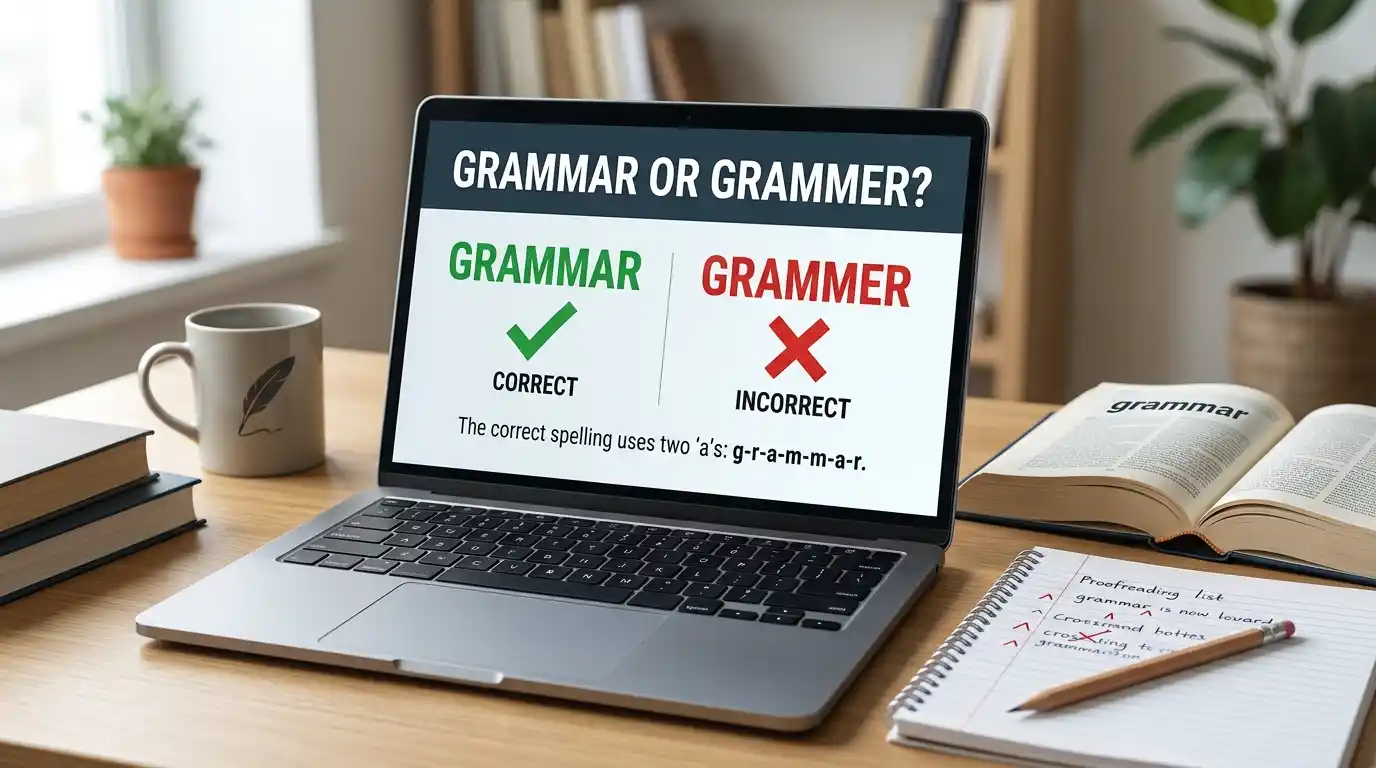
You typed a word. Then you stopped. Is it “grammar” or “grammer”? This tiny question stops millions of writers every day. It feels silly to ask. But spelling mix-ups happen to everyone, even skilled writers.
People search for this term for a simple reason. The word “grammar” doesn’t follow common English spelling patterns. Many similar words end in “-er” (like “teacher” or “writer”). So our brains guess “grammer” feels right. It isn’t.
This confusion isn’t about British versus American English. It’s a true spelling error that trips up native speakers and learners alike. The good news? There’s only one correct answer, and it’s easy to remember once you know why.
This article gives you the quick answer first. Then we’ll explore the word’s history, common mix-ups, and real-world examples. By the end, you’ll never second-guess this word again.
Grammar or Grammer Quick Answer
“Grammar” is the correct spelling. “Grammer” is always wrong.
This applies everywhere. It doesn’t matter if you write in US English or UK English. Every dictionary, style guide, and publisher uses “grammar.”
Examples:
- ✅ She has excellent grammar.
- ❌ She has excellent grammer.
- ✅ Check your grammar before submitting.
- ❌ Check your grammer before submitting.
There’s no regional version of this word. Unlike “color” and “colour,” grammar stays the same worldwide.
The Origin of Grammar
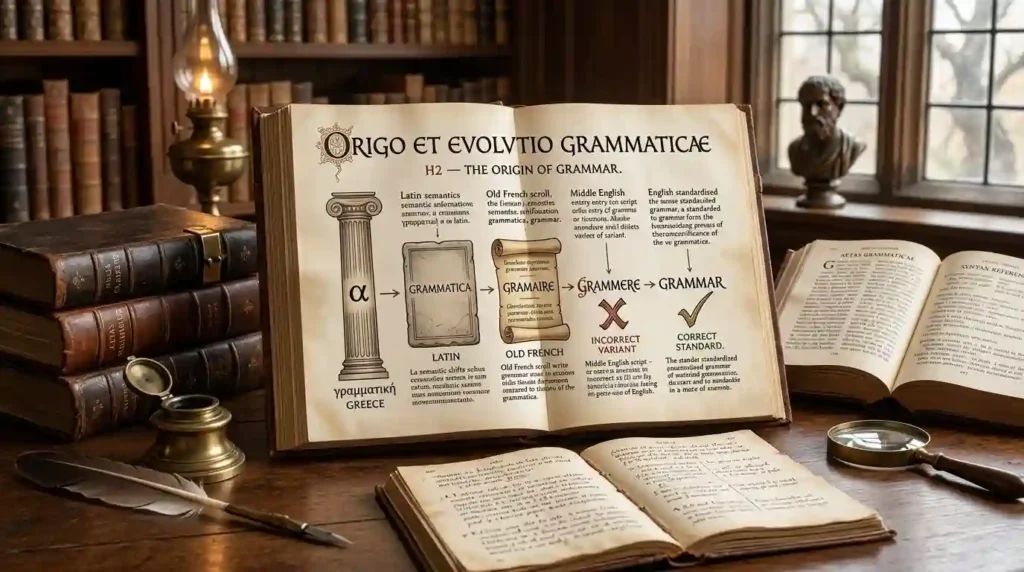
The word “grammar” comes from the Old French word gramaire. That word came from the Latin grammatica, which traces back to the Greek grammatikē, meaning “the art of letters.”
Over centuries, English borrowed thousands of words from Latin and Greek. Many kept unusual spelling patterns that don’t match typical English rules. “Grammar” is one of them.
So why do people write “grammer”? English has many words ending in “-er,” like “computer,” “banner,” and “hammer.” Our brains apply that pattern automatically. This creates a common and understandable mistake. It’s not a sign of poor writing skill. It’s just how memory and pattern recognition work.
British English vs American English Spelling
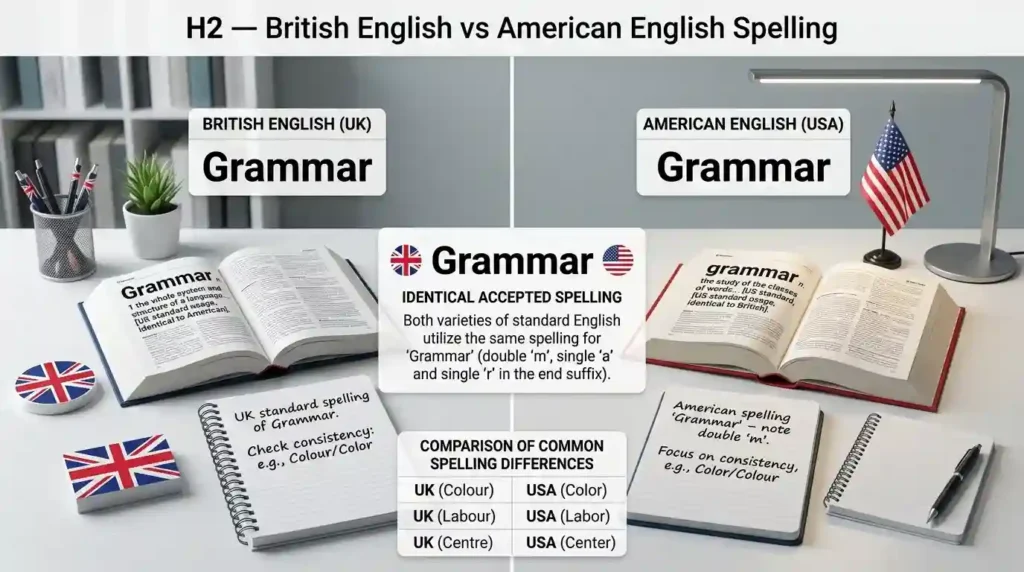
Many words do change between British and American English. Grammar is not one of them. Both versions use the identical spelling: g-r-a-m-m-a-r.
However, this question often comes up because people confuse it with other true British-American spelling differences.
| Concept | British English | American English |
| Grammar (the word itself) | grammar | grammar |
| Color/Colour | colour | color |
| Organize/Organise | organise | organize |
| Center/Centre | centre | center |
| Analyze/Analyse | analyse | analyze |
As the table shows, grammar stands alone. It never changes based on region.
Which Spelling Should You Use?
Since “grammar” is universal, this section focuses on confidence, not choice.
For US writers: Use “grammar.” This matches every American style guide, including AP and Chicago.
For UK and Commonwealth writers: Use “grammar.” British dictionaries like Oxford confirm this spelling too.
For global and ESL writers: Use “grammar.” No English-speaking country uses “grammer.” Memorize it as a fixed, unchanging word.
For students and professionals: Spell-check tools will flag “grammer” as an error. Trust that flag. There is no context where “grammer” is acceptable, even in casual writing.
Common Mistakes with Grammar
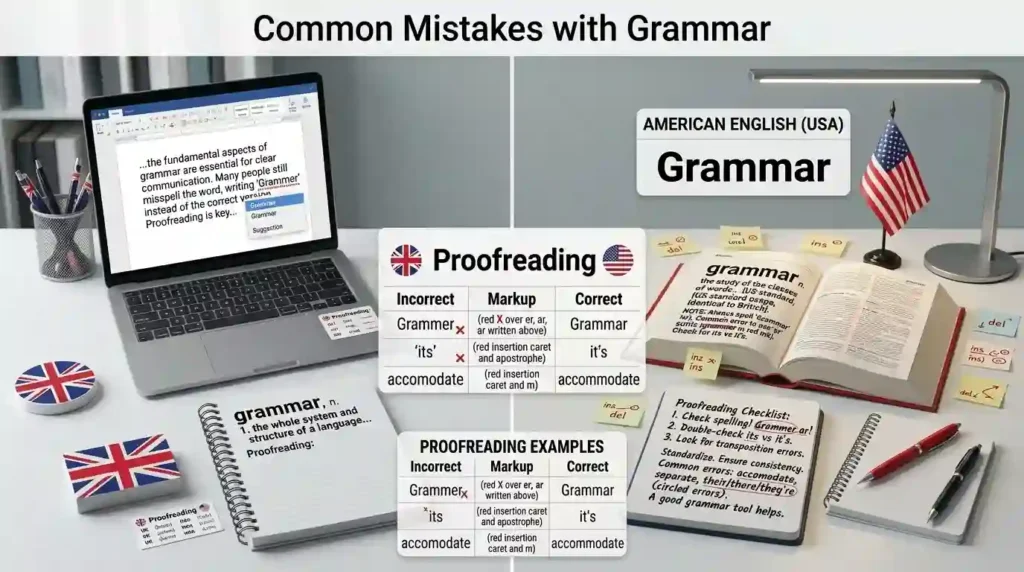
Here are frequent errors people make with this word and its related forms.
- Grammer instead of grammar the most common mistake.
- Grammer’s instead of grammar’s adds an apostrophe incorrectly, but still misspells the root word.
- Grammatical confused with grammatic “grammatical” is the correct adjective form. “Grammatic” is not standard.
- Grammer Nazi instead of Grammar Nazi a popular internet phrase, still often misspelled.
- Confusing grammar with syntax grammar covers all language rules; syntax specifically means sentence structure.
Grammar in Everyday Examples
In emails:
“Please review this document for grammar and clarity before sending.”
In social media posts:
“My grammar isn’t perfect, but I’m learning every day! 📚”
In formal writing:
“The report was rejected due to inconsistent grammar and formatting errors.”
In education:
“Third-grade students are learning basic grammar rules this semester.”
Notice how the spelling never changes across these different tones and platforms.
Grammar Google Trends & Usage Data
Search data shows “grammar” is searched far more often than “grammer” worldwide. The misspelled version still gets significant search volume, though, especially from:
- Students learning English as a second language
- Younger writers typing quickly on mobile devices
- Users searching for grammar-checking tools
Interest in grammar-related searches often spikes during back-to-school months and near college application deadlines. Countries with high English-as-a-second-language populations, including India, the Philippines, and Nigeria, show strong search interest in both spelling variations.
This confirms the mistake is common enough to track, but it doesn’t make “grammer” correct.
Comparison Table: Grammar and Related Word Variations
| Word | Correct Spelling | Common Misspelling | Notes |
| Grammar | grammar | grammer | Never changes by region |
| Grammatical | grammatical | grammatic | “Grammatical” is the correct adjective |
| Grammarian | grammarian | grammerian | Refers to a grammar expert |
| Grammar check | grammar check | grammer check | Common tool search term |
| Grammar Nazi | Grammar Nazi | Grammer Nazi | Popular internet slang |
FAQs
Is “grammer” ever correct in any English dialect?
No. “Grammer” is not correct in American, British, Australian, Canadian, or any other English variety.
Why do so many people misspell “grammar”?
Because many English words end in “-er,” like “teacher” and “computer.” This creates a false pattern that leads to the mistake.
Does autocorrect fix “grammer” automatically?
Most spell-checkers and autocorrect tools flag or fix it. However, always double-check important documents manually.
Is “grammar” a countable or uncountable noun?
“Grammar” is typically uncountable. You say “good grammar,” not “a grammar” or “many grammars,” except when referring to specific grammar systems or books.
What’s the difference between grammar and vocabulary?
Grammar refers to the rules for combining words into sentences. Vocabulary refers to the actual words you know and use.
Is “Grammarly” spelled with an “a” or “e”?
The popular writing tool is spelled “Grammarly,” using the correct “grammar” root, not “grammer.”
Can I say “grammars” for multiple languages?
Yes. When discussing the grammar systems of different languages, “grammars” (plural) is acceptable, as in “comparing the grammars of French and Spanish.”
Conclusion
The debate between “grammar” and “grammer” has a clear, simple answer: grammar is always correct, and grammer is always wrong. This isn’t a British versus American spelling difference like “color” and “colour.” It’s a straightforward, common misspelling caused by English’s inconsistent word patterns.
Understanding the word’s Latin and Greek origins helps explain why it doesn’t follow the typical “-er” ending pattern. Knowing this history makes the correct spelling easier to remember.
If you’re writing a professional email, a school assignment, or a quick social media post, always use “grammar.” No context, region, or writing style changes this rule.
If you’re ever unsure, a quick trick helps: think of “grammar” as having two A’s, just like the word “Latin” root it came from. This small memory tool can prevent future mistakes.
Mastering small details like this builds confidence in your overall writing, and that confidence shows in everything you create.

I’m Raheela Rani, a professional content writer and author with 3 years of experience in writing, editing, and storytelling. Through VisitLivo.com, I create clear, engaging, and well-crafted content that helps readers learn, connect, and communicate with confidence.