If you’ve ever paused mid-sentence wondering if to write “presenter” or “presentor,” you’re not alone. This tiny spelling question trips up writers, students, and professionals every single day and for good reason. English is full of words that end in “-er” for some jobs (teacher, writer, singer) but “-or” for others (actor, director, editor). So when you need to describe someone who gives a presentation, it’s easy to guess wrong.
This confusion isn’t random. It comes from Latin word patterns that snuck into English centuries ago, creating two competing “rules” that don’t always make sense. Add in autocorrect, regional dialects, and casual texting habits, and you get thousands of people typing “presentor” into Google every month, hoping for a clear answer.
This article gives you that answer. You’ll get the quick fix first, then the full story: where the confusion comes from, how British and American English handle it, and how to avoid this mistake for good if you’re writing an email, a resume, or a news headline.
Presenter or Presentor Quick Answer
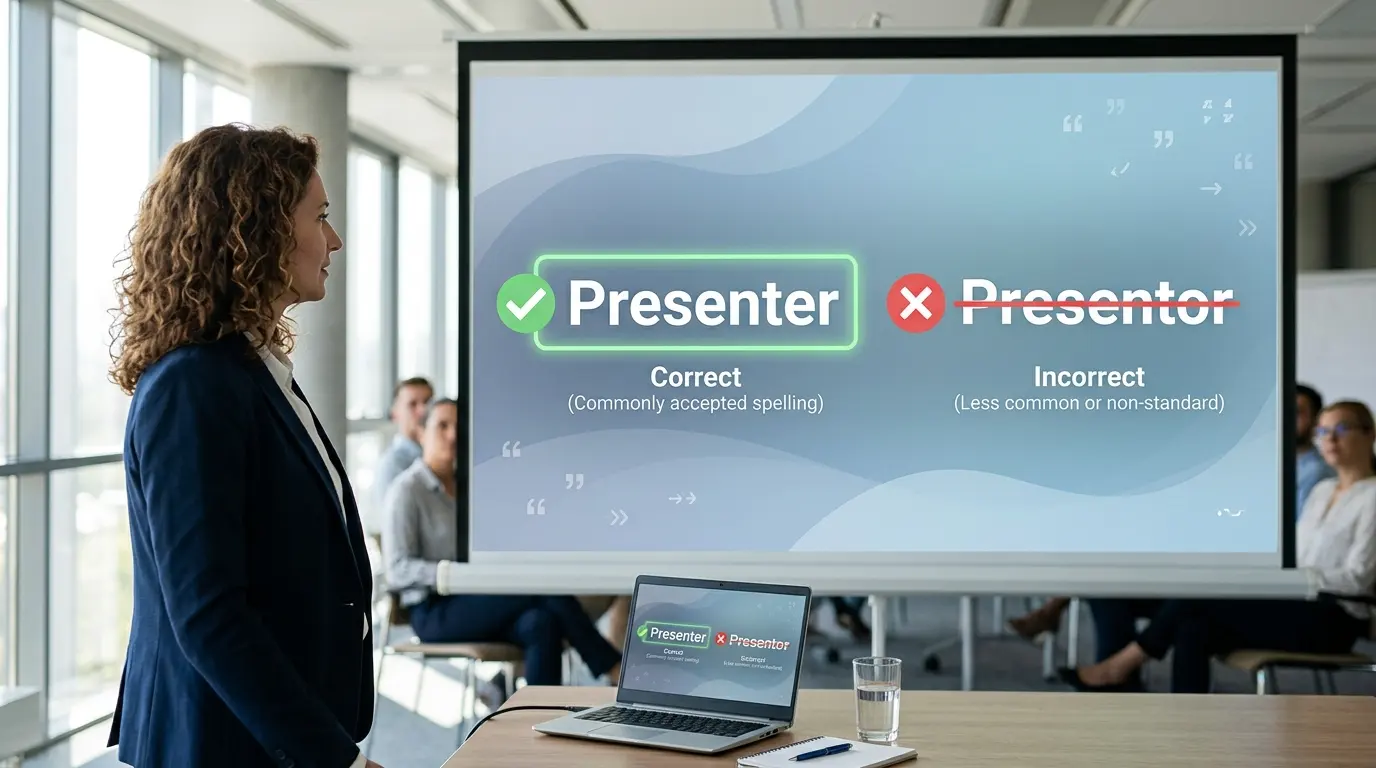
“Presenter” is the correct spelling. “Presentor” is a misspelling.
This is true in both American English and British English. There is no regional variant where “presentor” is accepted in formal writing. It’s simply an error, usually caused by confusion with other agent nouns like “director” or “actor.”
Examples of correct use:
- The presenter introduced the next speaker.
- She works as a TV presenter in London.
- The award presenter read the winner’s name aloud.
If you see “presentor” in a document, it needs to be corrected to “presenter.” No exceptions.
The Origin of Presenter
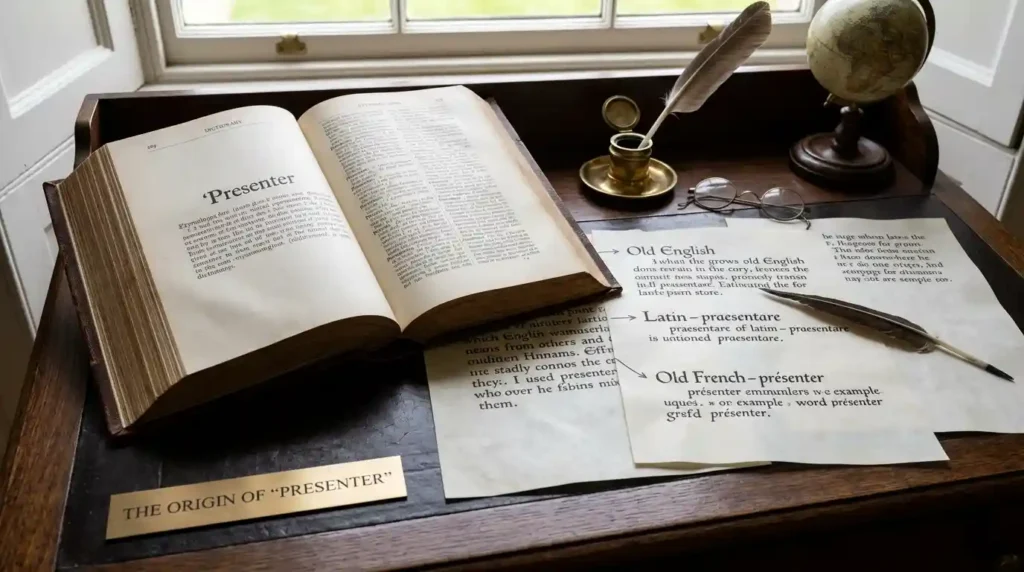
The word “presenter” comes from the verb “present,” which traces back to the Old French presenter and the Latin praesentare, meaning “to place before” or “to show.”
English forms agent nouns (words describing “a person who does X”) in two main ways:
- -er: added to native English or French-based verbs (teacher, writer, presenter)
- -or: added to words with stronger Latin roots, especially those ending in “-ate” or “-ct” (actor, director, editor, instructor)
“Present” follows the French-influenced pattern, so it takes “-er,” not “-or.” The confusion happens because so many related words like “director” and “instructor” end in “-or,” making “presentor” feel like it should fit the same pattern. It doesn’t.
British English vs American English Spelling
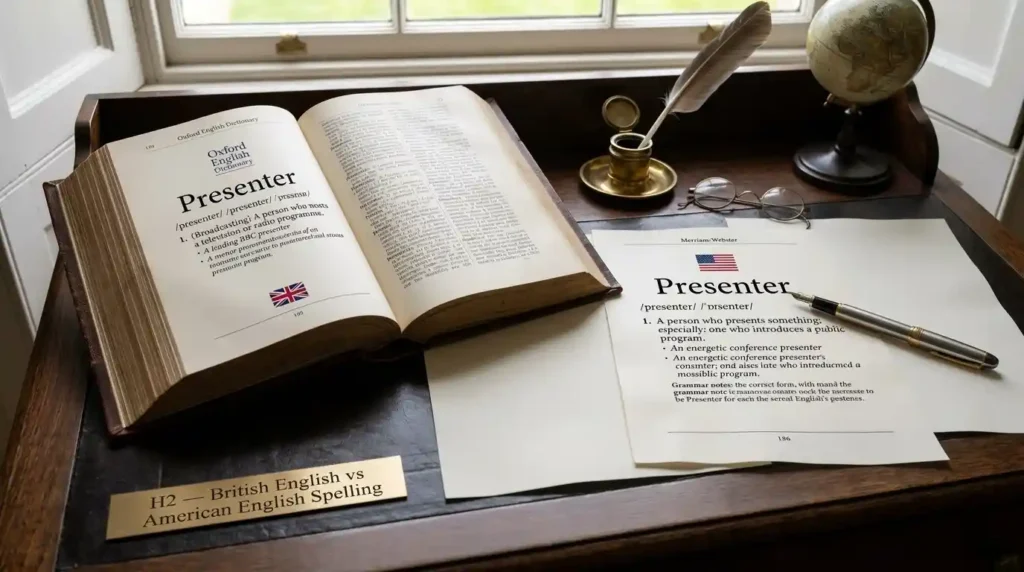
Here’s the twist: this isn’t actually a British vs. American spelling difference, like “colour” vs. “color” or “organise” vs. “organize.” Both British and American English agree on this one.
| Spelling | British English | American English | Status |
| Presenter | ✅ Correct | ✅ Correct | Standard in both |
| Presentor | ❌ Incorrect | ❌ Incorrect | Common misspelling |
Compare that to genuine US/UK spelling differences:
| Word | British English | American English |
| Colour / Color | colour | color |
| Organise / Organize | organise | organize |
| Centre / Center | centre | center |
“Presenter” simply doesn’t have a legitimate transatlantic variant. Anyone using “presentor” in the UK or the US is making the same mistake.
Which Spelling Should You Use?
Since there’s no regional debate here, the advice is simple:
- In the US: Use “presenter.” Always.
- In the UK, Ireland, Australia, Canada, and other Commonwealth countries: Use “presenter.” Always.
- For global or international audiences: Use “presenter.” It’s the only form recognized by every major dictionary, including Merriam-Webster, Oxford, and Cambridge.
If your writing tool, spellchecker, or job posting shows “presentor,” treat it as a typo, not a style choice.
Common Mistakes with Presenter
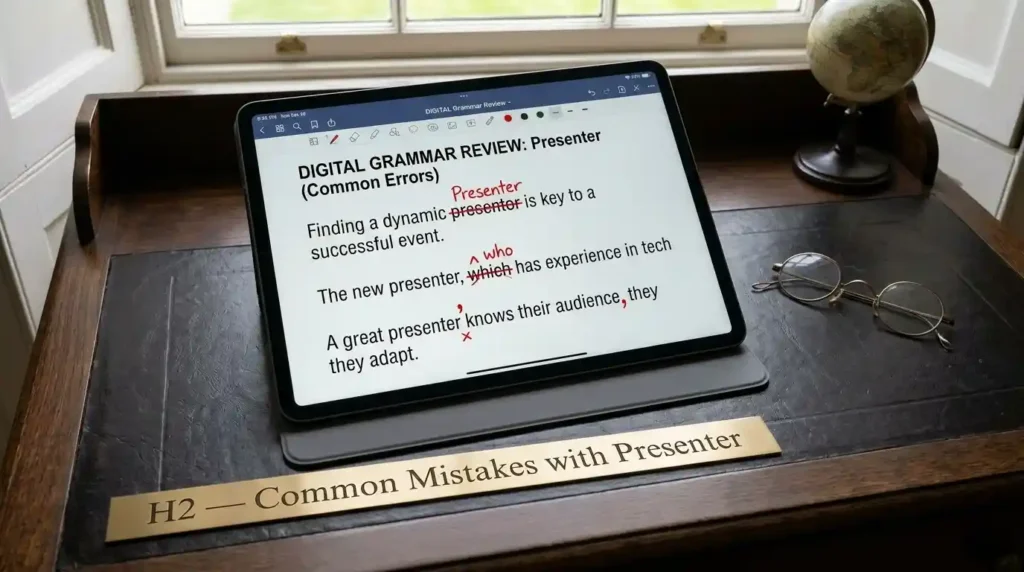
- Writing “presentor” instead of “presenter”
❌ He is a good presentor.
✅ He is a good presenter. - Confusing “presenter” with “presentee”
“Presentee” means the person receiving something, like an award. It’s the opposite role.
❌ The presentee introduced the show.
✅ The presenter introduced the show. The presentee accepted the trophy. - Subject-verb agreement errors
❌ The presenter are very funny.
✅ The presenter is very funny. - Mixing it up with “presentation”
These are different parts of speech. “Presentation” is the event or content; “presenter” is the person.
❌ She gave a great presenter.
✅ She gave a great presentation.
Presenter in Everyday Examples
In emails:
“Please confirm the presenter for tomorrow’s client meeting.”
In social media:
“Shoutout to our podcast presenter for another great episode! 🎙️”
In formal/business writing:
“Each presenter will have fifteen minutes for their session, followed by a Q&A.”
In academic settings:
“The conference presenter answered questions from the audience after her talk.”
Across every context casual, professional, or academic “presenter” is the only version that appears in edited, published writing.
Presenter Google Trends & Usage Data
Search data consistently shows “presenter” far outpacing “presentor” worldwide. “Presentor” searches tend to come from people actively trying to confirm the correct spelling, rather than people intentionally using it as a word.
Usage patterns show:
- United States: “Presenter” dominates in business, tech, and media contexts (e.g., “PowerPoint presenter,” “keynote presenter”).
- United Kingdom: “Presenter” is especially common in broadcasting (“radio presenter,” “TV presenter” are everyday job titles).
- India, Philippines, Nigeria: Higher relative search volume for “presentor,” often linked to English as a second language, where “-or” endings feel more intuitive due to patterns in other agent nouns.
- Global search intent: Most searches for “presentor” lead users to spelling-correction content, confirming it’s rarely used with confidenc it’s usually a moment of doubt.
Keyword Variation Comparison Table
| Term | Correct? | Common Context | Notes |
| Presenter | ✅ Yes | TV, business, awards, teaching | Standard spelling worldwide |
| Presentor | ❌ No | Typos, casual writing | Common misspelling |
| Presentator | ❌ No | Rare, non-native English | Sometimes seen in translated text |
| Presentee | ✅ Yes (different word) | Formal ceremonies | Refers to the recipient, not the speaker |
FAQs
Is “presentor” ever correct in any dialect of English?
No. Major dictionaries including Oxford, Cambridge, and Merriam-Webster list only “presenter” as correct.
Why do so many people spell it “presentor”?
It’s likely influenced by other “-or” agent nouns like “director,” “actor,” and “instructor,” which follow a different word-formation pattern.
Does spellcheck usually catch “presentor”?
Most modern spellcheckers flag it as an error, but some autocorrect tools may miss it if it’s typed quickly or the checker is set to a limited dictionary.
Is “presenter” used the same way in British and American English?
Yes. Both spelling and meaning are identical across British, American, and other English dialects.
What’s the difference between “presenter” and “presentee”?
A “presenter” gives or introduces something. A “presentee” receives something, such as an award.
Can “presenter” refer to a person and a device?
Yes. It usually means a person (TV presenter, meeting presenter), but it can also describe a tool, like a remote “slide presenter” used in presentations.
Is it okay to use “presentor” in informal texting or chat?
It’s technically still incorrect, but low-stakes in casual chats. For anything professional, academic, or public-facing, always use “presenter.”
Conclusion
The “presenter or presentor” question has a clear, simple answer: presenter is correct, and presentor is a misspelling not a regional variant, style choice, or acceptable alternative. This holds true across American English, British English, and every other major English dialect.
The confusion exists because English agent nouns don’t follow one consistent rule. Words like “director” and “actor” end in “-or,” while “presenter,” like “teacher” and “writer,” follows the “-er” pattern instead. Once you understand this history, the mistake becomes much easier to avoid.
If you’re writing a business email, a news article, a resume, or a social media post, stick with “presenter.” It’s the version recognized by every dictionary, used by every major news outlet, and expected in every professional context no matter where in the world your reader is.
When in doubt, remember: presenters present; they don’t “presentor.”

I’m Raheela Rani, a professional content writer and author with 3 years of experience in writing, editing, and storytelling. Through VisitLivo.com, I create clear, engaging, and well-crafted content that helps readers learn, connect, and communicate with confidence.