
Have you ever seen “OR” on a hospital sign or in a doctor’s note and wondered what it means? You are not alone. Thousands of people search this term every month. Some are worried about a loved one’s surgery. Others are reading medical shows or job listings. This short guide gives you a fast answer, then digs deeper.
The confusion often comes from two places. First, “OR” is an abbreviation, and abbreviations can feel like secret code. Second, hospitals in different countries use different words for the same room. In the United States, doctors say “OR.” In the United Kingdom, they often say “theatre.” Both mean the same place. This mix of terms trips up patients, students, and even writers who work on medical content.
By the end of this article, you will know exactly what OR means, where the term comes from, how US and UK hospitals talk about it differently, and how to use the term correctly in your own writing. Let’s start with the quick answer.
OR Meaning in Hospital Quick Answer
OR stands for Operating Room. It is the room where surgeons perform surgery.
Simple examples:
- “The patient is in the OR right now.”
- “Surgery will start once the OR is ready.”
- “She works as an OR nurse.”
In the UK, Ireland, Australia, and many Commonwealth countries, the same room is usually called the operating theatre, often shortened to just theatre. So if a British nurse says “he’s in theatre,” it means the same as “he’s in the OR” in the US.
A quick note: OR can have other meanings in healthcare, like “odds ratio” in medical research papers. But in day-to-day hospital talk, OR almost always means Operating Room.
The Origin of OR (Operating Room)
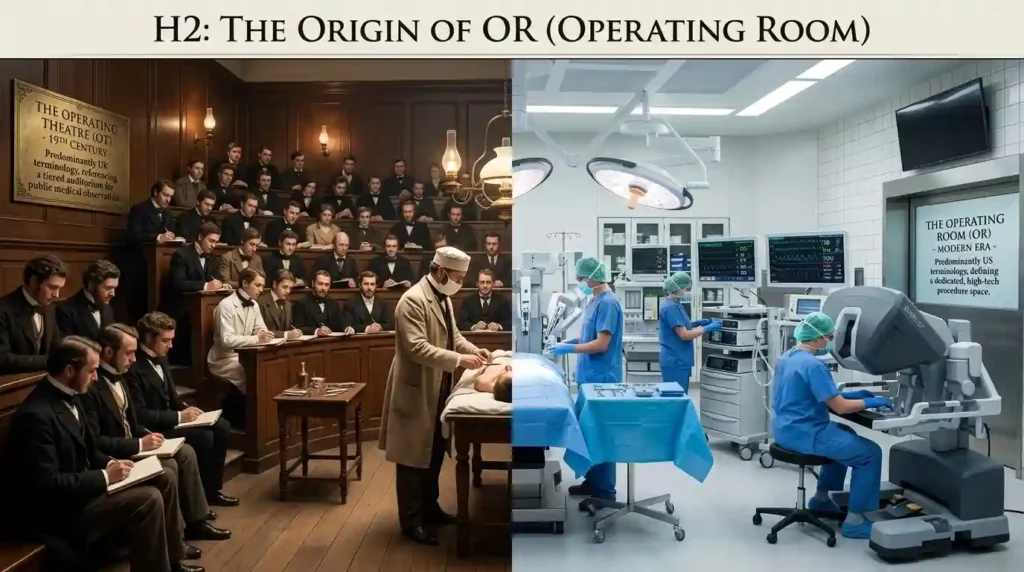
The word “operate” comes from the Latin word operari, which means “to work.” Surgeons have always seen their work as a kind of skilled labor on the body. So the room where this work happens became known as the “operating room.”
The word “theatre” has a different history. In the 1800s, surgery was often done in front of students. Rooms were built like small theatres, with seats rising in rows so students could watch the surgeon work below. Over time, the word “theatre” stuck in British hospitals, even after the viewing seats disappeared.
This is why the same room has two different names today. It is not a spelling difference like “color” and “colour.” It is a difference in the actual word each country chose to use. The US kept the plain, functional name: Operating Room. The UK kept the older, historical name: Operating Theatre.
British English vs American English Terminology

Most keyword guides compare spelling, like “organize” vs “organise.” OR is different. There is no spelling variant of the letters O and R. Instead, the difference is in the full term each country uses for the room.
Here is a side-by-side comparison:
| Term | Used In | Full Form | Common Short Form |
| OR | United States, Canada | Operating Room | “OR” |
| Theatre | UK, Ireland, Australia, NZ | Operating Theatre | “theatre” |
| OT | Sometimes used in South Asia | Operating Theatre | “OT” |
| Surgery Suite | Marketing/hospital branding (US) | Surgical Suite | “suite” |
Job titles follow the same pattern. In the US, you will see “OR nurse” or “OR technician.” In the UK, the same job is called a “theatre nurse” or “theatre practitioner.”
Which Term Should You Use?
The right term depends on your audience.
If you write for a US audience:
Use “OR.” It is the standard term in American hospitals, TV shows, and job postings. Readers expect it.
If you write for a UK, Irish, Australian, or Commonwealth audience:
Use “theatre” or “operating theatre.” “OR” will sound foreign or confusing to many readers there.
If you write for a global or mixed audience:
Use the full term first, then the short form. For example: “the operating room (OR).” Add a note like “also called the operating theatre in the UK” if your content reaches both regions.
If you write medical or academic content:
Check the style guide of the publication. Medical journals often prefer full terms on first use, then abbreviations after.
Common Mistakes with OR in Hospital Context
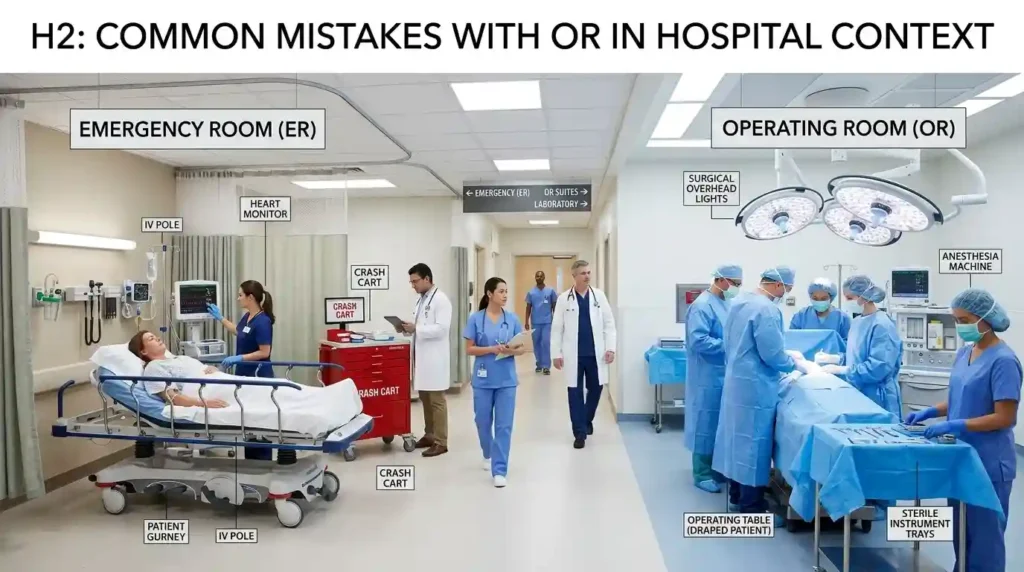
- Confusing OR with ER
ER means Emergency Room. OR means Operating Room. They are two separate places. A patient goes to the ER for urgent problems, then may move to the OR for surgery. - Using “OR” in UK-focused writing
This confuses UK readers, who expect “theatre.” Always match the term to your audience’s country. - Writing “operating theater” in American content
“Theater” is the correct American spelling of the word, but Americans do not use this word for the surgery room. They say “operating room” or “OR,” not “operating theater.” - Forgetting the abbreviation clash
OR also means “odds ratio” in research papers and simply the word “or” in everyday English. Always give context so readers know which meaning you mean. - Overusing the abbreviation
In formal writing, spell out “operating room” the first time, then use “OR” after that.
OR in Everyday Examples

In a text message:
“Mom just went into the OR. Surgery should take 3 hours.”
In a job posting:
“Hiring: OR nurse with 2+ years of experience in general surgery.”
In a UK news article:
“The trust reported a 15% increase in theatre capacity this year.”
On social media:
“Anxious night before my daughter’s OR time tomorrow morning. Sending love is appreciated.”
In formal medical writing:
“The patient was transferred to the operating room at 08:15 for a scheduled procedure.”
OR Google Trends & Usage Data
Search interest in “OR meaning” and related terms tends to rise for a few reasons. People search this term when a family member is scheduled for surgery. Students search it while studying for nursing or medical exams. Writers and content creators search it while researching hospital dramas or health blogs.
Country patterns are clear. In the United States and Canada, “OR meaning hospital” and “what does OR stand for” are the common searches. In the UK, Ireland, and Australia, people more often search “what is a theatre in hospital” or “operating theatre meaning.” Job seekers search terms like “OR nurse meaning” or “OR tech job” in the US, while UK job seekers search “theatre nurse job.”
Interest also spikes around popular medical TV shows, since scripts often use “OR” even in shows watched worldwide, which increases searches from non-US viewers trying to understand American medical slang.
Comparison Table: OR and Its Variations
| Term | Meaning | Region | Formality |
| OR | Operating Room | US, Canada | Casual and professional |
| Operating Room | Full form of OR | US, Canada | Formal |
| Theatre | Operating Theatre | UK, Ireland, Australia | Casual and professional |
| Operating Theatre | Full form of theatre | UK, Ireland, Australia | Formal |
| OT | Operating Theatre (short) | South Asia, some hospitals | Casual |
| Surgical Suite | Marketing term for OR | US (hospital branding) | Formal/marketing |
FAQs
What does OR mean in a hospital?
OR means Operating Room. It is the room where surgeons perform operations.
Is OR the same as ER?
No. ER means Emergency Room, for urgent care. OR means Operating Room, for surgery. A patient may go from the ER to the OR if surgery is needed right away.
What do British hospitals call the OR?
British hospitals usually call it the “operating theatre” or just “theatre.”
Why do the US and UK use different words for the same room?
The words come from different histories. “Operating room” is a plain, functional American term. “Theatre” comes from old British teaching hospitals, where students once watched surgery from raised seats.
What is an OR nurse?
An OR nurse works inside the operating room. They help prepare the room, assist the surgical team, and care for the patient before, during, and after surgery.
Does OR ever mean something else in medicine?
Yes. In medical research, OR can mean “odds ratio,” a statistic used to compare risk between two groups. Context tells you which meaning applies.
Should I write “OR” or “operating room” in a formal document?
Write the full term “operating room” the first time it appears. After that, you can use “OR” for the rest of the document.
Conclusion
OR is a simple term with a clear meaning: Operating Room, the space where surgeons perform surgery. The confusion around this term usually comes from two sources. First, people mix up OR with ER, which is a different room for different care. Second, different countries use different words for the same space. Americans say “OR.” The British, Irish, and many Commonwealth countries say “theatre.”
Knowing your audience is the key to using this term correctly. Write “OR” for US readers. Write “theatre” for UK and Commonwealth readers. For a global audience, use the full term first, then the short form, and mention both names if needed.
If you are a patient trying to understand a hospital sign, a student studying for an exam, or a writer creating health content, this small piece of vocabulary matters. Getting it right builds trust with your reader and avoids confusion during an already stressful time, like waiting for news about surgery.

“I’m Ibadat Fatima, a professional content writer and author with 3 years of experience in writing, editing, and storytelling. I share my work through visitlivo.com, where I help readers connect with clear, engaging, and well-crafted content.”