
You are writing a message. You stop. Should it be “I seen him” or “I saw him”? Or “I have saw” or “I have seen”? You are not alone. Every day, thousands of people search for “seen or saw” to get a fast, clear answer.
Why the confusion? Both words come from the same verb: see. Both talk about the past. They look close. They sound close. But they do not work the same way. One can stand alone. The other needs a helper.
This guide clears it up. You will get the quick answer first. Then you will learn where the words come from. You will see how British and American English use them. You will also find common mistakes, real examples, a comparison table, and an FAQ.
One note before we start. Seen and saw are not two spellings of one word. They are two different forms of the verb “see.” So the old spelling fight between US and UK English does not apply here. But there are small habit differences. We will cover those too.
By the end, you will know which word to use, every time.
Seen or Saw Quick Answer
Use “saw” by itself. Use “seen” with a helper word.
- Saw is the simple past. It needs no helper.
- Seen is the past participle. It needs a helper like have, has, had, was, were, or been.
Examples with “saw”:
- I saw a bird.
- She saw the movie last night.
- We saw them yesterday.
Examples with “seen”:
- I have seen that bird before.
- She has seen the movie twice.
- The car was seen near the park.
Quick test: Can you put have, has, had, or was before the word? If yes, use seen. If not, use saw.
The Origin of Seen and Saw
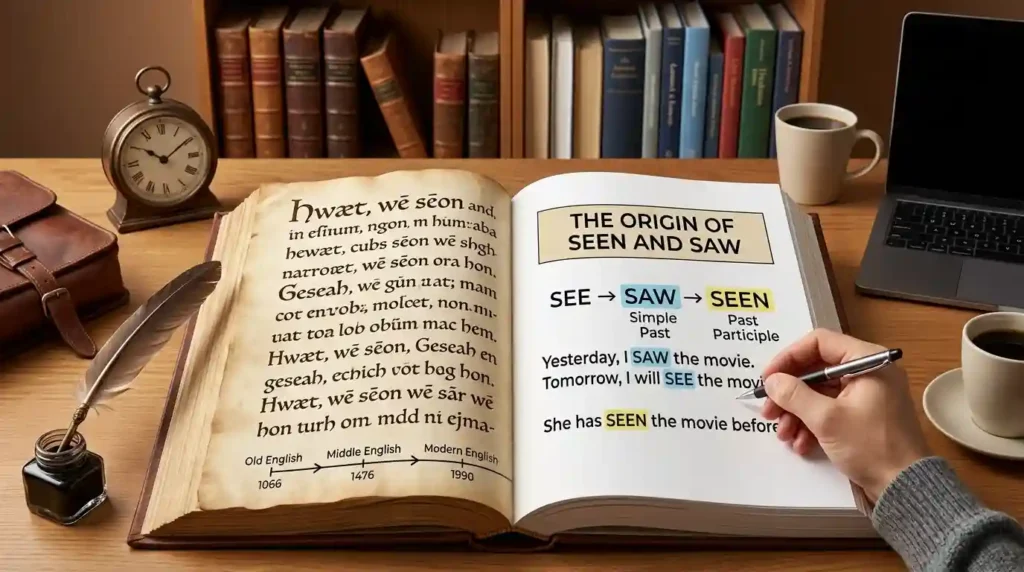
See is a very old English verb. It goes back to Old English, where it was sēon. It is an “irregular” verb. That means it does not add -ed to show the past. Instead, the word itself changes.
Old English had different forms for the simple past and for the past participle. Over hundreds of years, sounds and spellings shifted. In the end, we got:
- see (now)
- saw (past)
- seen (past participle)
Many old English verbs work like this. Think of go, went, gone and write, wrote, written. Each has a simple past and a separate participle.
There is also a second word saw. It is a tool for cutting wood. It can also be a verb: “I saw a board in half.” This is a different word with a different origin. Its past forms are sawed and sawn or sawed. This can add to the mix-up, but context makes the meaning clear.
Why spelling differences do not exist here: Both American and British English use seen and saw. No country spells them another way. The differences are in habit, not spelling.
British English vs American English Spelling
The spelling is the same in both. What changes is how often people use each form with certain time words.
Spelling rules:
- Simple past: saw (US and UK)
- Past participle: seen (US and UK)
- Both use “have seen,” “had seen,” and “was seen.”
Usage habits:
- British English uses the present perfect (“have seen”) more often for recent events. Example: “I’ve just seen him.”
- American English often uses the simple past (“saw”) in the same case. Example: “I just saw him.”
Both are correct in their own regions.
| Feature | American English | British English |
| Simple past spelling | saw | saw |
| Past participle spelling | seen | seen |
| Recent event | “I just saw him.” | “I’ve just seen him.” |
| Question about experience | “Did you see it yet?” | “Have you seen it yet?” |
| Standard grammar rule | Same | Same |
Note: In some regional dialects in both countries, people say “I seen it.” This is not standard English. Avoid it in school, work, and formal writing.
Which Spelling Should You Use?
The spelling is the same everywhere. So the real question is which form fits your reader
For readers in the United States:
- Both “I saw it” and “I’ve seen it” are fine.
- For recent events, “I just saw it” sounds natural.
For readers in the UK, Australia, India, and other Commonwealth countries:
- “I’ve just seen it” sounds natural.
- Both forms are still correct.
If your audience is global:
- Pick the clear, simple pattern.
- Use saw for one finished past event with a time: “I saw him on Monday.”
- Use have/has seen when the time is not given or still matters: “I have seen this before.”
Always avoid:
- “I seen”
- “I have saw”
These are wrong in every country.
Common Mistakes with Seen or Saw
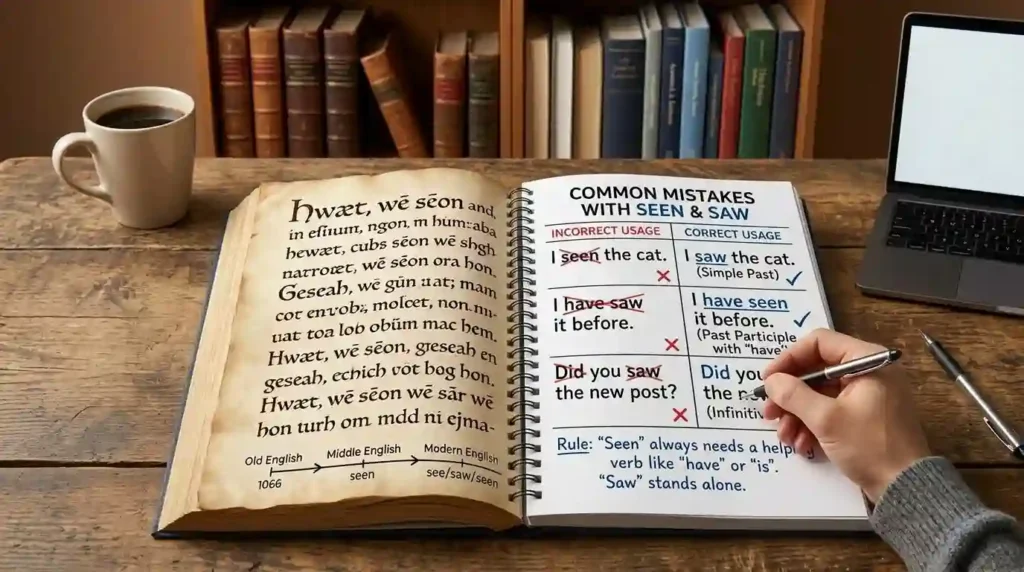
Mistake 1: Using “seen” without a helping verb.
- ❌ “I seen the report”
- ✅ “I saw the report” or “I have seen the report
Mistake 2: Using “Seen” After “Did”
- ❌ Did you seen it?
- ✅ Did you see it?
After did, use the base form: see.
Mistake 3: Wrong form with “was” or “were”
- ❌ The thief was saw by a guard.
- ✅ The thief was seen by a guard.
Mistake 4: Mixing up the tool and the verb
- ❌ He seen the wood with a saw.
- ✅ He saw the wood with a saw. (Saw the tool, or sawed the wood.)
Easy fix: Look for a helper word. If there is one, use seen. If there is none, use saw.
Seen or Saw in Everyday Examples
Emails
- “I saw your message this morning and will reply soon.”
- “I have seen the latest draft and it looks good.”
News writing
- “The suspect was last seen near the station.”
- “Witnesses saw a red car leave the scene.”
Social media
- “Just saw the best show ever!”
- “Have you seen this video? So funny.”
Formal writing
- “The committee has seen the results and approved the plan.”
- “In 1990, researchers saw a sharp rise in cases.”
Everyday speech
- “I saw her at the store.”
- “I have never seen snow.”
Seen or Saw Google Trends and Usage Data

I can’t pull live Google Trends numbers here, so I won’t guess at exact figures. Here is what is generally true, and how you can check for yourself.
What searchers often want:
- People search “seen or saw” to fix a grammar doubt while writing.
- Many searches come from students, non-native English speakers, and workers writing emails.
- Related searches often include “have seen or have saw,” “I seen or I saw,” and “saw vs seen.”
Popularity by context:
- Interest in grammar terms often rises during school terms and exam seasons.
- It also rises in countries where English is a second language, such as India, Pakistan, Nigeria, and the Philippines.
How to check current data:
- Go to Google Trends.
- Type “seen or saw” and compare it with “saw or seen.”
- Filter by country and time range.
- Look at “Related queries” for what people really ask.
This gives you fresh, real numbers you can trust.
Comparison Table: Seen vs Saw Variations
| Phrase | Correct? | Why |
| I saw him. | ✅ Yes | Simple past, no helper |
| I seen him. | ❌ No | “Seen” needs a helper |
| I have seen him. | ✅ Yes | “Have” + past participle |
| I have saw him. | ❌ No | “Saw” is not a participle |
| She had seen it. | ✅ Yes | “Had” + past participle |
| She had saw it. | ❌ No | Wrong form after “had” |
| It was seen by many. | ✅ Yes | Passive voice needs “seen” |
| It was saw by many. | ❌ No | Wrong form in passive |
| Did you see it? | ✅ Yes | Base form after “did” |
| Did you saw it? | ❌ No | “Did” needs base form |
Frequently Asked Questions
Is it “I seen” or “I saw”?
Use “I saw.” “I seen” is not standard English.
Is it “have saw” or “have seen”?
Use “have seen.” After have, you need the past participle.
What is the difference between seen and saw?
Saw is the simple past of see. Seen is the past participle. It always needs a helper word.
Is “seen” ever correct without a helper?
In standard English, no. In casual dialects you may hear it, but avoid it in writing.
Is there a British vs American spelling for seen and saw?
No. Both use the same spellings. The only difference is habit. British speakers often say “I’ve just seen it.” Americans often say “I just saw it.”
Can I say “I have not saw it”?
No. Say “I have not seen it” or “I did not see it.”
Is “saw” also a tool?
Yes. A saw is a tool for cutting wood. It is a different word from the verb saw, but they look the same.
What is the easy rule to remember?
No helper word? Use saw. Helper word? Use seen.
Conclusion
The choice between “seen or saw” is simple once you know the rule. Saw is the simple past of see. It stands alone. Seen is the past participle. It needs a helper like have, has, had, or was.
Remember these points:
- Say “I saw the movie,” not “I seen the movie.”
- Say “I have seen the movie,” not “I have saw the movie.”
- After did, use see: “Did you see it?”
- Spelling is the same in the US, UK, and everywhere else.
- Only habits differ. British English often prefers “I’ve just seen it.” American English often prefers “I just saw it.”
For school, work, and formal writing, stick to the standard forms. Avoid “I seen” and “I have saw.”
When in doubt, use the quick test. Look for a helper word before the verb. If it is there, choose seen. If it is not, choose saw.
Practice with a few sentences each day. Soon, the right word will come to you without thinking.

I’m Raheela Rani, a professional content writer and author with 3 years of experience in writing, editing, and storytelling. Through VisitLivo.com, I create clear, engaging, and well-crafted content that helps readers learn, connect, and communicate with confidence.