You are writing an email. You want to say “until then.” Your fingers stop. Is it “mean time” or “meantime”?
You are not the only one who wonders. The two forms look almost the same. They sound the same too. But they are not always the same thing. That is why people search for “mean time or meantime.” They want a fast answer, and they want to feel sure. One wrong choice can look like a typo in a work email, a school paper, or a cover letter.
This guide clears it up. You get the quick answer first. Then you learn where the words came from and how British and American writers use them. You will see which one to pick, which mistakes to avoid, and real examples. There is a simple table and a short FAQ too.
By the end, you will not need to guess again. Let’s begin.
Mean Time or Meantime Quick Answer
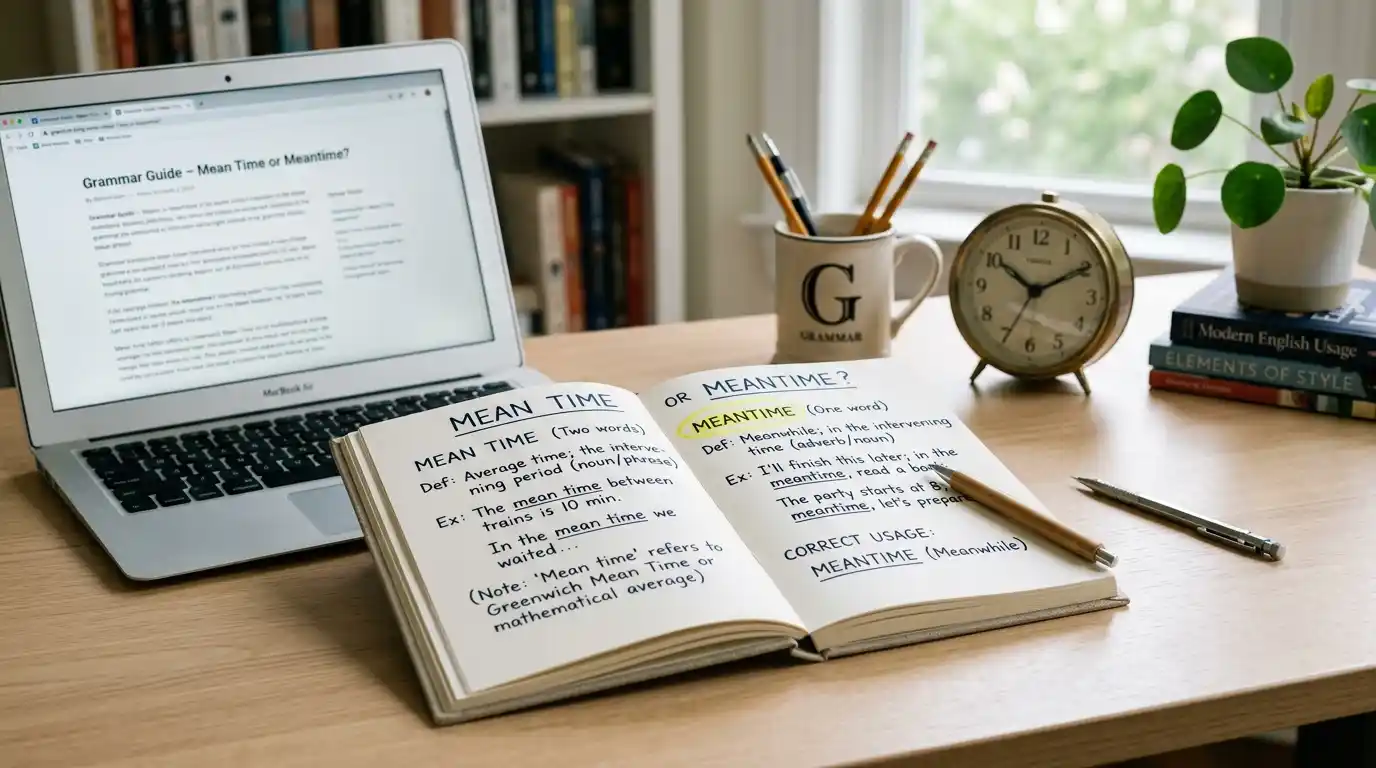
Use “meantime” (one word) for the time between two events. It is the normal choice in most writing.
- In the meantime, please read the report.
- The food is not ready. In the meantime, have a snack.
Use “mean time” (two words) only in special terms. Here, “mean” means “average” or “middle.”
- Greenwich Mean Time (GMT)
- Mean time between failures (MTBF)
- The mean time to fix a bug is two hours.
Simple rule: If you can swap it with “meanwhile,” write “meantime.” If you mean “average,” write “mean time.”
The Origin of Mean Time and Meantime
The word “mean” here is very old. It comes from Middle English mene, which meant “middle” or “in between.” That word came from Old French and Latin words that also meant “middle.”
“Time” comes from Old English tima.
Put them together and you get “the middle time.” That is the time in the middle of two events. People first wrote it as two words: in the mean time. Over the years, writers joined the words into one, and “meantime” became a fixed word, like “sometime” and “overtime.”
So why are there two spellings now? Language changes slowly. Old habits stay. Some writers kept the two-word form. Technical fields also use “mean” in the sense of “average,” so “mean time” lived on there. Today, both forms exist, but they do different jobs.
British English vs American English Spelling
Good news: this is not a big US vs UK fight. Both sides use “meantime” as the main form. Both sides use “mean time” in science and business terms.
The small difference is style. Some British writers still use the older “in the mean time” or “meanwhile” a bit more often. American writers lean toward “in the meantime.”
| Situation | American English | British English |
| Time between two events | in the meantime | in the meantime (also “meanwhile”) |
| Older two-word form | rare, seen as dated | rare, seen as dated |
| Standard time zone | Greenwich Mean Time | Greenwich Mean Time |
| Average time in tech | mean time to repair | mean time to repair |
| Casual writing | meantime / meanwhile | meantime / meanwhile |
Notice the pattern. The spelling rules match on both sides. Only the taste changes a little.
Which Spelling Should You Use?
If your readers are in the US: Write “in the meantime.” It is clean and expected. Use “mean time” only for averages.
If your readers are in the UK or Commonwealth: Write “in the meantime” too. “Meanwhile” also works well. Avoid “in the mean time” unless you want an old-style tone.
If your readers are global: Choose “in the meantime.” It is the safest choice. Almost every dictionary lists it. Spell checkers accept it, and readers everywhere know it.
Pro tip: For technical reports, keep “mean time” and define it once. For example: “Mean time to repair (MTTR) is the average time to fix a fault.”
Common Mistakes with Mean Time or Meantime
Mistake 1: Splitting the word when you mean “meanwhile.”
- Wrong: In the mean time, call me.
- Better: In the meantime, call me.
Mistake 2: Joining the words when you mean “average.”
- Wrong: The meantime between failures is 400 hours.
- Better: The mean time between failures is 400 hours.
Mistake 3: Dropping “the.”
- Wrong: In meantime, I will wait.
- Better: In the meantime, I will wait.
Mistake 4: Writing “mean while” as two words.
- Wrong: Mean while, the team left.
- Better: Meanwhile, the team left.
Mistake 5: Using “meantime” as a person.
- Wrong: I will call you meantime.
- Better: I will call you in the meantime.
Mean Time and Meantime in Everyday Examples
In emails
- Your order is on its way. In the meantime, you can track it here.
- Thanks for your note. In the meantime, I will check the numbers.
In news
- The storm hits tonight. In the meantime, officials ask people to stay home.
- The company will share results next week. In the meantime, its stock has stayed flat.
On social media
- Season finale is Sunday. In the meantime, I’m rewatching everything.
- Coffee first. Emails in the meantime.
In formal writing
- The committee will meet in May. In the meantime, members should send their comments.
- The mean time between failures for this part is 10,000 hours.
Mean Time or Meantime Google Trends & Usage Data
I can’t pull live Google Trends numbers here, so I won’t invent figures. Here are the patterns you can expect, and you can confirm them yourself on Google Trends.
- “In the meantime” is the phrase people use most. It shows up in everyday writing far more than the two-word form.
- “Mean time” searches are often technical. They come with terms like GMT, MTBF, and MTTR. Those searches tend to come from students, engineers, and IT workers.
- “Meantime or mean time” searches are about spelling doubts. They tend to rise when people write essays, emails, and reports.
- Interest appears in many English-speaking countries. These include the US, UK, Canada, Australia, India, Pakistan, and Nigeria. Learners of English often search this pair.
Tip: Open Google Trends and compare “meantime,” “mean time,” and “in the meantime.” Filter by country and by past 5 years to see the pattern for your region.
Side-by-Side Comparison of Keyword Variations
| Form | Correct? | Meaning | Example |
| meantime | Yes | Time between events | In the meantime, relax. |
| in the meantime | Yes (best) | Until then | In the meantime, I’ll cook. |
| meanwhile | Yes | At the same time | Meanwhile, she waited. |
| mean time | Yes (technical) | Average time | Mean time to repair is 3 hours. |
| Greenwich Mean Time | Yes | A standard time | The call is at 9 a.m. GMT. |
| in the mean time | Dated, less common | Until then | In the mean time, wait here. |
| mean while | No | Not standard | Use “meanwhile.” |
FAQs
Is it “mean time” or “meantime”?
Use “meantime” for the time between events. Use “mean time” for an average.
Is “in the meantime” correct?
Yes. It is the most common and safest form.
Is “in the mean time” wrong?
It is not a serious error. It is an older style. Most modern writers use “in the meantime.”
What does “mean time” mean in tech?
It means the average time for something to happen. Examples are “mean time between failures” and “mean time to repair.”
Is “meantime” a noun or an adverb?
Both. In “in the meantime,” it is a noun. In “Meantime, we wait,” it works like an adverb, though “meanwhile” is more common there.
Are “meantime” and “meanwhile” the same?
They are close. “Meantime” often means “until something happens.” “Meanwhile” often means “at the same time as something else.”
Does Greenwich Mean Time use “mean” as “average”?
Yes. It is based on the average time of the sun at Greenwich.
Do Americans and British people spell it differently?
No. Both use “meantime” as the main spelling.
Conclusion
The choice between “mean time” and “meantime” is easy once you know the rule.
Write “meantime” when you talk about the time between two events. Most of the time, you will write “in the meantime.” It works in emails, news, essays, and social posts. It is right in the US, the UK, and everywhere else.
Write “mean time” only when “mean” means “average.” You will see it in terms like Greenwich Mean Time and mean time between failures. Keep those terms as two words.
Avoid the common slips. Do not split “meantime” when you mean “until then.” Do not join “mean time” when you mean “average.” Do not forget “the” in “in the meantime.” If you feel unsure, swap in “meanwhile.” If it fits, use “meantime.” If you can say “average,” use “mean time.”
Now you have the answer, the history, and the tools to use both forms with confidence. Your writing will look sharp and professional.

“I’m Ibadat Fatima, a professional content writer and author with 3 years of experience in writing, editing, and storytelling. I share my work through visitlivo.com, where I help readers connect with clear, engaging, and well-crafted content.”