Ever typed a message and stopped mid-word? You wanted to say something felt awkward. Then you froze. Is it cringey or cringy?
You are not alone. Thousands of people search this every month. The word is everywhere now. It shows up in texts, reviews, memes, and news stories. But nobody taught us how to spell it in school.
People search this keyword for one reason. They want a fast, safe answer. They do not want to look silly in an email or a post. Some also wonder if one spelling is British and the other is American.
This article clears up the confusion. You get the quick answer first. Then you will see where the word comes from, how each spelling works, and which one to pick. You will also find real examples, common mistakes, comparison tables, and a short FAQ.
Read on. By the end, you will spell it with confidence.
Cringey or Cringy Quick Answer
Both are correct. Cringey and cringy mean the same thing: something that makes you feel embarrassed or awkward.
Cringey is the more common spelling in most dictionaries and style guides. If you want one safe choice, use cringey.
Examples:
- “That pickup line was so cringey.”
- “I watched my old videos. They were cringy.”
- “The speech was cringey, but he kept smiling.”
Same meaning. Same sound. Only the spelling changes.
The Origin of Cringey and Cringy

The story starts with the word cringe. It comes from Old English. The old word cringan meant to give way or bend under pressure. Over time, it came to mean pulling back in fear. Later, it meant shrinking from something unpleasant.
Then the internet changed it. In the 2000s and 2010s, young people used “cringe” for awkward moments. It became slang. Soon it needed an adjective form.
That is where -y comes in. English adds -y to make describing words. Salt becomes salty. Cringe becomes cringy or cringey.
So why two spellings? Because English has two habits:
- Drop the silent e. Shine becomes shiny. Noise becomes noisy. That gives cringy.
- Keep the e. Keeping it shows the root word and keeps the soft “j” sound. That gives cringey.
Both habits are common. The word is new, so no single rule has won yet.
British English vs American English Spelling
Here is the surprise. This is not a true UK vs US difference. Both countries use both spellings. Dictionaries in both places list them.
Still, it helps to see how English treats words that end in -e plus -y.
| Word | Keeps the “e” | Drops the “e” | Notes |
| Cringe | cringey | cringy | Both used |
| Pricey | pricey | pricy | “Pricey” wins |
| Cage | cagey | cagy | Both used |
| Shine | (shineey) ✗ | shiny | Drop the e |
| Nose | (noseey) ✗ | nosy / nosey | Both used |
| Home | homey | homy | “Homey” wins |
The lesson: English has no strict rule. Some words keep the e, some drop it, and some allow both. Pick one spelling and stay consistent.
Which Spelling Should You Use?
Writing for a US audience: Use cringey. Most American dictionaries list it first. Cringy is still fine in casual writing.
Writing for a UK or Commonwealth audience: Use cringey. British sources also list it first. Again, cringy is acceptable.
Writing for a global audience: Use cringey. It is the safest pick. It is also easier to spot in search.
Writing for a school, company, or publisher: Check the style guide. If none exists, choose cringey and use it every time.
Quick rule: When in doubt, keep the e.
Common Mistakes with Cringey and Cringy
Mistake 1: Thinking one is wrong.
Neither is wrong. Do not “correct” someone for using the other.
Mistake 2: Mixing both in one text.
Wrong: “The movie was cringey. The ending was cringy.”
Right: “The movie was cringey. The ending was cringey.”
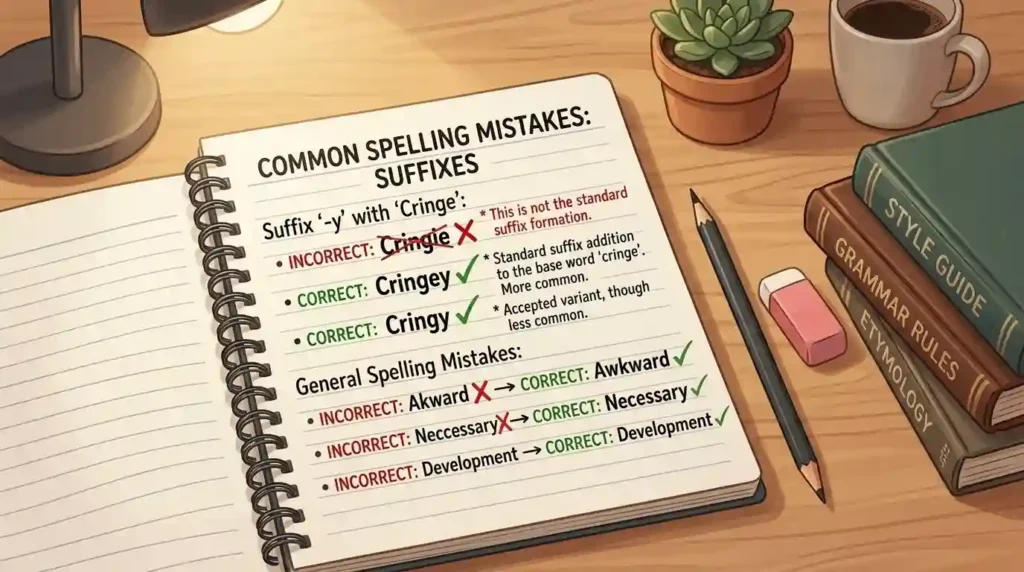
Mistake 3: Spelling it “cringie.”
This is not standard. Use -ey or -y.
Mistake 4: Using “cringe” as the adjective.
“That joke was so cringe” is common in slang. But in formal writing, use “cringey” or “cringy.”
Mistake 5: Mixing it up with “cringeworthy.”
Cringeworthy is a separate word. It means “deserving a cringe.” It is often written as one word or with a hyphen.
Cringey and Cringy in Everyday Examples
Email (casual):
“Sorry about my last message. Re-reading it, it was a bit cringey.”
Email (formal): Avoid it. Try “awkward” or “embarrassing” instead.
News headline:
“Brand’s Attempt at Viral Trend Called Cringey by Fans”
Social media:
“My 2012 profile pic is so cringy. Why did I do that?”
Text message:
“Don’t read my old diary. It’s so cringey 😭”
Product review:
“The acting is cringey, but the story is fun.”
Formal writing:
Use a stronger, more traditional word. “The speech was awkward” fits a report better than “cringey.”
Cringey or Cringy Google Trends and Usage Data
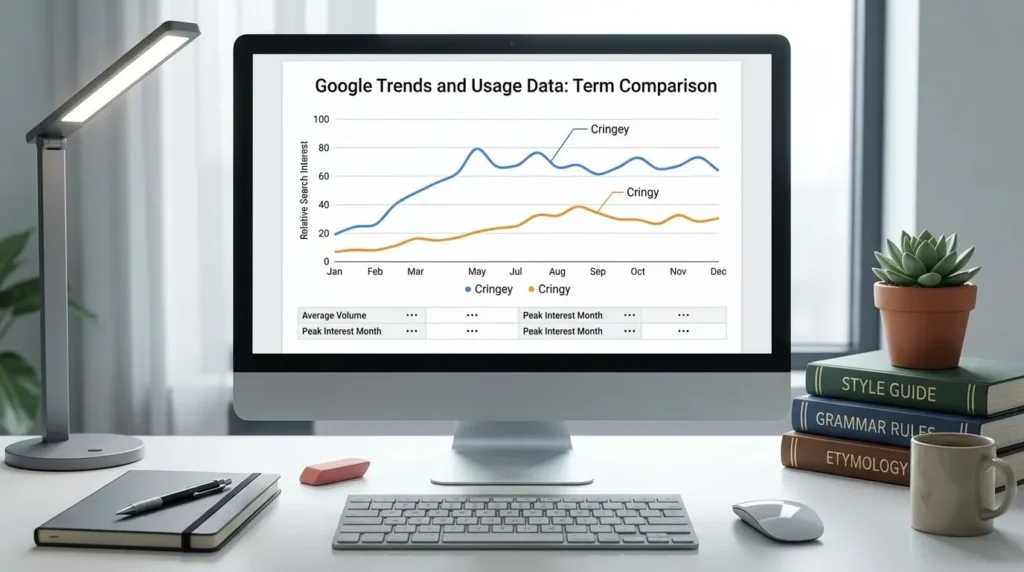
I can’t pull live numbers here, so I won’t guess exact figures. You can check them yourself at Google Trends. Here is what to look for:
- “Cringe” leads. People search the root word far more than either adjective.
- “Cringey” usually beats “cringy.” Most people who use the adjective choose the -ey form.
- Interest is strong in English-speaking countries. These include the US, UK, Canada, Australia, and Ireland.
- Younger users drive it. The word grew on social platforms, so casual settings use it most.
- Spikes follow trends. Viral videos and memes often cause jumps in searches.
To check for yourself, open Google Trends and compare “cringey” and “cringy” by country and time range.
Keyword Variations Side by Side
| Term | Type | Use It? | Example |
| Cringe | Verb / noun / slang adjective | Yes | “I cringe at old photos.” |
| Cringey | Adjective | Yes (best pick) | “That was cringey.” |
| Cringy | Adjective | Yes (variant) | “That was cringy.” |
| Cringeworthy | Adjective | Yes | “A cringeworthy speech.” |
| Cringie | Not standard | No | — |
| Cringing | Verb form | Yes | “I was cringing the whole time.” |
Frequently Asked Questions
Is it cringey or cringy?
Both are correct. Cringey is more common, so it is the safer choice.
Is “cringy” a real word?
Yes. It is a valid variant. Many dictionaries list it next to cringey.
Is cringey British or American?
Neither. Both countries use both spellings.
Which spelling do dictionaries prefer?
Most list cringey first and cringy as a variant. Check your own dictionary to be sure.
Can I use cringey in formal writing?
It is slang, so it is best in casual writing. For formal work, use “awkward,” “embarrassing,” or “uncomfortable.”
What does cringey mean?
It describes something so awkward or embarrassing that it makes you want to look away.
Is “cringe” an adjective?
In slang, yes (“That’s so cringe”). In standard writing, use cringey or cringy.
What is the difference between cringey and cringeworthy?
They are close in meaning. Cringeworthy sounds a bit stronger and fits more formal writing.
Conclusion
So, cringey or cringy? Now you know. Both spellings are right. They mean the same thing. They sound the same.
Here are the key points to remember:
- Cringey is the more common form. Use it when you want the safe choice.
- Cringy is a valid variant. It is fine in casual writing.
- The split is not UK vs US. Both countries use both forms.
- Consistency matters most. Pick one spelling and use it throughout.
- The word is slang. Save it for casual writing. In formal work, use “awkward” or “embarrassing.”
- Avoid “cringie.” It is not standard.
The word grew from the old verb cringe, and slang carried it into everyday speech. The spelling is still settling, which is why you see two forms.
Next time you freeze mid-sentence, relax. Type cringey. Keep the e. Move on. No one will call you wrong.

“I’m Ibadat Fatima, a professional content writer and author with 3 years of experience in writing, editing, and storytelling. I share my work through visitlivo.com, where I help readers connect with clear, engaging, and well-crafted content.”