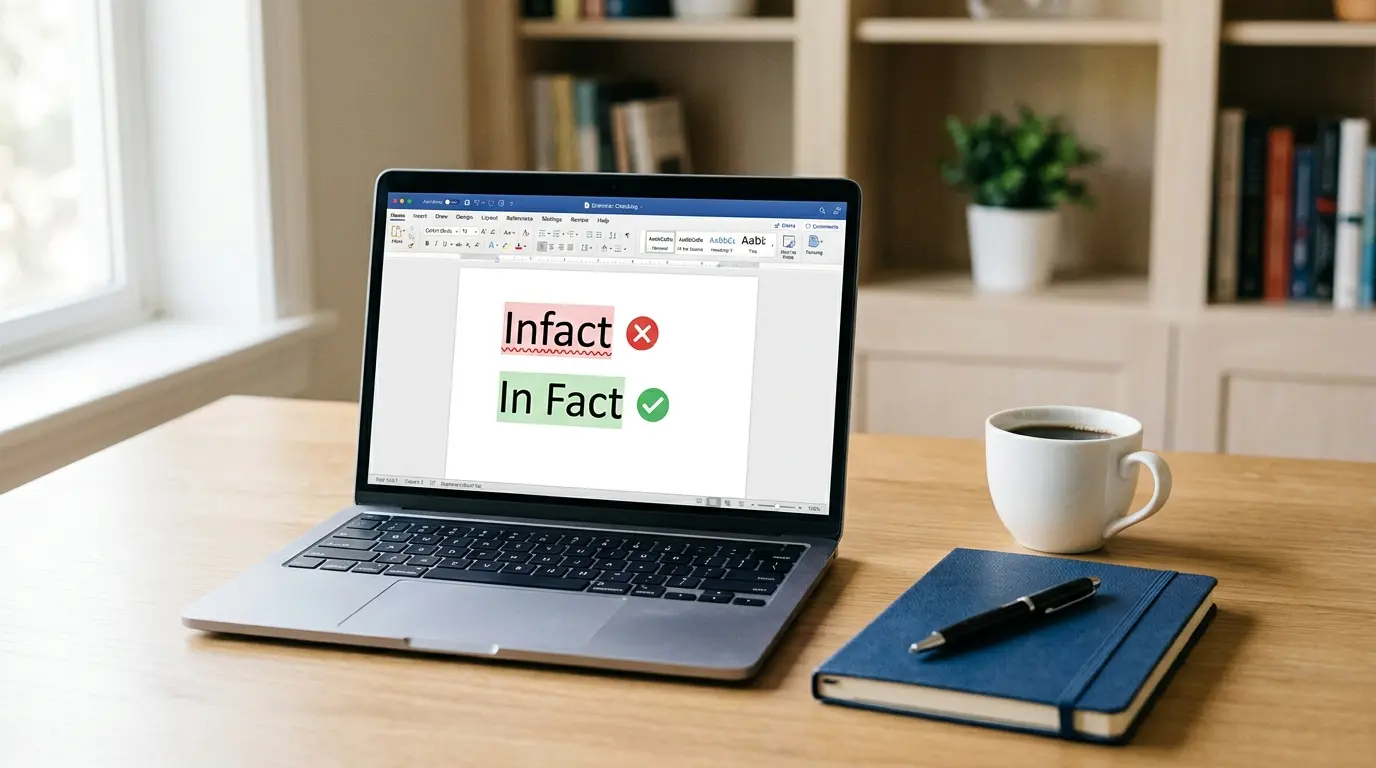
You are typing fast. You want a word that shows your point is true. Then you stop. Is it “infact” or “in fact”?
You are not alone. Many people ask this every month. It looks like a small question. But the wrong choice can make an email, essay, or CV look sloppy.
People search for “infact or in fact” because the two forms look almost the same. They sound the same when spoken. Some spell checkers miss the error. And many writers just want to be sure before they hit send.
This article clears up the confusion. Here is the short version: “in fact” is correct. “Infact” is a spelling mistake.
You will learn where the phrase came from. You will see how US and UK writers use it. You will learn the most common mistakes and how to fix them. You will also get simple examples, comparison tables, and answers to common questions.
By the end, you will never have to wonder again. Let’s start with the quick answer.
Infact or In Fact Quick Answer
Use “in fact.” Always two words.
“Infact” is not a standard English word. You will not find it in major dictionaries. It is a typo that many people make.
“In fact” means “in truth” or “in reality.” We use it to add a true detail, stress a point, or correct an idea.
Examples:
- I like coffee. In fact, I drink four cups a day.
- She said the test was easy. In fact, it was very hard.
- The plan worked. In fact, it worked better than we hoped.
Notice the comma after “in fact” when it starts a sentence. That is the usual style.
The Origin of In Fact
The word “fact” comes from the Latin word factum. It means “a thing done.” Long ago, a fact was an action or a deed. Over time, the meaning changed. Today a fact is something we know to be true.
“In” is a small word we use everywhere. “In fact” joins the two. It first meant “in the real act” or “in reality.” Writers have used it this way for hundreds of years.
So why do people write “infact”? There are a few reasons:
- We say it as one word. In speech, the words flow together.
- Other words work this way. Think of “indeed” or “inside.” Both are single words. So “infact” feels right to some people.
- Fast typing. People skip the space and never check.
But “in fact” is a phrase. It is a preposition plus a noun. Those stay apart, just like “in truth” or “in case.”
One small note: “INFACT” has been used as a name. Some groups and companies have used it as a brand. That is a proper noun. It is not the everyday phrase.
British English vs American English Spelling
Here is the good news. There is no difference. British and American English both use “in fact.” Both treat “infact” as an error.
Many spelling splits exist between the two. But this is not one of them. Look at how it compares with real spelling differences:
| Word | American English | British English | Same or Different? |
| In fact | in fact | in fact | Same |
| Color / Colour | color | colour | Different |
| Center / Centre | center | centre | Different |
| Organize / Organise | organize | organise (or organize) | Different |
| Infact | Not correct | Not correct | Same (error) |
The rule is simple. Phrases that start with “in” and have a noun stay as two words in both styles. Compare “in case,” “in time,” “in part,” and “in fact.”
Which Spelling Should You Use?
Your answer is the same for every reader: “in fact.”
- US readers: Use “in fact.” It is standard in schools, news, and business.
- UK and Commonwealth readers: Use “in fact.” This includes Australia, Canada, India, and South Africa.
- Global readers: Use “in fact.” It is safe in all forms of English.
If you write for work, school, or a website, this matters more. Readers may judge your care and skill by small errors. One misspelled word can weaken a strong message.
Simple tip: If you can swap it for “in truth” or “in reality,” write two words.
Common Mistakes with In Fact
Here are the errors people make most often.
1. Writing it as one word
- ❌ Infact, I was there.
- ✅ In fact, I was there.
2. Adding a hyphen
- ❌ In-fact, she won.
- ✅ In fact, she won.
3. Skipping the comma at the start of a sentence
- ❌ In fact she won.
- ✅ In fact, she won.
4. Confusing it with “in facts”
- ❌ In facts, it is true.
- ✅ In fact, it is true.
5. Using it too often
“In fact” is a strong phrase. If every sentence has it, it loses power. Use it once in a while.
6. Using it when nothing is added
Use “in fact” to add or stress something. Do not use it as filler.
In Fact in Everyday Examples
In an email:
Thanks for your message. In fact, I was about to write to you.
In the news:
Officials said the road would reopen soon. In fact, work ended yesterday.
On social media:
Monday is not so bad. In fact, I love it. 😄
In formal writing:
The study found no harm. In fact, the results showed a small benefit.
In casual speech:
“Are you tired?” “No. In fact, I feel great.”
Notice the pattern. “In fact” adds a stronger or clearer point to what came before.
Infact or In Fact Google Trends and Usage Data
I can’t pull live numbers here, so this section shows you how to read the data yourself. Open Google Trends and type both forms. Compare them side by side.
Here is what you will typically see:
- “In fact” is used far more. It is a real phrase and appears in books, news, and daily writing.
- “Infact” shows up as a typo. Its search interest is small, and it often comes from people checking their spelling.
- Interest is worldwide. Searches come from the US, UK, India, Pakistan, Nigeria, Canada, and Australia. Many are from people who write English as a second language.
- Searches often rise during school and exam seasons. People check their writing more then.
Tip: Use the “Related queries” box in Google Trends. It shows what else people ask, such as “in fact meaning” or “in fact synonym.”
Here is how the forms compare:
| Variation | Correct? | Notes |
| in fact | ✅ Yes | Standard in US and UK |
| infact | ❌ No | Common typo |
| in-fact | ❌ No | Hyphen is not needed |
| in facts | ❌ No | Wrong form |
| as a matter of fact | ✅ Yes | Longer, more formal |
| in actual fact | ✅ Yes | Common in UK English |
| in reality | ✅ Yes | Close in meaning |
FAQs
Is “infact” ever correct?
No. In normal English writing, “infact” is a spelling mistake. The right form is “in fact.”
Is “in fact” one word or two?
Two words. It is a phrase.
Is “in fact” British or American?
Both. It is spelled the same in the US, UK, and elsewhere.
Do I need a comma after “in fact”?
Yes, if it starts the sentence. Example: In fact, I agree. Mid-sentence, you can set it off with commas too.
What does “in fact” mean?
It means “in truth” or “in reality.” It adds or stresses a true point.
What can I use instead of “in fact”?
Try “actually,” “in truth,” “indeed,” “as a matter of fact,” or “in reality.”
Is “in fact” formal or casual?
Both. It works in emails, essays, and daily talk.
Why does my spell checker not flag “infact”?
Some tools miss it, and some auto-correct only sometimes. Always read your text again.
Conclusion
Let’s wrap up. The answer to “infact or in fact” is simple: write “in fact.” It is two words. It works in every kind of English.
Here are the key points:
- “Infact” is a common typo, not a real word.
- “In fact” means “in truth” or “in reality.”
- The phrase comes from the Latin word for “a thing done.”
- There is no US and UK spelling split here.
- Add a comma when the phrase opens a sentence.
- Do not use a hyphen.
- Do not overuse it.
Here is one trick to remember. If you can say “in truth” and the sentence still works, keep the space. Two words, always.
Small details build trust. A clean sentence tells your reader you care. So the next time you type this phrase, slow down for one second. Check the space. Then hit send with confidence.
If you liked this guide, share it with a friend who also wonders about this. In fact, they will thank you.

I’m Raheela Rani, a professional content writer and author with 3 years of experience in writing, editing, and storytelling. Through VisitLivo.com, I create clear, engaging, and well-crafted content that helps readers learn, connect, and communicate with confidence.