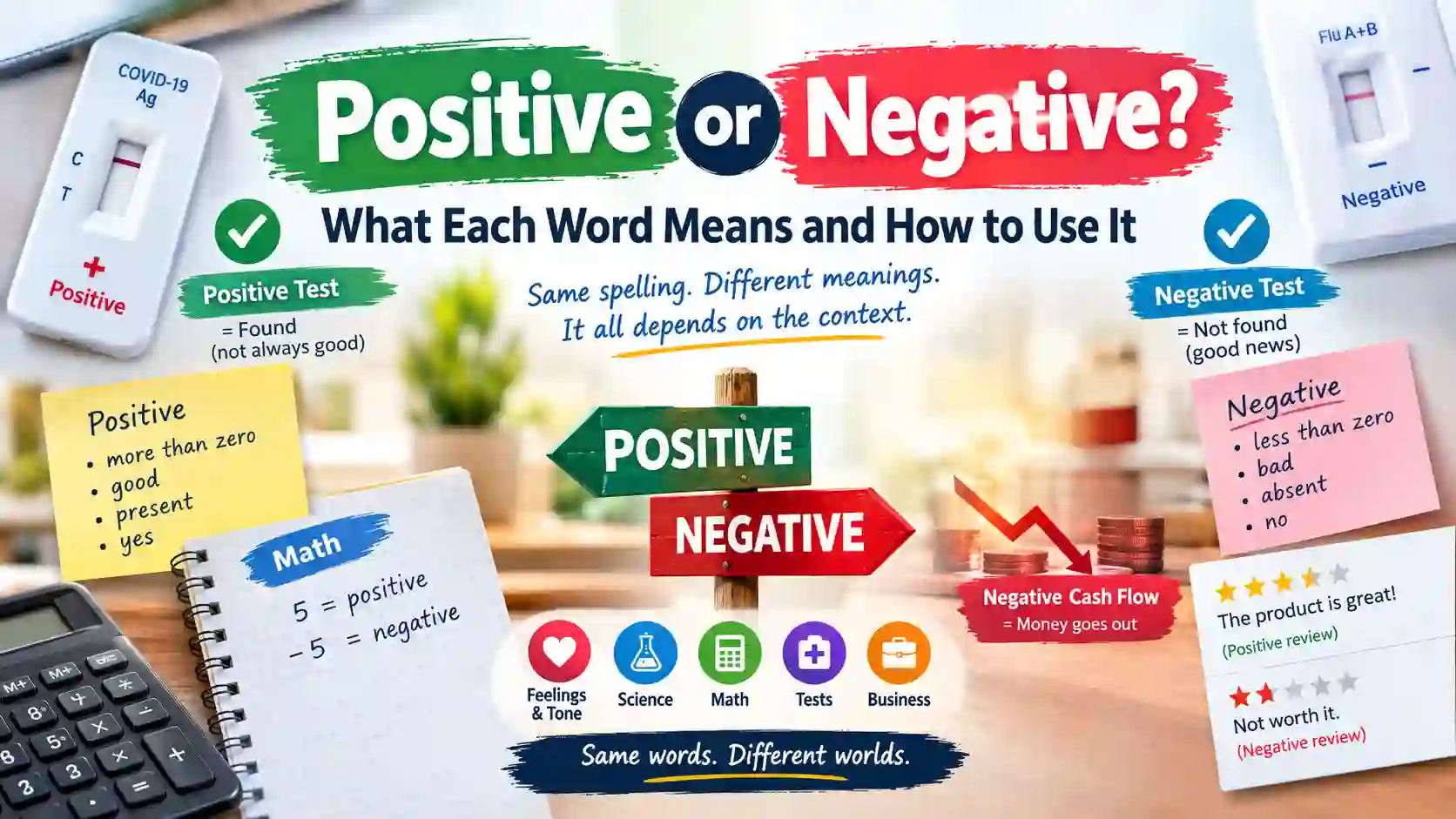
You might be staring at a test result. You might be stuck on a math problem. Or you might be reading a review and asking, “Is this good or bad?” Each one leads to the same search: positive or negative?
People type this phrase into Google every day. They want a fast answer. But the answer is not always the same. It depends on the setting.
Here is the twist. A positive test can be bad news. A negative test can be good news. That is why so many people get confused.
Some also wonder about spelling. Does British English spell these words differently from American English? It does not. But other words do change, and that is where mistakes start.
This guide gives you a quick answer first. Then you get the full story: where the words come from, how to spell them, common errors, and real examples. You will also find a table, FAQs, and tips for writers. By the end, you will know how to read and use both words with ease.
Positive or Negative Quick Answer
Positive means yes, present, more than zero, or good.
Negative means no, absent, less than zero, or bad.
Here is how it works in each setting:
- Math: 5 is positive. −5 is negative.
- Medical tests: Positive means the test found the thing. Negative means it did not.
- Feelings and tone: A positive comment is kind or hopeful. A negative comment is harsh or critical.
- Science: A proton has a positive charge. An electron has a negative charge.
- Business: Positive cash flow means money comes in. Negative cash flow means money goes out.
Key tip: In a test, “positive” does not mean “good.” It means “found.”
The Origin of Positive and Negative
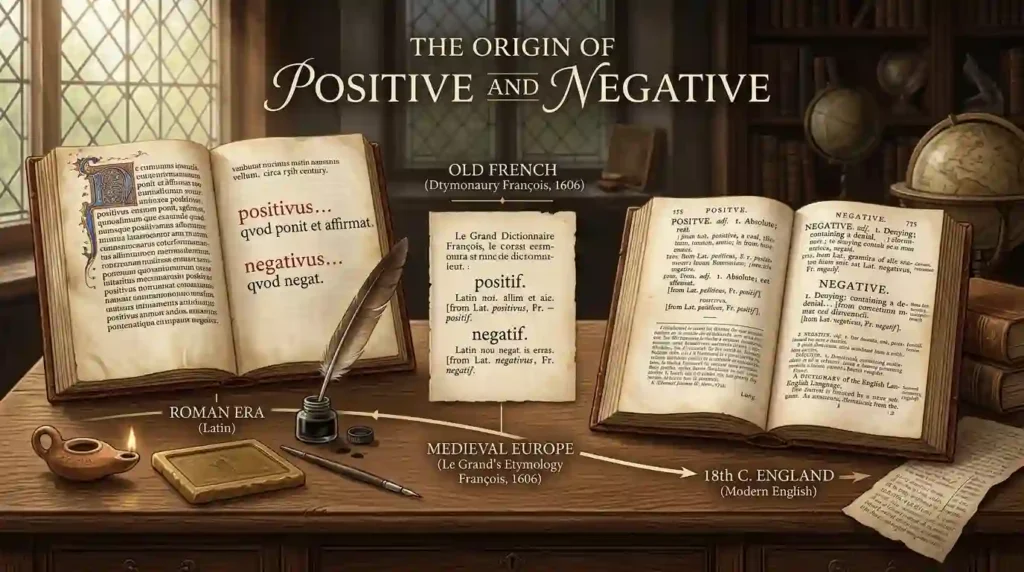
Both words come from Latin.
Positive comes from positivus, which comes from ponere. That means “to place.” Think of something put firmly in place. It is real and sure.
Negative comes from negativus, which comes from negare. That means “to deny” or “to say no.”
Both words passed through Old French and entered English long ago. At first, people used them in law, grammar, and logic. Later, math and science took them up. Now they are everywhere.
Why do spellings differ in some words? In the 1800s, Noah Webster pushed for simpler spelling in the United States. That is why Americans write “color” and the British write “colour.” But “positive” and “negative” were never changed. They end in -ive in both versions.
British English vs American English Spelling
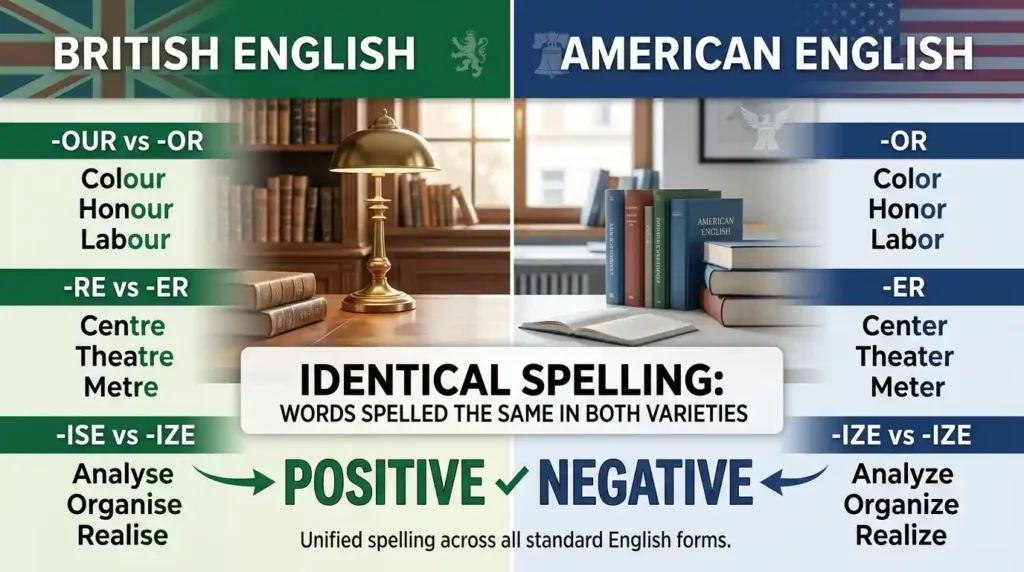
The truth is simple: “positive” and “negative” are spelled the same in British and American English.
There is no “positiv.” There is no “negatif.” Always end with -ive.
The table below shows these words next to words that do change.
| Word | American English | British English | Different? |
| Positive | positive | positive | No |
| Negative | negative | negative | No |
| Positivity | positivity | positivity | No |
| Negativity | negativity | negativity | No |
| Color | color | colour | Yes |
| Favorite | favorite | favourite | Yes |
| Center | center | centre | Yes |
| Analyze | analyze | analyse | Yes |
| Practice (verb) | practice | practise | Yes |
Rule to remember: Words ending in -ive stay the same in both versions.
Which Spelling Should You Use?
You only have one spelling to learn. Still, here is advice by audience.
- US readers: Write “positive” and “negative.” Use American spelling for nearby words (color, center, analyze).
- UK, Australia, India, Pakistan, and other Commonwealth readers: Write “positive” and “negative.” Use British spelling for nearby words (colour, centre, analyse).
- Global readers: Write “positive” and “negative.” Pick one style for the whole page. Do not mix “color” and “colour.”
Pro tip: Set your spell-checker to US or UK before you write. It keeps your text consistent.
Common Mistakes with Positive or Negative
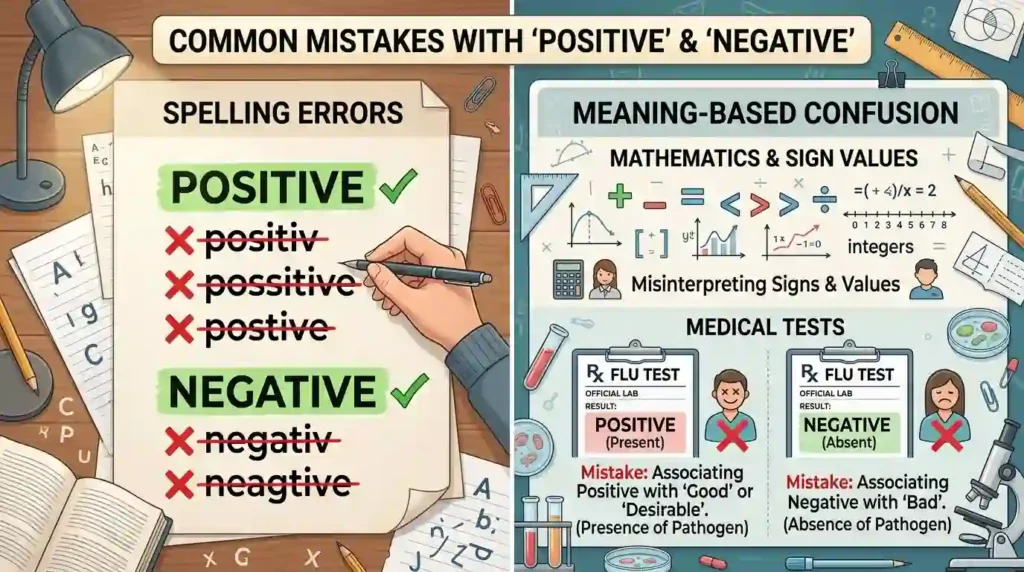
1. Thinking “positive” always means good.
A positive test for a disease is not good news. Say what was found.
2. Thinking “negative” always means bad.
A negative health screening is usually good news. Add a short note so readers do not panic.
3. Spelling errors.
- ❌ positiv, possitive, postive
- ✅ positive
- ❌ negativ, negatve, neagtive
- ✅ negative
4. Mixing up math signs.
A negative times a negative is a positive. For example, −2 × −3 = 6.
5. Using the wrong small word.
- ❌ “He tested positive of the flu.”
- ✅ “He tested positive for the flu.”
6. Mixing “or” and “and.”
Use “or” when you need one answer: “Is the result positive or negative?” Use “and” when both apply: “The plan has positive and negative points.”
Positive or Negative in Everyday Examples
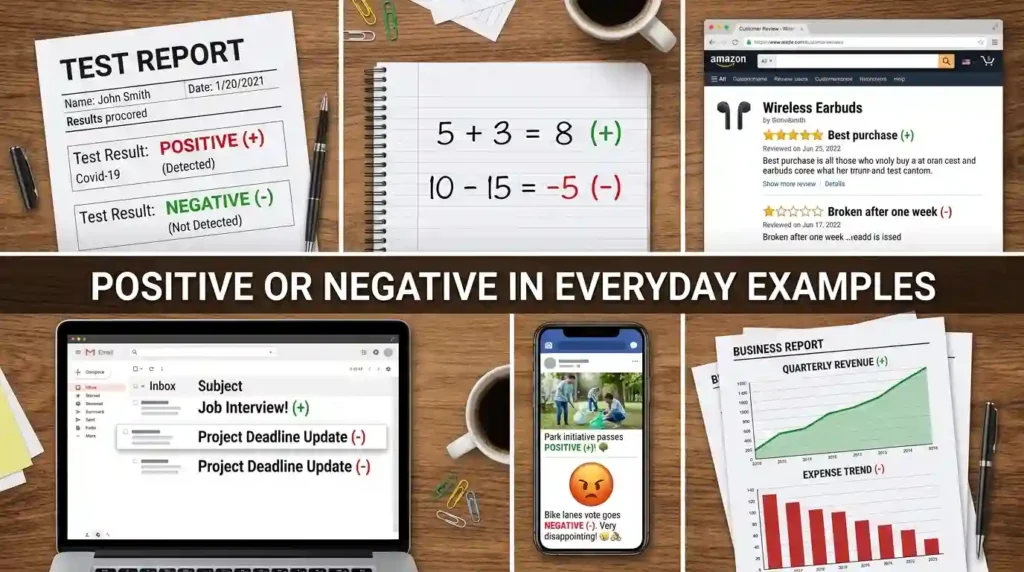
Email:
“The lab report is ready. The result is negative, so no further action is needed.”
News:
“Experts say the plan could have a positive effect on jobs. Some warn of negative effects on prices.”
Social media:
“Trying to stay positive today. Negative vibes, stay away! ✌️”
Formal writing:
“The study found a positive link between sleep and test scores. It found no negative side effects.”
Classroom:
“Is −7 positive or negative? It is negative, because it is less than zero.”
Customer reviews:
“Most reviews were positive. Only two were negative.”
Positive or Negative Google Trends & Usage Data
I do not have live Google Trends numbers, so I will not guess at figures. Here is what is generally true, and how you can check it yourself.
Why people search this phrase:
- Health: Interest often rises when people use home tests for pregnancy, COVID-19, or the flu.
- School: Students search for sign rules and charge rules, especially near exams.
- Writing and marketing: Many people check the tone of reviews and tweets. This is called sentiment analysis.
By country: The phrase is common in the US, UK, India, Pakistan, Canada, and Australia. Because the spelling is the same everywhere, there is no spelling split. The difference is context. Health searches spike during outbreaks. School searches spike during term time.
How to check it:
- Open Google Trends.
- Type “positive or negative.”
- Pick a country and a time range.
- Compare it with the phrases below.
Keyword Variations Side by Side
| Phrase | Common Use | Example |
| positive or negative | Asking which one applies | “Is my result positive or negative?” |
| positive and negative | Talking about both | “The plan has positive and negative points.” |
| positive/negative | Forms and notes | “Result: positive/negative” |
| pos or neg | Lab notes | “Strep: neg” |
| plus or minus | Math, batteries | “Is this plus or minus?” |
| positive vs negative | Comparing ideas | “Positive vs negative thinking” |
FAQs
Is it “positive or negative” or “positive and negative”?
Use “or” when only one can be true. Use “and” when both apply.
Does a positive test mean something is wrong?
Not always. It means the test found what it looked for. A positive pregnancy test means pregnant. A positive disease test means the disease was found. Ask a doctor if you are unsure.
Is “positive” spelled differently in the UK?
No. It is spelled the same in the UK, the US, and everywhere else.
What is a negative times a negative?
It is a positive. For example, −4 × −2 = 8.
Is zero positive or negative?
Neither. Zero sits between the two.
What does “positive vibes only” mean?
It means a person wants only happy and hopeful thoughts around them.
How can I tell if a text is positive or negative in tone?
Look at the words. “Great,” “love,” and “happy” feel positive. “Bad,” “hate,” and “poor” feel negative. Sentiment tools can do this at scale.
Conclusion
“Positive” and “negative” are small words with big meaning. Here is what to remember.
First, the spelling never changes. It is “positive” and “negative” in the US, the UK, and everywhere else. Just remember the -ive ending.
Second, think of the setting. In math, positive means more than zero. In a test, it means “yes, we found it.” When talking about feelings, it means happy or hopeful. Check the setting before you decide if news is good or bad.
Third, use the right small words. Say “tested positive for.” Use “or” for one answer and “and” for both.
Fourth, stay consistent. If you write for readers in many countries, choose US or UK spelling for the whole page.
Last, be clear. Do not make readers guess. A short note like “negative, which is good news” can save someone a lot of worry.
Now you know the answer. if it is a test, a number, or a comment, you can tell if it is positive or negative.

“I’m Ibadat Fatima, a professional content writer and author with 3 years of experience in writing, editing, and storytelling. I share my work through visitlivo.com, where I help readers connect with clear, engaging, and well-crafted content.”