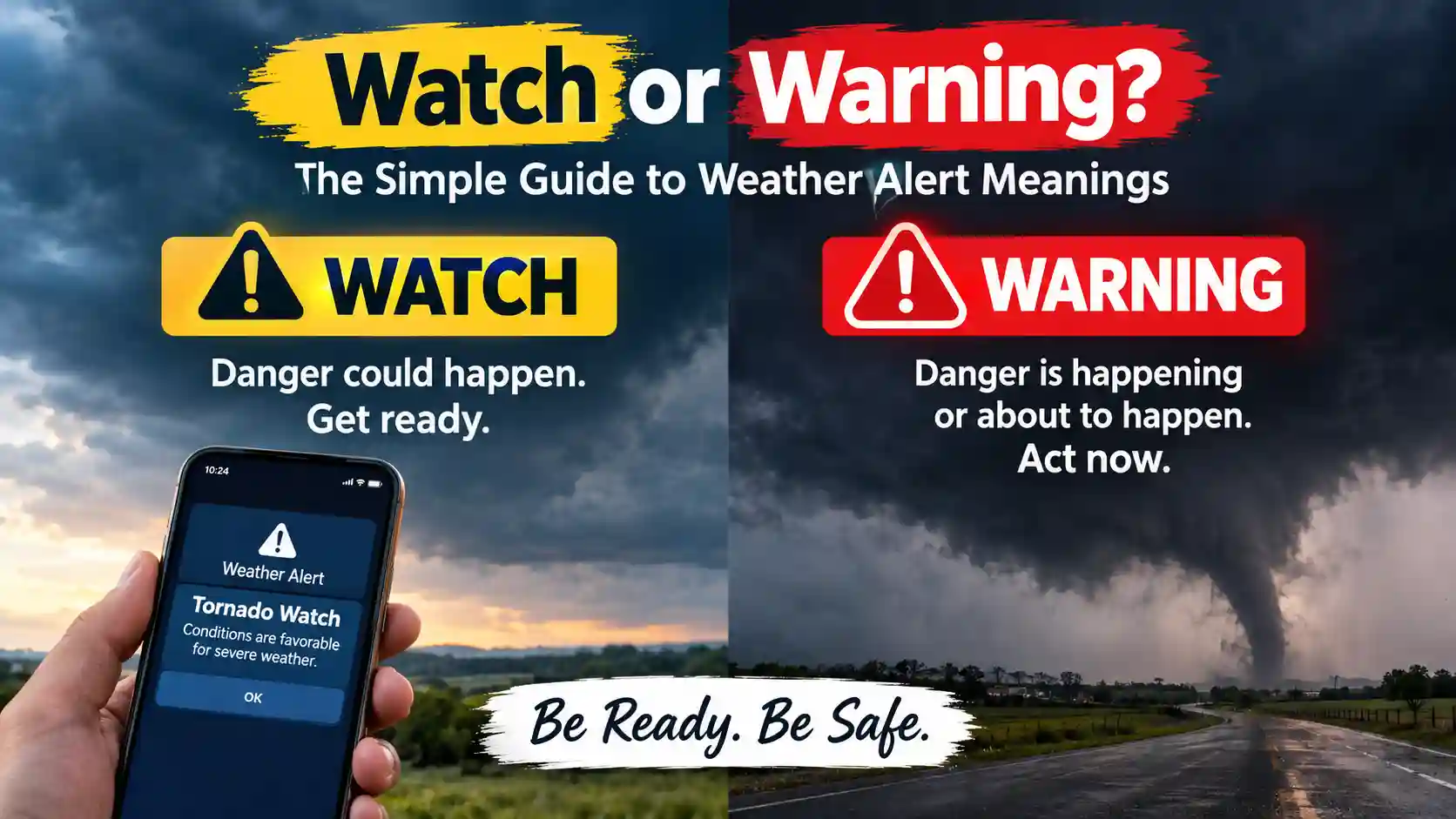
The sky turns dark. Your phone buzzes. The alert says “watch” or “warning.” Which one is worse? What should you do?
Millions of people search “watch or warning” every year. Most search during a storm, a flood, or a heat wave. They want a fast answer. They are not sure if they should relax or run.
The two words sound alike. Both mean “pay attention.” But they mean very different things. Mixing them up can cost you time when time matters most.
This guide clears up the confusion. You will get a quick answer first. Then you will learn where the words come from and how different countries use them. You will see common mistakes, real examples, and a clear table. Finally, you will get answers to common questions.
The short version: a watch means “get ready.” A warning means “act now.” Read on to learn the rest, and stay safe.
Watch or Warning Quick Answer
A watch means a danger could happen. Conditions are right. It has not happened yet. Get ready.
A warning means a danger is happening or about to happen. It is real. Take action now.
Here are quick examples:
- Tornado watch: Storms could make a tornado today. Know where you will shelter.
- Tornado warning: A tornado is seen or on radar. Go to shelter now.
- Flood watch: Flooding is possible. Stay alert.
- Flood warning: Flooding is happening or will start soon. Move to high ground if told to.
A simple memory trick: Watch = “Be ready.” Warning = “Be gone” (to safety).
The Origin of Watch and Warning

Both words are very old. They come from Old English.
“Watch” comes from an old word meaning “to be awake.” Guards “kept watch” at night. They stayed awake and looked for danger. That is why a weather watch means “keep your eyes open.”
“Warning” comes from an old word meaning “to be on guard” or “to caution.” To warn someone is to tell them danger is near.
Weather agencies began using these words in the 1900s. They wanted plain words that people could remember. Over time, the “watch” and “warning” system became standard in the United States and Canada.
Why are there no spelling differences? Both words are spelled the same everywhere in English. Americans and Brits both write watch and warning. The real difference is how each country uses them in alert systems.
British English vs American English How the Terms Compare
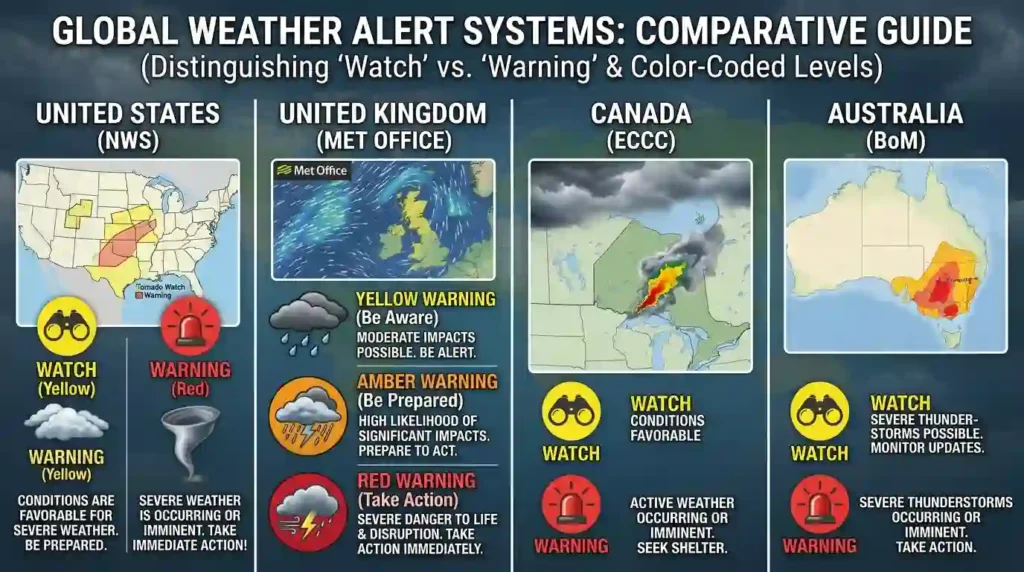
The spelling matches. The system does not. Here is how each region uses the words.
| Region | Main Alert Words | How It Works |
| United States | Watch, Warning, Advisory | Watch = possible. Warning = happening or soon. Advisory = less serious. |
| Canada | Watch, Warning, Statement | Similar to the US. A watch is “possible.” A warning is “happening or soon.” |
| United Kingdom | Warning (Yellow, Amber, Red) | The Met Office uses colored warnings. Red is the most serious. “Watch” is not the main term. |
| Australia | Warning, Watch and Act, Emergency Warning | Fire alerts use levels. “Watch and Act” means danger is rising. |
Key point: In the UK, you will hear “weather warning” more than “weather watch.” Colors show how bad it is. In the US, the word you hear tells you the stage.
Which Spelling (and Term) Should You Use?
Since spelling is the same, think about your audience and context.
Writing for the US: Use “watch” for “possible” and “warning” for “happening.” Add “advisory” for minor events.
Writing for the UK or Commonwealth: Use “warning” with the color level, such as “amber warning.” Only use “watch” if you mean “to look at” or a timepiece.
Writing for a global audience: Explain each term in one short sentence. Do not assume readers know the US system. For example: “A watch means danger is possible. A warning means danger is here.”
Pro tip: Always follow your local weather agency’s words. They are the official source.
Common Mistakes with Watch or Warning
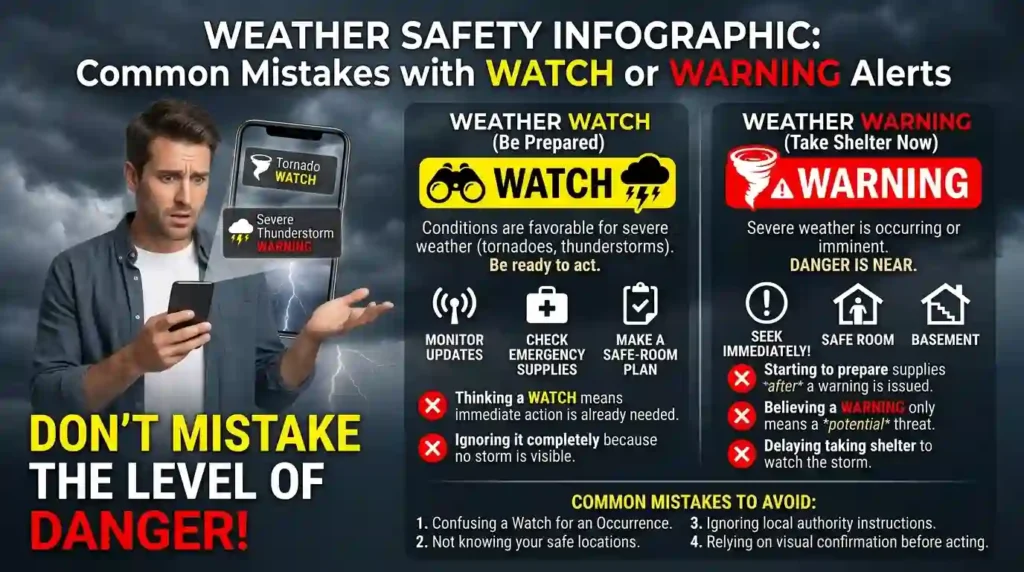
Mistake 1: Thinking a watch is a small warning.
A watch is not “less of a warning.” It is an earlier stage. Use it to prepare.
Mistake 2: Ignoring a watch.
A watch can turn into a warning fast. Make a plan early.
Mistake 3: Waiting for more proof during a warning.
A warning is the proof. Act right away.
Mistake 4: Mixing up “warning” and “advisory.”
An advisory is a lower level. It still matters, but it is less serious.
Mistake 5: Using “watch” and “warning” as the same word in writing.
Wrong: “A tornado watch is in effect, so take shelter now.”
Right: “A tornado warning is in effect, so take shelter now.”
Mistake 6: Assuming UK and US systems match.
A “yellow warning” in the UK is not the same as a US “watch.”
Watch or Warning in Everyday Examples

In an email to your team:
“A winter storm watch is in effect for Friday. Please prepare to work from home.”
In a news headline:
“Tornado warning issued for three counties. Residents told to take cover.”
On social media:
“Hurricane watch just posted for our coast. Time to stock up on water and batteries!”
In formal writing:
“The agency issues a flood warning when flooding is occurring or expected shortly.”
In a text to family:
“Heat warning today. Stay inside and drink water.”
Notice how the word changes the message. A watch gives you time. A warning asks you to move.
Watch or Warning Google Trends and Usage Patterns
I can’t show live numbers here. To see current data, open Google Trends and search “watch or warning” or “watch vs warning.” Here is what you will usually find:
- Spikes during storm seasons. Interest rises during hurricane season, tornado season, and big winter storms.
- Strong interest in the United States. The watch/warning system is most common there, so people search more.
- Interest in Canada too. Canada uses a similar system.
- Less use in the UK. Brits search for “weather warning” and color levels more often.
- Mobile searches rise during events. People look it up the moment an alert hits their phone.
Tip for writers: Publish this kind of content before storm season. Update it every year.
Comparison Table Watch vs Warning vs Advisory
| Term | Meaning | Risk Level | What You Should Do | Example |
| Watch | Danger is possible | Medium | Get ready. Make a plan. | Tornado watch |
| Warning | Danger is happening or very close | High | Act now. Take shelter or leave. | Flash flood warning |
| Advisory | Trouble is expected but less severe | Lower | Be careful. Adjust plans. | Wind advisory |
FAQs
What is the main difference between a watch and a warning?
A watch means danger is possible. A warning means danger is happening or will happen soon.
Which is more serious, a watch or a warning?
A warning is more serious. It means act now.
Can a watch turn into a warning?
Yes. If the danger shows up, the agency upgrades the watch to a warning.
What should I do during a watch?
Stay alert. Check your supplies. Know your safe place. Keep your phone charged.
What should I do during a warning?
Follow official advice right away. Go to shelter or leave the area if told to.
Is “advisory” the same as a “watch”?
No. An advisory is for less severe events. A watch is about a possible serious threat.
Does the UK use watches?
Not as a main weather term. The UK uses yellow, amber, and red warnings.
Is there a spelling difference between US and UK English for these words?
No. Both words are spelled the same everywhere.
Conclusion
Here is what to remember. A watch means “danger is possible.” Get ready. A warning means “danger is here or close.” Act now.
The words are spelled the same in every English-speaking country. What changes is how each country uses them. The US and Canada use watch, warning, and advisory. The UK uses colored warnings. Australia uses its own action levels.
Avoid the common mistakes. Do not treat a watch like a small warning. Do not ignore it, either. A watch is your time to prepare. A warning is your time to move.
If you write about weather, keep your words clear and short. Explain each term in one line. Match your words to your audience and local agency.
When in doubt, trust your official weather service. Turn on alerts on your phone. Make a simple plan before storm season starts.
A few minutes of planning today can protect you and your family when the sky turns dark. Now you know the difference between a watch and a warning. Share it with someone who needs it.

I’m Raheela Rani, a professional content writer and author with 3 years of experience in writing, editing, and storytelling. Through VisitLivo.com, I create clear, engaging, and well-crafted content that helps readers learn, connect, and communicate with confidence.