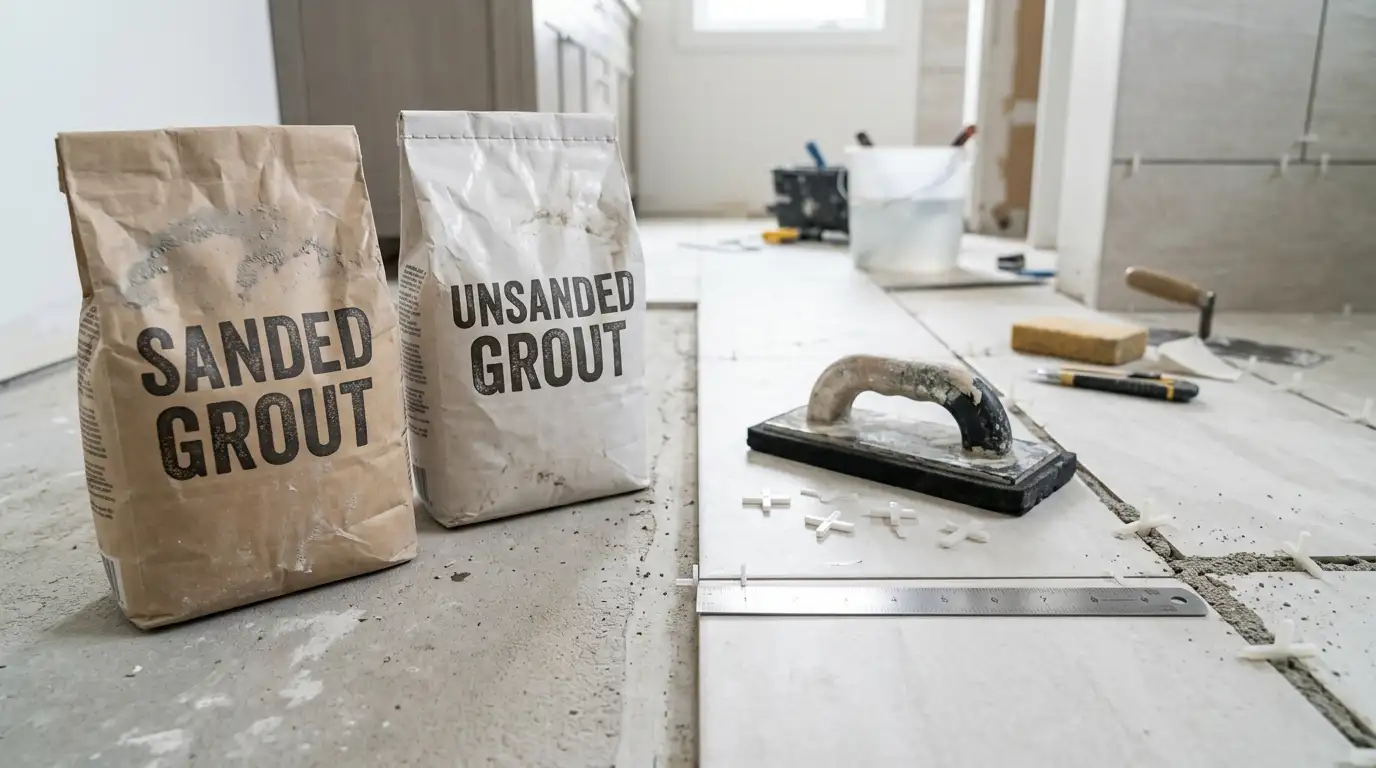
You stand in the tile aisle. Two bags of grout look almost the same. One says sanded. The other says unsanded. Which one do you buy?
People search “sanded or unsanded grout” to avoid a costly mistake. Grout fills the gaps between tiles. Pick the wrong type and it can crack, sink, or scratch your tile. That is a lot of work to redo.
The words can confuse people too. Does “non-sanded” mean the same thing? Do UK and US shops use different words? Does the sand really matter?
Here is the good news. The choice is simple. It mostly depends on one thing: how wide your grout lines are.
This guide gives you a quick answer first. Then it explains where the words come from, how they differ by country, common mistakes, and real examples. You will also find comparison tables and a FAQ. By the end, you will know which grout to buy and why.
Sanded or Unsanded Grout Quick Answer
Use sanded grout for wide joints. Use it when the gap is wider than 1/8 inch (3 mm). The sand makes the grout strong and helps stop cracks.
Use unsanded grout for narrow joints. Use it when the gap is 1/8 inch (3 mm) or smaller. It is smooth and packs tightly into thin lines.
Here are some examples:
- Kitchen floor tile with 3/16 inch gaps: sanded grout
- Glass mosaic backsplash with thin gaps: unsanded grout
- Polished marble wall: unsanded grout (sand can scratch it)
- Wide-gap stone patio or floor: sanded grout
- Vertical shower wall with very small gaps: unsanded grout
Always read the grout label too. The maker’s advice comes first.
The Origin of Sanded and Unsanded Grout
The word grout is old. It comes from the Old English word grūt, which meant coarse meal. It is related to the word grits. In Middle English it became grout. Over time, the word came to mean a thin, runny mortar.
Why add sand? Builders have used sand in mortar for thousands of years. Sand is a cheap filler. It adds bulk and strength. It also helps reduce shrinking as the mix dries.
Modern tile grout follows the same idea. Sanded grout has fine sand mixed in. Unsanded grout has none. The word unsanded is simple. It is un- (not) plus sanded (with sand added). So it means “without sand.”
Why do the words vary? Brands and stores pick their own labels. Stores use different labels. You may see “unsanded,” “non-sanded,” or a joint-width name like “narrow joint.” That is where the spelling and wording confusion starts.
British English vs American English Spelling
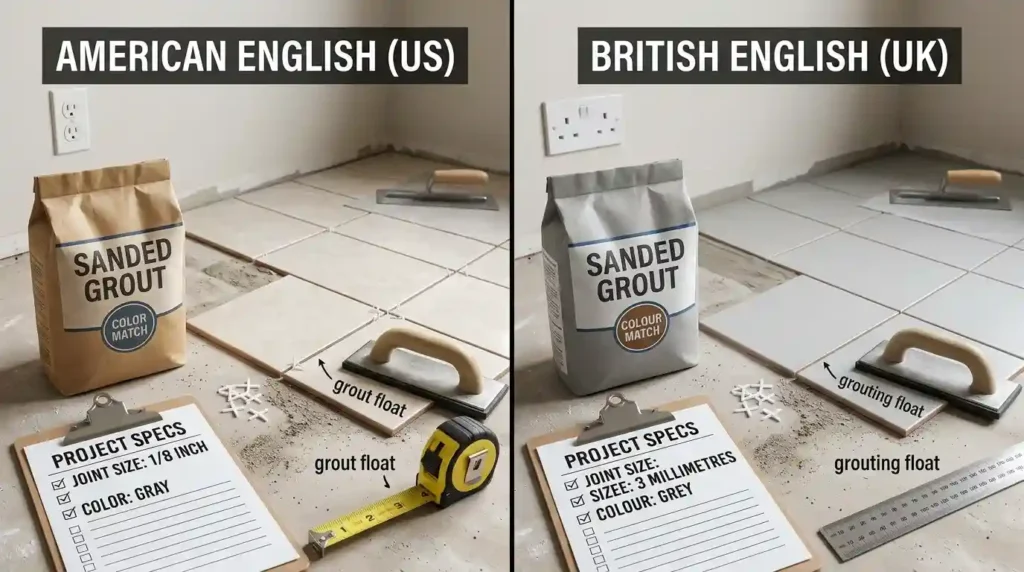
Good news: grout, sanded, and unsanded are spelled the same in the US and UK. The differences show up in the words around them.
| Term | American English | British English |
| Main term | sanded / unsanded grout | sanded / unsanded grout (also described by joint width) |
| Alternate label | non-sanded grout | non-sanded grout (less common on labels) |
| Colour word | color | colour |
| Grey word | gray | grey |
| Joint size | inches (1/8 in) | millimetres (3 mm) |
| Length word | meter | metre |
| Common label style | “Sanded” or “Unsanded” | Often “wide joint” or “narrow joint” |
Example: “Choose a gray sanded grout” (US) and “Choose a grey sanded grout” (UK). Only the colour word changes.
Which Spelling Should You Use?
Writing for a US audience: Use “sanded or unsanded grout.” Use “non-sanded” only as a second term. Use inches, then add millimetres in brackets.
Writing for a UK or Commonwealth audience: Use the same grout words. Switch to colour and grey. Use millimetres first. Mention “wide joint” and “narrow joint” grout, since many shops use those labels.
Writing for a global audience: Use “unsanded grout” as your main term. Say once that it is also called “non-sanded.” Show both measurements, like “3 mm (1/8 inch).” Then stay consistent. Do not switch terms halfway through.
Common Mistakes with Sanded or Unsanded Grout
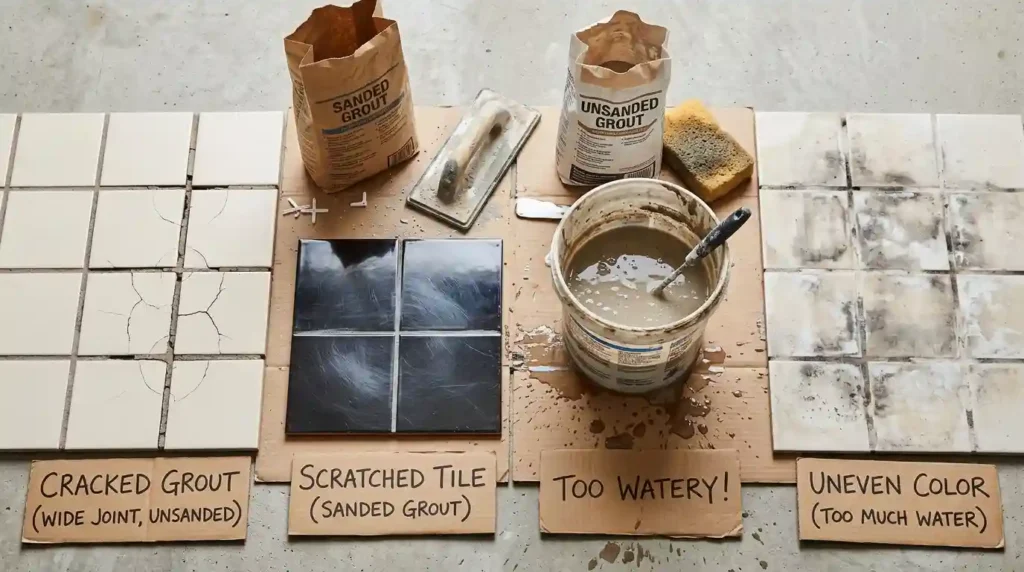
- Using unsanded grout in wide joints. It shrinks and cracks. Fix: Use sanded grout for gaps wider than 1/8 inch (3 mm).
- Using sanded grout on soft or shiny tile. Sand can leave scratches on polished marble, glass, and metal. Fix: Use unsanded grout, and test a small spot first.
- Forcing sanded grout into thin gaps. It will not pack in well. Fix: Switch to unsanded grout.
- Thinking “sanded” always means stronger. Sand helps in wide gaps. It does not help in tiny ones. Fix: Match the grout to the gap.
- Adding too much water. Weak, wet grout cracks and fades. Fix: Mix to a thick paste, like peanut butter.
- Skipping the sealer. Cement-based grout soaks up water and stains. Fix: Seal it after it cures.
- Mixing batches unevenly. Colors can look patchy. Fix: Mix enough in one go for each area.
- Writing “un-sanded” with a hyphen. The standard spelling is “unsanded.” Fix: Drop the hyphen.
Sanded or Unsanded Grout in Everyday Examples

In an email to a contractor:
“Please use sanded grout for the bathroom floor. The gaps are 4 mm. Use unsanded grout on the glass wall tile.”
In a news or DIY article:
“Experts say joint width decides the grout. Wide gaps need sanded grout. Thin gaps need unsanded.”
On social media:
“Just finished my backsplash! Went with unsanded grout so my glass tile stayed scratch-free. #DIY #tilework”
In a forum question:
“Sanded or unsanded grout for 1/8 inch joints? Both seem to work. Which is better?”
In formal writing, such as a project spec:
“Install sanded cement grout in floor joints wider than 3 mm. Install unsanded grout in joints of 3 mm or less.”
Sanded or Unsanded Grout Google Trends & Usage Data
I can’t pull live Google Trends numbers here, so I won’t invent any. You can check them for free at trends.google.com. Here is what you can usually expect to see.
By season: Interest tends to rise in spring and summer. That is peak home renovation time in the northern hemisphere.
By country: Interest tends to be strongest in the United States, where “sanded or unsanded” is the standard label. Canada, the UK, and Australia also show steady searches. In the UK, searches often mix in words like “wide joint” or “floor grout.”
By context: Most searchers want a quick DIY answer. Many ask about bathrooms, showers, and kitchen floors. Others ask about specific tile types, like marble, glass, or porcelain.
Tip: Compare “sanded grout,” “unsanded grout,” and “non-sanded grout” in Google Trends. You will see which term people in your country use most.
Keyword Variations Side by Side
| Term | Meaning | Best Joint Width | Best For |
| Sanded grout | Grout with fine sand added | Over 1/8 inch (3 mm) | Floors, wide gaps, stone |
| Unsanded grout | Smooth grout, no sand | 1/8 inch (3 mm) or less | Walls, glass, polished tile |
| Non-sanded grout | Another name for unsanded | 1/8 inch (3 mm) or less | Same as unsanded |
| Wide joint grout | Common UK-style label for sanded type | Wider gaps | Floors, large gaps |
| Narrow joint grout | Common UK-style label for unsanded type | Thin gaps | Walls, small gaps |
FAQs
What is the main difference between sanded and unsanded grout?
Sanded grout has fine sand in it. Unsanded grout does not. Sand adds strength and cuts down on cracks in wide gaps.
Can I use sanded grout on wall tile?
Yes, if the gaps are wide. For thin gaps on walls, unsanded grout is usually easier to work with. It also sticks better to vertical surfaces.
Will sanded grout scratch my tile?
It can scratch soft or polished tile like marble, glass, and metal. Test a small spot first. Or use unsanded grout.
Is “non-sanded” the same as “unsanded”?
Yes. Both mean grout with no sand. Both terms are used.
What width should I use for each type?
Use unsanded for gaps of 1/8 inch (3 mm) or less. Use sanded for anything wider.
Do I need to seal sanded or unsanded grout?
Cement-based grout of either type should be sealed. This helps stop stains and water damage. Epoxy grout usually does not need sealing.
Which one is stronger?
Sanded grout is stronger in wide gaps. Unsanded grout is the better fit in narrow gaps. “Stronger” depends on the right match.
Is the spelling different in the UK and US?
No. The grout words are the same. Only nearby words change, like color/colour and gray/grey.
Conclusion
Let’s wrap it up. The choice between sanded and unsanded grout is simple. Look at your grout lines.
If the gaps are wider than 1/8 inch (3 mm), pick sanded grout. The sand gives it strength and helps stop cracks.
If the gaps are 1/8 inch (3 mm) or smaller, pick unsanded grout. It packs in smoothly and sticks well on walls.
Use unsanded grout on soft or shiny tile, like polished marble and glass. Sand can scratch them. Always test a small spot first.
The spelling is the same in American and British English. Only words like color/colour and gray/grey change. For a global audience, write “unsanded grout,” mention “non-sanded” once, and show both inches and millimetres.
Avoid the common mistakes. Match the grout to your gap size. Mix it with just enough water. Seal it once it cures. Follow the label on your grout bag.
Do these things, and your tile will look great for years.

I’m Raheela Rani, a professional content writer and author with 3 years of experience in writing, editing, and storytelling. Through VisitLivo.com, I create clear, engaging, and well-crafted content that helps readers learn, connect, and communicate with confidence.