
You are writing a news story. A man stood in court. He said he was guilty. Now you need the past tense of “plead.” Do you write “pleaded” or “pled”? Your fingers stop over the keyboard. You open a new tab and search.
You are not alone. Many people search this question every month. Writers, students, lawyers, and reporters all get stuck on it. Both words look right. Both sound right. Yet they are not used the same way everywhere.
The confusion comes from how English works. Most verbs add “-ed” in the past tense. Some verbs change in other ways, like “lead” and “led.” “Plead” sits between these two groups, so two forms grew up side by side.
This article gives you the answer fast. Then it explains why. You will see the word’s history, the US and UK differences, common mistakes, real examples, and a simple rule you can trust. By the end, you will know which word to use and when.
Pleaded or Pled Quick Answer
Both are correct. “Pleaded” is the safer choice.
“Pleaded” is the standard past tense of “plead.” It works in every country and every style of writing. “Pled” is a shorter form. It is mostly American, and you often see it in legal and news writing.
Examples:
- He pleaded guilty to the charge.
- He pled guilty to the charge.
- She pleaded with her boss for more time.
- The company pleaded ignorance.
All four sentences are correct. If you are unsure, use “pleaded.”
The Origin of Pleaded and Pled

“Plead” came into English from Old French. The French word was plaidier, which meant to bring a case in court. It goes back to a Latin word meaning “to please” or “to seem good.” A “plea” was once a decision or an argument made before a judge.
At first, English gave “plead” a regular past tense: “pleaded.” That is the “-ed” ending most verbs use.
Later, some speakers began to shorten it. English already had verbs like “lead/led,” “feed/fed,” and “flee/fled.” People saw the pattern and made “plead/pled.” This form appeared in Scots English and in dialects, and it spread into American English.
That is why the spelling differs today. Neither form is a mistake. They come from two habits of speech. One follows the regular “-ed” rule. The other follows the “lead/led” pattern.
British English vs American English Spelling

British English almost always uses “pleaded.” American English uses both, with “pled” more common in law and news.
| Feature | British English | American English |
| Standard past tense | pleaded | pleaded |
| Short form | rare | pled |
| Legal writing | pleaded guilty | pled guilty or pleaded guilty |
| News writing | pleaded | both are used |
| Formal writing | pleaded | pleaded (safer) |
| Everyday speech | pleaded | pled is common |
Some US style guides prefer “pleaded” and some accept “pled.” Check your own guide if you write for a publication.
Which Spelling Should You Use?
Writing for a US audience: Both are fine. Use “pleaded” for formal work. Use “pled” if your style guide or field allows it, as many US courts and papers do.
Writing for a UK or Commonwealth audience: Use “pleaded.” Readers in the UK, Australia, Canada, and India may see “pled” as odd.
Writing for a global audience: Use “pleaded.” Everyone knows it. Nobody will question it.
One more tip: Stay consistent. If you write “pled” in the first paragraph, do not switch to “pleaded” in the third.
Common Mistakes with Pleaded and Pled
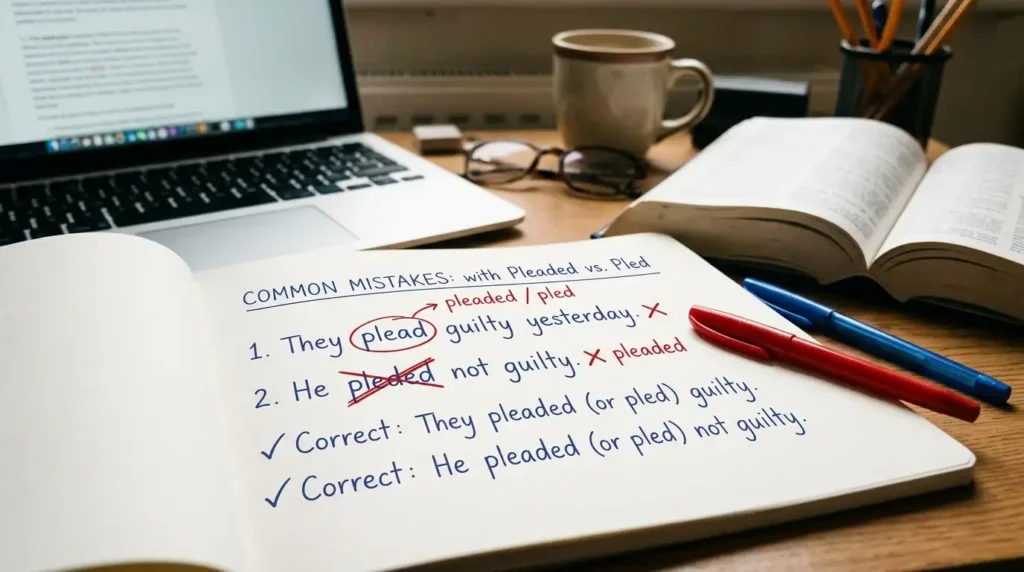
Using “plead” as the past tense.
- Wrong: He plead guilty yesterday.
- Right: He pleaded guilty yesterday.
Writing “pleed.”
- Wrong: She pleed for mercy.
- Right: She pleaded for mercy.
Mixing both forms in one text.
- Wrong: He pled guilty, and she pleaded guilty.
- Right: Pick one and keep it.
Adding an apostrophe.
- Wrong: He pled’.
- Right: He pled.
Pleaded and Pled in Everyday Examples

- I pleaded with the vendor to extend the deadline.
- She pleaded for a few more days to finish the report.
News
- The mayor pleaded not guilty to all charges.
- The driver pled guilty and paid a fine.
Social media
- I pleaded with my cat to get off the keyboard. He did not.
- We all pled for one more episode.
Formal or legal writing
- The defendant pleaded guilty to a lesser charge.
- The applicant pleaded hardship in her appeal.
Pleaded or Pled Google Trends and Usage Data
I can’t pull live Google Trends numbers here, so I won’t quote exact figures. The general pattern is well known, and you can check it yourself at trends.google.com.
- Overall: “Pleaded” is used more than “pled” in books, articles, and formal writing.
- United States: This is where “pled” is strongest, especially in court news and legal phrases like “pled guilty.”
- United Kingdom, Australia, Canada, India: “Pleaded” dominates. “Pled” is rare.
- Context: Searches for “pled” often rise after major trials and court cases, when people write about pleas.
To confirm current numbers, search “pleaded” and “pled” as two terms in Google Trends. Then compare by country and by time range.
Comparison Table: Keyword Variations Side by Side
| Form | Correct? | Where it is used | Example |
| pleaded | Yes | Worldwide, all styles | She pleaded for help. |
| pled | Yes | Mostly US | He pled guilty. |
| plead | Yes (present tense only) | Everywhere | They plead not guilty today. |
| plead (as past tense) | No | Nowhere in standard English | He plead guilty. |
| pleading | Yes | Everywhere | She is pleading with him. |
| pleads | Yes | Everywhere | He pleads innocent. |
| pleed | No | Nowhere | She pleed for mercy. |
FAQs
Is “pled” a real word?
Yes. It is a valid past tense of “plead,” mostly in American English.
Is “pleaded” more correct than “pled”?
Not more correct, but more universal. “Pleaded” works in every country and style.
Which one do lawyers use?
US lawyers and courts often use “pled.” Many also use “pleaded.” UK lawyers use “pleaded.”
Can I say “he plead guilty”?
No. “Plead” is the present tense. Use “pleaded” or “pled” for the past.
Is “pled” used in the UK?
Rarely. Most UK readers expect “pleaded.”
What is the past participle of “plead”?
It is the same as the past tense: “pleaded” or “pled.” Example: “She has pleaded” or “She has pled.”
Which should I use in an essay or school paper?
Use “pleaded.” It is safe with any teacher or style guide.
Conclusion
The question of “pleaded or pled” has a simple answer. Both are correct. They are two accepted past tenses of “plead.”
“Pleaded” is the standard form. It follows the normal “-ed” rule. It works in the US, the UK, and everywhere else. If you are ever unsure, choose it.
“Pled” is a shorter form. It grew from the same pattern as “led” and “fled.” You will see it mostly in American writing, especially in court news and legal phrases.
Remember these key points:
- Never use “plead” as the past tense.
- Do not write “pleed.”
- Match your audience. Use “pleaded” for UK and global readers.
- Stay consistent inside one document.
- Follow your style guide if you have one.
Now you can write with confidence. The next time a man stands in court and admits his guilt, you will know just what to type. When in doubt, he pleaded.

I’m Raheela Rani, a professional content writer and author with 3 years of experience in writing, editing, and storytelling. Through VisitLivo.com, I create clear, engaging, and well-crafted content that helps readers learn, connect, and communicate with confidence.