
You typed a sentence. Then you paused. Is it “input” or “imput”? Your fingers moved fast, but your brain wasn’t sure. This happens to many people every day.
The confusion is real. English has tricky spelling rules. Some words change between British and American English. Others just look odd when you type them fast. “Input” and “imput” fall into different camps than most people think.
Here’s the short truth: only one of these words is correct. The other is a common typo. This mix-up trips up writers, students, and even professionals in emails and reports.
In this guide, you’ll get a clear answer fast. You’ll also learn why this confusion happens, how to avoid the mistake, and how native speakers use the correct word in real life. By the end, you’ll never second-guess this word again.
Let’s clear it up.
Input or Imput Quick Answer
“Input” is correct. “Imput” is not a real word.
“Input” means information, data, or ideas put into a system, process, or discussion.
Correct examples:
- Please give me your input on this plan.
- The computer needs input from the user.
- Her input helped fix the report.
Incorrect:
- ~~Please give me your imput on this plan.~~
“Imput” is simply a misspelling.It’s not a British variant. It’s not an informal version. It’s simply a typo. Two things cause it: the “m” and “n” keys sit next to each other, so fingers slip. And “imp-” looks like a normal English prefix, the same one found in words like “import” and “impute,” so the misspelling feels oddly natural even though it’s wrong.
The Origin of Input

“Input” is a compound word. It joins two simple English words:
- In – meaning “into” or “inside”
- Put – meaning “to place”
Together, “input” means “to place into.” The word entered common use in the early 20th century, mostly in economics and engineering. People used it to describe resources or energy fed into a system.
When computers became common in the 1950s and 1960s, “input” took on its modern meaning: data entered into a machine. This use stuck. Today, “input” appears everywhere, from tech manuals to casual conversation.
So why does “imput” show up so often? Two reasons stand out:
- Typing speed. The letters “n” and “m” are close together on a keyboard, so swaps happen fast.
- Word confusion. English has real words like “impute” (to assign blame or a quality to someone). This may cause people to guess “imput” is a shortened form. It isn’t.
There is no historical root, dictionary entry, or accepted use for “imput.” It has never been a standard spelling in any form of English.
British English vs American English Spelling

Many word pairs do differ between British and American English. Words like “colour/color” or “organise/organize” follow real spelling rules. “Input,” however, is not one of these cases.
Both British and American English use the exact same spelling: input. There is no regional variant. “Imput” is not used in any English-speaking country as a standard word.
Here’s a comparison table showing real UK/US differences next to this word, for context:
| Word | British English | American English | Notes |
| Colour | colour | color | Real spelling difference |
| Organise | organise | organize | Real spelling difference |
| Input | input | input | No difference same in both |
| Imput | Not a word | Not a word | Incorrect in both regions |
The takeaway: “input” is a global standard word. It doesn’t change based on where you live.
Which Spelling Should You Use?
This one is simple, no matter your audience.
- United States: Use “input.” Always.
- United Kingdom and Commonwealth countries (Canada, Australia, India, etc.): Use “input.” Always.
- Global or international writing: Use “input.” It’s the only correct choice.
There is no context formal, informal, academic, or casual where “imput” is acceptable. Spell checkers, style guides, and dictionaries (Oxford, Merriam-Webster, Cambridge) all confirm this.
If you’re writing for any audience, in any English dialect, “input” is your safe and correct choice.
Common Mistakes with Input
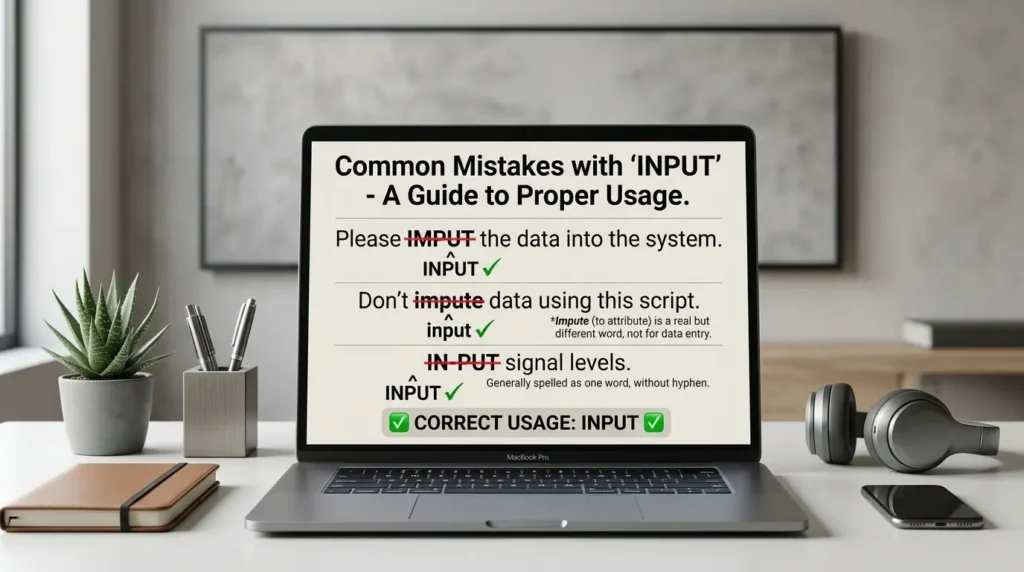
Here are the errors people make most, and how to fix them.
Mistake 1: Typing “imput” instead of “input”
This is the most common slip. It happens fast, often without notice.
- Wrong: Please send your imput by Friday.
- Right: Please send your input by Friday.
Mistake 2: Mixing up “input” and “impute”
These words look similar but mean different things. “Impute” means to credit or blame something to someone.
- Wrong: I need your impute on this design.
- Right: I need your input on this design.
Mistake 3: Misusing “input” as a verb
“Input” works as a verb too, but the form must match the sentence.
- Correct: Please input the data into the form.
- Also correct (noun form): Your input was helpful.
Mistake 4: Trusting autocorrect too much
Some spell checkers miss “imput” because it resembles other real words nearby. Never skip a final read-through.
Mistake 5: Adding an unnecessary hyphen
Some writers split the word by habit, especially when typing fast.
- Wrong: in-put
- Right: input
Input in Everyday Examples
In emails:
“Thanks for your input on the proposal. I’ve made the changes you suggested.”
In news writing:
“Economists say consumer input plays a key role in shaping monetary policy.”
In social media:
“Would love some input from you all which logo do you like best? 👇”
In formal writing:
“The committee welcomes public input before finalizing the policy draft.”
In tech contexts:
“The system requires valid input before processing the request.”
Across all these settings, the spelling stays the same: input.
Input Google Trends & Usage Data
Search data shows “input” is one of the most searched words in English, especially in tech, education, and business contexts. Interest spikes around:
- Software and app tutorials (“data input,” “input field”)
- Academic and workplace settings (“your input is valued”)
- Form design and UX writing (“input error,” “input validation”)
Searches for “imput” also happen often but not because it’s a real word. These searches usually come from people trying to confirm the correct spelling, much like you may be doing now. This pattern is common with near-typos: high search volume, but the intent is always to find the correct form.
Interest in “input” holds steady across the US, UK, India, Canada, and Australia, confirming its status as a universal English word.
Comparison Table: Keyword Variations
| Spelling | Correct? | Used In | Notes |
| Input | ✅ Yes | US, UK, global | Standard spelling everywhere |
| Imput | ❌ No | Nowhere | Common typo |
| Impute | ✅ Yes (different word) | US, UK, global | Means to assign blame/credit |
| In-put | ❌ No | Nowhere | Incorrect hyphenation |
FAQs
Is “imput” a real word?
No. “Imput” is not found in any English dictionary. It’s a common misspelling of “input.”
Why do people write “imput” instead of “input”?
Mainly due to typing speed and the letters “m” and “n” being close on the keyboard. Confusion with the word “impute” also plays a role.
Is “input” spelled differently in British English?
No. “Input” is spelled the same in British and American English.
Can “input” be used as a verb?
Yes. For example: “Please input your details into the form.”
What’s the difference between “input” and “impute”?
“Input” means data or ideas given to a system or process. “Impute” means to assign a quality, blame, or value to someone or something.
Does spell check catch “imput”?
Most spell checkers do catch it, but not all autocorrect tools flag it consistently. Always double-check.
Is “input” only used in tech contexts?
No. It’s used in business, education, everyday conversation, and writing, not just technology.
Conclusion
The answer is clear: “input” is correct, and “imput” is not a real word. This isn’t a British versus American spelling issue it’s simply a common typing mistake caused by keyboard layout and confusion with similar words like “impute.”
“Input” comes from two simple English words, “in” and “put,” and it has been part of the language for over a century. Today, it appears in emails, news articles, social media, and everyday conversation, always with the same spelling, no matter where you are in the world.
If you remember one rule, remember this: if you’re writing for a US audience, a UK audience, or a global one, “input” is always the correct choice. There’s no acceptable variant.
Use spell check, slow down when typing fast, and keep an eye out for the “m” and “n” swap. With this guide, you now have a clear, simple answer you can rely on every time you write.

“I’m Ibadat Fatima, a professional content writer and author with 3 years of experience in writing, editing, and storytelling. I share my work through visitlivo.com, where I help readers connect with clear, engaging, and well-crafted content.”