
You’re writing an email. You want to say “the second option,” but your fingers type “ladder” instead of “latter.” Autocorrect doesn’t catch it. Spell check doesn’t catch it. And now your sentence makes no sense.
This mix-up happens all the time. “Latter” and “ladder” look similar on the page. They sound almost the same when spoken fast, especially in American English. So people search “latter or ladder” hoping for a fast, clear answer.
Here’s the short version: a ladder is something you climb. The word latter means “the second of two things mentioned.” They have nothing to do with each other in meaning. The confusion is purely about spelling and sound, not definition.
This article gives you the quick answer, the word history, the pronunciation trap that causes most mistakes, and real examples so you never mix them up again.
Latter or Ladder Quick Answer
Here’s the difference in one line each:
- Ladder = a tool with rungs, used for climbing. “He climbed the ladder to fix the roof.”
- Latter = refers to the second of two items just mentioned. “Between coffee and tea, I prefer the latter.”
Quick memory trick: Ladder has two D’s, like the two side rails you climb. Latter has two T’s, and it always points to the second thing in a pair.
The Origin of Latter and Ladder
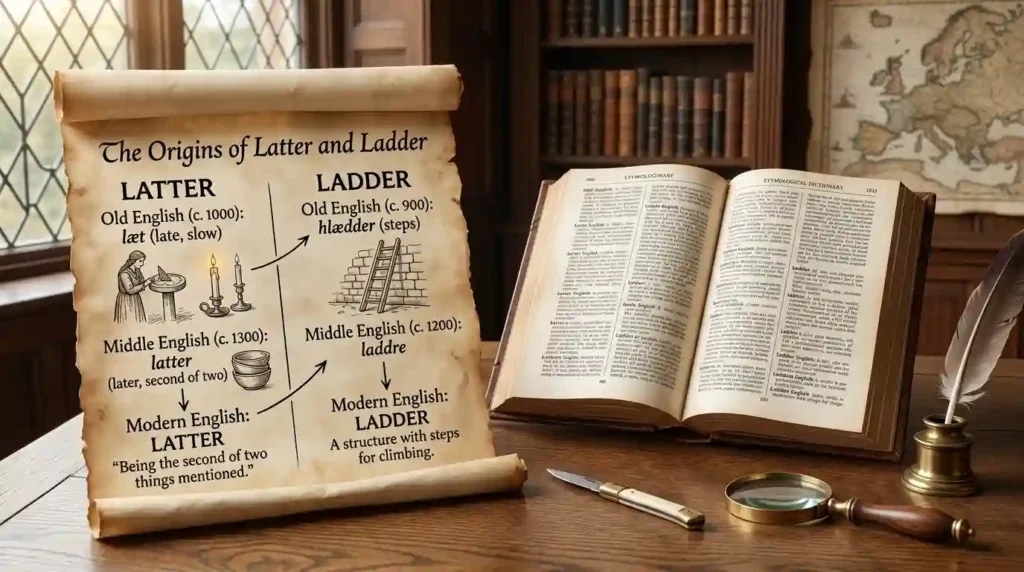
Both words come from Old English, but they have separate roots and separate meanings.
Ladder comes from the Old English word hlæder, meaning a climbing frame with rungs. It’s related to old Germanic words for “leaning” or “framework,” since early ladders were built by leaning wood against a wall.
Latter comes from Old English lætra, a comparative form of læt, meaning “late.” Originally it meant “more late” or “coming after.” Over time, English speakers narrowed it to mean “the second of two things,” since the second item always comes after the first.
So the words split off from completely different Old English roots. They only became confusing centuries later, once pronunciation shifted.
Why Latter and Ladder Sound Alike (Pronunciation, Not Spelling)
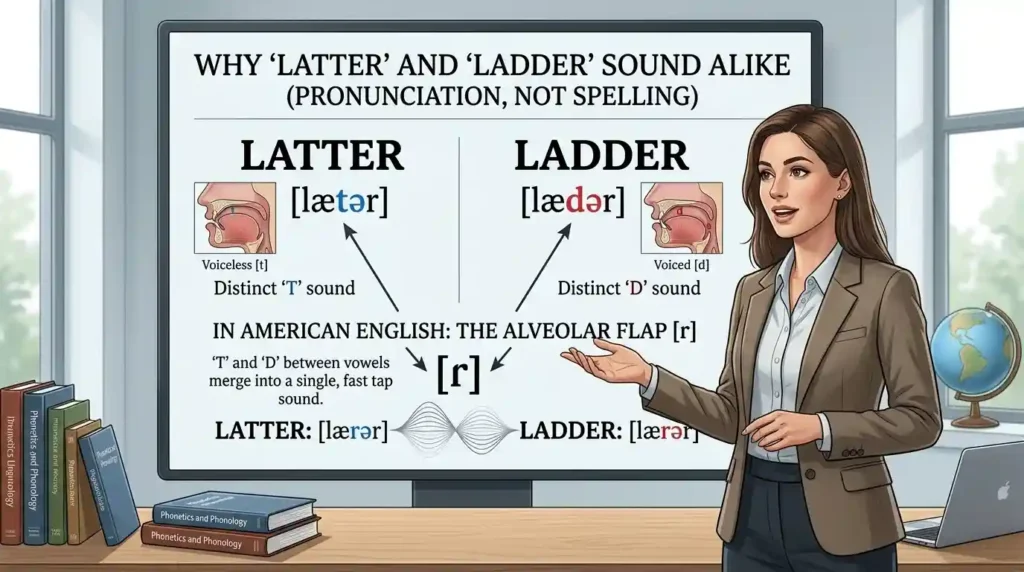
This is the real source of confusion, and it’s not about British versus American spelling it’s about how Americans pronounce the letter T.
In American English, when a T sits between two vowels in a word, speakers often turn it into a soft “d” sound. This is called flapping. It happens in words like water, butter, and matter.
That means:
- Latter gets pronounced close to “ladder.”
- The two words can sound nearly identical in fast, casual American speech.
British English speakers pronounce the T in “latter” more crisply, so the two words sound more distinct in the UK.
| Feature | American English | British English |
| “Latter” pronunciation | Sounds close to “ladder” (flapped T) | Clear T sound, more distinct from “ladder” |
| “Ladder” pronunciation | Standard D sound | Standard D sound |
| Spelling of either word | Same in both dialects | Same in both dialects |
| Main confusion type | Sound-alike (homophone-like) | Less common, due to clearer T |
Both words are spelled the same way everywhere. There’s no US-vs-UK spelling split here, unlike “colour/color” or “organise/organize.” The confusion is purely about how “latter” sounds when spoken.
Which Word Should You Use?
This isn’t about choosing a dialect. It’s about choosing the right word for your meaning.
Use “latter” when:
- You’re referring to the second of two items you just named.
- You’re writing formally, in essays, reports, or professional emails.
- Example: “You can pay by card or cash. I recommend the latter.”
Use “ladder” when:
- You mean the physical climbing tool.
- You’re using it in an idiom, like “career ladder” or “climb the social ladder.”
- Example: “She’s climbing the corporate ladder fast.”
If you’re ever unsure, ask: “Am I comparing two things, or am I talking about climbing something?” That answers it instantly.
Common Mistakes with Latter and Ladder
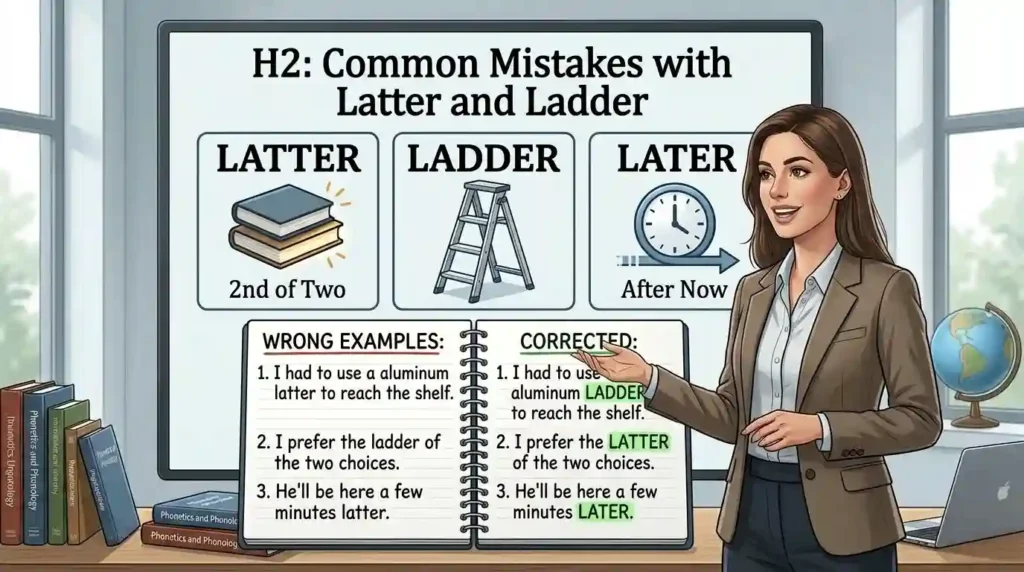
Mistake 1: Writing “ladder” when you mean the second item in a list.
❌ “I chose the ladder option.”
✅ “I chose the latter option.”
Mistake 2: Using “latter” for more than two items.
❌ “Of the three plans, I picked the latter.”
✅ “Of the three plans, I picked the last one.” (“Latter” only works for exactly two items.)
Mistake 3: Confusing “latter” with “later.”
❌ “See you the latter.”
✅ “See you later.” (Different word entirely “later” means “after now.”)
Mistake 4: Typing “ladder” on autopilot because it’s the more common word.
✅ Slow down and check your meaning before hitting send.
Latter and Ladder in Everyday Examples
In emails:
“We can meet Tuesday or Thursday. I’d prefer the latter.”
In news writing:
“The two candidates disagree on tax policy. The latter supports a flat tax rate.”
On social media:
“Save money or spend it now? I always choose the latter lol”
In formal writing:
“The report compares urban and rural income levels. The latter shows slower growth.”
Using “ladder” correctly:
“He set up the ladder to paint the ceiling.”
“She’s near the top of the career ladder.”
Latter or Ladder Google Trends & Usage Data
Search interest in “latter vs ladder” spikes mainly in the United States, which matches the pronunciation explanation above American speakers hear the words as near-homophones far more often than British or Australian speakers do.
Common search patterns include:
- “Latter or ladder in a sentence”
- “Latter vs ladder meaning”
- “Is it latter or ladder”
Usage in writing shows a clear pattern too. “Ladder” appears more often overall, since it’s used in idioms like “career ladder,” “ladder of success,” and literal descriptions of climbing tools. “Latter” appears more in formal, academic, and news writing, where comparing two options is common.
Comparison Table: Keyword Variations
| Term | Meaning | Word Type | Common Context |
| Latter | The second of two things mentioned | Adjective/pronoun | Formal writing, comparisons |
| Ladder | A climbing tool with rungs | Noun | Physical objects, idioms |
| Later | Happening after the present time | Adverb/adjective | Time references |
| Latte | A coffee drink with steamed milk | Noun | Coffee shops, menus |
FAQs
Is “latter” the same as “ladder”?
No. “Latter” refers to the second of two items. “Ladder” is a climbing tool. They only sound similar in casual American speech.
Why do “latter” and “ladder” sound the same?
American English often turns the T sound between vowels into a soft D sound, a feature called flapping. This makes “latter” sound close to “ladder.”
Can I use “latter” for three or more items?
No. “Latter” only works when you’re comparing exactly two things. For three or more, use “last” or “final.”
What’s the opposite of “latter”?
“Former.” Use “former” for the first item and “latter” for the second. Example: “Of tea and coffee, I like the former; my sister likes the latter.”
Is “latter” formal or informal?
“Latter” leans formal. It’s common in essays, reports, and news writing. In casual speech, people often just repeat the noun instead.
Is there a British vs American spelling difference for “latter” or “ladder”?
No. Both words are spelled the same in British and American English. The only difference is pronunciation.
What’s a simple trick to remember the difference?
“Ladder” has two D’s, like its two side rails. “Latter” has two T’s and always means the second item, never the tool.
Conclusion
“Latter” and “ladder” trip people up because they sound alike, not because they mean anything similar. A ladder is something you climb. “Latter” points to the second of two things you just mentioned. Once you separate sound from meaning, the confusion disappears.
The mix-up is most common in American English, where the T in “latter” softens into a D sound, making it echo “ladder” in fast speech. British English speakers hit the T more firmly, so the words stay more distinct.
Here’s the simple rule to keep in your pocket: if you’re comparing two things, reach for “latter.” If you’re talking about climbing, rungs, or career progress, reach for “ladder.” Watch out too for “later,” a different word entirely that means “after now.”
Get this right, and your writing stays clear in emails, reports, and everyday conversation, no matter which side of the Atlantic you’re writing for.

“I’m Ibadat Fatima, a professional content writer and author with 3 years of experience in writing, editing, and storytelling. I share my work through visitlivo.com, where I help readers connect with clear, engaging, and well-crafted content.”