Chemistry students search “PCl5 polar or nonpolar” for one reason: the answer feels like it should be simple, but it isn’t. Phosphorus and chlorine have different electronegativities. That should make the molecule polar, right? Not always.
This confusion trips up students in general chemistry and organic chemistry courses every semester. The problem is that people mix up two different ideas: bond polarity and molecule polarity. A molecule can have polar bonds and still be nonpolar overall. Shape decides the final answer, not just the atoms involved.
This article gives you the direct answer first. Then it explains the reasoning behind it, so you understand it instead of just memorizing it. You’ll also see common mistakes, real exam-style examples, and a clear breakdown of how PCl5 compares to similar molecules like PCl3 and PF5.
By the end, you’ll know the answer, why it’s true, and how to explain it confidently on a test or in a lab report.
PCl5 Polar or Nonpolar Quick Answer
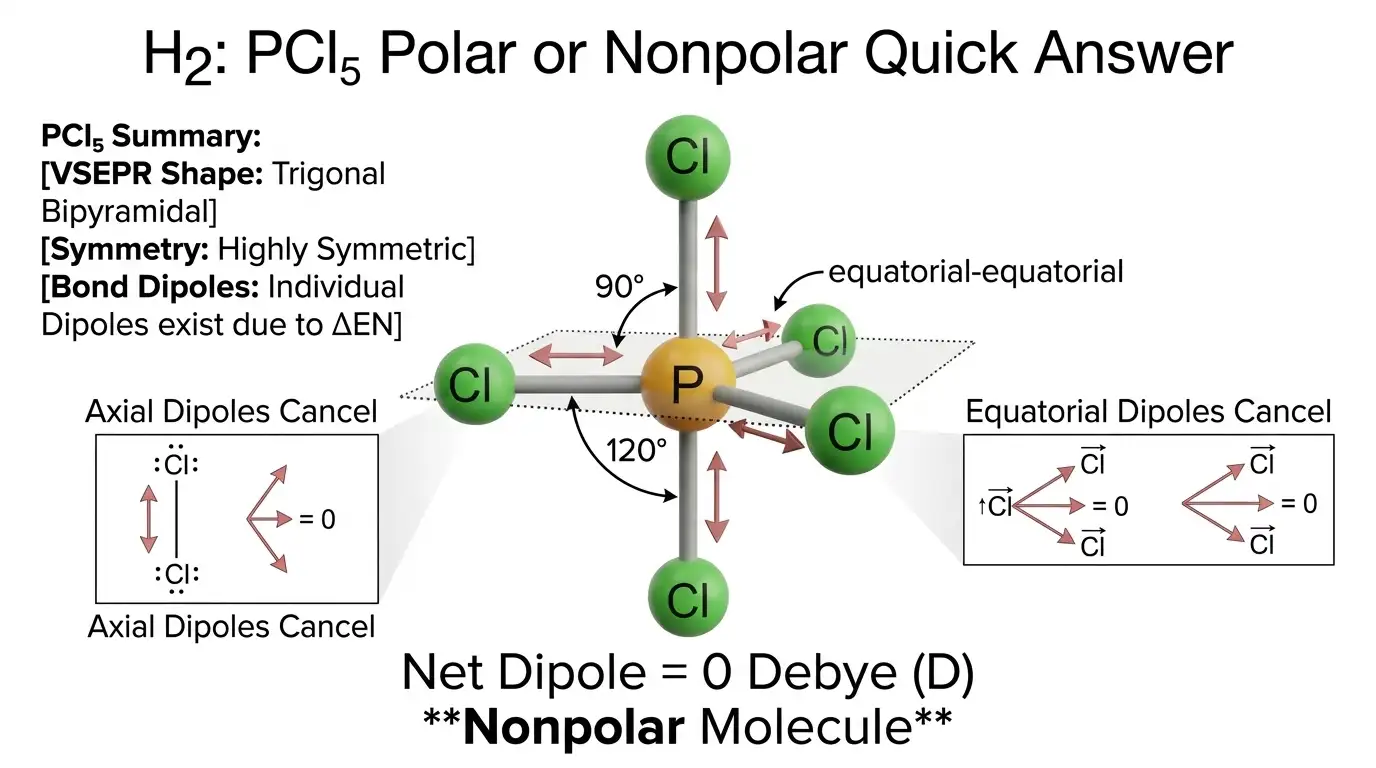
PCl5 (phosphorus pentachloride) is nonpolar.
Here’s why in three steps:
- Each P–Cl bond is polar. Chlorine is more electronegative than phosphorus, so electrons sit closer to chlorine.
- PCl5 has a trigonal bipyramidal shape. Five chlorine atoms surround one phosphorus atom.
- This shape is symmetric. The individual bond dipoles cancel each other out, leaving no net dipole moment.
Result: polar bonds, nonpolar molecule. This is the same logic used for CO2 and CCl4.
The Origin of PCl5
Phosphorus pentachloride was first studied in the 19th century as chemists explored phosphorus halides. The name follows standard chemical nomenclature: “penta” means five, showing five chlorine atoms bonded to one phosphorus atom.
PCl5 is made industrially by reacting phosphorus trichloride (PCl3) with chlorine gas. It’s used mainly as a chlorinating agent in organic synthesis, converting alcohols and carboxylic acids into chlorides.
One detail trips people up: in its solid state, PCl5 isn’t even a simple molecule. It exists as an ionic compound made of [PCl4]+ and [PCl6]- ions. The nonpolar, trigonal bipyramidal PCl5 that we discuss for polarity questions refers to the gas or liquid phase, where it exists as a true molecular compound.
Notation and Naming Variations
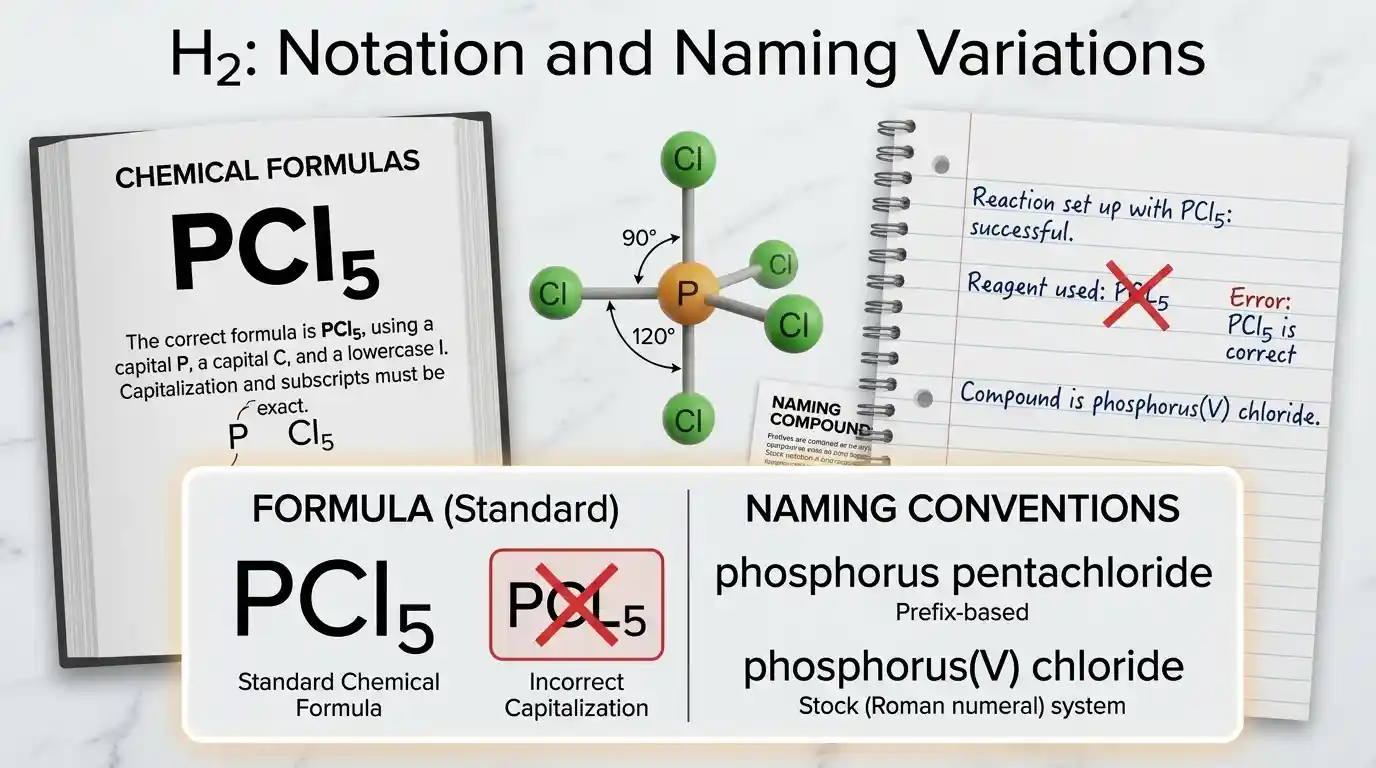
Unlike words with regional spelling differences, PCl5 doesn’t have British vs. American versions. But you will see it written differently depending on the source. Here’s a comparison:
| Form | Where You’ll See It | Notes |
| PCl5 | Textbooks, most common | Standard chemical formula |
| PCL5 | Casual writing, search queries | Incorrect capitalization; “l” should be lowercase |
| Phosphorus pentachloride | Formal writing, safety data sheets | Full chemical name |
| Phosphorus(V) chloride | IUPAC-style naming | Shows oxidation state of phosphorus |
| P2Cl10 | Rare, usually a student error | Incorrect; PCl5 does not dimerize this way |
Which Notation Should You Use?
- Students and exam answers: Use PCl5. It’s the standard formula your teacher or textbook expects.
- Lab reports and formal chemistry writing: Use “phosphorus pentachloride” on first mention, then PCl5 afterward.
- Safety documentation (SDS, shipping labels): Use the full name, “phosphorus pentachloride,” since formulas alone aren’t always accepted in regulatory paperwork.
- Search and casual notes: PCl5 is fine and most recognizable, but avoid writing “PCL5” in formal work.
Common Mistakes with PCl5 Polarity
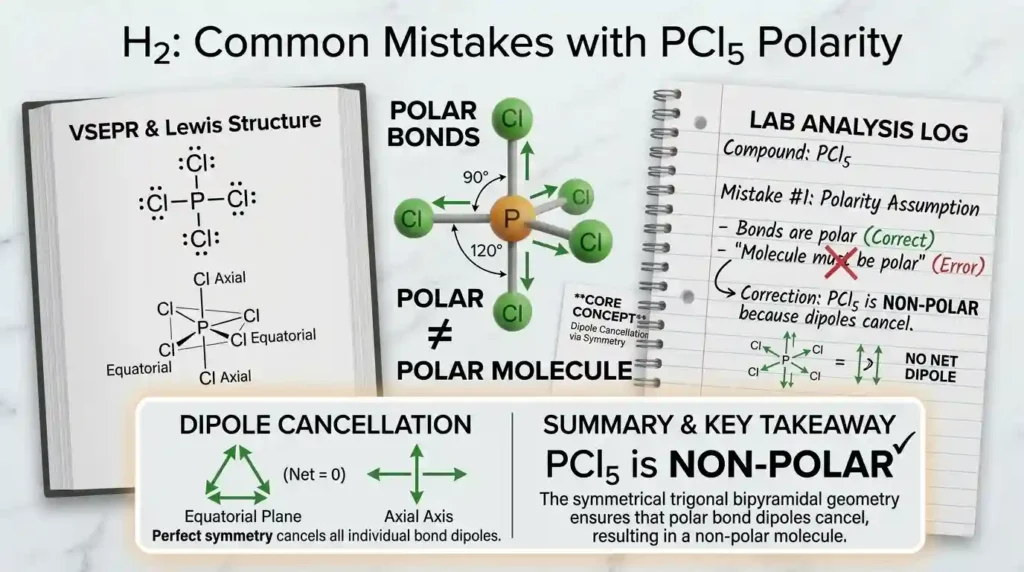
- Assuming polar bonds mean a polar molecule. This is the most common error. Shape matters as much as electronegativity.
- Confusing PCl5 with PCl3. PCl3 has a trigonal pyramidal shape with a lone pair on phosphorus. That lone pair breaks symmetry, making PCl3 polar. PCl5 has no lone pairs and full symmetry.
- Forgetting the solid-state structure. Some students cite the ionic solid form when asked about molecular polarity, which leads to the wrong answer.
- Mixing up axial and equatorial bonds. In trigonal bipyramidal shapes, axial and equatorial bond angles differ (90° and 120°), but the overall symmetry still cancels the dipoles.
- Skipping the electron geometry step. Always draw the Lewis structure and identify the molecular geometry before deciding on polarity.
PCl5 in Everyday Examples
- Chemistry exams: “Explain why PCl5 is nonpolar despite having polar P–Cl bonds.” This is a standard short-answer question in general chemistry.
- Lab reports: “PCl5 was used to convert the carboxylic acid to its corresponding acyl chloride.” Here, chemists reference its reactivity, not its polarity.
- Online forums and study groups: Students often post Lewis structures asking others to confirm the trigonal bipyramidal shape.
- Safety documentation: Industrial use describes PCl5 as a corrosive chlorinating agent, with polarity rarely mentioned directly.
- Science communication and videos: Educational content often uses PCl5 as a teaching example for molecular symmetry and the VSEPR model.
PCl5 Google Trends & Usage Data
Search interest in “PCl5 polar or nonpolar” follows the academic calendar. Spikes happen during the school year, especially around exam periods in September through December and again in spring semesters.
Search volume is highest in countries with large English-speaking student populations studying general or inorganic chemistry, including the United States, India, the Philippines, and the United Kingdom. India in particular shows strong search interest tied to competitive exam preparation.
The query is almost always educational, not industrial. People searching this term are usually students or tutors, not chemists working in manufacturing. This explains why simple, direct explanations rank better than highly technical papers for this keyword.
Comparison Table: Related Molecules
| Molecule | Shape | Polar Bonds? | Overall Polarity |
| PCl5 | Trigonal bipyramidal | Yes | Nonpolar |
| PCl3 | Trigonal pyramidal | Yes | Polar |
| PF5 | Trigonal bipyramidal | Yes | Nonpolar |
| CCl4 | Tetrahedral | Yes | Nonpolar |
| NH3 | Trigonal pyramidal | Yes | Polar |
FAQs
Is PCl5 polar or nonpolar?
PCl5 is nonpolar. Its bonds are polar, but the trigonal bipyramidal shape cancels the dipoles.
Why are P–Cl bonds polar if the molecule isn’t?
Bond polarity depends on electronegativity difference between atoms. Molecule polarity depends on both bond polarity and molecular shape. PCl5’s symmetric shape cancels out the individual bond dipoles.
What is the molecular geometry of PCl5?
PCl5 has a trigonal bipyramidal geometry, with three chlorine atoms in the equatorial plane and two in axial positions.
Is PCl3 polar or nonpolar?
PCl3 is polar. It has a lone pair on phosphorus, giving it a trigonal pyramidal shape that breaks symmetry.
Does PCl5 have a dipole moment?
No. PCl5 has a net dipole moment of zero due to its symmetric structure, even though individual bonds have dipole moments.
Is PCl5 ionic or covalent?
In gas or liquid form, PCl5 is a covalent molecule. In solid form, it exists as an ionic compound made of [PCl4]+ and [PCl6]- ions.
Why does PCl5 matter outside the classroom?
PCl5 is used industrially as a chlorinating agent, converting alcohols and carboxylic acids into their chloride forms in organic synthesis.
Conclusion
PCl5 is nonpolar, even though its P–Cl bonds are individually polar. The reason comes down to shape: its trigonal bipyramidal geometry is symmetric enough to cancel out every bond dipole, leaving no net molecular dipole.
The most common mistake is stopping at bond polarity and skipping the geometry step. Always check both. Look at electronegativity differences first, then draw the shape and check for symmetry.
For students, remember PCl5 as your go-to example of “polar bonds, nonpolar molecule,” right alongside CO2 and CCl4. For professionals writing formal documents, use “phosphorus pentachloride” on first mention, then switch to PCl5. Avoid the miswritten form “PCL5” in academic or professional writing.
If you’re studying for an exam or writing a lab report, the core idea stays the same: individual atoms and bonds tell only part of the story. Shape and symmetry decide the final answer.

“I’m Ibadat Fatima, a professional content writer and author with 3 years of experience in writing, editing, and storytelling. I share my work through visitlivo.com, where I help readers connect with clear, engaging, and well-crafted content.”