Ever paused mid-sentence, unsure if you should write “moustache” or “mustache”? You’re not alone. Millions of people search this exact question every month. Some learned to spell it one way in school. Others see it spelled differently in emails, ads, or news articles and start to doubt themselves.
Here’s the truth: both spellings are correct. The confusion comes from something simple geography. English isn’t one fixed language. It split into different versions over time, especially between Britain and America. Each version kept some words the same and changed others.
This mix-up isn’t rare. Words like “colour/color” and “favourite/favorite” cause the same confusion. “Moustache” and “mustache” just add facial hair to the list.
This article gives you the quick answer, the history behind it, and clear advice on which spelling fits your writing. By the end, you’ll never second-guess this word again.
Moustache or Mustache Quick Answer
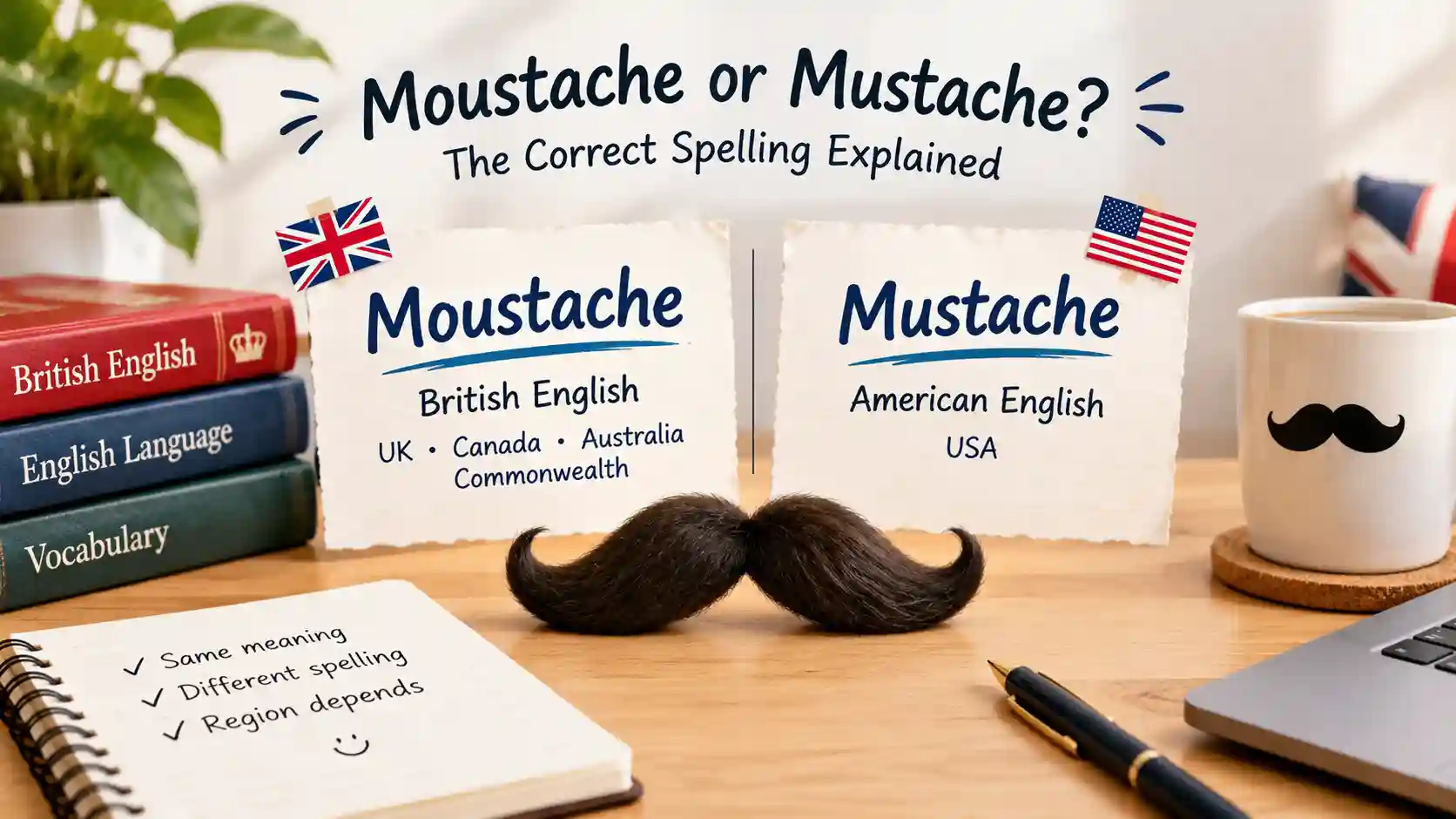
Both spellings are correct. The difference depends on where you are, not which one is “better.”
- Moustache used in British English, Canada, Australia, and most Commonwealth countries.
- Mustache used in American English.
Example sentences:
- “He grew a thick moustache for Movember.” (British style)
- “He grew a thick mustache for Movember.” (American style)
Same word. Same meaning. Different spelling based on region.
The Origin of Moustache/Mustache
The word traveled a long path before landing in English.
It started with the Greek word mystax, meaning “upper lip” or “upper lip hair.” From there, it moved into Italian as mostaccio, then into French as moustache. English borrowed the word from French in the 16th century, keeping the French spelling: moustache.
For centuries, English speakers everywhere used “moustache.” The split happened later, thanks to one man: Noah Webster.
In the early 1800s, Webster wanted American English to have its own identity, separate from British English. He believed spelling should match pronunciation more closely and drop “unnecessary” letters. This led to changes like:
- colour → color
- theatre → theater
- moustache → mustache
Webster’s dictionary became the standard in the United States. Britain never adopted his changes. That’s why the spelling split still exists today.
British English vs American English Spelling
British and American English differ in several spelling patterns. The “ou” versus “u” pattern is one of the most common. Words that came from French often kept their “ou” in British English but lost it in American English.
Here’s how the pattern shows up across similar words:
| British English | American English |
| Moustache | Mustache |
| Colour | Color |
| Favourite | Favorite |
| Honour | Honor |
| Neighbour | Neighbor |
Notice the pattern? British English tends to keep the fuller, older French-based spelling. American English simplifies it.
Which Spelling Should You Use?
The right spelling depends on your audience, not personal preference.
Use “moustache” if:
- You’re writing for a British, Canadian, Australian, or Commonwealth audience.
- Your brand or publication follows British English style guides.
- You’re writing for international or European readers who expect British spelling.
Use “mustache” if:
- You’re writing for an American audience.
- Your company or publication follows US English style (most US blogs, news sites, and businesses do).
- You’re targeting SEO for the US market, where “mustache” gets more search volume.
If you’re writing for a global audience:
Pick one spelling and stay consistent throughout your content. Mixing both looks like a mistake, not a style choice. Many global brands default to American spelling since it has wider search volume online, but this isn’t a strict rule.
Common Mistakes with Moustache/Mustache
Even confident writers slip up on this word. Here are the most common errors.
1. Mixing both spellings in one piece of writing.
Wrong: “She loved his moustache, but mustaches aren’t her usual type.”
Right: Pick one spelling and use it throughout.
2. Misspelling the word entirely.
Common typos include “mustach,” “moustach,” and “mustashe.” Neither of these is correct in any English variant.
3. Assuming one spelling is “wrong.”
Neither spelling is incorrect. They’re regional choices, like “truck” versus “lorry.”
4. Using British spelling in US-focused SEO content.
This can hurt search rankings, since American users search “mustache” far more often than “moustache.”
5. Ignoring brand or publication style guides.
Many companies pick one spelling for consistency. Always check house style before writing.
Moustache/Mustache in Everyday Examples
Here’s how each spelling appears in real-world writing.
Emails (US business):
“Please note our new hire, John, sports a mustache in his profile photo.”
News (UK publication):
“The actor debuted a bold new moustache for his latest film role.”
Social media (global brand):
“Movember is here! Time to grow that mustache/moustache and support men’s health.” (Some brands use both to reach wider audiences.)
Formal writing (UK academic paper):
“The study examined grooming trends, including moustache styles, across three decades.”
Formal writing (US academic paper):
“The study examined grooming trends, including mustache styles, across three decades.”
Context always signals which spelling fits best.
Moustache/Mustache Google Trends & Usage Data
Search data shows a clear regional divide.
- United States, Canada (partially), and other American-English-leaning regions: “Mustache” dominates search volume.
- United Kingdom, Australia, India, and other Commonwealth countries: “Moustache” is the preferred and more searched term.
- Global average: “Mustache” tends to show higher overall search volume, largely because the US has a very large English-speaking online population.
This matters for content creators. If you’re writing SEO content for a US audience, “mustache” will likely perform better in search rankings. If your audience is UK-based or Commonwealth-based, “moustache” is the safer, more natural choice.
Keyword Variations Comparison Table
| Term | Region | Search Volume Trend | Best Used For |
| Mustache | US, North America | Higher globally | American audiences, US SEO |
| Moustache | UK, Australia, Commonwealth | Strong regionally | British/Commonwealth audiences |
| Mustache/Moustache | Global content | Mixed | International brands (use consistently) |
| Mustach, Moustach | N/A | Misspelling | Never correct avoid |
FAQs
Is “moustache” or “mustache” correct?
Both are correct. “Mustache” is American English. “Moustache” is British English.
Why do Americans spell it differently from the British?
Noah Webster simplified many English spellings in the early 1800s to give American English its own identity. This included dropping the “ou” in words like “moustache.”
Which spelling should I use for SEO?
Use “mustache” for US audiences, since it has higher search volume. Use “moustache” for UK or Commonwealth audiences.
Can I use both spellings in the same article?
Avoid mixing them. Pick one spelling based on your audience and stay consistent.
Is “moustache” the older spelling?
Yes. “Moustache” is closer to the original French word. “Mustache” came later, after American spelling reforms.
Do other countries use “moustache” or “mustache”?
Most Commonwealth countries (UK, Australia, India, Canada in some cases) use “moustache.” Non-native English speakers often default to whichever spelling they learned first.
Does spelling affect meaning?
No. Both words mean the same thing: hair grown above the upper lip. Only the spelling changes, not the definition.
Conclusion
“Moustache” and “mustache” are two correct spellings of the same word, split by regional English differences. “Moustache” follows British English tradition and stays closer to the word’s French origin. “Mustache” reflects American English, simplified through Noah Webster’s 19th-century spelling reforms.
Neither spelling is wrong. The right choice depends on your audience. Write “mustache” for American readers. Write “moustache” for British, Australian, or Commonwealth readers. For global content, pick one spelling and use it consistently throughout your writing.
Understanding this small difference helps you write with confidence, avoid common mistakes, and connect better with your audience. It also helps your content perform better in search results, since search engines match user intent based on regional spelling habits.
Next time you write about facial hair styles, grooming trends, or Movember campaigns, you’ll know exactly which spelling fits your readers and why.

I’m Raheela Rani, a professional content writer and author with 3 years of experience in writing, editing, and storytelling. Through VisitLivo.com, I create clear, engaging, and well-crafted content that helps readers learn, connect, and communicate with confidence.