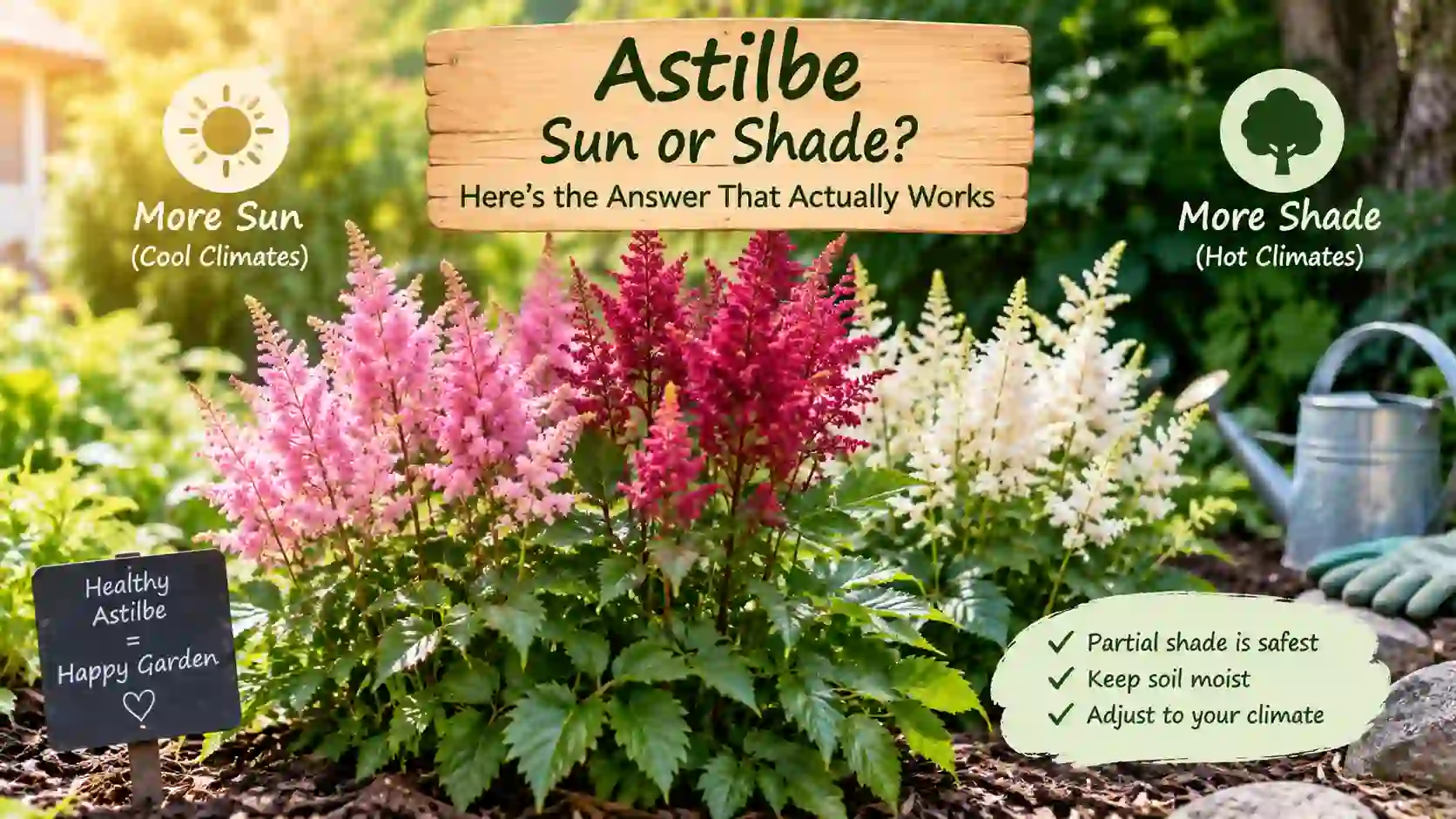
Astilbe is a garden favorite. Its feathery pink, red, and white plumes light up borders all summer. But one question stops new gardeners cold: does astilbe want sun, or does it want shade?
The confusion is real. Some plant tags say “partial shade.” Some nurseries say “full sun to part shade.” Garden blogs disagree. This happens because astilbe’s light needs change based on your climate, your soil moisture, and where you live. A rule that works in Georgia can kill a plant in Minnesota.
This guide gives you a clear, simple answer. No guesswork. No conflicting advice. You’ll learn exactly how much sun or shade your astilbe needs, why the advice varies, and how to avoid the most common planting mistakes. If you’re planting your first astilbe or fixing a struggling one, this article solves the confusion for good.
Astilbe Sun or Shade Quick Answer
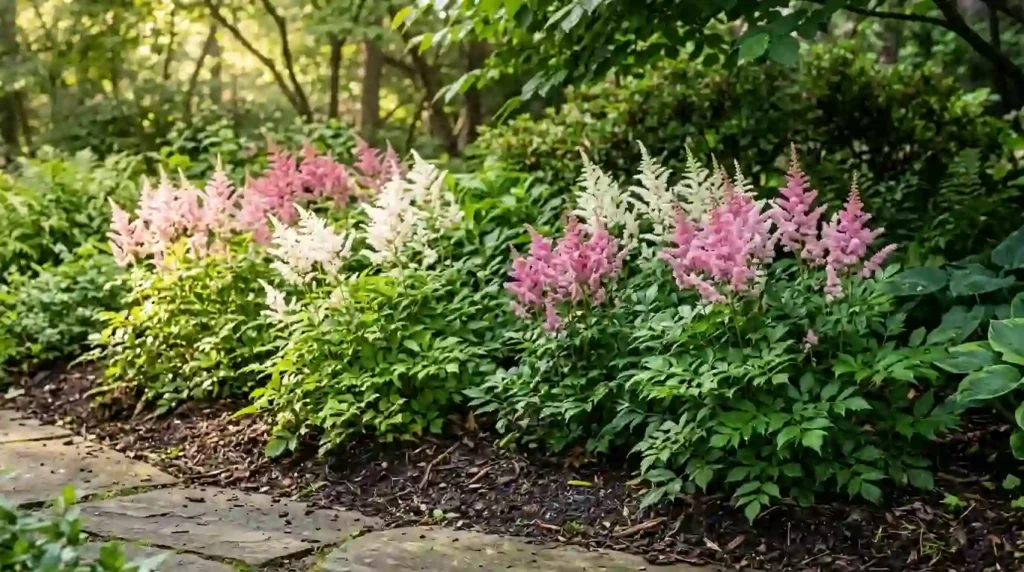
Astilbe grows best in partial shade with moist soil. In cooler climates, it can handle more sun. In hot climates, it needs more shade.
- Cool climates (north, high elevation): Morning sun, afternoon shade, or even full sun if soil stays moist.
- Hot climates (south, low elevation): Full shade or dappled shade all day.
- Everywhere: Astilbe hates dry soil more than it hates the wrong light. Keep the roots damp.
Example: In Seattle, astilbe can take several hours of direct sun. In Texas, the same plant will scorch and need full shade.
The Origin of Astilbe
The word astilbe comes from Greek. “A” means “without,” and “stilbe” means “brightness” or “shine.” Botanists gave it this name because the plant’s small individual flowers have a dull, matte look. The plumes only look bright because thousands of tiny flowers bunch together.
Astilbe was first classified in the 1800s by British botanist John Bellenden Ker Gawler. The plant was later brought from Japan and China into European gardens, then into North America. As it spread across countries with very different climates, growing advice split into two camps: one for cool, damp regions like the UK, and one for hot, humid regions like the southern United States. That split is the real reason the “sun or shade” advice looks so inconsistent today.
Full Sun vs Partial Shade What Astilbe Actually Needs
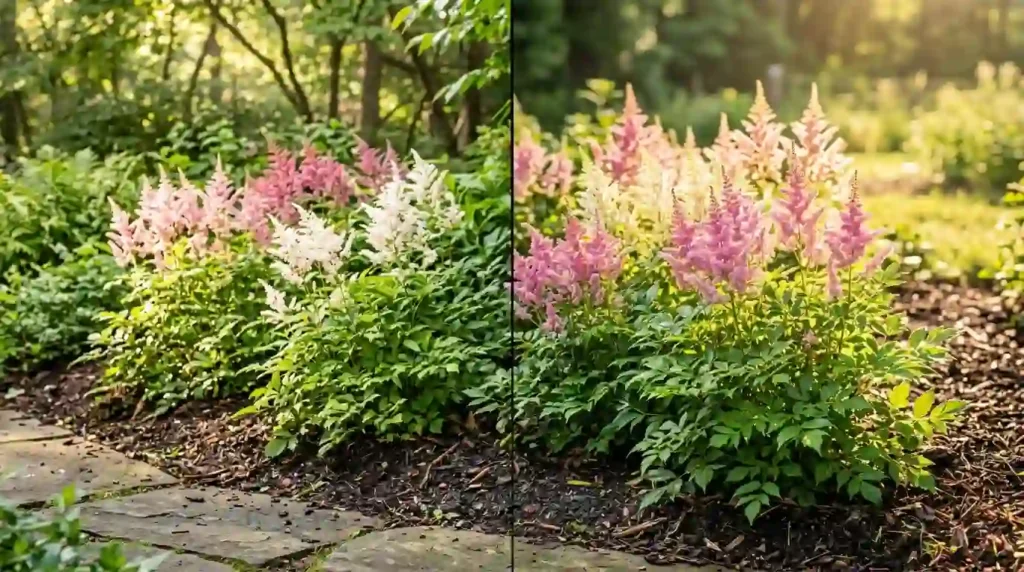
Instead of a spelling difference, astilbe has a climate difference. Growers in different regions give different advice because their weather is different, not because one is “correct” and one is “wrong.”
| Growing Condition | Best For | Risk if Wrong Climate |
| Full sun (6+ hours) | Cool, northern climates with rich, moist soil | Leaves scorch and turn brown in heat |
| Partial shade (3–6 hours) | Most climates; the safest all-around choice | Rarely causes problems |
| Full shade | Hot, humid, southern climates | Fewer blooms, but healthy plant |
| Dry shade | Not recommended for any climate | Plant wilts regardless of light level |
Which Light Condition Should You Choose?
If you live in a cool or northern climate (UK, Pacific Northwest, Canada, New England): Give astilbe morning sun and afternoon shade, or even full sun, as long as the soil never dries out.
If you live in a hot or humid climate (southern US, southern Europe, Australia’s warmer regions): Choose full shade or dappled shade under trees. Protect it from afternoon sun completely.
If you’re unsure of your climate zone: Partial shade is the safest global default. It works in almost every region and forgives small mistakes.
If you’re growing in containers: Containers dry out faster than garden beds. Choose more shade than you would for the same plant in the ground.
Common Mistakes with Astilbe Sun or Shade Placement
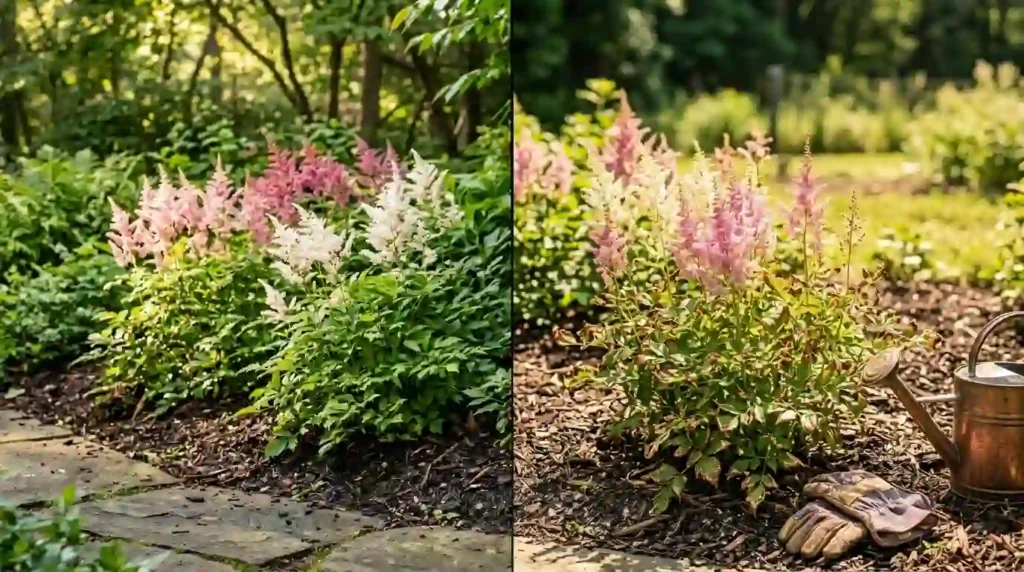
- Planting in full sun without checking soil moisture. Sun alone isn’t the problem dry soil in sun is. Always pair sun with consistent watering.
- Assuming “shade” means deep shade. Astilbe still needs some light. Deep, dark shade under a dense tree canopy causes weak, leggy growth and few flowers.
- Ignoring regional climate advice. Copying a sun-loving planting tip from a cooler climate into a hot one is the top reason astilbe fails in southern gardens.
- Letting mulch dry out. Mulch helps lock in moisture, which matters more than the exact number of sun hours.
- Forgetting afternoon sun is harsher than morning sun. Morning sun is gentle. Afternoon sun, especially in summer, is the real danger.
Astilbe Sun or Shade in Everyday Examples
In a gardening email: “Hi Sam, I’m putting the astilbe along the north fence it gets morning sun only, so that should be perfect.”
In a news or lifestyle article: “Garden experts recommend astilbe for shaded backyard corners where other flowering plants struggle to bloom.”
On social media (a caption): “Finally found the perfect shade-loving plant for my dark side yard 🌸 #astilbe #shadegarden”
In formal landscaping notes: “Astilbe x arendsii shall be planted in partial shade with irrigation scheduled to maintain consistent soil moisture.”
Astilbe Sun or Shade Search Trends & Usage Data
Search interest in “astilbe sun or shade” rises every spring, peaking in April and May when gardeners plan new beds. Searches are highest in the United States, Canada, and the United Kingdom regions with active home gardening cultures and varied climates.
In hotter regions like the southern US, related searches lean toward “astilbe full shade” and “astilbe for hot climates.” In cooler regions like the Pacific Northwest and UK, searches lean toward “astilbe full sun” and “astilbe morning sun.” This regional split confirms that the “right” answer genuinely depends on where the gardener lives, not on a single fixed rule.
Keyword Variations Comparison
| Search Phrase | Typical Region | Best Answer |
| astilbe full sun | Cool, northern climates | Yes, with moist soil |
| astilbe full shade | Hot, southern climates | Yes, recommended |
| astilbe partial shade | Global, all climates | Safe default everywhere |
| astilbe morning sun only | Mixed climates | Good compromise |
| astilbe dry shade | Any climate | Not recommended |
FAQs
Can astilbe survive in full sun?
Yes, but only in cool climates with soil that stays consistently moist. In hot climates, full sun will scorch the leaves.
Will astilbe grow in full shade?
Yes. It grows well in full shade, especially in hot climates, though it may produce fewer blooms than in partial shade.
How much water does astilbe need?
A lot. Astilbe needs consistently moist soil. It’s more sensitive to dry soil than to the amount of sunlight it gets.
What happens if astilbe gets too much sun?
The leaves turn brown or crispy at the edges, and the plant wilts quickly, especially in the afternoon heat.
What happens if astilbe gets too little light?
It grows tall and leggy, produces fewer flower plumes, and can look weak or sparse.
Is morning sun or afternoon sun better for astilbe?
Morning sun is better. It’s gentler and won’t dry out the soil as fast as strong afternoon sun.
Can I grow astilbe in containers?
Yes, but containers dry out faster than garden beds. Give container astilbe more shade and water more often.
Conclusion
Astilbe doesn’t have one single answer for sun or shade. The right choice depends on your climate. Cool, northern regions can give astilbe more sun, as long as the soil stays moist. Hot, humid regions should stick to partial or full shade to protect the leaves from scorching.
The most important lesson is this: soil moisture matters more than the exact number of sun hours. A shaded astilbe in dry soil will struggle more than a sunny astilbe in moist, well-mulched soil.
If you’re not sure which category fits your garden, partial shade is the safest choice worldwide. It works in nearly every climate and gives your astilbe room to adjust. Watch your plant’s leaves scorched edges mean too much sun, and leggy, sparse growth means too little light. Adjust based on what you see, and your astilbe will reward you with full, feathery blooms all season.

“I’m Ibadat Fatima, a professional content writer and author with 3 years of experience in writing, editing, and storytelling. I share my work through visitlivo.com, where I help readers connect with clear, engaging, and well-crafted content.”