
Type the word into Google and you’ll see two spellings fighting for attention: “lying” and “lieing.” Only one is correct. This mix-up trips up native speakers and English learners alike, mostly because English spelling rules feel inconsistent and this word is a textbook example of that.
People search “lying or lieing” for a few reasons. Some are drafting a text, email, or essay and freeze mid-sentence, unsure which version looks right. Others have seen “lieing” written somewhere (a typo, a forum post, a non-native speaker’s message) and wonder if it’s an accepted variant. And some are just confused because the base word is “lie,” so adding “-ing” seems like it should give you “lieing,” not “lying.”
This article settles the confusion for good. You’ll get the quick answer, the spelling rule behind it, real usage examples, and answers to the most common follow-up questions so you never have to double-guess this word again.
Lying or Lieing Quick Answer
“Lying” is correct. “Lieing” is a misspelling.
There is no legitimate context formal, informal, British, or American where “lieing” is accepted.
- ✅ She is lying about her age.
- ❌ She is lieing about her age.
- ✅ Stop lying to me.
- ❌ Stop lieing to me.
The word comes from the verb “lie” (to say something untrue), and its correct present participle / gerund form is lying.
The Origin of Lying (and Why Lieing Feels Right)

The confusion comes from a basic English spelling rule most people learn early and then forget: when a verb ends in -ie, you drop the e and change the i to y before adding -ing.
- lie → lying
- die → dying
- tie → tying
- vie → vying
If you followed the “just add -ing” pattern you use for most verbs (walk → walking, talk → talking), you’d naturally write “lieing.” But English carves out an exception for verbs ending in -ie. That exception is old it dates back centuries in English spelling conventions and exists mainly to avoid an awkward string of vowels (“lieing” has three vowels in a row: i-e-i).
So “lieing” isn’t a regional variant or an outdated spelling. It’s simply a rule violation a very understandable one, but incorrect in every dialect of English.
British English vs American English Spelling
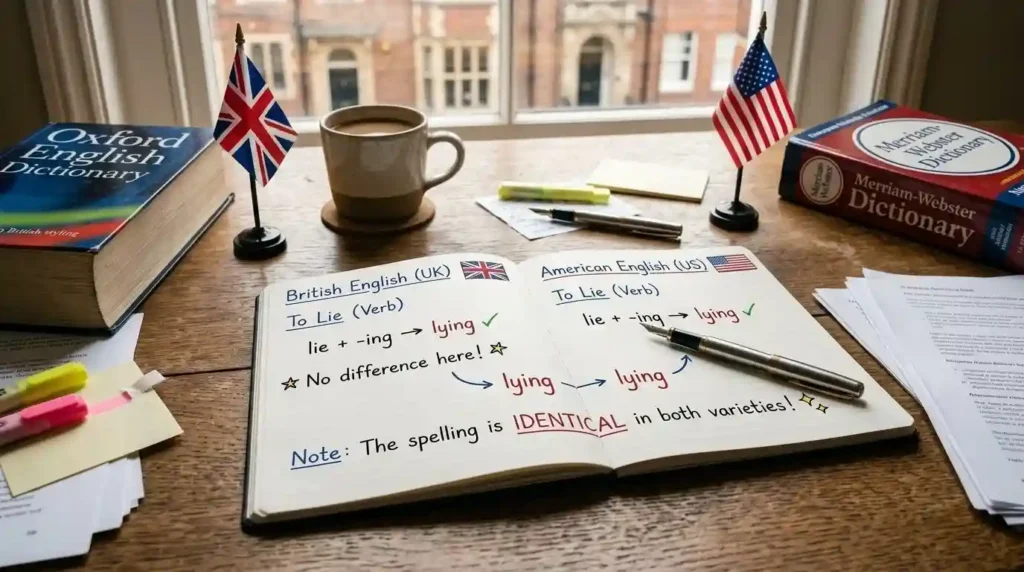
Here’s the useful news: this is one of the rare cases where British and American English agree completely. Unlike “color/colour” or “organize/organise,” there’s no transatlantic split here.
| Feature | British English | American English |
| Correct spelling | lying | lying |
| Common misspelling | lieing | lieing |
| Rule applied | Drop -ie, add -ying | Drop -ie, add -ying |
| Accepted in formal writing | Yes | Yes |
| Dictionary-recognized | Oxford English Dictionary | Merriam-Webster |
Both major dictionaries list only one spelling: lying. If you’ve seen “lieing” used somewhere, it’s a typo or an error not a dialect choice.
Which Spelling Should You Use?
Since there’s no regional variation, the advice is simple:
- US writers: Use “lying.” Always.
- UK, Canada, Australia, and other Commonwealth countries: Use “lying.” Always.
- Global / ESL writers: Use “lying.” It’s the only correct form worldwide, in every English-speaking context business, academic, casual, or legal.
Unlike words with genuine regional spelling differences, you never need to adjust “lying” based on your audience’s country.
Common Mistakes with Lying
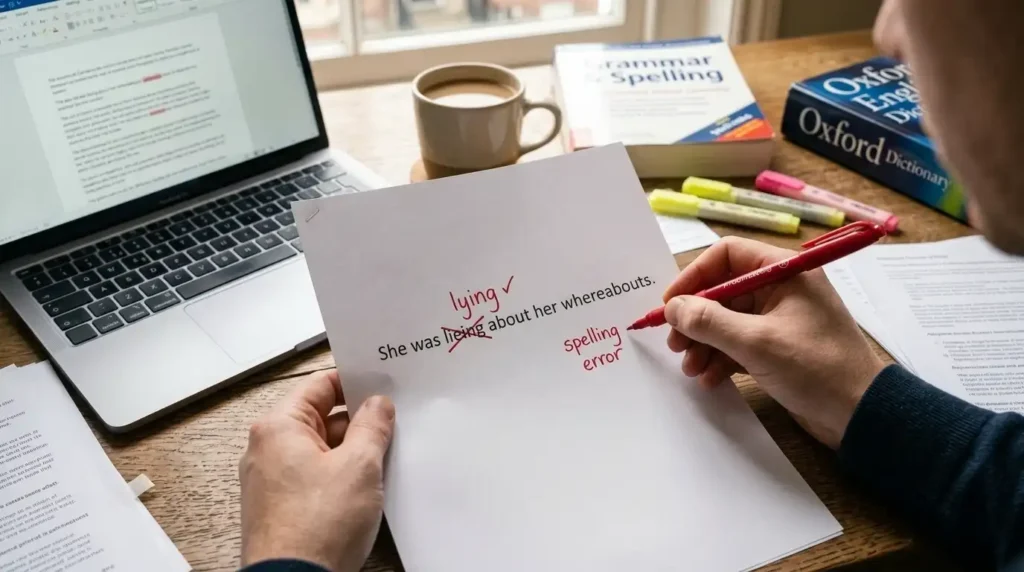
- Writing “lieing” instead of “lying”
- ❌ He’s lieing again.
- ✅ He’s lying again.
- Confusing “lying” (untruth) with “lying” (reclining)
Both meanings share the same spelling, but context tells them apart.
- He is lying about the accident. (telling an untruth)
- She is lying on the couch. (reclining)
- Mixing up “lie” and “lay”
This is a separate but related error. “Lie” means to recline or rest (I lie down). “Lay” means to place something (I lay the book down). Their past tenses complicate things further: lie → lay → lain; lay → laid → laid. - Using “lieing” in professional documents
Spellcheck usually catches this, but not always in fast typing on phones or in auto-generated text.
Lyin in Everyday Examples

emails:
“I want to be honest I wasn’t lying when I said the report would be late.”
news headlines:
“Officials accused of lying about safety inspection results.”
social media posts:
“Y’all lying if you say you’ve never rewatched a show for the 5th time 😂”
formal writing:
“The witness admitted to lying under oath during the initial testimony.”
Across every format casual texts, journalism, academic writing the spelling never changes. Only the tone does.
Lying Google Trends & Usage Data
Search interest in “lying vs lieing” spikes consistently across English-speaking countries, driven mostly by students, content writers, and non-native speakers double-checking spelling before publishing something.
General patterns:
- United States and United Kingdom show the highest search volume for this comparison, largely due to large English-writing populations searching for quick spelling confirmation.
- India, Philippines, and other ESL-heavy regions show notable search interest, tied to English-language learning and content writing work.
- Searches tend to spike alongside “ie to y spelling rule” and other similar grammar queries, suggesting people search this as part of a broader effort to understand English spelling exceptions, not just this one word.
The takeaway: this is a global point of confusion, not a regional one reinforcing that “lying” is the universal correct choice.
Keyword Variation Comparison Table
| Variation | Correct? | Notes |
| lying | ✅ Yes | Correct in all English dialects |
| lieing | ❌ No | Common misspelling |
| lieying | ❌ No | Rare, incorrect |
| lying vs lieing | Common search phrase comparing both | |
| lie, lying, lied | ✅ Yes | Correct verb conjugation set |
FAQs
Is “lieing” ever correct?
No. It’s a misspelling in every English dialect and context.
Why do people write “lieing” instead of “lying”?
Because most verbs simply add “-ing” (walk → walking), so people assume “lie” follows the same pattern. It doesn’t, due to the -ie to -y spelling rule.
Is “lying” both British and American spelling?
Yes. Unlike many words, there’s no US/UK spelling split for this term.
What’s the past tense of “lie” (to tell an untruth)?
Lie → lied → lied. (“He lied to me yesterday.”)
What’s the past tense of “lie” (to recline)?
Lie → lay → lain. (“She lay down for a nap.”)
Does spellcheck always catch “lieing”?
Usually, yes, but autocorrect can miss it in fast typing, especially on mobile devices or in auto-generated content.
Are there other words with the same -ie to -y spelling rule?
Yes “die” becomes “dying,” “tie” becomes “tying,” and “vie” becomes “vying.”
Conclusion
“Lying” is the only correct spelling “lieing” is simply a common error, not an accepted variant. The mix-up happens because English usually just adds “-ing” to a verb, but words ending in “-ie” break that pattern: you drop the e, swap i for y, and add “-ing.” That’s how “lie” becomes “lying,” matching “die” → “dying” and “tie” → “tying.”
Unlike many English spelling debates, this isn’t a British-versus-American issue. Every major dictionary, in every English-speaking country, agrees on one spelling. If you’re writing a formal report, a quick text, or a news headline, “lying” is always the right choice no adjustments needed for your audience or region.
The bigger lesson here applies beyond this one word: when a verb ends in “-ie,” expect the spelling to shift before you add “-ing.” Once you know that rule, you’ll never second-guess “lying” or the next word like it again.

“I’m Ibadat Fatima, a professional content writer and author with 3 years of experience in writing, editing, and storytelling. I share my work through visitlivo.com, where I help readers connect with clear, engaging, and well-crafted content.”